
Your cart (0)
Your cart is empty
Tax included and shipping calculated at checkout
Your cart is empty
Tax included and shipping calculated at checkout

Outdoor RV has two meanings for U.S. campers: the specific Northwest brand known for four-season durability, and the broader category of adventure-ready RVs designed for extreme weather, off-grid camping, and off-road exploration.
Top 5 Questions Americans Ask About Outdoor RVs:
Outdoor RV as a brand represents the Northwest’s approach to serious four-season camping. Founded for harsh mountain conditions, Outdoor RV trailers feature reinforced construction, superior insulation, and systems designed for extended winter use in places like Idaho, Montana, and the Pacific Northwest.
The broader outdoor RV market in America is experiencing significant growth driven by several trends:
Core characteristics that define outdoor-capable RVs include reinforced chassis construction, independent suspension systems, oversized battery and solar systems, enhanced insulation packages, and rugged tire and wheel combinations designed for diverse terrain.
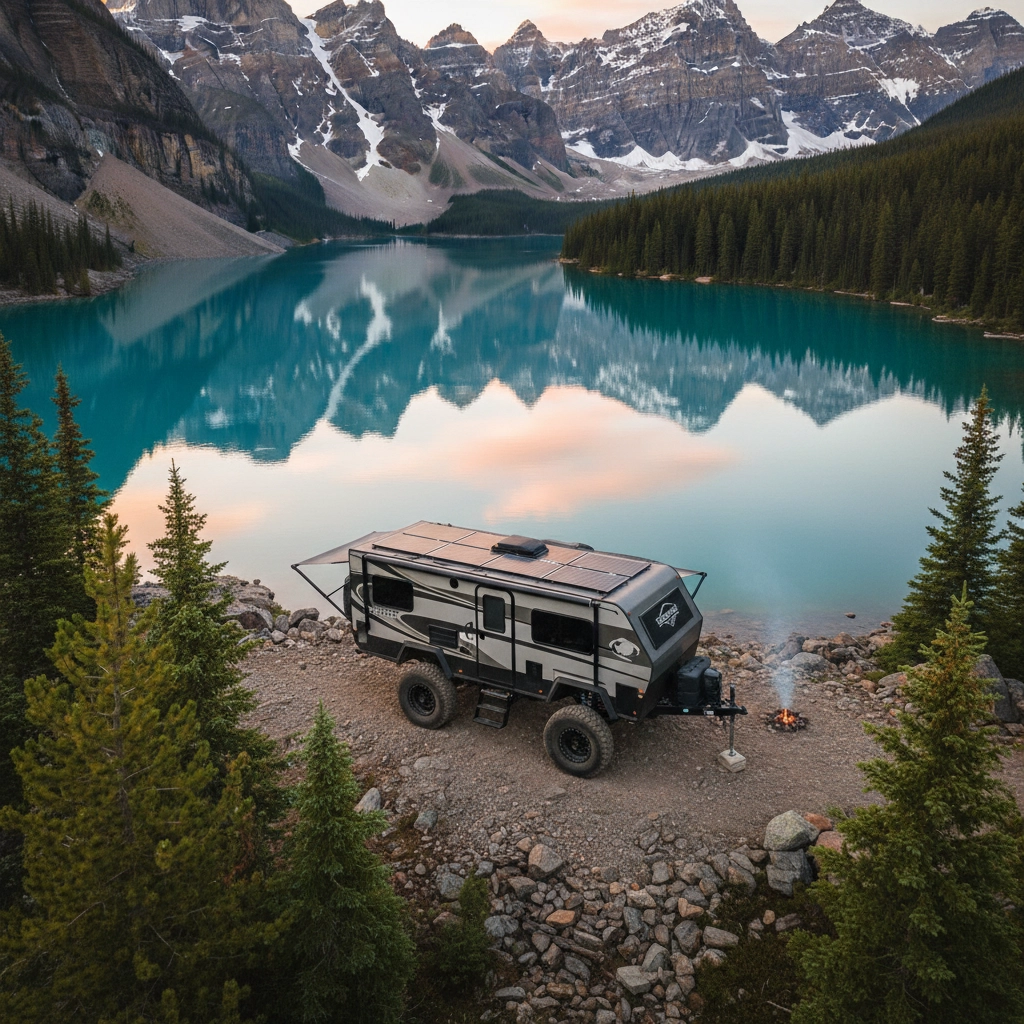
True off-road trailers feature independent suspension systems with dual shock absorbers, heavy-duty axles, and increased ground clearance. These systems maintain stability across rocky terrain, sand dunes, and forest roads where standard leaf-spring trailers fail.
Key specifications include:
For serious overlanding, off-road trailer suspension systems become the determining factor between accessible adventure and roadside breakdowns.
Four-season capability means year-round comfort in temperatures from -20°F to 110°F. Authentic four-season trailers include:
Popular four-season states include Colorado, Utah, Montana, and Alaska, where winter camping extends the adventure season significantly.
Off-grid RVs prioritize self-sufficiency for extended boondocking. Essential systems include:
The typical off-grid setup supports 5-7 days of complete independence from utilities.
Bunkhouse outdoor trailers combine adventure capability with family-friendly layouts. Features include:
Chassis and Suspension: Look for welded steel construction, not aluminum. Independent suspension outperforms leaf springs on rough terrain by 400% in stability tests.
Insulation Standards: R-value ratings should exceed R-30 in all surfaces. Spray foam insulation surpasses fiberglass batts in both insulation and moisture resistance.
Electrical Systems: Lithium batteries provide 3x the usable capacity of lead-acid systems. Quality inverters handle high-draw appliances like microwaves and air conditioning.
Power Management: Calculate daily power needs, then double the battery capacity. Solar systems should provide 1.5x daily consumption for cloudy weather backup.
Water Systems: Fresh water tanks of 40+ gallons enable week-long stays. Grey and black tanks should match fresh capacity for balanced use.
Waste Management: Composting toilets eliminate black water entirely, while cassette systems offer portability advantages.

Several manufacturers compete directly with Outdoor RV’s four-season focus:
The off-road segment offers the most innovation for serious adventurers. BlackSeries RV leads this category with Australian-engineered expedition trailers designed for extreme global conditions. Their independent suspension systems, reinforced construction, and comprehensive off-grid systems set the standard for American overlanding.
Key advantages include:
Advantages: Large living spaces, integrated power systems, no separate tow vehicle needed.
Disadvantages: Limited off-road capability, higher fuel costs, less campground accessibility.
Popular models include Winnebago Revel and Pleasure-Way Ascent for off-grid capability.
High mobility truck campers offer supreme terrain access with complete camping systems. Top picks include Lance, Arctic Fox, and Northern Lite for four-season capability.
Requirements include 3/4-ton or 1-ton pickup trucks for safe payload capacity.
Step 1: Define your primary camping style – weekend trips, extended boondocking, or year-round travel.
Step 2: Establish budget parameters including purchase price, insurance, and modification costs.
Step 3: Evaluate chassis, suspension, and structural components for intended terrain.
Step 4: Verify electrical, water, and heating systems match your off-grid requirements.
Step 5: Confirm tow vehicle compatibility including payload, tongue weight, and braking systems.
Suspension upgrades provide the biggest improvement for off-road access. Independent systems cost $3,000-$8,000 but enable access to remote locations impossible with standard axles.
Solar and battery expansion extends off-grid capability exponentially. Adding 400 watts of solar and 200 amp-hours of lithium batteries typically costs $2,500-$4,000.
Insulation improvements enable four-season use. Spray foam kits and thermal barriers cost $1,500-$3,000 but provide year-round comfort.
Pre-trip preparation includes testing all heating systems, checking antifreeze levels, and packing extra propane.
Site selection prioritizes wind protection and southern solar exposure. Leveling becomes critical in frozen ground conditions.
Daily operations require monitoring water systems, managing condensation, and maintaining adequate ventilation despite cold weather.

Does Outdoor RV mean four-season camping capability?
Not automatically. “Outdoor RV” as a brand specializes in four-season trailers, but outdoor-capable RVs range from basic weather resistance to extreme cold capability. Verify specific insulation, heating, and construction specifications.
Must Outdoor RVs be off-road capable?
No – four-season and off-road capabilities are separate features. Many excellent four-season trailers use standard suspension systems suitable only for paved roads, while off-road trailers may lack winter insulation packages.
Which RVs work best for off-grid camping?
Purpose-built expedition trailers like BlackSeries models excel at off-grid use with oversized solar, battery, and water systems. Standard RVs require significant modifications for extended boondocking capability.
What makes a true four-season RV?
Continuous insulation, heated underbelly, dual-pane windows, high-capacity heating systems, and arctic-rated components. Marketing claims vary widely – verify actual specifications and cold-weather testing.
How do BlackSeries and Outdoor RV compare?
BlackSeries focuses on extreme off-road and expedition capability with global testing, while Outdoor RV emphasizes four-season comfort and durability. BlackSeries offers superior off-road systems; Outdoor RV provides larger living spaces.
Are Outdoor RVs suitable for family camping?
Many outdoor-capable RVs offer family layouts with bunks, slide-outs, and large dinette areas. However, off-road and four-season features may add complexity unsuitable for casual family camping – match capabilities to actual usage needs.
The evolution of outdoor-capable RVs continues advancing rapidly, driven by Americans’ increasing desire to access remote destinations year-round. Whether prioritizing four-season comfort, off-road capability, or extended off-grid operation, today’s market offers proven solutions for every adventure style and budget level.
Outdoor RV for 4-Season Off-Grid Camping & Best Alternatives最先出现在Black Series RV | Off-Road Travel Trailers, Toy Haulers & Camper Trailers | Off road rv | Off grid rv | Overland rv | Off road trailer | Off road travel trailer | Overland travel trailer。