Introduction: Why 4×4 Camper Trailers Are Exploding in the U.S. Market
The overlanding and off-grid camping movement has transformed from a niche adventure pursuit into mainstream American recreation. From Colorado’s Rocky Mountains to Arizona’s Sonoran Desert, millions of Americans are discovering the freedom of remote camping with capable 4×4 camper trailers. Unlike conventional travel trailers designed for paved campgrounds, true off-road camper trailers feature reinforced chassis, independent suspension systems, and high ground clearance to tackle washboard roads, rocky trails, and sandy washes.
BlackSeries has positioned itself at the forefront of this movement, engineering 4×4 off-road camper trailers specifically for America’s diverse terrain. Our trailers aren’t just styled to look rugged, they’re built with military-grade construction, hot-dip galvanized steel frames, and proven suspension systems that deliver real capability when the pavement ends.
Quick Answer: What Makes a True 4×4 Camper Trailer?
A genuine 4×4 camper trailer combines several critical elements that separate it from standard RVs:
- Heavy-duty chassis with independent suspension for articulation over rocks and rough terrain
- High ground clearance (12+ inches) with proper approach and departure angles
- Reinforced body construction with stone guards and underbody protection
- Off-grid capability including solar power, large battery banks, and fresh water storage
- Compatibility with 4×4 tow vehicles like Toyota Tacoma, Ford F-150, Jeep Gladiator
BlackSeries 4×4 camper trailers are engineered specifically for U.S. off-road conditions, not just gravel roads. Our hot-dip galvanized chassis and composite body panels deliver the durability overlanders demand for extended backcountry adventures.
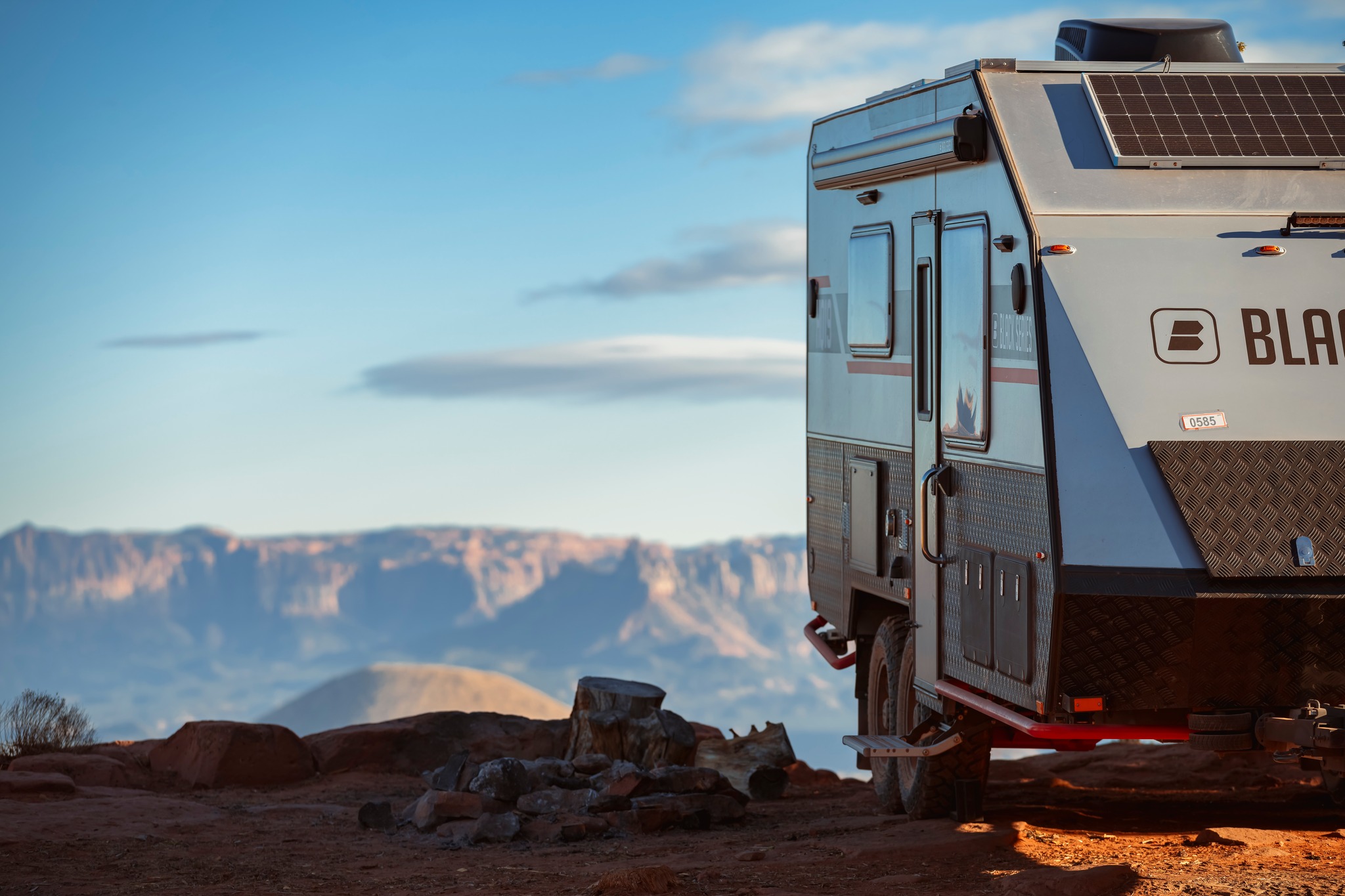
Key Features of a 4×4 Camper Trailer
Chassis & Frame Construction
The foundation of any capable off-road camper trailer starts with its chassis. Hot-dip galvanized steel frames resist corrosion from salt, sand, and moisture encountered during overlanding. Box section chassis construction provides superior strength compared to C-channel designs, distributing stress loads across the entire frame. BlackSeries utilizes military-spec welding techniques and galvanized steel that outlasts powder-coated alternatives in harsh conditions.
Suspension System
Independent suspension represents the gold standard for serious off-road capability. Unlike leaf-spring setups, independent systems allow each wheel to articulate independently, maintaining tire contact over uneven terrain. Our comprehensive suspension guide explains why dual-shock, trailing-arm designs excel in rocky environments where conventional suspensions fail.
Ground Clearance & Protection
Minimum 12-inch ground clearance becomes essential for navigating rocky trails, desert washes, and forest roads without damage. Equally important are approach angles (front), departure angles (rear), and breakover angles that determine how steep an obstacle your trailer can clear. Quality 4×4 camper trailers feature reinforced underbody protection, stone guards, and skid plates protecting vulnerable components.
Off-Grid Systems Integration
Extended backcountry camping requires self-sufficiency. Solar charging systems, lithium battery banks, and large fresh water capacity (40+ gallons) enable weeks of boondocking. Efficient 12-volt appliances, LED lighting, and proper insulation reduce power consumption while maintaining comfort.
How to Choose the Best 4×4 Camper Trailer: Step-by-Step Guide
Step 1: Define Your Terrain & Travel Style
Identify your primary destinations and camping style. Weekend desert trips require different capabilities than month-long mountain expeditions. Consider factors like:
- Terrain difficulty (fire roads vs. technical rock crawling)
- Trip duration (overnight vs. extended overlanding)
- Group size and sleeping arrangements
- Seasonal camping (summer-only vs. four-season capability)
Step 2: Assess Your Tow Vehicle Capability
Your 4×4’s towing capacity, payload rating, and tongue weight limits determine trailer size. Mid-size trucks like Toyota Tacoma and Ford Ranger typically handle 3,000-6,000 lb trailers, while full-size pickups can tow 8,000+ lbs safely. Calculate total loaded weight including gear, water, and provisions, not just dry trailer weight.
Step 3: Prioritize Layout & Features
Family overlanding demands different layouts than couples’ adventures. Consider:
- Sleeping capacity (queen bed vs. convertible dinette vs. bunk beds)
- Kitchen requirements (indoor vs. outdoor cooking)
- Bathroom facilities (wet bath vs. cassette toilet vs. none)
- Storage needs for gear, clothing, and supplies
Step 4: Evaluate Off-Road Capability
Use this checklist to assess true off-road capability:
- ✓ Independent suspension system
- ✓ 12+ inch ground clearance
- ✓ All-terrain or mud-terrain tires
- ✓ Reinforced chassis construction
- ✓ Underbody protection and stone guards
- ✓ Proper electrical connections and breakaway systems
Step 5: Calculate Total Cost of Ownership
Consider purchase price plus long-term costs including maintenance, insurance, storage, and modifications. Quality 4×4 off-road camper trailers typically retain value better than budget alternatives, making them smart long-term investments.

BlackSeries 4×4 Camper Trailers: What Sets Them Apart
True Off-Road Chassis & Suspension
BlackSeries trailers feature hot-dip galvanized steel chassis with independent suspension designed for extreme terrain. Our dual-shock systems and trailing arms provide superior articulation over rocks, logs, and uneven surfaces that would damage conventional trailers.
Build Quality for U.S. Conditions
American overlanding presents unique challenges from desert heat to mountain snow. Our composite body panels resist UV degradation, while military-grade welding and corrosion protection ensure longevity. Four-season insulation and efficient heating systems enable year-round adventures.
Models Overview
HQ12 – Compact couples’ trailer perfect for mid-size trucks and tight trails
HQ15 – Enhanced storage and comfort for extended trips
HQ17 – Family-friendly layout with convertible sleeping options
HQ19 – Premium features with full kitchen and bathroom facilities
HQ21 – Maximum space and luxury for full-time overlanding
Best 4×4 Camper Trailer Use Cases in the USA
Best for Weekend Warriors
- Recommended: Compact trailers (HQ12-HQ15 range)
- Tow Vehicle: Mid-size pickup (Tacoma, Ranger, Gladiator)
- Focus: Quick setup, lightweight for fuel economy
Best for Full-Time Overlanding
- Recommended: Full-featured trailers (HQ19-HQ21 range)
- Tow Vehicle: Full-size truck (F-150, RAM 1500, Silverado)
- Focus: Large water tanks, solar capacity, four-season comfort
Best for Families
- Priority: Convertible sleeping, storage, safety features
- Layout: Dinette conversion or dedicated bunks
- Considerations: Child-friendly bathroom access, secure storage
Real-World Tips: Towing & Maintaining Your 4×4 Camper Trailer
Towing Best Practices
Proper weight distribution hitches reduce trailer sway and improve stability on highways and mountain passes. Trailer brake controllers should be adjusted for loaded weight, with stronger settings for downhill grades. Practice backing and turning in open areas before attempting tight campgrounds.
Maintenance Schedule
After Every Trip: Inspect suspension components, check tire pressure and tread wear, verify all lights and brakes function properly.
Seasonal Maintenance: Lubricate suspension pivots, inspect wheel bearings, check roof sealants and window gaskets, test electrical systems.
Winter Storage: Drain water systems, charge batteries monthly, cover tires from UV exposure, inspect for rodent damage in spring.
Frequently Asked Questions
What is a 4×4 camper trailer and how is it different from a regular travel trailer?
A 4×4 camper trailer features reinforced construction, independent suspension, high ground clearance, and off-road tires designed for unpaved terrain. Regular travel trailers use lighter construction and basic suspension suitable only for paved roads and developed campgrounds.
Do I really need a 4×4 tow vehicle for a 4×4 camper trailer?
While not absolutely required for all terrain, 4×4 tow vehicles provide essential traction and control when accessing remote campsites. The combination of 4×4 truck and off-road camper trailer enables access to locations impossible with 2WD vehicles.
Are BlackSeries 4×4 camper trailers suitable for full-time living?
Yes, our larger models like the HQ19 and HQ21 include full kitchens, bathrooms, ample storage, and four-season insulation suitable for extended or full-time overlanding adventures across diverse climates.
How much does a good 4×4 off-road camper trailer cost?
Quality 4×4 camper trailers typically range from $30,000-$80,000+ depending on size and features. While more expensive than basic travel trailers, they offer superior durability and capability for serious overlanding.
Can a mid-size truck like a Tacoma tow a 4×4 camper trailer safely?
Most mid-size trucks can safely tow compact 4×4 camper trailers in the 3,000-5,000 lb range when properly equipped with towing packages and weight distribution hitches. Always verify your specific vehicle’s towing capacity and payload ratings.
Is a 4×4 camper trailer worth it compared to a rooftop tent or van build?
4×4 camper trailers offer advantages including leaving your daily driver unmodified, more living space, better storage, and the ability to unhitch for day trips. They’re ideal for overlanders wanting maximum comfort and capability without sacrificing vehicle practicality.

