First-time RV campers often make mistakes related to setup, weight, power management, weather prep, and campsite rules. Avoiding these common errors, like ignoring weight limits or skipping a walkthrough, makes your first trip safer, smoother, and far more enjoyable.
What First-Time RV Campers Get Wrong Most Often
Let’s get real: RVing isn’t just “big car camping.” It’s more like driving a small apartment with wheels, and that apartment has rules. The learning curve is steep, and the “experience gap” is where most disasters happen.
Beginners usually underestimate the complexity of a mobile home system. You’ve got electrical, plumbing, propane, weight distribution, and driving dynamics to think about, all before you even arrive at your campsite. The good news? Most mistakes are totally preventable with a little upfront homework and a willingness to practice before you hit the road.
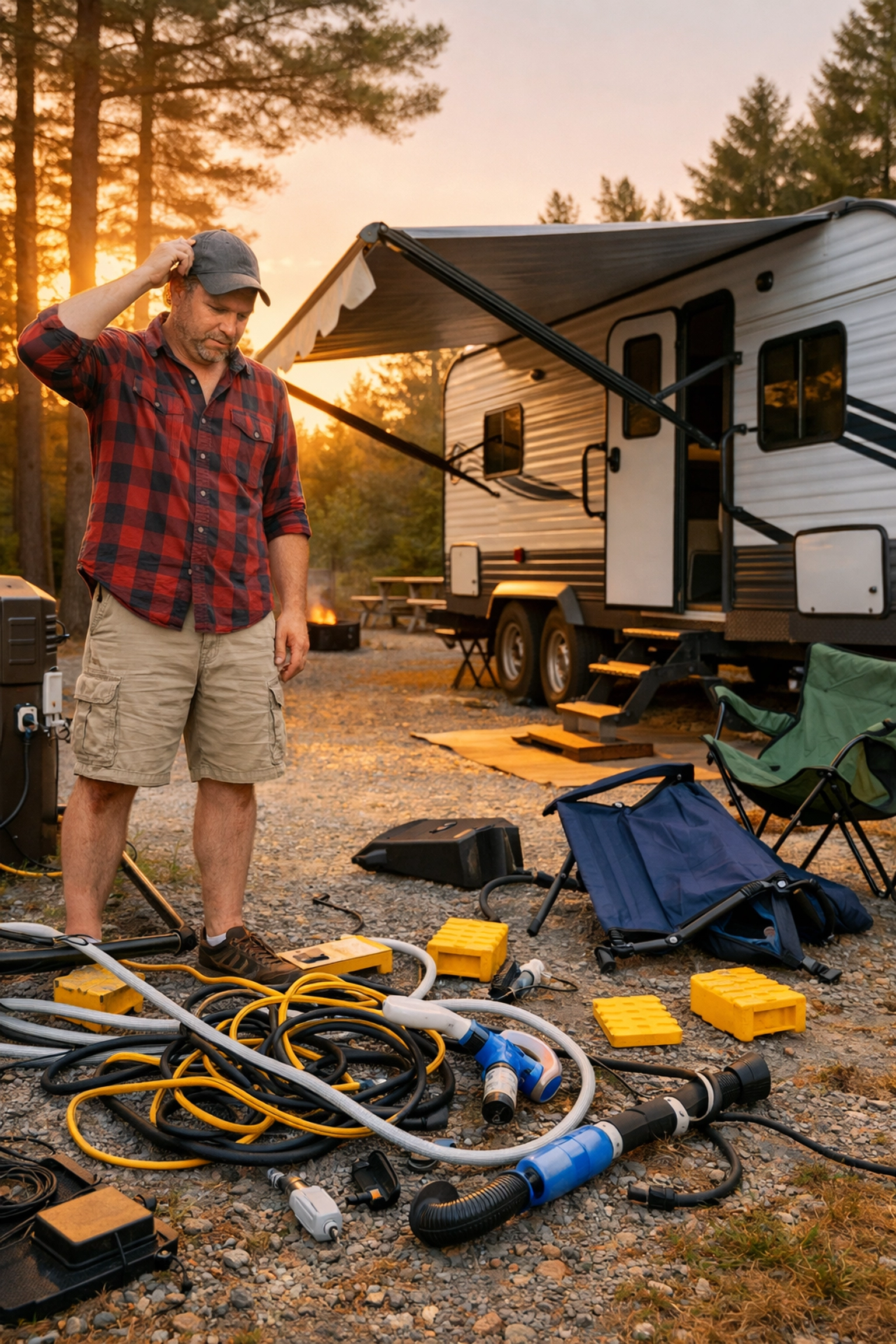
Top 10 First Time RV Camping Mistakes to Avoid
1. Skipping the Full RV Walkthrough
❌ The Mistake: You’re excited. You sign the papers, hop in the cab, and drive off into the sunset without understanding how anything works.
⚠️ The Consequence: You arrive at the campsite and have no clue how to hook up power, deploy the awning, or even find the water pump switch.
✅ Do This Instead: Don’t leave the dealership or rental lot without a complete walkthrough. Ask questions. Take videos on your phone. Learn where every valve, breaker, and switch is located. If you’re driving a BlackSeries off-road travel trailer, understand the unique features like solar panels, independent suspension, and onboard water systems.
2. Ignoring RV Weight Limits and Payload Capacity
❌ The Mistake: You load up your brand-new trailer with camping gear, mountain bikes, kayaks, a cooler full of steaks, and your entire home tool kit, without checking the numbers.
⚠️ The Consequence: You exceed your average weight of camper capacity, blow out a tire, or worse, lose control on a steep grade because your tongue weight is all wrong.
✅ Do This Instead: Know your trailer’s dry weight, GVWR (Gross Vehicle Weight Rating), and your tow vehicle’s payload capacity. Whether you’re hauling a 16 ft camper weight model (typically 2,500–3,500 lbs dry) or a 30 foot rv weight beast (often 7,000–10,000 lbs loaded), math matters. Use a scale before your first trip. Seriously.
For context, here are average travel trailer weights by size:
- 16 ft camper weight: 2,500–3,500 lbs
- 18 ft camper weight: 3,000–4,200 lbs
- 24 ft camper weight: 4,500–6,500 lbs
- 30 ft camper weight / 30 ft rv weight: 7,000–10,000 lbs
Overloading is the #1 safety risk in RV camping. Don’t let it be yours.
3. Not Practicing Setup at Home
❌ The Mistake: You assume setup will be intuitive once you get there.
⚠️ The Consequence: It takes you two hours to level the trailer, you forget to secure the stabilizer jacks, and the family inside feels like they’re in a funhouse.
✅ Do This Instead: Practice in your driveway or an empty parking lot. Learn how to level, deploy slides, connect utilities, and retract the awning. Do it once at home, and you’ll do it in 15 minutes at the campground.

4. Tank Mismanagement (Gray vs. Black)
❌ The Mistake: Mixing up gray water (from sinks and showers) and black water (from the toilet) tanks, or worse, not knowing how to dump them.
⚠️ The Consequence: You create a mess at the dump station that will haunt you forever. Trust us, you only make this mistake once.
✅ Do This Instead: Learn the difference before you leave. Gray is soapy water. Black is… well, you know. Always close the black tank valve until it’s time to dump, and always dump black first, then gray (to rinse the hose). Watch a YouTube tutorial if you have to.
5. Power Confusion: 30A vs. 50A
❌ The Mistake: You plug your 50-amp RV into a 30-amp outlet without an adapter, or vice versa.
⚠️ The Consequence: You trip breakers, fry electronics, or blow a fuse in the middle of nowhere.
✅ Do This Instead: Know your rig’s electrical requirements. Most smaller trailers use 30-amp service; larger rigs use 50-amp. Carry adapters and always check campground hookups before arrival. If your BlackSeries has built-in solar, you’ve got backup: but don’t rely on it for heavy loads like air conditioning.
6. Poor Weather Preparation
❌ The Mistake: You check the weather once, three days before departure, and assume it’ll stay sunny.
⚠️ The Consequence: High winds flip your awning into a pretzel, or a surprise cold snap leaves you shivering in a trailer designed for summer camping.
✅ Do This Instead: Check the forecast daily leading up to your trip. High winds are especially dangerous for taller rigs like a 30-foot camper weight trailer. Retract your awning if winds exceed 20 mph, and always have extra blankets if you’re camping at elevation.
7. Overpacking Like You’re Moving In
❌ The Mistake: You pack like you’re going on a six-month expedition when it’s really just a weekend trip.
⚠️ The Consequence: Excess weight affects fuel efficiency, handling, and tire wear. Plus, you’ll spend the entire trip tripping over stuff you never use.
✅ Do This Instead: Pack smart. Do you really need that cast-iron waffle maker? Probably not. Stick to essentials: bedding, cookware, toiletries, first-aid kit, and tools. Remember, every pound counts when calculating average travel trailer weights.
8. Poor Stop Planning (Fuel, Dump Stations, Low Bridges)
❌ The Mistake: You rely on Google Maps to route you like a sedan.
⚠️ The Consequence: You end up under a bridge with 11-foot clearance when your rig is 12 feet tall. Or you run out of fuel because your GPS sent you to a station with no RV access.
✅ Do This Instead: Use RV-specific GPS apps like RV LIFE, CoPilot GPS, or Garmin RV models. These tools account for your rig’s dimensions and flag hazards like weight-restricted bridges, steep grades, and narrow roads. Plan fuel stops in advance: not every gas station fits a 24 ft camper weight trailer.
9. Skipping Pre-Departure Safety Checks
❌ The Mistake: You’re eager to hit the road, so you skip the walkaround.
⚠️ The Consequence: You drive off with the awning deployed, the antenna up, or the stabilizer jacks still down. Expensive repairs follow.
✅ Do This Instead: Create a pre-departure checklist and follow it religiously. Check tire pressure, lug nuts, brake lights, turn signals, hitch connection, safety chains, and breakaway cable. Make sure all windows, vents, and roof hatches are closed. Confirm the water pump and water heater are off before towing.
10. Assuming Tech Works Everywhere
❌ The Mistake: You assume your phone’s GPS, campground WiFi, and cell signal will be reliable.
⚠️ The Consequence: You’re lost in the backcountry with no signal, and the campground’s “free WiFi” only works within 50 feet of the office.
✅ Do This Instead: Download offline maps. Bring physical maps as backup. Don’t rely on campground WiFi for work or streaming: it’s usually slow and unreliable during peak hours. Consider a cellular booster or satellite internet if you plan to camp off-grid regularly.
Step-by-Step: Preparing for Your First Trip
Pre-Trip Inspection Checklist:
- Inspect tires (tread, pressure, age)
- Check all lights and signals
- Test brakes and brake controller
- Verify hitch, coupler, and safety chains
- Confirm propane tanks are secured and full
- Test water pump and check for leaks
Campsite Booking Checklist:
- Confirm hookups (30A/50A, water, sewer)
- Verify site dimensions fit your rig
- Ask about WiFi and cell signal quality
- Check for pet policies if traveling with animals
Essentials & Emergency Gear:
- Leveling blocks and wheel chocks
- Sewer hose kit and gloves
- Fresh water hose with pressure regulator
- Extension cords rated for RV use
- First-aid kit, fire extinguisher, flashlights
- Tool kit with basic wrenches and screwdrivers
Common RV Terms Beginners Often Misunderstand
Dry Camping vs. Boondocking: Dry camping means camping without hookups (usually in a designated campground). Boondocking means camping off-grid in dispersed public land: totally free, but zero amenities.
Shore Power (30A vs. 50A): Shore power is the electrical service at campgrounds. 30-amp is standard for smaller RVs; 50-amp is for larger rigs with heavy electrical demands (like dual A/C units).
GVWR (Gross Vehicle Weight Rating): The maximum your trailer can safely weigh when fully loaded. Exceed this, and you risk tire blowouts, brake failure, and insurance liability.
Tongue Weight: The downward force the trailer’s tongue puts on the hitch ball. Too much causes the tow vehicle’s rear to sag; too little causes dangerous sway. Target 10–15% of total trailer weight.
Black Tank vs. Gray Tank: Black = toilet waste. Gray = sink and shower water. Never confuse them at the dump station.
Why BlackSeries Owners Have an Edge
Let’s be honest: not all trailers are built the same. BlackSeries off-road travel trailers are designed for the rough stuff, which means they’re also more forgiving for beginners.
Better Suspension = Easier Towing: Independent suspension on BlackSeries models reduces sway and improves handling, even on rough roads. This gives first-timers more confidence behind the wheel.
Built-In Solar Reduces Power Stress: Our trailers come standard with integrated solar panels, so you’re less dependent on campground hookups. That means fewer worries about finding a 30A or 50A site: you’ve got backup power for lights, fans, and charging devices.
Four-Season Insulation = Fewer Weather Surprises: BlackSeries trailers are built for all-season camping, so you’re not scrambling to winterize or deal with condensation issues on your first trip.
Want to see how our trailers handle off-road conditions? Check out our guide on off-road travel trailer maintenance.
FAQ: First Time RV Camping Mistakes
What is the biggest mistake first-time RV campers make?
Ignoring weight limits and payload capacity. Overloading your trailer or tow vehicle is dangerous and leads to tire blowouts, brake failure, and poor handling. Always weigh your rig before your first trip and know your average weight of camper specifications.
How many days should a first RV trip be?
Start with a 2–3 day local trip within 50 miles of home. This gives you time to learn systems, practice setup, and troubleshoot issues without the pressure of being far from help. Think of it as a shakedown cruise.
Is boondocking good for beginners?
Not really. Boondocking (camping off-grid with no hookups) requires experience with water management, battery monitoring, and self-sufficiency. Start with campgrounds that offer full hookups, then work your way up to dry camping, and eventually boondocking after a few successful trips.
Do I need special insurance for RV camping?
Yes. Standard auto insurance often doesn’t cover RVs fully. Get dedicated RV insurance that includes liability, collision, comprehensive, and roadside assistance. Many policies also cover personal belongings inside the trailer.
Can I tow a 30 ft camper weight trailer with a half-ton truck?
It depends on your truck’s towing capacity and payload rating. A 30 ft rv weight trailer can weigh 7,000–10,000 lbs loaded, which may exceed some half-ton trucks’ limits: especially when you factor in passengers, cargo, and tongue weight. Always check your vehicle’s specs and consider upgrading to a three-quarter-ton or one-ton truck if needed.
Ready to start your RV adventure the right way? Browse our blog for more tips on everything from living the RV lifestyle to choosing your first off-road trailer. And if you’re serious about getting started, explore the BlackSeries lineup to find a trailer built for adventure: and built for beginners.

