
Your cart (0)
Your cart is empty
Tax included and shipping calculated at checkout
Your cart is empty
Tax included and shipping calculated at checkout

The deep woods are calling, but standard RVs can’t always answer. If you want to wake up surrounded by towering pines rather than asphalt, a lightweight off-road travel trailer is your ticket to the real wild. BlackSeries rigs are built for exactly this: turning narrow forest service roads into your personal driveway.
Forest camping isn’t just about escaping the crowds. It’s about accessing those hidden spots where the only neighbors you’ll have are deer, owls, and the occasional curious raccoon. But getting there requires more than just courage: it requires the right rig. When you’re navigating tight switchbacks, dodging low-hanging branches, and crossing creek beds, every pound and every inch of your trailer matters.
Let’s talk about the reality of forest roads. Most weren’t designed for modern RVs: they were carved out decades ago for logging trucks and park rangers. That means narrow passages, sharp turns, and terrain that would make a highway patrol officer wince.

Here’s the thing: towing a rig in the 16 ft camper weight class (typically 2,500–3,200 lbs) versus dragging a massive 30 foot rv weight unit (often 8,000–10,000 lbs) makes a world of difference when you’re dodging low-hanging branches and navigating tight switchbacks.
When you’re backing up because you missed a turn marker on a single-lane forest road, you’ll thank yourself for choosing compact. The average 18 ft camper weight model gives you enough living space for a family weekend while still fitting through gaps that would stop bigger rigs cold.
Less weight behind your truck means more gas in the tank for exploring deeper into the backcountry. When the nearest fuel station is 60 miles of dirt road away, every MPG counts. A lightweight off-road travel trailer typically improves your fuel economy by 25–40% compared to heavier models, which translates directly into more range and less anxiety about making it back to civilization.
The math is simple: lighter trailer = better fuel economy = more money for camping gear (or that fancy camp breakfast you’ve been craving).
Smaller trailers fit into those perfect, secluded spots that big rigs have to pass by. You know that gorgeous meadow clearing 200 yards off the main trail? That’s yours with a compact rig. The 24 ft camper weight category is often the sweet spot: big enough for comfort, small enough for access: but if you’re really hunting for solitude, going even more compact pays dividends.
Standard average travel trailer weights for off-road models run slightly higher than their on-road cousins due to reinforced chassis, all-terrain suspension, and protective armor plating. But that extra durability is what lets you confidently tackle forest terrain without worrying about every rock and root.
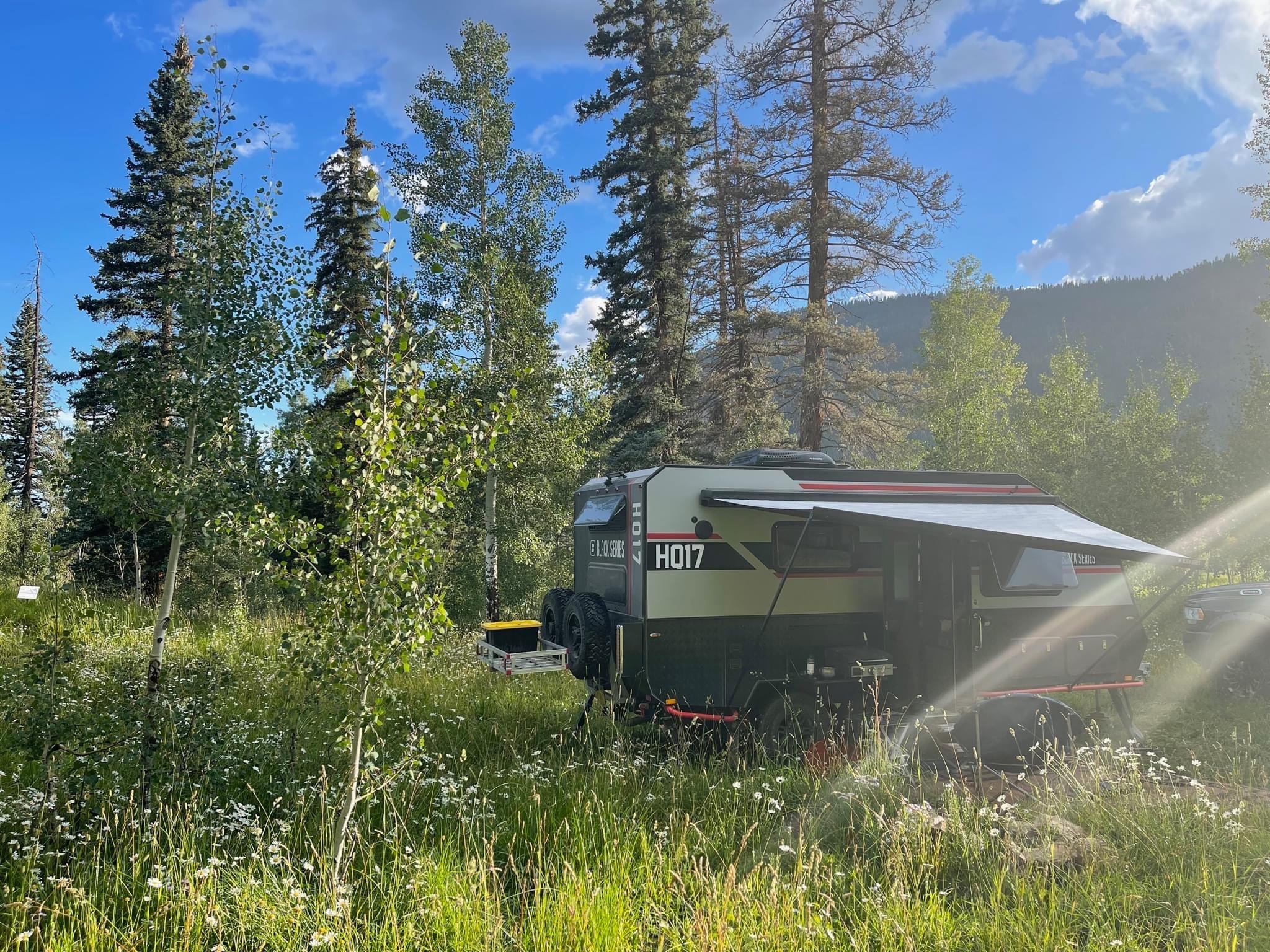
Not all lightweight trailers are created equal. Some are “lightweight” because they cut corners on construction. BlackSeries builds light smart: using advanced materials and engineering instead of just making everything thinner and cheaper.
Essential for crawling over tree roots and uneven forest floors, independent suspension means each wheel responds to terrain independently. Hit a rock on the left side? The right side stays stable. Cross a drainage ditch at an angle? Your trailer flexes with the ground instead of fighting it.
Standard trailer suspension systems (the old leaf-spring setup) basically treat both wheels as a single unit. That works fine on highways. In the forest? It’s a recipe for bottoming out, losing traction, and potentially damaging your frame. BlackSeries uses independent trailing arm suspension with coil springs on every model, giving you up to 12 inches of articulation: enough to handle just about anything a forest road throws at you.
Standard on BlackSeries, all-terrain tires provide the grip you need for muddy or needle-covered trails. Regular highway tires? They’ll get you stuck faster than you can say “winch cable.”
Our trailers come equipped with aggressive tread patterns designed for off-pavement use. We’re talking 16-inch reinforced tires with sidewall protection: because when you’re 15 miles from the nearest paved road, a blown tire isn’t just inconvenient, it’s a genuine emergency.
Forests can be damp and chilly, even in summer. Morning fog, afternoon rain showers, and that persistent moisture that comes from being surrounded by thousands of trees: it all adds up to a potentially miserable camping experience if your trailer isn’t properly insulated.
BlackSeries uses closed-cell foam insulation in walls, floors, and ceilings. This isn’t the cheap stuff you find in budget trailers that absorbs moisture and breeds mold. Our insulation maintains R-values even when wet, prevents condensation buildup, and keeps interior temperatures stable whether it’s 90°F or 20°F outside.
The practical result? You’re not running your heater or AC constantly, which means longer battery life and more time between generator runs. That’s crucial when you’re boondocking deep in the woods.

Let’s break down what different weight classes actually mean for forest camping. Understanding average weight of camper options in each category helps you match your vehicle’s towing capacity with your adventure ambitions.
Typical specs: 2,500–3,200 lbs dry weight, sleeps 2–3
The BlackSeries HQ12 falls into this category. At roughly 2,800 lbs empty, it’s towable by most mid-size trucks and even some larger SUVs. This is your “go anywhere” option: the trailer that laughs at narrow trails and tight camping spots.
Pros: Ultimate agility, fits basically anywhere, excellent fuel economy
Cons: Limited interior space, smaller tanks (fresh water typically 20–25 gallons), less storage
Best for: Couples, weekend warriors, hunters, photographers who need to access remote locations
Typical specs: 3,500–5,200 lbs dry weight, sleeps 4–6
This is where most families land. The 24 ft camper weight models like the BlackSeries HQ19 still maintain off-road capability while providing actual living space. You get a real bathroom, a functional kitchen, and enough bed space that nobody’s sleeping on the dinette conversion.
These rigs typically feature 40–50 gallon fresh water tanks, larger battery banks (often 200+ amp-hours of lithium), and enough cargo capacity for extended trips. The trade-off? You need a capable tow vehicle: think 3/4-ton truck minimum: and you’ll need to plan your routes more carefully.
Pros: Family-friendly, self-sufficient for 4–7 days, maintains off-road capability
Cons: Requires larger tow vehicle, won’t fit the tightest spots, costs more upfront
Best for: Families, extended trips, groups who value comfort alongside capability
Typical specs: 7,000–10,000+ lbs dry weight, sleeps 6–8
Let’s be honest: these aren’t really forest camping rigs. The 30 ft rv weight category is designed for RV parks and established campgrounds with paved roads and hookups. Can you take them into the forest? Sure, on well-maintained roads. But you’re sacrificing access for amenities.
If your forest camping involves driving to a developed National Park campground, these work fine. If you’re hunting for that secret swimming hole five miles down a barely-maintained fire road? Leave the 30-footer at home.
It’s worth noting that average travel trailer weights have crept upward over the past decade as manufacturers add more features. A trailer advertised as “lightweight” in the 30-foot camper weight class might still tip the scales at 8,500 lbs: hardly light by any practical measure.

Getting to your forest campsite is only half the battle. Staying comfortable and safe requires proper preparation.
Before you head down that forest service road, walk around your trailer with intention:
Seals and weatherstripping: Check every seal on doors, windows, and hatches. Forest humidity is relentless: any gap is an invitation for moisture and insects.
Tire pressure: Verify cold pressure on both tow vehicle and trailer. Most off-road scenarios benefit from slightly reduced tire pressure (consult your owner’s manual), but always check before airing down.
Suspension components: Visually inspect shocks, springs, and mounting points. Look for leaks, cracks, or loose hardware.
Lighting: Test all exterior lights, including markers and brake lights. Seeing and being seen matters on narrow forest roads.
Weight distribution: Confirm your tongue weight is 10–15% of total trailer weight. Too much weight forward makes steering difficult; too little causes sway.
For more detailed maintenance guidance specific to off-road conditions, check out our off-road trailer maintenance guide.
Forests present a unique solar challenge: trees. That lush canopy that makes forest camping so beautiful also blocks your solar panels. Roof-mounted solar on BlackSeries trailers typically includes high-efficiency panels (our standard is 300+ watts), but you need realistic expectations about charging rates.
Under dense canopy, expect 20–40% of rated capacity. A 400-watt system might only deliver 80–150 watts of actual charging power. That’s why we spec our trailers with oversized battery banks: the HQ19, for example, comes standard with 400Ah of lithium, giving you 3–5 days of power without any solar input.
Pro tip: If possible, position your trailer in the largest available clearing and angle it toward any breaks in the canopy. Even partial sun exposure dramatically improves charging efficiency.
Storing food properly in bear country is obvious (and mandatory in many National Forests). But wildlife safety extends beyond just keeping your snacks away from grizzlies:
Secure trash immediately: Don’t let garbage accumulate outside. Smaller critters like raccoons and skunks can be just as disruptive as bears.
Don’t feed wildlife: That chipmunk begging for crackers is adorable until it chews through your electrical wiring looking for more.
Store toiletries inside: Bears consider toothpaste and deodorant food. Keep all scented items inside your trailer.
Make noise when walking: Especially at dawn and dusk, make your presence known to avoid surprising wildlife on trails.
Keep dogs leashed: Even well-trained dogs can chase wildlife, leading to dangerous encounters or simply stressing native animals.
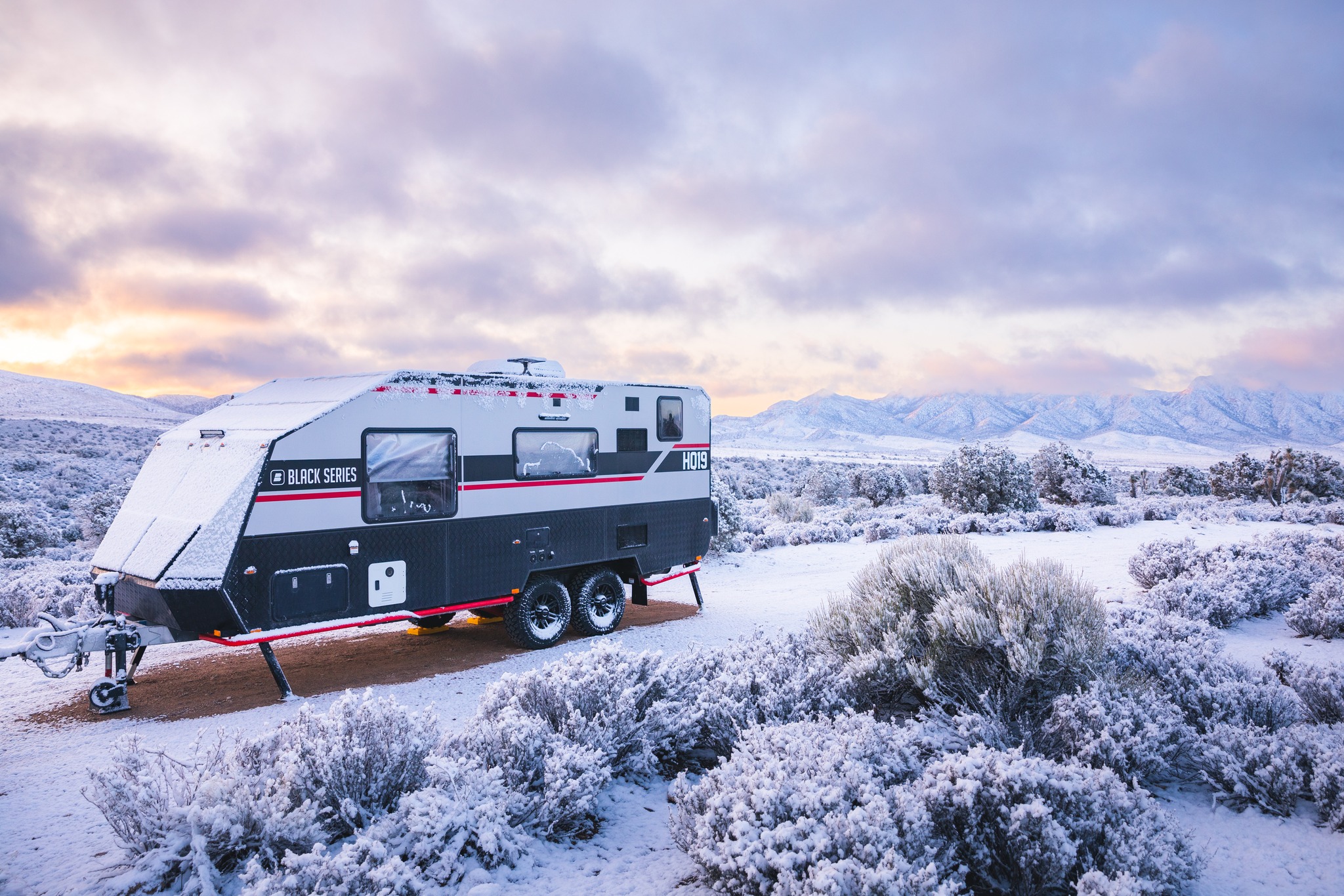
Forests are magical in the snow. Discuss how BlackSeries’ heating systems and insulated tanks allow for year-round exploration.
Winter forest camping is next-level adventure. The crowds disappear. Wildlife is easier to spot against snow. And there’s something primal about being warm and comfortable inside your trailer while snow piles up outside.
Our 4-season construction isn’t marketing fluff: it’s engineering. Here’s what actually matters:
Enclosed and heated underbelly: All plumbing runs through a heated compartment. Your pipes won’t freeze even when it’s 10°F outside because they’re in a protected space that stays above freezing as long as your propane or diesel heater is running.
Dual-pane windows with thermal breaks: Single-pane windows are instant cold spots and condensation magnets. Our insulated windows reduce heat loss by 60–70% compared to standard RV windows.
Heated tank pads: Fresh, gray, and black water tanks all include 12-volt heating pads that automatically engage when temperatures drop. No more frozen waste tanks or ice-blocked fresh water lines.
High-output heating: The Webasto diesel heater in BlackSeries trailers puts out 13,000 BTUs: enough to keep you comfortable even in extreme cold: while sipping fuel (a gallon of diesel lasts 20+ hours of runtime).
Monitor battery levels closely: Cold reduces battery capacity. A battery bank that gives you 3 days in summer might only deliver 1.5 days in winter. Plan accordingly.
Ventilate properly: Running your heater produces moisture. Crack a vent slightly to allow air exchange and prevent condensation buildup.
Insulated water hoses: If you’re near a water source, insulated hoses prevent freeze-ups during filling operations.
Extra propane/fuel: Heating consumes resources fast. Carry backup fuel sources: you don’t want to run out in the middle of a snowstorm.
For those considering full-time winter camping, our article on living in a trailer full-time covers year-round considerations in detail.
It depends on your family size and tolerance for close quarters. A 16-footer works great for a couple with one small child, especially for weekend trips. But for extended stays or larger families (3+ people), you’ll quickly feel cramped. Most families find the 18–24 ft range more practical: enough space to avoid cabin fever while maintaining good off-road capability.
Yes, with proper planning and driving technique. A 24-footer is manageable on most forest service roads, but you need to scout your route beforehand. Check forest service websites for road width restrictions, and don’t hesitate to unhitch and scout ahead on foot if you’re unsure. The key is taking it slow, using a spotter when backing up, and knowing when to turn around.
True lightweight off-road travel trailers typically range from 2,500–5,500 lbs depending on length. However, many manufacturers inflate their “lightweight” claims. Always check the actual GVWR (Gross Vehicle Weight Rating) and dry weight specs. And remember: dry weight doesn’t include water, propane, batteries, or any of your gear: expect to add 1,000–1,500 lbs to the advertised dry weight for realistic loaded weight.
BlackSeries trailers are actually ideal for beginners precisely because they’re over-engineered. You don’t need to worry about whether you can handle that rough road: the trailer can handle it. The learning curve with off-road camping is steep enough without also fighting marginal equipment. Our trailers give beginners confidence to explore while they develop skills. Plus, the comprehensive build quality means fewer repairs and less time troubleshooting problems: more time actually camping.
Drive slowly (seriously, slower than you think), air down tires slightly for better traction and cushioning, and use your tow vehicle’s low-range gearing when available. Inspect your route on foot if uncertain, and don’t push your luck. It’s always better to turn around than to drag a damaged trailer out of the backcountry. BlackSeries trailers include skid plates and reinforced frames, but physics is physics: give your rig the best chance by driving smart.
Forest camping with a lightweight travel trailer opens up an entirely different world of adventure. The deep woods, the solitude, the sounds of wind through pines instead of highway traffic: it’s what camping was always supposed to be.
BlackSeries builds trailers specifically for these moments. Not for campground parking lots, but for places where the pavement ends and the real adventure begins. Whether you’re eyeing a compact HQ12 for ultimate agility or an HQ19 for family-friendly forest expeditions, you’re getting a rig engineered for the tight trails, rough roads, and wild places most RVs will never see.
Ready to plan your forest escape? Explore our full trailer lineup and find the perfect rig for your backcountry adventures.