Off-grid RVs with solar represent the pinnacle of self-sufficient camping, allowing adventurers to venture beyond traditional campgrounds into America’s most remote and beautiful locations. With advanced lithium battery technology and high-efficiency solar systems becoming standard in 2026, these setups enable weeks of independent living in places like Utah’s red rock country, Arizona’s Sonoran Desert, and Colorado’s alpine wilderness. BlackSeries leads this evolution with purpose-built off-grid travel trailers featuring robust solar packages, intelligent energy management, and heavy-duty construction designed for the demanding terrain where true boondocking happens. This comprehensive guide will help you navigate solar system sizing, lithium battery selection, and the best BlackSeries models for your off-grid adventures.
Quick Highlights
Who It’s For: Full-time RVers, families seeking remote camping experiences, remote workers, and serious off-road enthusiasts
What’s Inside: Complete solar system breakdowns, lithium battery comparisons, energy planning worksheets, BlackSeries model reviews, and professional buying advice
Ideal Regions: Utah’s BLM lands, Arizona desert corridors, Colorado backcountry, Nevada wilderness areas, Montana’s Big Sky country, and Pacific Northwest forest roads
Understanding Off-Grid RV Systems
An off-grid RV operates independently of external power sources, water hookups, and sewer connections for extended periods. These self-contained units rely on integrated solar panels, lithium battery banks, and sophisticated inverter systems to power everything from LED lighting to residential refrigerators and air conditioning units.
Key terminology every off-grid buyer should understand:
- Solar wattage: The power generation capacity of your panels, typically ranging from 200W to 1,200W+ in modern systems
- Battery capacity: Measured in amp-hours (Ah) or kilowatt-hours (kWh), indicating how much energy your system can store
- Lithium vs AGM: Lithium batteries offer 3x longer life, 50% weight reduction, and deeper discharge capabilities compared to traditional AGM batteries
- Inverter capacity: Converts 12V DC battery power to 120V AC household current, typically 1,500W to 3,000W in serious off-grid setups
- MPPT charge controller: Maximizes solar panel efficiency by optimizing voltage and current flow to batteries
- Energy budget: Your daily power consumption calculated in watt-hours to properly size your solar and battery systems
BlackSeries has positioned itself as the premier manufacturer of towable off-road RVs because they combine the mobility advantages of a dedicated 4×4 tow vehicle with the living space and amenities of a full-size travel trailer. This configuration proves superior for accessing remote boondocking locations while maintaining comfort.
2026 Market Trends in Off-Grid Solar RVing
The American RV market is experiencing unprecedented demand for solar-powered boondocking capabilities. Remote work flexibility has enabled more families to embrace extended off-grid adventures, while crowded state and national parks drive campers toward dispersed camping on BLM and Forest Service lands.
Regional solar advantages vary significantly across the United States. The Southwest’s high elevation and minimal cloud cover provide optimal solar generation, with systems producing 6-8 peak sun hours daily. Mountain regions offer excellent summer solar production but require larger battery banks for shorter winter days. Coastal and forest environments need higher wattage systems to compensate for filtered sunlight.
Pricing evolution in 2026 reflects both technological advancement and supply chain stabilization. Complete lithium solar packages range from $8,000 for basic 400W systems to $25,000+ for premium 1,200W installations with smart monitoring. Factory-integrated systems command premium pricing but eliminate compatibility concerns and installation complexity that plague aftermarket retrofits.
Essential Off-Grid Configuration Checklist
Solar Panel Systems (200W-1,200W Range)
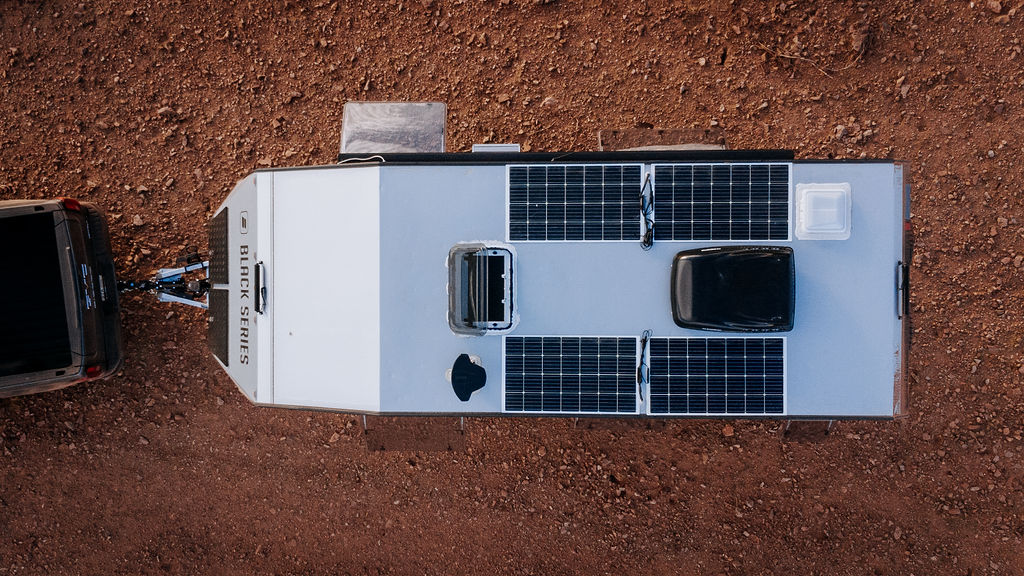
Modern off-grid RVs typically feature 400W-800W solar arrays as the sweet spot for extended boondocking. Monocrystalline panels deliver superior efficiency per square foot, critical for RV roof space constraints. Fixed roof-mounted panels handle daily power needs, while portable fold-out arrays provide supplemental generation during extended stays.
Lithium Battery Banks (300Ah-800Ah Capacity)
Lithium Iron Phosphate (LiFePO4) chemistry has become the gold standard for RV applications. A 400Ah lithium bank provides approximately 5kWh of usable energy, enough to run LED lighting, water pumps, furnace fans, and a residential refrigerator for 2-3 days without solar input. Unlike lead-acid batteries that lose capacity below 50% discharge, lithium batteries maintain consistent voltage down to 20% capacity.
Smart Energy Management Systems
Advanced inverter-chargers with monitoring track real-time energy production, consumption, and battery status. Victron, Battle Born, and similar systems provide smartphone connectivity for remote monitoring and system optimization. Smart load management automatically prioritizes critical systems during low-battery conditions.
High-Capacity Fresh Water Systems
Off-grid camping success depends equally on water independence. 60-100 gallon fresh water tanks support 4-7 days of family camping, while efficient filtration systems extend capacity by enabling safe water harvesting from natural sources.
BlackSeries integrates these components through factory engineering that ensures proper wire sizing, fusing, and thermal management, critical factors often overlooked in aftermarket installations.
Best BlackSeries Models for Off-Grid Adventures
BlackSeries HQ19: Premium Full-Time Living
The HQ19 represents the pinnacle of off-grid luxury with its spacious interior, high-capacity lithium system, and heavy-duty independent suspension. Key features include a 600W solar package, 400Ah lithium battery bank, 75-gallon fresh water capacity, and residential-grade appliances. The full bathroom with cassette toilet and 6-foot interior height accommodate full-time living comfort.

BlackSeries HQ21: Family Adventure Headquarters
The HQ21 maximizes sleeping capacity with convertible bunk beds while maintaining serious off-grid capability. Family-focused features include quad bunk sleeping, oversized dinette, abundant storage, and ruggedized construction that withstands active family use. The 800W solar upgrade package supports higher family energy demands.
BlackSeries HQ17: Compact Desert Explorer
The HQ17 strikes the optimal balance between capability and maneuverability for accessing remote desert locations. Lightweight advantages include better fuel economy, easier backing/parking, and compatibility with half-ton pickup trucks while maintaining full off-grid amenities including solar, lithium, and fresh water systems.
Step-by-Step Off-Grid RV Buying Process
Step 1: Calculate Your Daily Energy Budget
Document every electrical device you’ll use daily: refrigerator (60W continuous), LED lights (20W total), water pump (8A when running), phone chargers (15W), laptop (65W). Multiply by hours of use to establish daily watt-hour requirements. Most families need 200-400Ah of battery capacity for comfortable 2-3 day autonomy.
Step 2: Match Your Camping Environment
Desert boondocking favors maximum solar wattage and large water tanks. Forest camping requires higher-wattage systems to compensate for shade. Mountain camping needs extra battery capacity for shorter winter days and cold-weather performance.
Step 3: Verify Tow Vehicle Compatibility
Check your vehicle’s towing capacity, payload rating, and tongue weight limits. Off-grid RVs carry additional weight from solar equipment, lithium batteries, and full water tanks. Ensure 20% safety margin below maximum ratings.
Step 4: Inspect Off-Grid Systems In Person
Visit a BlackSeries dealer to examine battery installation, solar panel mounting, wire management, and monitoring systems. Critical inspection points include proper battery ventilation, accessible service panels, quality electrical connections, and intuitive control interfaces.
Real-World Case Study: Arizona Desert Adventure
A Colorado family recently completed a 14-day off-grid journey through Arizona and Utah using their BlackSeries HQ19. Route highlights included Quartzsite dispersed camping, Organ Pipe Cactus National Monument, and remote BLM sites near Moab.
System performance exceeded expectations: the 600W solar array maintained battery charge even during partly cloudy days, while the 75-gallon fresh water system supported four people for the entire trip with careful conservation. The lithium battery bank powered the residential refrigerator, LED lighting, and water pump without generator backup.
User feedback emphasized the peace of mind provided by real-time energy monitoring and the comfort enabled by the HQ19’s spacious interior and effective climate control. The independent suspension handled washboard roads smoothly, while the reinforced chassis showed no signs of stress after thousands of miles on rough terrain.
Frequently Asked Questions
How much solar power do I need for off-grid RV living?
Most comfortable off-grid setups require 400-800W of solar panels. Calculate your daily energy use in watt-hours, then size your solar array to generate 120-150% of that amount to account for weather variability and battery charging efficiency.
Are lithium batteries essential for serious boondocking?
While not absolutely required, lithium batteries provide significant advantages: 3x longer lifespan, 50% weight reduction, consistent voltage output, and safe deep discharge to 20% capacity. The investment typically pays for itself within 3-5 years of active use.
How long can an off-grid RV stay autonomous with solar?
Properly sized systems can maintain indefinite autonomy in sunny conditions. Most families achieve 3-7 days of complete independence during cloudy weather, depending on conservation efforts and battery capacity.
What size inverter is optimal for RV appliances?
A 2,000W pure sine wave inverter handles most RV appliances including microwaves, coffee makers, and small electronics simultaneously. Upgrade to 3,000W if you plan to run residential air conditioners or power tools.
Are BlackSeries RVs suitable for full-time off-grid living?
Yes, models like the HQ19 and HQ21 are specifically engineered for extended off-grid use with high-capacity water tanks, robust electrical systems, four-season insulation, and durable construction designed for continuous use.
Do I need a backup generator with solar?
While not essential in sunny climates, a small 2,000W generator provides backup power during extended cloudy weather or high-consumption activities like running air conditioning in hot climates.
For those ready to embrace true off-grid freedom, BlackSeries offers the most capable and reliable platform for accessing America’s most spectacular remote locations while maintaining home-like comfort and convenience.

