
Your cart (0)
Your cart is empty
Tax included and shipping calculated at checkout
Your cart is empty
Tax included and shipping calculated at checkout

Planning to explore America’s backcountry and rugged terrain with a camping trailer? This comprehensive guide will walk you through everything you need to know about selecting, purchasing, and using a rugged camping trailer in the USA. From understanding key terminology to maintenance best practices, we’ll cover why BlackSeries stands out as a leading choice for serious off-road adventurers seeking reliable, all-season capability.
The demand for rugged camping trailers in the USA has surged dramatically as more Americans seek authentic outdoor experiences beyond traditional campgrounds. Unlike standard travel trailers designed for paved roads and established RV parks, rugged camping trailers are engineered specifically for off-road adventures, remote wilderness access, and extended off-grid camping.
Rugged camping trailers USA represent a specialized segment that combines expedition-grade construction with modern comfort amenities. These trailers enable adventurers to access remote locations while maintaining the creature comforts necessary for extended wilderness stays.
BlackSeries has established itself as a premier manufacturer in this space, bringing Australian outback expertise to North American terrain. Our trailers are purpose-built for the diverse challenges of American wilderness – from desert Southwest heat to Rocky Mountain winter conditions, from coastal humidity to high-altitude alpine environments.
The growing popularity of off-grid camping and backcountry exploration has created demand for trailers that can handle everything from rocky desert washes to snow-covered mountain passes while providing reliable shelter, power, and comfort systems.
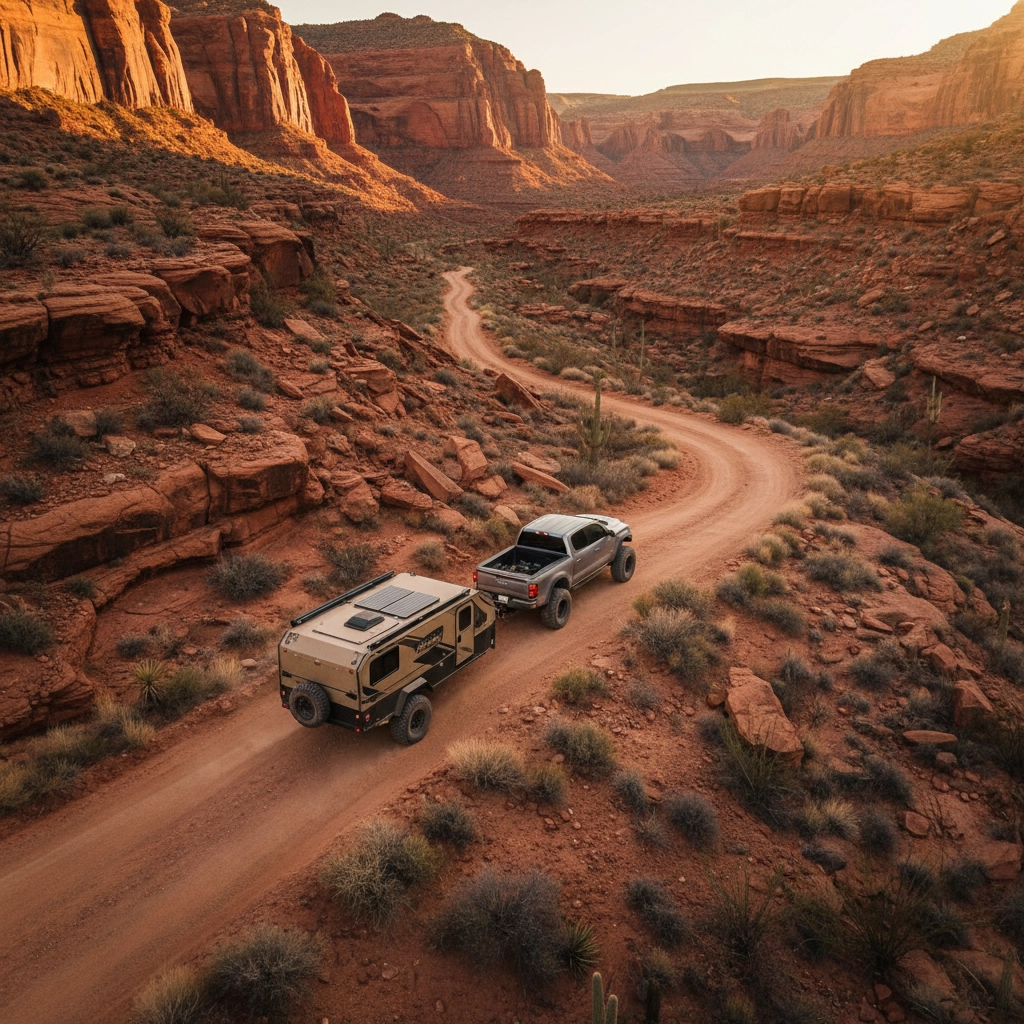
Understanding the key terminology is essential when shopping for a rugged camping trailer:
Rugged Camping Trailer: A purpose-built recreational vehicle designed specifically for off-road use, featuring reinforced construction, high ground clearance, and systems engineered for remote camping without hookups.
Heavy-Duty Chassis: The reinforced frame structure that forms the foundation of an off-road trailer, typically featuring fully welded construction, thicker frame rails, and strategic reinforcement at stress points.
Off-Road Suspension: Specialized suspension systems designed to absorb impacts from rough terrain while maintaining stability and load capacity. Options include independent suspension, heavy-duty leaf springs, and air suspension systems.
All-Season Insulation: Advanced insulation packages that enable comfortable use in extreme temperatures, typically including upgraded wall insulation, thermal windows, and climate-controlled systems.
Off-Grid Capability: The trailer’s ability to operate independently without external power, water, or sewer connections, typically involving solar power systems, large water tanks, and waste management systems.
Ground Clearance: The distance between the lowest point of the trailer and the ground, critical for navigating rocky terrain, logs, and other obstacles.
GVWR (Gross Vehicle Weight Rating): The maximum safe loaded weight of the trailer, including the base trailer weight plus cargo, water, propane, and occupants.
The distinction between a standard travel trailer and a rugged camping trailer lies primarily in construction quality, component durability, and system integration designed for harsh environments and extended remote use.
The North American travel trailer market has experienced remarkable growth, with the travel trailer market size projected to exceed $28.6 billion by 2025, according to Future Market Insights. Within this broader market, the off-road camping trailer segment represents the fastest-growing subsection.
Key market drivers include:
The rugged camping trailer USA market specifically targets consumers willing to invest in premium capability. Average purchase prices range from $45,000 to $85,000 for quality off-road trailers, reflecting the specialized engineering and materials required.
Regional demand patterns show strongest growth in Western states, with Colorado, Utah, Arizona, and California leading in off-road trailer registrations. This aligns with access to public lands and established outdoor recreation cultures.
Consumer priorities when purchasing off-road camping trailers include:

Before evaluating specific trailers, clearly define your intended use:
Your existing tow vehicle determines trailer size and weight limitations:
Heavy-Duty Chassis Requirements:
Suspension System Priorities:
Ground Clearance Standards:
Power Systems:
Water Systems:
Consider manufacturer reputation, warranty coverage, and service availability:
Essential Camping Trailer Checklist:
□ Heavy-duty chassis with welded construction
□ Independent suspension system
□ 14+ inches ground clearance
□ Solar power system (400W minimum)
□ Large capacity battery bank
□ 40+ gallon fresh water capacity
□ All-season insulation package
□ Comprehensive tool and spare parts kit
□ Quality construction materials (aluminum/composite)
□ Established service network support
The BlackSeries HQ series represents our flagship line of all-season trailers designed specifically for American conditions:
HQ12 Compact: Perfect for solo adventurers or couples
HQ15 Mid-Size: Balances capability with comfort
HQ19 Flagship: Maximum capability and comfort
HQ21 Premium: Ultimate in off-road luxury
Australian Heritage: Our designs originate from Australian outback conditions, arguably more demanding than most American terrain. This heritage ensures proven durability and reliability.
American Adaptation: While maintaining outback-proven fundamentals, we’ve specifically adapted our trailers for American regulations, road conditions, and user preferences.
Materials Excellence: We utilize premium materials including marine-grade aluminum framing, composite panel construction, and stainless steel components throughout.
System Integration: Rather than cobbling together aftermarket components, our trailers feature integrated systems designed to work together seamlessly.

Structural Components:
System Checks:
Safety Equipment:
Site Selection:
Mechanical Setup:
System Activation:
Daily Checks:
Weekly Maintenance:
Seasonal Maintenance:

Q: Can rugged camping trailers handle regular highway towing?
A: Yes, quality rugged camping trailers are designed for dual-purpose use. While optimized for off-road capability, they maintain excellent highway stability and fuel efficiency. The reinforced construction actually enhances highway safety, though you may experience slightly increased wind resistance compared to conventional trailers.
Q: What additional equipment do I need for winter camping in a rugged trailer?
A: USA winter trailer use requires specialized cold-weather preparation including upgraded insulation, heated water systems, cold-weather batteries, emergency heating backup, and appropriate camping gear. Most quality rugged trailers include winter packages, but additional equipment like emergency supplies and cold-weather clothing remain essential.
Q: How do insurance and registration differ for off-road trailers?
A: Insurance for off-road camping trailers typically costs 15-25% more than standard RV insurance due to increased risk exposure. Many insurers offer specialized policies covering off-road use, emergency extraction, and remote location incidents. Registration follows standard trailer protocols, though some states have specific requirements for trailers over certain weights or with specific features.
Q: What’s the realistic lifespan of a rugged camping trailer with regular use?
A: Quality rugged camping trailers with proper maintenance typically provide 15-20 years of reliable service with regular off-road use. The key factors affecting lifespan include build quality, maintenance consistency, usage intensity, and environmental exposure. Premium manufacturers like BlackSeries design trailers for extended service life under demanding conditions.
Q: Can I modify or upgrade my trailer after purchase?
A: Most rugged camping trailers accommodate modifications and upgrades, though major structural changes should be professionally evaluated. Common upgrades include solar system expansion, storage additions, appliance upgrades, and enhanced off-road capability modifications. Always consult with the manufacturer or qualified technician before major modifications to ensure safety and warranty compliance.
Background: Colorado resident Mark Peterson purchased a BlackSeries HQ19 specifically for year-round camping throughout the Rocky Mountain region, from high-altitude summer camping to winter snow camping.
Challenge: Peterson needed a trailer capable of handling extreme temperature variations (-20°F to 95°F), high altitude conditions (up to 11,000 feet), and challenging terrain including snow-covered forest roads, rocky mountain passes, and desert washes.
Solution: The HQ19’s all-season trailer design proved ideal for Peterson’s diverse requirements:
Results: After two years and over 25,000 miles of towing across 12 states, Peterson reports zero major mechanical issues and continued satisfaction with performance. His trailer has handled everything from Death Valley summer heat to Montana winter camping, validating the rugged camping trailer design philosophy.
Key Success Factors:
Southwest Desert Regions:
Mountain Regions:
Coastal Access:
Winter Destinations:
Each destination presents unique challenges that validate the importance of choosing a properly equipped rugged camping trailer with proven reliability and comprehensive systems integration.

This comprehensive guide serves as a pillar page linking to specialized supporting articles covering specific aspects of rugged camping trailer ownership and use. Related articles include detailed maintenance procedures, seasonal preparation guides, specific model comparisons, and technical modification instructions.
Supporting articles link back to this guide while providing deep-dive information on specialized topics like winter camping preparation strategies, electrical system upgrades and maintenance, and specific model feature comparisons.
This structure creates a comprehensive knowledge base helping users make informed decisions while improving search engine visibility for rugged camping trailer USA and related long-tail keywords.
Choosing the right rugged camping trailer requires careful consideration of your specific needs, intended use, and long-term adventure goals. The investment in quality construction, proven systems, and reliable service support pays dividends through years of dependable performance in challenging conditions.
BlackSeries trailers represent a premium choice for serious adventurers who demand proven capability, innovative design, and comprehensive system integration. Our Australian heritage combined with American market adaptation creates trailers specifically engineered for North American conditions and user preferences.
Ready to Start Your Adventure?
The journey to authentic off-road adventure begins with choosing the right partner. BlackSeries trailers are engineered to be that reliable partner, enabling you to focus on the adventure while we handle the capability and reliability.
GVWR: Gross Vehicle Weight Rating – maximum safe loaded trailer weight
Boondocking: Camping without hookups (electricity, water, sewer)
Tongue Weight: Downward force exerted by trailer hitch on tow vehicle
Approach Angle: Maximum incline angle trailer can approach without contact
Breakaway System: Emergency brake activation if trailer detaches from tow vehicle
Gray Water: Used water from sinks and shower (not toilet waste)
Black Water: Sewage waste from toilet systems
BTU: British Thermal Unit – measure of heating/cooling capacity
Inverter: Device converting 12V DC battery power to 120V AC household power
TPMS: Tire Pressure Monitoring System providing real-time tire pressure data
This comprehensive guide provides the foundation for making an informed rugged camping trailer purchase decision while establishing BlackSeries as the premium choice for serious off-road adventures across America’s diverse and challenging terrain.
Rugged Camping Trailer USA Guide | How to Choose & Best Budget Picks最先出现在Black Series RV | Off-Road Travel Trailers, Toy Haulers & Camper Trailers | Off road rv | Off grid rv | Overland rv | Off road trailer | Off road travel trailer | Overland travel trailer。