Introduction: Your Battery Is Your Adventure’s Heartbeat
Your battery is the heartbeat of your off-grid adventure. If it fails, the lights go out, the fridge stops, and the fun ends. For BlackSeries owners, maintaining that “heartbeat” is easier because we build our rigs with heavy-duty LiFePO4 (Lithium) systems, but even the best tech needs some love during a long haul.
Whether you’re planning a weekend escape or a month-long expedition through remote backcountry, your RV’s battery bank is what keeps you comfortable, connected, and safe. In 2026, the gap between “prepared adventurers” and “stranded campers” often comes down to one thing: proper battery maintenance.
This guide will walk you through everything you need to know about keeping your power systems running smoothly, from pre-trip inspections to cold-weather care. Let’s dive in.
Why Battery Maintenance Matters for the Long Haul
A dead battery in a suburban driveway is an annoyance; a dead battery 50 miles deep in the backcountry is an emergency.
Here’s what’s at stake when you neglect battery care:
Power Failures at the Worst Times: Imagine losing refrigeration in 90-degree heat or having your water pump fail when you’re trying to wash dishes after a long day of hiking. Battery failure doesn’t just kill your lights: it shuts down your entire living system.
Expensive Replacements: A quality lithium battery bank can cost $2,000-$4,000. Lead-acid systems are cheaper upfront but need replacement every 2-3 years. Proper maintenance extends these lifespans significantly, saving you thousands over the life of your trailer.
Safety Concerns: Your battery powers critical systems like CO detectors, water pumps, and communication devices. In remote areas, these aren’t luxuries: they’re lifelines.
Temperature Vulnerability: Batteries hate temperature extremes. Without proper care, summer heat accelerates degradation while winter cold can literally freeze lead-acid batteries solid, causing permanent damage.
For BlackSeries owners tackling serious off-road travel trailer adventures, battery reliability isn’t optional: it’s the foundation of everything else.
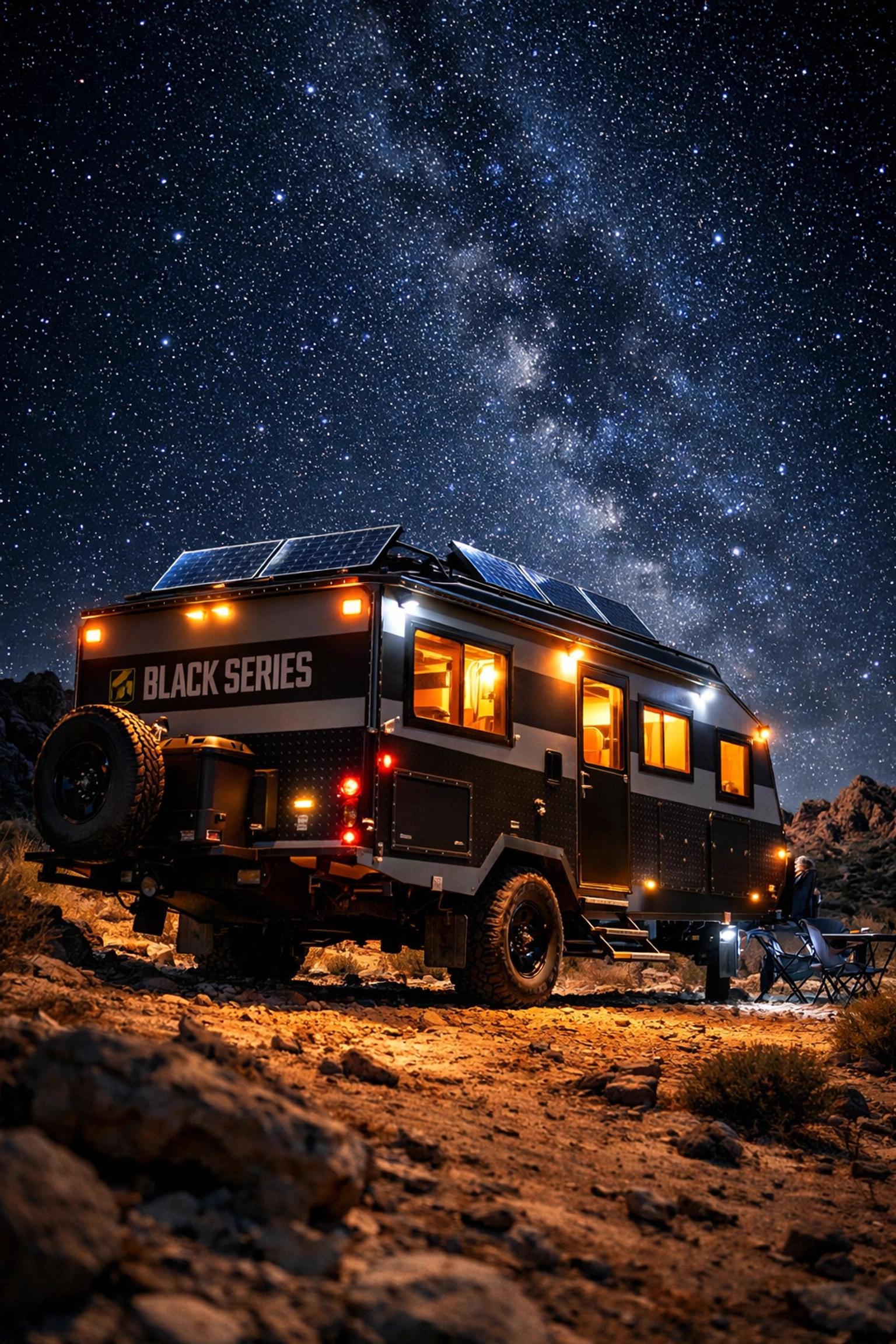
Lithium vs. Lead-Acid: The BlackSeries Advantage
BlackSeries trailers prioritize high-capacity Lithium (LiFePO4) systems because they handle deep discharges better than lead-acid. Here’s why this matters for long trips:
Weight Considerations: This is huge. A lithium battery bank weighs roughly 60% less than an equivalent lead-acid setup. When you’re towing a 16 ft camper weight rig that’s already optimized for off-road performance, saving 100-150 pounds on batteries means more payload for gear, food, and water. Compare this to a massive 30 foot rv weight trailer where a heavy lead-acid bank doesn’t impact handling as dramatically: but you still sacrifice valuable cargo capacity.
Usable Capacity: Lead-acid batteries should never discharge below 50% to avoid damage. A 200Ah lead-acid bank gives you only 100Ah of usable power. Lithium batteries can safely discharge to 80-90%, meaning that same 200Ah lithium bank delivers 160-180Ah of usable capacity. That’s nearly double the effective power from the same rated capacity.
Charge Speed: Lithium batteries accept charge 4-5 times faster than lead-acid. When you’re running solar panels on your roof or charging from your vehicle’s alternator while driving, this speed advantage means you’re back to 100% capacity much quicker.
Lifespan: Lead-acid batteries typically last 500-1,000 charge cycles (2-3 years of regular use). LiFePO4 batteries deliver 4,000-15,000 cycles: that’s a potential 10-15 year lifespan. The upfront cost is higher, but the long-term value is undeniable.
Temperature Tolerance: While both battery types struggle in extreme temperatures, lithium batteries have built-in Battery Management Systems (BMS) that protect against thermal damage. They also self-discharge at only 1-3% monthly compared to 10-15% for flooded lead-acid batteries.
For a 18 ft camper weight or 24 ft camper weight BlackSeries rig designed for extended backcountry trips, lithium isn’t just better: it’s essential. The average travel trailer weights can be deceptive; what matters is the usable payload after you account for water, propane, gear, and batteries. Going lithium gives you back hundreds of pounds of capacity.
Best Practices for Battery Charging and Monitoring
Let’s get into the practical stuff: how to keep your batteries healthy during long trips.
Pre-Trip Voltage Check
Before you leave civilization, grab a digital multimeter and check your baseline voltage:
- Fully charged lithium (LiFePO4): 13.3-13.6 volts
- Fully charged lead-acid: 13.6-14.4 volts
If you’re below these numbers before you even start your trip, you’re already behind the curve. Charge fully before departure.
The Three-Stage Charging Process
Modern charging systems (which BlackSeries trailers have as standard) use a three-stage approach:
- Bulk Charge (0-90%): Maximum current flows to rapidly charge the battery. This is where solar panels or your alternator do most of their work.
- Absorption Charge (90-100%): Current gradually decreases as voltage plateaus. This “tops off” the battery safely without overcharging.
- Float Charge (Maintenance): A low-voltage trickle maintains 100% capacity without cooking the battery. Essential for long-term storage or when you’re plugged into shore power.
Your smart charger handles this automatically, but understanding the process helps you troubleshoot issues.
Monitor Your State of Charge (SOC)
The Golden Rule: Never let your battery drop below 50% SOC for lead-acid, or 20% SOC for lithium.
For lead-acid systems, discharging below 50% causes sulfation: microscopic crystals that permanently reduce capacity. For lithium, deep discharges below 20% stress the cells and reduce cycle life.
BlackSeries trailers come with built-in battery monitors that show real-time voltage, current draw, and remaining capacity. Check this display daily during long trips. If you see your voltage dropping below 12.7V (50% SOC for lead-acid) or 13.0V (20% SOC for lithium), it’s time to charge: immediately.
Solar Charging on the Move
Most BlackSeries off-road travel trailers come solar-ready with roof-mounted panels and integrated charge controllers. Here’s how to maximize solar during travel:
- Park Smart: When you stop for lunch or overnight, position your trailer to maximize sun exposure on your panels. A 30-degree angle adjustment can increase charging by 25-40%.
- Clean Your Panels: Dust, dirt, and bird droppings can reduce solar efficiency by 20-30%. Wipe them down weekly during dusty backcountry trips.
- Understand Your Limits: A typical 400W solar array on a 30 ft camper weight BlackSeries trailer generates 25-30Ah per hour in perfect conditions. That’s 150-180Ah on a sunny day: enough to run your fridge, lights, and water pump indefinitely if you’re conservative with high-draw appliances.
Alternator Charging While Driving
Your tow vehicle’s alternator can also charge your trailer’s batteries while driving, but you need a DC-DC charger or battery isolator to do it safely. BlackSeries HQ models include this integration standard.
The advantage? If you’re covering ground in a 16 ft camper weight rig, every hour of driving adds 30-50Ah of charge. Over a 6-hour travel day, that’s 180-300Ah: often enough to fully recharge from a night’s use.

Cold Weather Battery Care: Winter-Proofing Your Power
Batteries hate the cold. Here’s how to protect them when temperatures drop.
Understanding Cold Weather Performance
When temperatures fall below freezing, several things happen:
- Capacity Drops: A lead-acid battery at 0°F has only 50% of its rated capacity. Lithium batteries fare better but still lose 10-20% capacity in extreme cold.
- Charging Efficiency Plummets: Cold batteries resist accepting charge. Your solar panels might generate power, but the battery can’t absorb it efficiently.
- Freezing Risk: A fully discharged lead-acid battery can freeze solid at 32°F, causing permanent damage. A fully charged lead-acid battery won’t freeze until -70°F.
BlackSeries’ Winter Advantage
BlackSeries trailers position batteries inside the insulated cabin space, not in exterior compartments. This single design choice makes a massive difference in freezing conditions.
When exterior-mounted batteries hit 10°F on a cold Wyoming morning, your interior-mounted BlackSeries batteries might still be at 40-50°F thanks to residual cabin heat and insulation. That’s the difference between “working perfectly” and “completely dead.”
Winter Maintenance Tips
Keep Batteries Charged: A fully charged battery is a protected battery. Aim for 80-100% SOC at all times during winter camping.
Use Battery Blankets: If you’re winter camping in a non-BlackSeries rig with exterior battery boxes, invest in battery heating blankets. These 12V or 120V wraps keep batteries above freezing.
Monitor Temperature: Many advanced BMS systems (standard in BlackSeries lithium setups) include temperature sensors. If your battery temperature drops below 32°F, the BMS will automatically prevent charging to avoid lithium plating damage.
Winterize When Storing: If you’re storing your trailer through winter, disconnect the batteries and bring them indoors. Store lithium batteries at 50-60% charge in a temperature-controlled space. Lead-acid batteries should be stored fully charged and recharged monthly.
Troubleshooting Common Battery Issues
Even with perfect maintenance, issues can arise. Here’s how to diagnose and fix them.
Problem: Battery Not Charging
Symptoms: Battery voltage stays flat despite being connected to solar, shore power, or alternator charging.
Diagnosis Steps:
- Check the obvious: Is your charge controller actually turned on? Is the solar disconnect switch engaged?
- Use a multimeter to test voltage at the charge controller output. If you’re getting 14V+ at the controller but nothing at the battery, you have a wiring issue.
- Inspect for blown fuses or tripped circuit breakers in your charging circuits.
- For lithium systems, check if the BMS has shut down charging due to temperature extremes or overvoltage protection.
Fix: 90% of “not charging” issues are connection problems: corroded terminals, loose wires, or tripped breakers. Clean all connections with a wire brush and baking soda solution, tighten everything down, and reset your circuit breakers.
Problem: Phantom Drains
Symptoms: Battery drains overnight even when “everything is turned off.”
Common Culprits:
- CO/propane detectors (draw 0.5-1A continuous)
- Stereo systems with memory functions (0.1-0.3A)
- Inverters left in standby mode (1-3A)
- Battery monitors themselves (0.1-0.2A)
Fix: Install a battery disconnect switch (standard on BlackSeries trailers) and use it whenever you leave the rig for more than a few hours. Before bed, check your battery monitor to see real-time amperage draw. Anything over 1-2A with “everything off” indicates a phantom drain that needs investigation.
Problem: Reduced Runtime
Symptoms: Your battery used to last 2-3 days between charges; now it barely makes it one night.
Diagnosis: This usually indicates battery degradation. For lead-acid batteries older than 3 years, it’s probably time for replacement. For lithium batteries, check your BMS for error codes: cell imbalance or thermal stress can reduce effective capacity.
Prevention: Avoid deep discharges, keep batteries at moderate temperatures, and maintain proper charge levels. BlackSeries’ integrated solar and smart charging systems help prevent the charge/discharge abuse that kills batteries prematurely.
Energy Conservation: Making Every Amp-Hour Count
The best battery maintenance is reducing how much you need in the first place. Here’s how to stretch your power during long trips:
LED Everything
BlackSeries trailers come standard with LED lighting throughout, but if you’ve added aftermarket lights or accessories, make sure they’re LED. A traditional 12V incandescent bulb draws 1.5-2A; an equivalent LED draws 0.1-0.2A: a 90% reduction.
Efficient Appliances
Your fridge is typically your biggest power draw, consuming 30-60Ah daily depending on model and outside temperature. BlackSeries includes high-efficiency compressor refrigerators that use 40-50% less power than traditional RV fridges.
Other power-hungry culprits:
- Water pump: 4-5A while running (use it sparingly)
- Furnace fan: 3-7A depending on speed
- Microwave: 100-150A from inverter (massive draw: use propane stove instead when off-grid)
- Air conditioning: 120-150A from inverter (only viable with massive battery banks or generator backup)
Smart Usage Patterns
During extended trips in your 24 ft camper weight or 30-foot camper weight rig, adopt these habits:
- Morning charging: Use your solar’s peak production hours (10am-3pm) to run high-draw appliances and recharge batteries simultaneously
- Evening conservation: After sunset, minimize lighting and avoid running pumps or fans unnecessarily
- Weather watching: Cloudy days mean reduced solar input: adjust consumption accordingly
Real-World Battery Capacity: What Can You Actually Run?
Let’s talk numbers. If you have a 300Ah lithium bank (standard on many BlackSeries HQ models), here’s your realistic runtime:
Conservative Use (50Ah/day):
- LED lights as needed
- Fridge running 24/7
- Water pump for normal use
- Phone/device charging
- Runtime: 5-6 days off-grid with zero recharging
Moderate Use (100Ah/day):
- All of the above plus:
- Furnace fan occasionally
- Stereo system
- Laptop use
- Runtime: 2-3 days off-grid, or indefinite with 200W+ solar
Heavy Use (200Ah/day):
- All of the above plus:
- Frequent water pump use
- Inverter loads (power tools, hair dryer)
- Multiple devices charging
- Runtime: 1 day off-grid, requires aggressive solar or generator charging
The average weight of camper considerations here matter because larger trailers (like a 30 ft rv weight rig) have more roof space for solar panels, potentially offsetting their higher power consumption from larger fridges and more interior lights.
Frequently Asked Questions
How can I tell if my RV battery is healthy for a long trip?
Use a multimeter to check resting voltage after the battery has been disconnected from all loads for 3+ hours. For lithium batteries, 13.3V+ indicates good health and full charge. For lead-acid, you want 12.6V or higher. Additionally, check for physical damage: bulging cases, leaking, or corroded terminals all indicate replacement is needed. If your battery is over 3 years old (lead-acid) or has completed 2,000+ cycles (lithium), consider replacement before a major trip.
How often should I check my RV battery during extended travel?
Check your battery monitor daily, especially in the morning before solar charging begins. This shows your actual overnight consumption and helps you adjust usage patterns. Physically inspect battery terminals weekly for corrosion or loose connections. If you’re experiencing extreme temperatures (below 20°F or above 100°F), check twice daily as these conditions accelerate degradation.
Can solar panels charge my RV battery during long road trips?
Absolutely: in fact, this is one of the biggest advantages of integrated solar systems on BlackSeries trailers. Your panels continue generating power while you’re driving, working alongside your alternator charging system. A 400W solar array can add 20-30Ah during a 6-hour drive under good conditions, significantly extending your off-grid capability. The key is having a quality charge controller that can manage simultaneous solar and alternator inputs without overcharging.
How can I protect my RV battery in extremely hot or cold conditions?
For extreme heat (100°F+), ensure batteries have adequate ventilation and aren’t exposed to direct sunlight. Park in shade when possible and consider adding ventilation fans to battery compartments. Avoid charging batteries when they’re very hot: let them cool first. For extreme cold (below 20°F), BlackSeries’ interior battery placement provides natural insulation. For exterior batteries, use heating blankets and maintain a high state of charge (80-100%). Lithium batteries with BMS protection will automatically prevent charging below 32°F to avoid damage.
Conclusion: Power Equals Freedom
Battery maintenance isn’t sexy, but it’s what separates memorable adventures from expensive rescues. For BlackSeries owners heading off-grid in 2026, your lithium power system is already light-years ahead of conventional RV setups: but it still needs attention.
The good news? Modern battery technology is incredibly forgiving. Lithium systems handle abuse far better than the lead-acid batteries of yesterday. With basic monitoring, smart charging habits, and an understanding of how temperature affects performance, your power system should deliver years of reliable service.
Remember: whether you’re piloting a nimble 16 ft camper weight rig through tight forest trails or commanding a spacious 30 ft camper weight expedition trailer across the desert, your battery bank is what makes off-grid camping possible. Treat it well, and it’ll keep the lights on, the fridge cold, and your adventures running smoothly for years to come.
Ready to upgrade your off-grid experience with BlackSeries’ integrated lithium systems? Explore our current models and see how we’ve engineered power independence into every trailer we build. Your next adventure is waiting: and now you know how to keep the lights on when you get there.

