RV towing requires the right vehicle, proper setup, and safe driving practices to prevent accidents, equipment damage, and legal issues. Whether you’re planning your first adventure or upgrading to a larger trailer, understanding towing fundamentals protects your investment and keeps everyone safe on the road.
What Is RV Towing?
RV towing means pulling a recreational vehicle behind your truck or SUV using a hitch system. This includes travel trailers (single-axle or tandem-axle units hitched to your vehicle’s rear bumper), fifth wheels (larger RVs that connect over your truck bed using a special hitch), and off-road trailers (rugged units designed for rough terrain and boondocking).
The biggest misconception among new RVers? Towing isn’t just driving with extra weight behind you. Your vehicle’s handling, braking, acceleration, and fuel consumption change dramatically. Wind affects steering more, stopping distances increase by 40-60%, and backing up requires completely different techniques than parking a regular vehicle.
Unlike van life (where you live inside your vehicle) or car camping (using tents), RV towing gives you the flexibility to unhitch and explore while keeping your “home base” stationary at camp.
Is Your Vehicle Capable of Towing an RV?
Tow rating is your vehicle’s maximum pulling capacity, but this number assumes perfect conditions. Payload capacity measures how much weight your truck can carry, including passengers, gear, and the trailer’s tongue weight pressing down on your hitch.
Here’s what each rating means:
- GVWR (Gross Vehicle Weight Rating): Maximum total weight your vehicle can handle
- GCWR (Gross Combined Weight Rating): Maximum weight of vehicle + trailer combined
- Payload: Weight your truck can carry in its bed and cabin
- Towing Capacity: Maximum trailer weight your vehicle can pull
The critical mistake: Assuming “it can move the trailer” equals “safe to tow.” A truck might pull an overweight trailer up your driveway, but struggle dangerously on mountain grades or emergency stops.
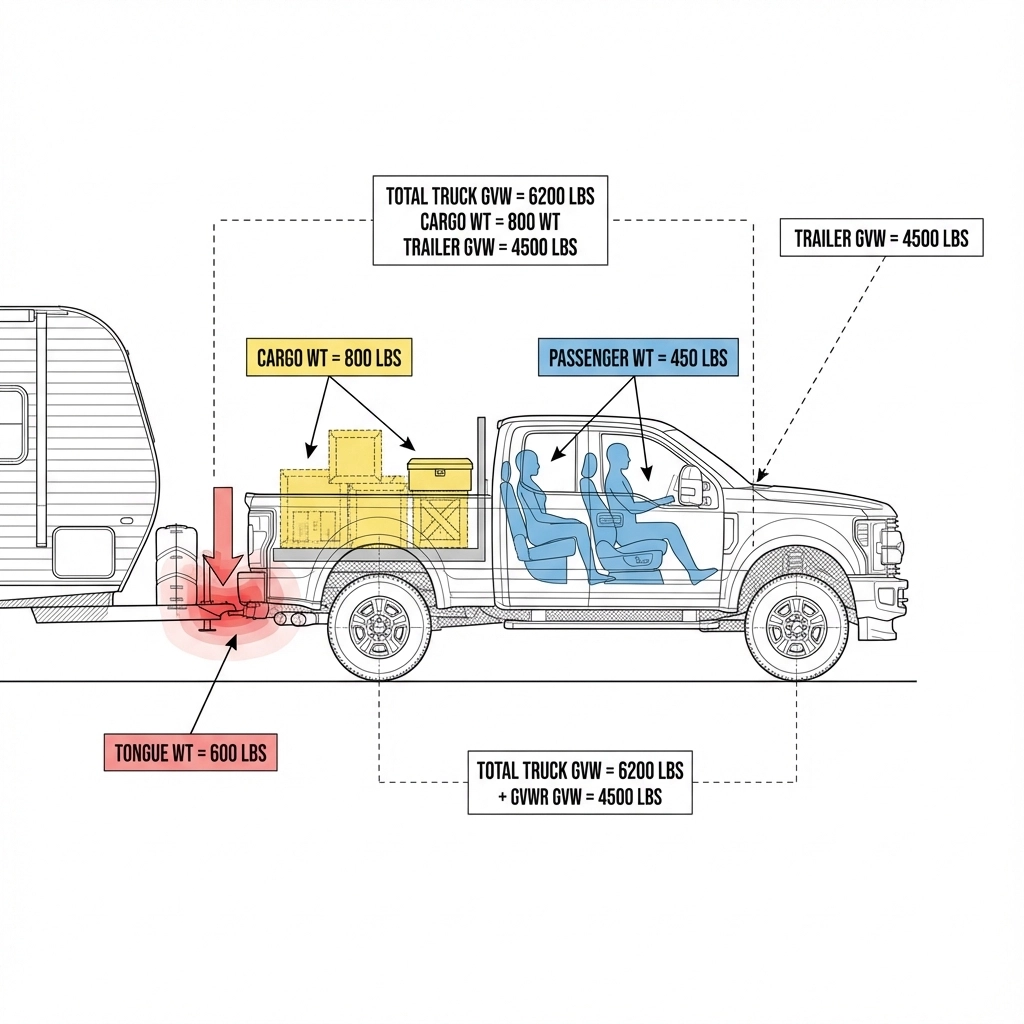
Real-world example: A half-ton pickup with 11,000 lbs towing capacity seems perfect for a 9,000 lb travel trailer. But add passengers (400 lbs), gear (300 lbs), and the trailer’s tongue weight (900 lbs), and you’ve exceeded the truck’s payload capacity by 600 lbs, making it unsafe despite being under the towing limit.
RV Towing Checklist (Before Every Trip)
Print this checklist and keep it in your glove box:
Hitch & Coupler
- Hitch ball matches trailer coupler size
- Ball is properly torqued and locked
- Coupler latches completely over ball
- Hitch pin inserted and secured
Safety Chains & Breakaway Cable
- Safety chains crossed under trailer tongue
- Chains attached to vehicle frame (not bumper)
- Breakaway cable connected to vehicle
- Breakaway battery charged and functional
Trailer Brakes & Controller
- Electric brake controller set correctly
- Test trailer brakes at 25 mph before highway speeds
- Manual brake override working
Tires & Load
- All tires (vehicle + trailer) at proper pressure
- No visible tire damage or irregular wear
- Spare tires accessible and inflated
- Weight distributed properly in trailer
Lights & Signals
- Brake lights, turn signals, hazards functional
- Running lights and license plate light working
- Check from outside vehicle before departing
How to Tow an RV: Step-by-Step
Step 1: Connect the Trailer
Back your vehicle until the hitch ball sits directly under the trailer coupler. Lower the trailer onto the ball, ensuring the coupler fully engages. Lock the coupler lever and insert the hitch pin.
Step 2: Attach Safety Systems
Cross safety chains under the trailer tongue and hook to your vehicle’s frame. Connect the breakaway cable to a different attachment point than the chains. Plug in the electrical connector.
Step 3: Adjust Brake Controller
Set your brake controller based on trailer weight. Start with manufacturer recommendations, then fine-tune during your first few stops. The trailer should brake firmly but not lock up.
Step 4: Pre-Drive Test
At 15 mph in an empty parking lot, test your turn signals, brake lights, and trailer brakes. Practice backing up and turning before hitting the road.
Step 5: Highway Driving
Accelerate gradually, maintain 60-65 mph maximum speed, and leave extra following distance. Use your trailer brakes in conjunction with vehicle brakes when slowing down.
RV Towing for Beginners
The 5 things first-time towers must know:
- Your mirrors aren’t big enough anymore. Invest in towing mirrors that let you see past your trailer’s sides.
- Backing up is opposite everything you know. Turn the steering wheel in the opposite direction you want the trailer to go, then correct as it responds.
- Hills change everything. Your vehicle will work much harder on grades. Downshift before steep climbs and use trailer brakes on descents.
- Wind hits differently. Crosswinds from passing trucks or weather will push your trailer. Slow down and grip the wheel firmly.
- Plan your route. Avoid low bridges, narrow roads, and restricted areas. Apps like RV Trip Wizard help plan trailer-safe routes.
Practice scenarios for new towers:
- Empty parking lot backing and turning
- Local roads with light traffic
- Highway on-ramps and lane changes
- Gas station navigation (longer rigs need truck stops)

RV Towing Safety Tips
Speed management saves lives. Never exceed 65 mph when towing, regardless of speed limits. Higher speeds exponentially increase stopping distances and make sway corrections nearly impossible.
Master downhill technique. Shift to a lower gear before steep descents. Use your trailer brake controller to slow down gradually instead of riding your vehicle’s brakes, which can overheat and fail.
Handle crosswinds properly. When a large truck passes or strong winds hit, don’t overcorrect. Ease off the accelerator slightly, maintain your lane position, and let the trailer settle naturally.
Why stability matters most: A stable, well-designed trailer tows predictably even in challenging conditions. This is where trailer engineering makes the difference between white-knuckle drives and confident adventures.
Common RV Towing Mistakes to Avoid
Overloading destroys everything. Exceeding your vehicle’s payload or towing capacity causes premature transmission failure, brake system damage, and dangerous handling. Weigh your loaded rig at a truck stop before your first trip.
Wrong hitch selection creates problems. A weight-distribution hitch is essential for trailers over 5,000 lbs and any trailer that makes your vehicle’s front end feel light. Don’t rely on a basic ball mount for heavy loads.
Ignoring trailer brakes is dangerous. Electric trailer brakes need regular adjustment and maintenance. Test them before every trip and have them serviced annually by a qualified technician.
Underestimating off-road towing risks. Dirt roads, steep grades, and uneven terrain demand different techniques than highway towing. Off-road trailers require specific approach angles, ground clearance, and suspension systems.
Why Trailer Design Matters for Safe Towing
Center of gravity determines stability. A trailer with a low center of gravity and proper weight distribution naturally resists sway and handles crosswinds better. This is why off-road trailer manufacturers like BlackSeries engineer their units with heavy components (water tanks, batteries) mounted low in the chassis.
Chassis strength affects longevity. Highway travel trailers work fine for campground-to-campground travel, but off-road adventures demand reinforced frames, heavy-duty suspension, and ruggedized components. The difference becomes obvious on washboard roads or when navigating tight mountain switchbacks.
Design beats horsepower for real-world towing. A well-engineered 6,000 lb trailer tows more safely than a poorly designed 4,000 lb unit. Independent suspension, proper axle placement, and aerodynamic design matter more than your truck’s power output for daily driving comfort and long-term reliability.
FAQ
How fast should you tow an RV?
Never exceed 65 mph when towing, even if speed limits allow higher speeds. Most tire manufacturers void warranties for trailer tires used over 65 mph, and insurance claims may be denied for speed-related accidents.
Can beginners tow an RV safely?
Yes, with proper preparation and practice. Start with a smaller, lighter trailer to learn basic techniques before upgrading. Take a towing safety course if available in your area.
Do I need a weight distribution hitch?
For any travel trailer over 5,000 lbs or any trailer that makes your vehicle’s steering feel light, yes. Weight distribution hitches transfer some tongue weight to the trailer’s axles and your vehicle’s front wheels.
Is towing different for off-road trailers?
Off-road trailers typically have better ground clearance and more durable components, but they may also be heavier and have different weight distributions than highway trailers. Check your specific model’s towing requirements.
What is the most common RV towing accident?
Trailer sway leading to loss of control, often caused by improper loading, excessive speed, or inadequate hitch systems. This is entirely preventable with proper setup and driving techniques.

