Boondocking, the art of camping without hookups, is the ultimate test of freedom. For those who want to escape the crowded RV parks and find solitude in the wild, it’s the only way to travel. No reservations. No fees. No neighbors blasting their generator at 6 AM. Just you, your rig, and miles of untouched wilderness.
But here’s the thing: not every travel trailer is built for it. Most rigs are designed for campgrounds with electrical hookups, water spigots, and level concrete pads. Take them off-grid, and they’ll leave you stranded with a dead battery and an empty water tank by day two.
BlackSeries rigs aren’t just “boondocking-ready”, they’re built to thrive where others get stuck. From the compact 16 ft camper weight of the HQ12 to the spacious luxury of the HQ19 and HQ21, every model is engineered for off-grid endurance, rugged terrain, and long-haul adventures far beyond the pavement.
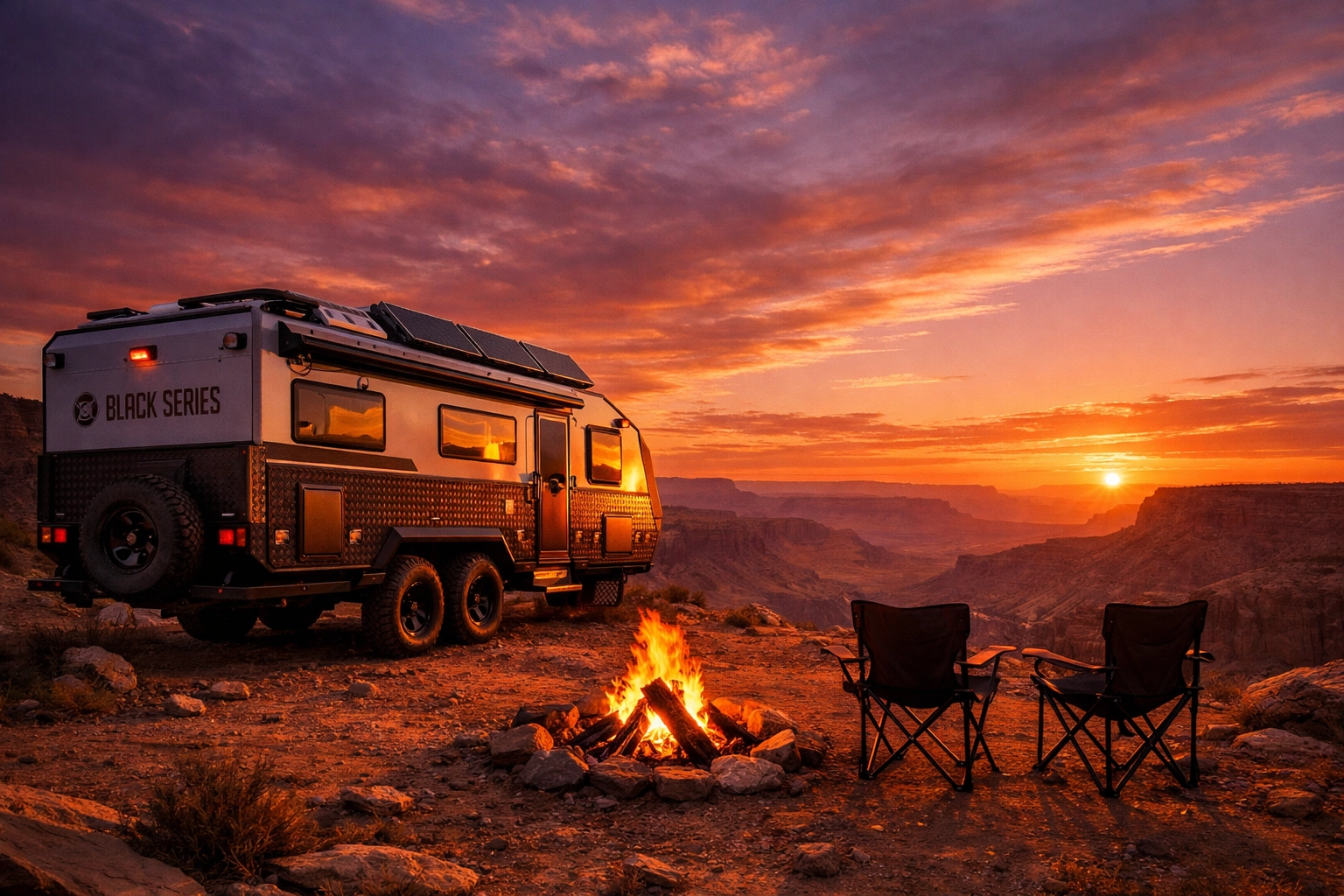
What is Boondocking?
Boondocking means camping on public lands, Bureau of Land Management (BLM) areas, National Forests, and dispersed camping zones, without water, power, or sewer connections. It’s sometimes called “dry camping” or “wild camping,” and it’s completely free (with some 14-day stay limits depending on location).
The Benefits:
- Zero Cost: No nightly campground fees means you can stretch your travel budget indefinitely.
- Total Privacy: You’re not sandwiched between two motorhomes with barking dogs and loud music.
- Epic Views: The best campsites aren’t in RV parks, they’re on ridge lines, next to alpine lakes, and deep in canyon country.
The Challenges:
- Resource Management: You’re responsible for your own power, water, and waste disposal.
- Terrain Navigation: Getting to remote spots often requires traversing rocky, muddy, or steep roads that will destroy a standard trailer’s undercarriage.
- Self-Sufficiency: If something breaks, you’re fixing it yourself, there’s no campground host to call.
But for those who crave adventure over convenience, boondocking isn’t a compromise. It’s the entire point.
Why Choose BlackSeries for Boondocking?
Most travel trailers are designed for paved campgrounds and weekend trips to state parks. BlackSeries rigs are built for the places those trailers can’t reach.
4-Season Capability
Our insulation isn’t just for looks, it’s engineered to handle desert heat and mountain snow. Whether you’re boondocking in the scorching Arizona desert in July or chasing powder in the Colorado Rockies in January, a BlackSeries maintains livable interior temps without draining your battery on climate control.
Independent Suspension
This is the difference-maker. Most travel trailers use basic torsion axles that bottom out on washboard roads and rocky trails. BlackSeries trailers feature independent suspension systems that absorb impacts, protect your gear, and give you access to campsites that would snap the frame of a conventional rig.
If the road looks sketchy, your BlackSeries says, “Let’s go.”
Reinforced Chassis and Armor
Our trailers are built with reinforced steel chassis and diamond-plate armor on vulnerable areas like the underbelly and wheel wells. This isn’t overkill, it’s essential when you’re dragging a 30 foot rv weight rig down a two-track forest road littered with rocks and roots.

The Models: HQ12, HQ19, and HQ21
- HQ12: Nimble and lightweight, the HQ12 is perfect for solo travelers and couples who want maximum maneuverability. Its compact 16 ft camper weight makes it towable by most mid-size trucks and SUVs, and it fits into tight spots that larger rigs can’t access. Learn more about choosing the right off-road camper.
- HQ19: The sweet spot for families and extended trips. It offers luxury amenities, spacious sleeping arrangements, and serious off-grid capability without sacrificing comfort. At approximately 24 ft camper weight, it’s still manageable for most 3/4-ton trucks.
- HQ21: For those who want it all, maximum living space, full kitchen, bathroom, and enough solar and water capacity to stay off-grid for weeks. Yes, the 30 ft camper weight demands a capable tow vehicle, but the payoff is a mobile basecamp that goes anywhere.
Essential Gear for Travel Trailer Boondocking
Solar Power Setup
This is non-negotiable. Without solar, you’re running a generator constantly or driving into town every few days to recharge. BlackSeries trailers come standard with roof-mounted solar panels and integrated lithium battery systems that generate and store enough power to run lights, charge devices, and power your fridge indefinitely.
What You Need:
- At least 400 watts of solar panel capacity
- 200+ amp-hours of lithium battery storage
- A robust inverter (1,500W minimum) to handle high-draw appliances
BlackSeries rigs come solar-ready out of the factory, so you’re not cobbling together aftermarket solutions.
Water Storage and Filtration
The average travel trailer weights often reflect skimpy water tanks: 20 gallons of fresh water won’t last a weekend if you’re showering and cooking. BlackSeries trailers feature oversized freshwater tanks (40–50 gallons) and corresponding gray/black tank capacity, giving you 5–7 days of off-grid autonomy.
Pro Tip: Bring a portable water filtration system for refilling from streams or lakes. It’s not drinking water until you filter it, but it extends your boondocking window significantly.
Waste Management
Most boondockers empty their tanks every 5–7 days. If you want to stay out longer, consider a composting toilet or carry extra portable waste tanks. BlackSeries layouts maximize tank capacity without adding unnecessary 30 ft rv weight that kills your fuel economy.
Navigation and Communication
Off-grid doesn’t mean off-map. Download offline maps using apps like Gaia GPS or onX Offroad before you leave cell service. A satellite communicator (Garmin inReach, SPOT) is essential for emergencies: if your axle breaks on a remote forest road, you’re not walking 20 miles to find help.
Boondocking Checklist for USA (Step-by-Step)
Pre-Trip Planning
- Identify Legal Boondocking Sites: BLM and National Forest lands allow dispersed camping (usually 14-day limits). Apps like FreeRoam and Campendium show verified free sites with user reviews.
- Check Road Conditions: Some forest roads are impassable after rain or snow. Call the local ranger station before you commit.
- Understand Permits and Regulations: Most dispersed camping is free, but some areas require permits or restrict campfires during dry seasons.
Trailer Preparation
Before you leave pavement, inspect everything:
- Tires: Check pressure and tread. Underinflated tires on rough terrain = blowouts.
- Suspension: Look for leaks, cracks, or loose bolts.
- Seals and Roof: Water intrusion ruins trips fast. A 10-minute inspection now saves a $3,000 repair later.
- Weight Distribution: Understanding your rig’s average weight of camper plus loaded cargo helps you avoid overloading your truck’s payload capacity. A 30-foot camper weight fully loaded can easily exceed 8,000 lbs: know your limits.
Protect your investment with comprehensive coverage.
Packing Essentials
- Fire extinguisher and first-aid kit
- Recovery boards (MaxTrax or similar) for muddy/sandy situations
- Spare tire, lug wrench, and jack rated for your trailer’s weight
- Basic tools: wrenches, screwdrivers, duct tape, zip ties
- Leveling blocks: even off-grid, your fridge needs to be level
Sustainable Practices
Leave No Trace isn’t just a slogan: it’s how we keep these places open for future campers. Pack out all trash, use existing fire rings, and scatter your gray water (dish soap should be biodegradable). Respect wildlife and don’t camp within 200 feet of water sources.
Common Boondocking Problems and How to Avoid Them
Battery Drainage
The Problem: Running your heater, charging laptops, and keeping the fridge cold drains batteries fast: especially on cloudy days when solar input is weak.
The BlackSeries Solution: Our lithium battery banks hold more charge and recharge faster than traditional lead-acid setups. Coupled with high-efficiency appliances, you can run indefinitely on solar alone.
Water Shortages
The Problem: A family of four can blow through 30 gallons in two days if they’re not careful.
The BlackSeries Solution: Larger freshwater tanks (40–50 gallons) give you breathing room. Combine that with water-saving habits: navy showers, reusable dishes: and you’ll easily hit a week between refills.
Weight Management and Fuel Economy
The Problem: Hauling a fully loaded 30 ft rv weight trailer through mountain passes destroys your fuel economy and strains your truck.
The BlackSeries Solution: Our trailers use lightweight yet durable materials: aluminum framing, composite panels: to minimize weight without sacrificing strength. Even our largest models stay within the towing capacity of most 3/4-ton and 1-ton trucks. Master the art of remote exploration with proper weight distribution.
GPS and Navigation Issues
The Problem: Cell service dies 10 miles before you reach your campsite, and Google Maps is useless.
The BlackSeries Solution: This one’s on you: download offline maps before you leave. But our independent suspension means you can take the “road less traveled” without worrying about trail damage.
Frequently Asked Questions (FAQ)
How do I ensure my travel trailer is ready for boondocking?
Start with a full system check: tires, brakes, suspension, roof seals, and battery health. Make sure your solar panels are clean and your water tanks are sanitized. Test all appliances before you leave: discovering your fridge doesn’t work at mile 300 is a bad time.
What are the best boondocking locations in the USA for beginners?
Utah and Arizona have some of the most accessible BLM land with stunning views. Try areas around Moab, Sedona, or Quartzsite for first-timers. National Forests in Colorado, Montana, and Oregon also offer incredible dispersed camping with well-marked forest roads.
How much water and power do I need for a week of boondocking?
Plan for 40–50 gallons of fresh water minimum (more if you’re showering daily). For power, 200 amp-hours of lithium battery plus 400+ watts of solar will keep you running indefinitely in sunny conditions. Cloudy weather? You’ll need to conserve or add more solar capacity.
Can I boondock with a smaller trailer like the HQ12?
Absolutely. The HQ12’s compact 16 ft camper weight makes it perfect for nimble off-road access, and its solar/battery setup rivals larger rigs. You’ll sacrifice some living space, but you gain the ability to camp in spots that bigger trailers can’t reach.
What’s the difference between the 18 ft camper weight and 24 ft camper weight models for boondocking?
The 18 ft camper weight models (like the HQ12 and HQ15) are lighter, more maneuverable, and easier on fuel economy: ideal for solo travelers or couples. The 24 ft camper weight rigs (HQ19) offer more living space, larger tanks, and better amenities for families or longer trips. Both are equally capable off-road.
Conclusion
Boondocking with a travel trailer isn’t about roughing it: it’s about redefining what comfort looks like when you’re 50 miles from the nearest paved road. With the right rig, proper preparation, and a sense of adventure, you’ll discover campsites that most people only see in photos.
BlackSeries trailers are built for this. Whether you’re towing a nimble 16 ft camper weight HQ12 or a spacious 30 ft rv weight HQ21, you’re driving a machine designed to take you further, stay out longer, and handle terrain that would leave other trailers broken on the side of the road.
Ready to go off-grid? Explore the full BlackSeries lineup at blackseries.net and start planning your next adventure. The wilderness is waiting; and it doesn’t have hookups.

