When you’re shopping for an off-road RV in America, you’re not just buying a camper, you’re choosing a lifestyle. The Black Series RV lineup isn’t a one-size-fits-all catalog. It’s a carefully engineered family of adventure vehicles, each designed to tackle different terrain, tow behind different trucks, and support different levels of off-grid exploration. Whether you’re a weekend warrior looking to escape the pavement or a full-time overlander planning to chase BLM land across the Southwest, there’s a Black Series rig built for your specific mission.
What Is the Black Series RV Lineup?
In the US market, an “RV lineup” refers to a manufacturer’s complete family of recreational vehicles, spanning different sizes, layouts, and capability levels. Most RV brands focus on highway comfort and campground compatibility. Black Series takes a different approach: every model in our lineup is engineered first for the dirt, then optimized for the road.
The term “off-road travel trailer” can mean different things depending on who you ask. Some manufacturers slap knobby tires on a standard rig and call it overlanding-ready. Black Series builds from the ground up with armored chassis, independent suspension systems, and genuine off-grid capability. Whether you’re looking at our compact 13-foot models or our flagship 22-foot trailers, the DNA is the same: hot-dipped galvanized steel frames, quad-shock suspension, and real-world durability tested across Australian Outback conditions before they ever touch American soil.
The relationship between our “RVs,” “travel trailers,” and “off-road campers” is straightforward. They’re all built on the same reinforced platform, the difference lies in size, interior layout, and how much luxury you want when you’re 50 miles from the nearest paved road. A Black Series pop-up tent camper shares the same rugged chassis philosophy as our full-size travel trailers; it just packs down smaller and weighs less for tighter trail access.
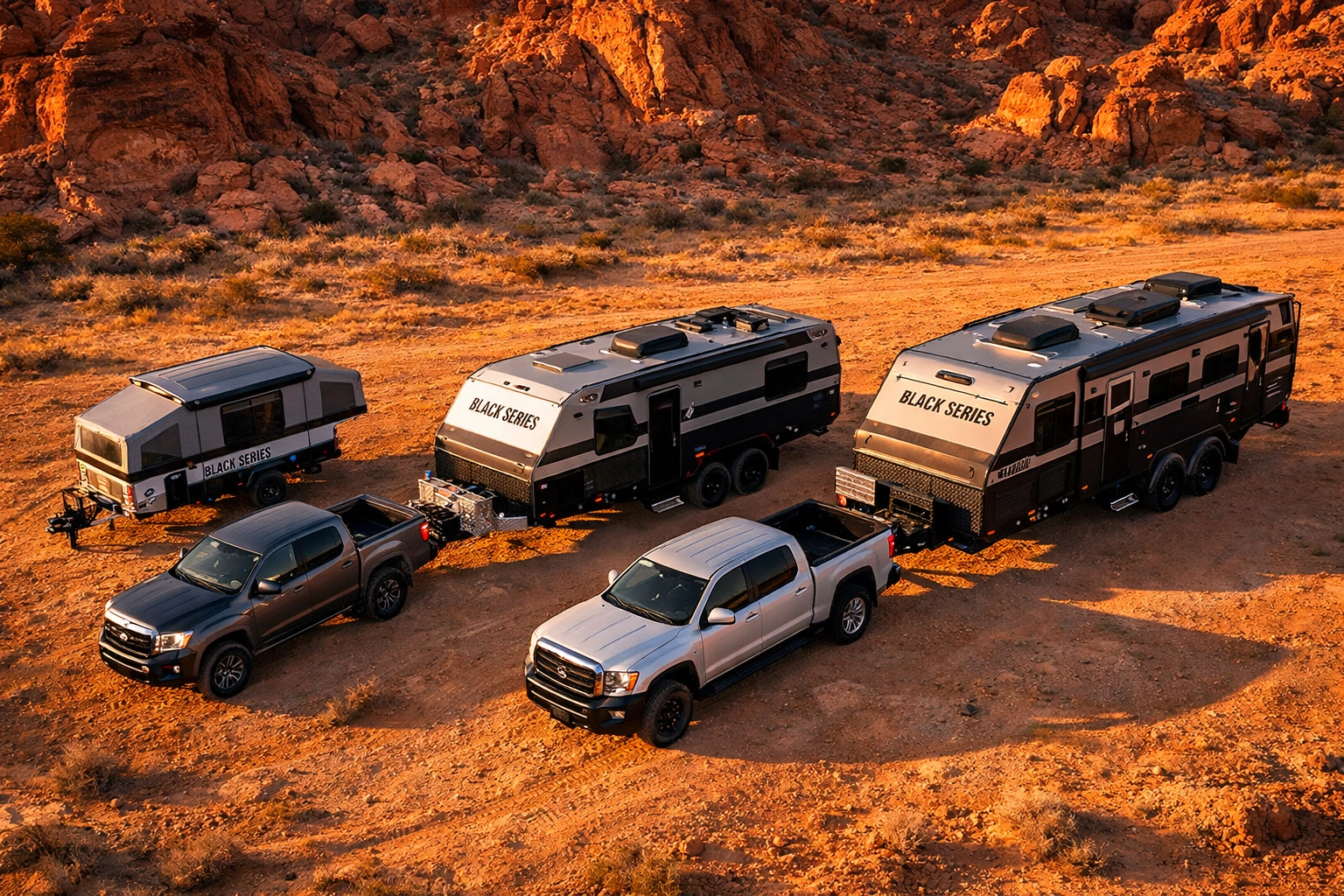
Overview of Black Series RV Models in the USA
Our lineup breaks down into two primary categories: pop-up tent campers and hard-sided travel trailers. Each serves a distinct purpose in the overlanding ecosystem.
Pop-Up Tent Campers
These are the nimble, low-profile rigs built for maximum terrain access. When you’re navigating forest trails with overhanging branches or squeezing through tight switchbacks in the Rockies, a pop-up keeps your vertical clearance manageable. Our pop-up family includes:
- Dominator – The entry-level option, sleeping four people with an outdoor kitchen and shower setup
- Patron – Mid-range choice sleeping five, featuring two onboard batteries, portable toilet, and integrated boat racks
- Classic Double – Premium option accommodating six people with expanded storage
- Sergeant and Alpha – Specialized models at 15′ (2,200 lbs) and 17′ (2,400 lbs) respectively
All pop-ups feature compartmentalized storage, solar charging capability, mesh windows with skylights, and LED lighting throughout. The 16 ft camper weight range for these models makes them towable behind mid-size SUVs and half-ton trucks without maxing out your payload capacity.
Hard-Sided Travel Trailers
This is where Black Series really flexes its engineering muscle. Our travel trailer range spans from the Classic 12 up to the TH22, with the HQ series (HQ12, HQ15, HQ17, HQ19, HQ21) filling out the middle. Sleeping capacity ranges from three to six people depending on configuration.
These aren’t your grandfather’s highway cruisers. Each model includes propane stoves, microwave ovens, full bathrooms, queen-size beds, and premium wood paneling, but the real differentiator is what’s underneath. The average travel trailer weights in the RV industry hover around 5,000 pounds for a 20-foot unit. Black Series models in the same length category often weigh 20-30% more, and that extra weight isn’t wasted. It’s the galvanized steel armor plating, the quad suspension system, and the reinforced frame that keeps your kitchen cabinets attached after 100 miles of desert washboard.
Select models feature smart monitoring systems for electricity, gas, and water usage accessible via tablet or smartphone. The HQ19T and HQ22T variants include dedicated toy hauler garages, because sometimes you need to bring your dirt bikes or ATVs to the party.

How to Choose the Right Black Series RV Model
Finding the best Black Series RV for overlanding depends on three critical decision points that have nothing to do with marketing hype and everything to do with physics, terrain, and your actual travel plans.
Tow Vehicle Matching
This is the non-negotiable first step. Your truck’s payload capacity dictates which Black Series models you can safely tow. A mid-size truck like a Toyota Tacoma or Ford Ranger can handle our compact pop-ups in the 16 ft camper weight range (around 2,200-2,400 pounds dry).
For our mid-range models in the 18 ft camper weight and 24 ft camper weight categories, you’re looking at trailers between 3,500 and 4,500 pounds dry weight. Add water, gear, and supplies, and you’ll need a heavy-duty half-ton or a ¾-ton truck with proper towing packages. Our flagship models approaching the 30 foot rv weight category (though we cap at 22 feet in floor length) require 2500 or 3500 series trucks to handle the gross vehicle weight rating safely.
Don’t just look at towing capacity, check your truck’s payload rating. When you load up the bed with camping gear, fill the trailer’s tanks, and add passengers, that payload number matters more than the tow rating stamped on the door jamb. If you’re unsure, check out our comprehensive travel trailer weight guide for the math breakdown.
Space vs. Trail Capability Trade-Off
There’s no free lunch in RV design. Bigger trailers offer more living space, larger water tanks, and increased battery capacity for extended boondocking. But they also have wider turning radiuses, require more clearance on switchbacks, and reduce your ability to access truly remote campsites.
Our 16 ft camper weight models can squeeze into backcountry spots that a 22-footer can’t physically reach. But those compact rigs sleep fewer people and carry less fresh water. The question isn’t “Which is better?”, it’s “Which matches where you actually camp?”
If your overlanding style involves established fire roads and dispersed camping on BLM land with decent access, the mid-range models (17-19 feet) hit the sweet spot. If you’re rock-crawling into secret hot springs or chasing epic photography locations down sketchy two-tracks, stay compact and lightweight.
Off-Grid Duration Requirements
How long do you plan to camp without hookups? This determines your water capacity, battery bank size, and solar array requirements.
Our pop-up models typically carry 15-20 gallons of fresh water and feature portable power stations. That’s fine for a long weekend. The mid-range HQ series trailers bump that up to 35-50 gallons with onboard lithium batteries and roof-mounted solar panels. The flagship models can carry 60+ gallons of fresh water, 300+ amp-hours of lithium storage, and enough solar wattage to run your HVAC system off-grid for days.
If you’re planning week-long excursions into the backcountry without resupply, you need a trailer with the tankage and energy systems to match. Shorter trips allow for lighter, more nimble rigs.
Feature Comparison Across the Black Series RV Lineup
What sets Black Series apart isn’t just that we build tough trailers, it’s that we build them with consistency across the entire lineup. Whether you’re looking at the smallest pop-up or the largest travel trailer, certain features are non-negotiable.
Suspension and Chassis
Every Black Series model, regardless of size, features our signature quad independent suspension system. This isn’t marketing fluff. Traditional leaf spring setups use two shocks per axle. Our system uses four, distributing load more evenly and dramatically reducing heat buildup during extended off-road travel.
The result? Shock absorbers that last 2-3 times longer than industry standard, and a ride quality that keeps your dishes in the cabinets instead of on the floor. The hot-dipped galvanized chassis comes standard across the lineup, backed by a 15-year structural warranty. That 30-foot camper weight flagship model? Same rust-proof chassis as the lightweight Dominator.
Energy Systems
Solar capability isn’t an optional upgrade, it’s baked into every model. Pop-ups come with integrated solar charging for onboard batteries. Travel trailers feature roof-mounted arrays with expandable capacity. The lithium battery banks scale with trailer size, from portable 100Ah units in the compacts to fixed 300Ah+ systems in the full-size rigs.
All models include 12V and USB charging ports throughout, LED lighting for energy efficiency, and the ability to run essential systems (water pump, furnace, lights) completely off-grid for multiple days.
Armor and Protection
Stone guards, skid plates, and reinforced underbody protection come standard. These aren’t cosmetic add-ons, they’re critical for survival on rocky trails where a punctured water tank or damaged electrical line can end your trip. The average weight of camper models in our lineup includes this armor plating, which is why we’re often heavier than competitors at the same length.
That weight difference? It’s the insurance policy that keeps your trailer functional after the kind of abuse that would total a standard RV.
Best Use Cases for the Black Series RV Lineup in the USA
American overlanding has exploded in the past five years, with participation growing by double digits annually. The combination of vast public lands (BLM territory, National Forests, dispersed camping sites) and improved off-road vehicle capability has created a perfect storm for adventure travel. Black Series rigs are purpose-built for this exact scenario.
Cross-Country Overlanding Expeditions
Our mid-to-large travel trailers excel at extended trips where you’re mixing highway miles with off-road exploration. The 18 ft camper weight and 24 ft camper weight models provide enough living space for comfortable long-term travel while remaining manageable on forest service roads and two-track trails.
These setups shine when you’re chasing seasonal adventures, ski touring in the Rockies during winter, desert exploration in Arizona come spring, then heading north to Wyoming for summer dispersed camping. The four-season insulation and powerful HVAC systems keep you comfortable in extreme temperatures, while the solar and battery capacity supports weeks between hookups.
National Park and BLM Land Basecamp Operations
For adventurers who like to set up a basecamp and explore from there, our larger models (19-22 feet) become mobile command centers. The 30 ft rv weight category provides serious amenities, full bathrooms with hot water, real kitchens with three-burner stoves and microwave ovens, queen-size beds, and entertainment systems.
Park your rig at a dispersed camping site in Moab, then spend your days rock climbing, mountain biking, or four-wheeling. Come back to a hot shower, a home-cooked meal, and climate-controlled comfort. The independent suspension means you can reach campsites that standard RVs can’t access, giving you private spots with epic views instead of crowded campgrounds.
Technical Trail Access and Photography Missions
This is where the compact pop-ups dominate. When you’re chasing sunrise photos at remote locations or accessing trailheads that require navigating narrow forest roads with significant elevation change, the lightweight nimbleness of a 16 ft camper weight rig becomes critical.
Set up camp at 10,000 feet in the San Juan Mountains, or squeeze into a canyon-bottom site near a world-class climbing area. The low profile lets you navigate under tree branches, while the reduced weight and shorter wheelbase make tight switchbacks manageable. You sacrifice interior space, but gain access to places that larger trailers physically cannot reach.
For more detailed comparisons of off-road models, check out our 2025 Off-Road Travel Trailer Buying Guide.
Black Series RV Comparison Guide: What Buyers Evaluate
When comparing our models, American buyers consistently focus on three evaluation criteria that reveal their priorities and experience level.
Weight-to-Capability Ratio
Experienced overlanders understand that the average travel trailer weights from standard RV manufacturers don’t tell the full story. A lightweight 4,000-pound trailer might seem easier to tow, but if it’s built with aluminum framing and minimal ground clearance, you’ll be repairing it constantly.
Black Series models in the 24 ft camper weight range often weigh 5,000-6,000 pounds dry, significantly heavier than competitors at the same length. But that weight includes the galvanized chassis, the quad suspension, the armored underbody, and reinforced cabinetry that won’t shake apart on washboard roads.
Buyers who’ve destroyed cheaper trailers understand this trade-off immediately. First-time buyers sometimes get sticker shock when comparing spec sheets, until they realize they’re not comparing apples to apples.
Interior Layout and Real-World Usability
Floor plans matter, but not the way you’d think. A big bathroom sounds great until you realize the larger the bathroom, the smaller your storage capacity for outdoor gear. Our HQ series includes slide-out outdoor kitchens specifically because serious overlanders often cook outside, why dedicate precious interior space to a full kitchen when you’re eating under the stars 90% of the time?
The models with toy hauler garages (HQ19T, HQ22T) sacrifice some living space for dedicated gear storage. If you’re bringing dirt bikes, kayaks, or climbing equipment, that trade-off makes perfect sense. If you’re primarily doing couples camping without toys, the standard floor plans maximize comfort.
Maintenance and Long-Term Ownership Costs
The 15-year chassis warranty isn’t just marketing, it reflects the difference between a trailer that survives off-road abuse and one that requires constant repair. Buyers compare our warranty terms against competitors and quickly realize the value proposition.
The quad suspension system costs more upfront, but replacement shocks are standard parts available at any off-road shop. The galvanized steel frame never needs rust treatment. The reinforced cabinetry doesn’t require re-securing screws every few trips. Over a five-year ownership period, the total cost of ownership often favors Black Series despite higher purchase prices, because you’re not constantly fixing things that should have been built right from the factory.
For practical tips on keeping your rig in top shape, visit our guide on off-road trailer maintenance and tire pressure setup.
FAQ: Black Series RV Lineup
How many models are in the Black Series RV lineup?
We offer a diverse range from 13ft to 22ft floor plans, spanning both pop-up tent campers (Dominator, Patron, Classic Double, Sergeant, Alpha) and hard-sided travel trailers (Classic 12, HQ12, HQ15, HQ17, HQ19, HQ21, and TH22). Each model is designed for specific use cases and towing capabilities.
What is the difference between Black Series RVs and travel trailers?
In our lineup, both terms refer to towable units built on the same rugged, galvanized chassis. “RV” is often used as a catch-all term, while “travel trailer” typically denotes the hard-sided models. The key distinction is that all Black Series units, regardless of naming, feature off-road capability that standard RVs lack.
Which Black Series RV is best for overlanding?
The best choice depends on your tow vehicle’s payload capacity and your target terrain. For technical trail access, our compact pop-ups (16-17 ft, 2,200-2,400 lbs) offer maximum maneuverability. For extended off-grid trips with more comfort, the HQ15 or HQ17 mid-range models balance capability with amenities. Full-time overlanders often choose the HQ19 or HQ21 for maximum self-sufficiency.
Are Black Series RVs street legal in the USA?
Yes, absolutely. All Black Series models are 100% DOT compliant for highway use across all 50 states. The independent suspension provides excellent on-road handling, and the electric braking systems meet or exceed federal towing safety standards. You can legally drive from coast to coast without restrictions.
How does the weight of Black Series trailers compare to standard RVs?
Black Series trailers typically weigh 20-30% more than standard RVs of comparable length. This is due to the hot-dipped galvanized chassis, quad suspension system, reinforced cabinetry, and armored underbody protection. While this requires a more capable tow vehicle, it dramatically improves durability and off-road survival. The extra weight is functional armor, not wasted mass.
The Black Series lineup isn’t about offering the most options: it’s about offering the right options for serious off-road adventure. Whether you’re towing a lightweight pop-up behind your Tacoma into the mountains or pulling a flagship HQ21 with a diesel F-350 across the Southwest, you’re getting the same core engineering philosophy: build it tough enough to survive Australian Outback conditions, then let American overlanders put it through hell and come back for more.
Ready to explore the models in detail? Visit BlackSeries RV to see our complete lineup and find your perfect off-road match.

