
Your cart (0)
Your cart is empty
Tax included and shipping calculated at checkout
Your cart is empty
Tax included and shipping calculated at checkout

When shopping for a travel trailer, weight is one of the most critical factors that determines not just what your vehicle can tow, but whether your trailer can actually handle the adventures you’re planning. Understanding average travel trailer weights across different sizes: and why most conventional campers fail spectacularly on off-road terrain: could save you thousands in repairs and keep your family safe on remote adventures.
16 ft camper weight typically ranges from 2,500 to 3,500 pounds dry weight. These compact units are designed for fuel efficiency and easy towing, but their lightweight construction often means thinner walls, basic suspension systems, and minimal ground clearance.
18 ft camper weight averages between 3,200 to 4,200 pounds dry weight. While slightly more robust than 16-footers, most still use standard leaf-spring suspensions and lightweight aluminum frames that weren’t designed for anything beyond paved campgrounds.
24 ft camper weight ranges from 4,500 to 6,500 pounds dry weight, with loaded weights often exceeding 8,000 pounds. These trailers offer more living space but rely on conventional construction methods that prioritize cost over durability.
Mid-size trailers represent the sweet spot for many families, but their average weight of camper in this category makes them challenging to maneuver off-road while their standard suspensions struggle with uneven terrain.
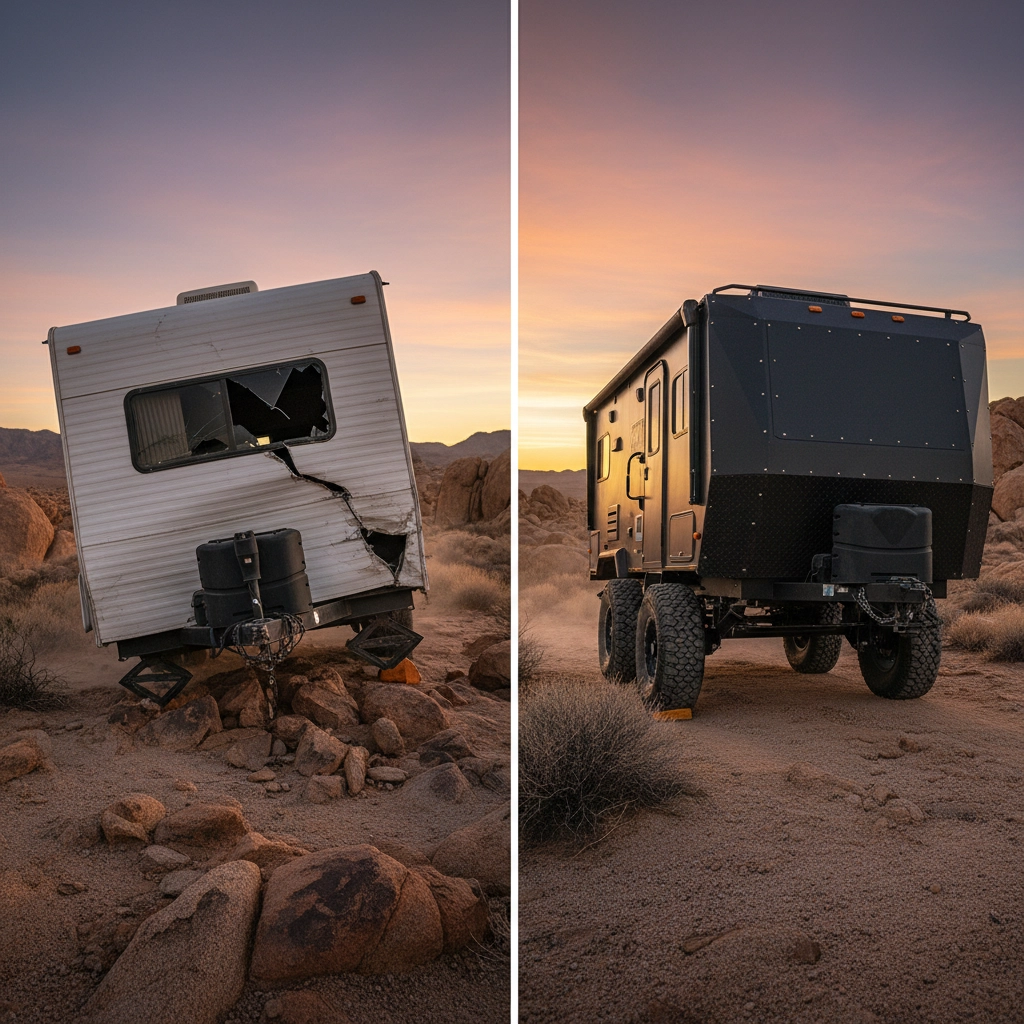
30 foot rv weight typically starts around 7,000 pounds dry and can exceed 12,000 pounds when fully loaded. These behemoths offer apartment-like amenities but are essentially mobile homes designed exclusively for established campgrounds with level pads and hookups.
Most conventional travel trailers use stick-and-tin construction: a lightweight wood frame wrapped in thin aluminum skin. This method keeps costs down but creates critical weaknesses:
Standard leaf-spring suspensions found on most travel trailers were designed for smooth highway travel, not the constant articulation required for off-road terrain:
The average travel trailer weights create inherent stability issues off-road:

According to industry data, conventional travel trailers experience significantly higher failure rates when used beyond paved campgrounds:
Many owners discover too late that their “rugged-looking” trailer wasn’t built for real adventures:
Dry Weight: The trailer’s weight without water, propane, or personal belongings. This number is largely meaningless for real-world use since you’ll never tow an empty trailer.
GVWR (Gross Vehicle Weight Rating): The maximum safe weight including all cargo, fluids, and passengers. This is your actual operational weight limit.
Curb Weight: The trailer’s weight with full tanks but no cargo. More realistic than dry weight but still doesn’t account for gear and supplies.
Tongue Weight: The downward force the trailer places on your hitch ball, typically 10-15% of total trailer weight. Critical for tow vehicle stability and safety.
Understanding these specifications helps you realize why the average weight of camper trailers makes them unsuitable for serious off-road adventures:

Purpose-built off-road trailers like those from BlackSeries incorporate features that standard manufacturers simply don’t offer:
Reinforced Steel Chassis: Full steel construction with strategic reinforcement points handles the constant stress of off-road travel.
Independent Suspension Systems: Each wheel moves independently, maintaining ground contact and protecting the trailer from impacts.
Optimized Weight Distribution: Careful placement of heavy components lowers the center of gravity and improves stability.
Protected Underbody: Skid plates and tank shields protect vital components from rock strikes and debris.

Off-road specific trailers demonstrate measurably better performance in challenging conditions:
When considering the total cost of off-road camping, the initial trailer price is just the beginning:
Standard Trailer Hidden Costs:
Quality Off-Road Trailer Investment:
The average travel trailer weights and construction methods used by mainstream manufacturers create a fundamental mismatch between what most trailers can handle and where adventurous families want to go.
For serious off-road adventures, dispersed camping, and remote location access, purpose-built off-road trailers aren’t just better: they’re essential for safety and long-term value.

Before buying any travel trailer, ask these critical questions:
BlackSeries trailers are engineered specifically for the demands of off-road adventure travel. With reinforced steel chassis, independent torsion suspension, and optimized weight distribution, BlackSeries models like the HQ21 deliver the durability and capability that conventional trailers simply cannot match.
Unlike mass-market manufacturers focused on maximizing interior space at minimum cost, BlackSeries prioritizes the engineering and materials needed for true off-road performance while maintaining the comfort features families expect.
Ready to explore beyond the pavement? Discover BlackSeries Off-Road Travel Trailers and experience the confidence that comes with purpose-built adventure capability.
Camping car average weight explanation: why most trailers cannot achieve true off-road exploration最先出现在Black Series RV | Off-Road Travel Trailers, Toy Haulers & Camper Trailers | Off road rv | Off grid rv | Overland rv | Off road trailer | Off road travel trailer | Overland travel trailer。