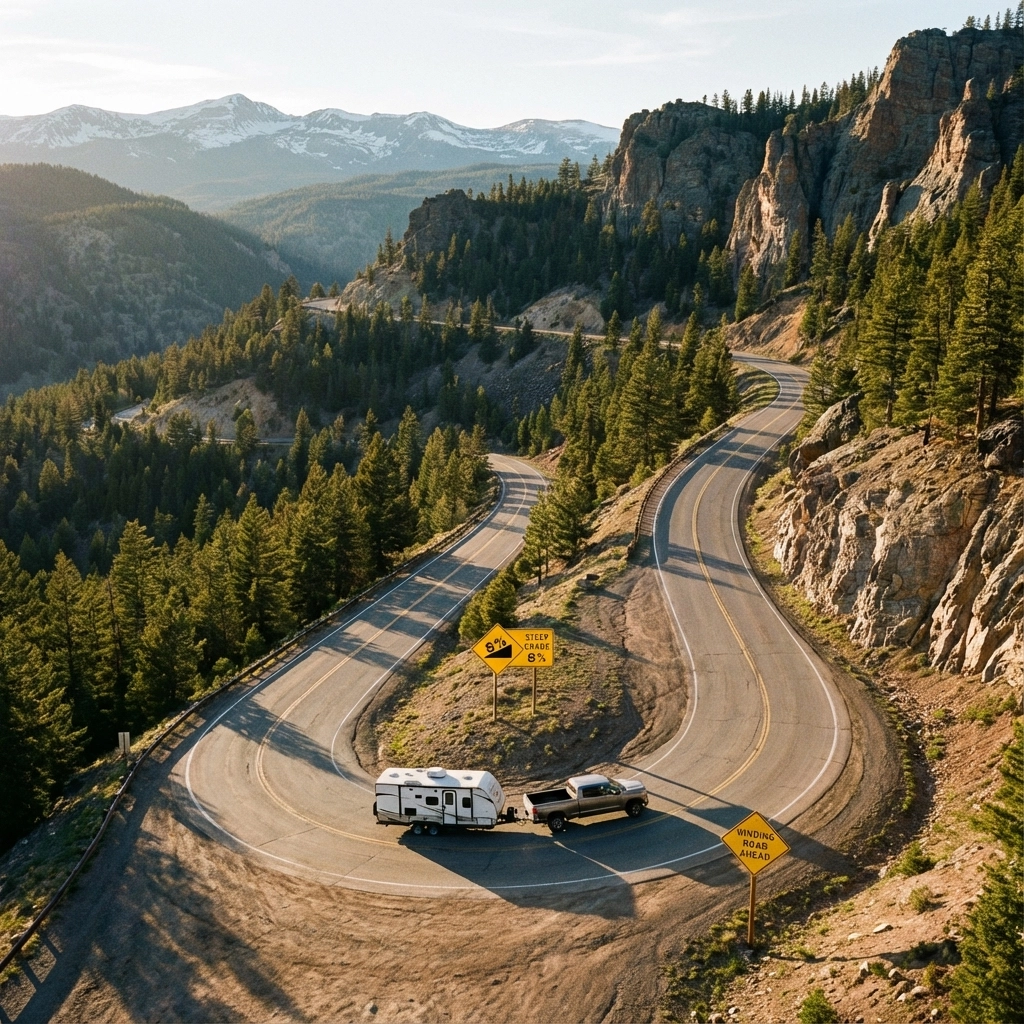
Downhill trailer towing involves navigating steep descents while managing increased gravitational forces that can cause brake overheating, loss of control, and dangerous trailer push. The key to safe downhill towing is controlling speed through engine braking rather than relying solely on your vehicle’s brake system, making speed management more critical than engine power.
What Is Considered a “Steep Grade” When Towing?
Understanding grade classifications helps you prepare for challenging descents before they become dangerous. In the United States, road grades are measured as percentages representing the vertical drop over horizontal distance.
Standard Grade Classifications:
- 4-6% grades: Considered moderate and typically marked with warning signs
- 8% grades: Present significant risk of brake overheating during extended descents
- 10%+ grades: Require extreme caution and specialized driving techniques
- 12% grades: Among the most challenging scenarios for trailer towing
Mountain states like Colorado, Utah, and California feature some of America’s steepest highway grades. Colorado’s I-70 through the Rockies includes sustained 6-7% grades spanning several miles, while California’s Grapevine along I-5 features 6% grades that have challenged truckers and RV drivers for decades. Utah’s highways through Zion and Capitol Reef areas present similar challenges with grades reaching 8-10% in some sections.
The critical factor isn’t just the percentage, it’s the combination of grade steepness and length. A short 10% grade may be manageable, but a sustained 6% grade over three miles creates cumulative heat buildup that can lead to complete brake failure.
Why Towing Downhill Is So Dangerous
Downhill towing fundamentally changes your vehicle’s physics, creating forces that work against your control systems rather than with them. Unlike uphill climbs where gravity helps slow your rig, downhill descents turn gravity into your enemy.
Gravitational Force Multiplication: Your trailer’s weight multiplies the gravitational pull, creating momentum that builds exponentially. A 5,000-pound travel trailer on a 6% grade generates roughly 300 pounds of additional downward force, equivalent to having an extra passenger constantly pushing your rig forward.
Trailer Push Phenomenon: Instead of following your tow vehicle, the trailer begins “pushing” from behind, creating an unnatural feeling where your rig wants to go faster than you’re comfortable with. This push can overwhelm your vehicle’s natural handling characteristics and make steering feel loose or unpredictable.
Brake System Overload: Your brake system wasn’t designed for continuous operation against gravitational forces. Extended brake application generates excessive heat, leading to brake fade, a condition where your brakes become progressively less effective until they potentially fail entirely.
Key Risks of Towing on Steep Grades Downhill
Brake Fade & Overheating
Brake fade represents the most serious threat during downhill towing. When brake pads and rotors overheat, they lose their ability to create friction, resulting in longer stopping distances or complete brake failure.
The “15-second rule” serves as your safety guideline: never apply brakes continuously for more than 15 seconds. This time limit allows brake components to dissipate heat between applications. Sustained braking beyond this threshold can raise brake temperatures above 600°F, the point where brake fluid begins to boil and brake pads start to glaze.
Professional truckers understand this principle and use it religiously on mountain passes. The same physics apply to travel trailer towing, regardless of your rig’s size.
Loss of Control & Trailer Push
When your trailer begins pushing your tow vehicle, several dangerous scenarios can develop. The increased weight transfer to your front axle reduces rear tire traction, making your vehicle’s back end feel “light” and prone to sliding. Simultaneously, the forward weight transfer can cause understeer, where your vehicle doesn’t respond normally to steering inputs.
This condition becomes particularly dangerous when combined with trailer sway. If your trailer begins oscillating side-to-side while also pushing forward, the combined forces can quickly overwhelm even experienced drivers.
Transmission & Engine Stress
Incorrect gear selection during downhill towing can damage your transmission or engine. Many drivers mistakenly believe they should use higher gears to “save” their engine, but this forces your brakes to handle all deceleration forces.
Conversely, proper gear selection allows your engine to absorb much of the gravitational energy through compression braking, protecting your brake system while operating within your engine’s design parameters. Modern engines can safely operate at 4,500+ RPM for extended periods when properly cooled.

How to Tow Downhill With a Trailer
Use Engine Braking First
Engine braking should be your primary speed control method. Before beginning any significant descent, downshift your transmission to a lower gear that maintains 3,000-4,500 RPM at your target speed. This high RPM range maximizes your engine’s compression braking effect.
For automatic transmissions, engage tow/haul mode if available, or manually select a lower gear range (typically “3,” “2,” or “L” depending on your vehicle). Manual transmission drivers should downshift before the descent begins, not during it.
Don’t worry about engine noise or high RPM, this operating range protects your brake system and represents normal downhill towing technique. The temporary engine stress is far less damaging than brake failure.
Control Speed Before the Descent
Speed management begins before you start descending. Reduce your speed to 10-15 mph below the posted limit before the grade begins, giving yourself a safety buffer as gravitational forces build.
Establish your target speed range, for example, cycling between 35-45 mph on a moderate grade or 25-35 mph on steeper descents. This range gives you flexibility to accelerate slightly when needed while maintaining safe maximum speeds.
Never attempt to slow down from highway speeds once you’re already descending. The longer you wait to reduce speed, the more heat you’ll generate trying to regain control.
Brake in Short, Firm Intervals
When engine braking alone isn’t sufficient, use firm, decisive brake applications lasting no more than 15 seconds. Apply brakes with enough pressure to meaningfully reduce speed, then release completely to allow cooling.
This interval braking technique might mean cycling between your minimum and maximum target speeds repeatedly. For instance, on a challenging grade, you might brake firmly from 40 mph down to 30 mph, then coast and use engine braking back to 35 mph before the next brake application.
Avoid light, continuous brake pressure, this generates maximum heat with minimum speed reduction, the worst possible combination.
Downhill Towing Safety Checklist
Pre-Descent Inspection:
- Check brake pedal feel and responsiveness
- Verify trailer brake controller is functioning and properly adjusted
- Inspect tire condition and pressure on both tow vehicle and trailer
- Ensure trailer load is properly secured and weight distributed
Gear and Speed Preparation:
- Downshift to appropriate gear before descent begins
- Reduce speed to 10-15 mph below posted limit
- Activate hazard lights if traveling significantly slower than traffic
- Increase following distance to account for extended stopping distances
Ongoing Monitoring:
- Watch for brake fade symptoms (longer stopping distances, spongy pedal feel)
- Monitor engine temperature and transmission temperature if equipped with gauges
- Identify runaway truck ramps or safe pull-off areas
- Maintain awareness of other vehicles’ positions and speeds
Best Practices for Braking Downhill With a Trailer
Engine Braking Priority: Always attempt speed control through engine braking before using your brake pedal. This principle applies whether you’re driving a compact pickup with a small trailer or a heavy-duty truck with a large travel trailer.
Brake Controller Optimization: Increase your trailer brake controller gain setting for steep grades. Settings that work for flat highway driving may be insufficient when gravity adds substantial force. Test your controller’s responsiveness on level ground before tackling serious grades.
Strategic Rest Stops: Plan stops at scenic overlooks or rest areas during long descents. These breaks allow your entire brake system to cool completely and give you opportunities to inspect your equipment.
Stability Over Schedule: Professional drivers prioritize arrival over schedule, and the same principle applies to recreational towing. BlackSeries RV designs incorporate low center-of-gravity engineering and robust construction specifically to enhance stability during challenging driving conditions, but even the best equipment requires proper technique.
Real-World U.S. Mountain Driving Scenarios
Mountain driving incidents often share common patterns that demonstrate the importance of proper downhill technique. Brake fade typically develops gradually over 2-3 miles of sustained descent, giving drivers multiple opportunities to recognize warning signs and take corrective action.
Commercial truckers and experienced RV drivers share similar approaches to mountain driving: early speed reduction, consistent gear selection, and conservative brake usage. These professionals understand that arriving safely, even if slightly behind schedule, far outweighs the risks of aggressive driving.
Weather conditions amplify downhill towing challenges. Rain reduces tire traction, snow obscures road surface conditions, and wind can destabilize trailers that are already compromised by improper speed management. Mountain weather can change rapidly, making conservative driving techniques even more critical.
The most successful downhill towing experiences combine proper equipment maintenance, conservative technique, and realistic time expectations. Drivers who attempt to maintain normal highway speeds on mountain grades consistently encounter problems, while those who embrace slower, controlled descents typically complete challenging drives without incident.
FAQ – Towing on Steep Grades Downhill
What gear should I use when towing downhill?
Use the lowest gear that maintains 3,000-4,500 RPM at your target descent speed. For most vehicles, this means 3rd gear or “2” range in automatic transmissions, or 2nd-3rd gear in manual transmissions depending on the grade steepness and your target speed.
How fast is too fast on steep downhill grades?
Generally, 10-15 mph below the posted speed limit provides adequate safety margin. On grades exceeding 8%, consider speeds of 35-45 mph maximum, regardless of posted limits. If your rig feels like it’s “pushing” or your brakes require continuous application, you’re going too fast.
Can engine braking damage my vehicle?
No, engine braking at high RPM is safer for your vehicle than brake overheating. Modern engines are designed to handle sustained high RPM operation when properly maintained and cooled. Temporary engine stress from downhill braking is far less damaging than brake system failure.
Should trailer brakes be stronger downhill?
Yes, increase your trailer brake controller gain setting for steep grades. Standard settings for flat driving are typically insufficient when gravity adds substantial force to your rig. Test adjustments on level ground before tackling challenging descents.
When should I pull over to cool brakes?
Stop immediately if you notice longer stopping distances, spongy brake pedal feel, burning smells, or if your brake pedal travels closer to the floor than normal. Additionally, plan strategic cooling stops every 3-5 miles on sustained grades, even if brakes feel normal.

