In 2026, the definition of a “self-contained RV” has evolved from a simple legal requirement to a hallmark of total freedom. For American campers exploring BLM lands or National Forests, being self-contained means your rig is a closed-loop ecosystem capable of supporting life without external hookups for days or weeks. This guide breaks down the essential systems and how to verify if your rig is truly ready for the deep backcountry.
What Is a Self-Contained RV? (Definition)
The term “self-contained” has a standardized meaning in the RV industry, specifically relating to how the vehicle handles resources and waste. At its core, a self-contained RV must have three integrated systems:
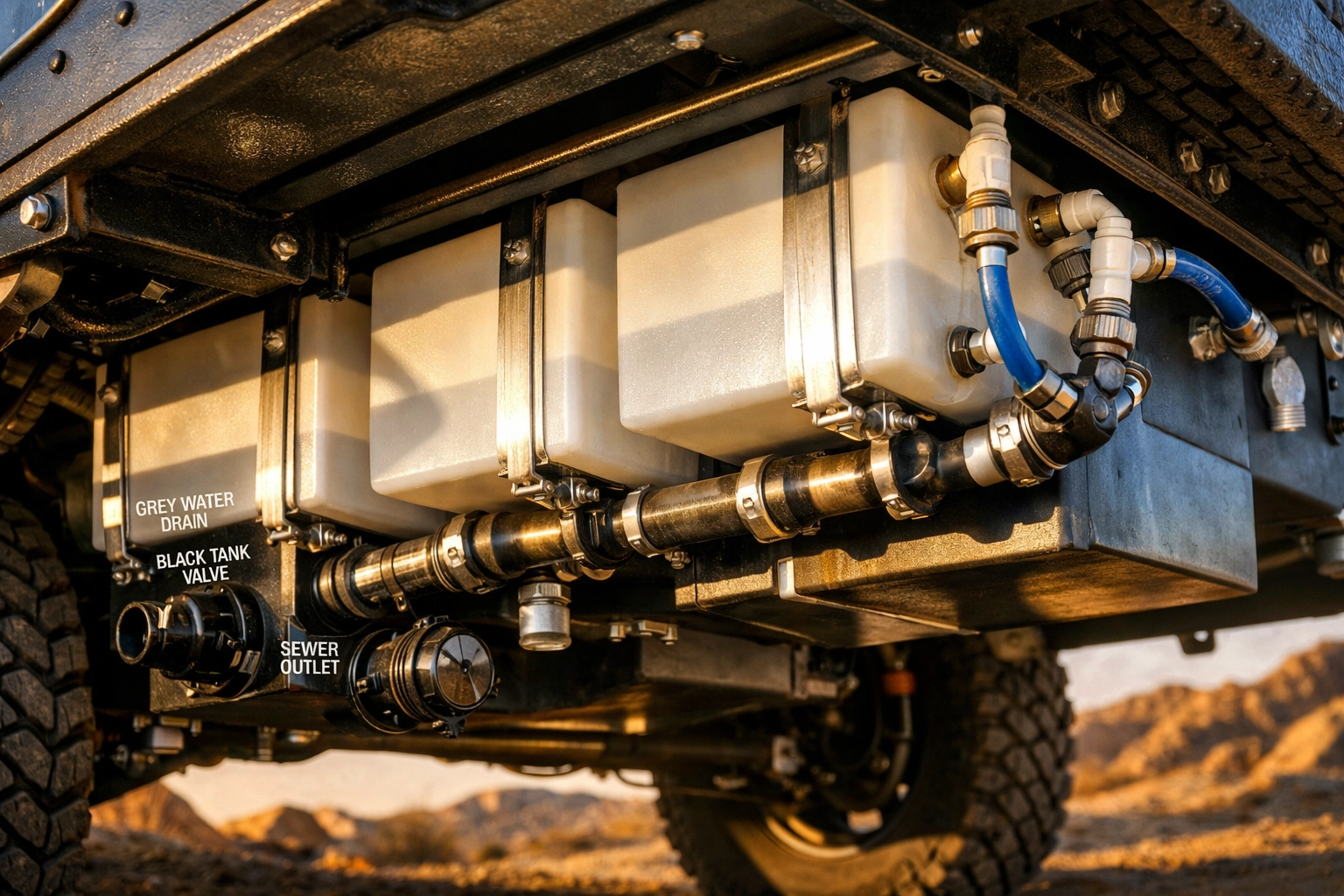
Water System: This includes permanent fresh water storage (not jerry cans strapped to a bumper) and dedicated grey water and black water holding tanks. The grey tank collects wastewater from sinks and showers, while the black tank handles toilet waste.
Power System: An onboard battery bank paired with a reliable charging source, solar panels, alternator charging, or a generator. In 2026, lithium batteries and high-wattage solar arrays have become the industry standard, allowing you to run modern conveniences like Starlink without constant generator noise.
Sanitation: A permanently installed toilet plumbed into a holding tank. This is the dealbreaker for many rigs. A portable camping toilet might work for car camping, but it doesn’t meet the legal definition of “self-contained” required on most public lands.
Common Misconceptions: Many first-time buyers assume that having a portable power station or a cassette toilet makes their rig self-contained. It doesn’t. The key word is “integrated.” If you can remove the toilet or disconnect the water system without tools, it’s not meeting the self-contained standard. Similarly, having electricity doesn’t automatically qualify your rig if it lacks proper plumbing and waste management.
The Core Systems of a Self-Contained RV
To survive off-grid for extended periods, your systems must be balanced and redundant. Here’s how each one works in practice:
Water: Capacity is king. For serious off-grid travel, look for rigs with 50+ gallons of fresh water storage. That sounds like a lot, but a family of four will burn through water faster than you think, especially when doing dishes, showering, and cooking. The limiting factor for most trips isn’t the fresh water tank, though. It’s the grey and black water tanks. Once those are full, your trip is over unless you can find a dump station.
Power: In 2026, the shift to lithium batteries has been a game-changer. Unlike old lead-acid batteries, lithium can be discharged to 20% without damage, giving you usable power for longer. Pair that with 400-600 watts of solar on the roof, and you can run lights, a fridge, water pumps, and even charge laptops without ever firing up a generator. High-efficiency inverters allow you to run AC appliances off your battery bank, which is crucial for remote workers or families who need consistent power.
Waste Management: This is the unglamorous reality of self-contained camping. Your black water tank (toilet waste) and grey water tank (sink and shower) have finite capacity. Efficient tank monitoring systems, available on most modern rigs, are crucial. Running out of space in your black tank 50 miles from the nearest dump station is a nightmare scenario. Some experienced campers extend their off-grid time by using external grey water solutions, but this must be done responsibly and legally.
Climate Control: Proper insulation and a high-efficiency heater or air conditioning unit are essential for year-round comfort. In winter, a quality furnace or diesel heater keeps you warm without draining your battery bank. In summer, running an AC unit will test even the most robust solar setup, which is why many off-gridders choose to camp in cooler seasons or shaded areas.
How to Judge if an RV is Truly Self-Contained
Not all rigs marketed as “self-contained” meet the standard. Here’s a 4-step verification process to use when shopping or evaluating your current setup:
The 4-Step Verification
1. The “Closed Loop” Test: Can you live in the rig for 72 hours without dumping any liquids, plugging into shore power, or refilling water? If the answer is no, you’re not fully self-contained yet.
2. Integrated Sanitation: Is the toilet plumbed into a holding tank that’s part of the RV’s structure? Portable toilets and cassette systems don’t count for legal self-contained status in most jurisdictions.
3. Power Autonomy: Does your solar system generate enough power to keep up with your daily amp-hour (Ah) consumption? A single 100W panel won’t cut it if you’re running a fridge, lights, and electronics. Most serious boondockers aim for 400W minimum.
4. Legal Compliance: Does the rig meet the “self-contained” criteria listed by the BLM or local forestry departments? Many public lands require proof of a holding tank and fresh water system before issuing dispersed camping permits.

Where Can You Use a Self-Contained RV?
Boondocking: This is the primary benefit of being self-contained. You can camp in dispersed areas on BLM land or National Forest Service roads where standard RVs with no tanks are prohibited. These spots are often the most scenic: far from crowded campgrounds and RV parks.
Public Lands (BLM/USFS): Many of the best camping spots in Utah, Arizona, Colorado, and Nevada are legally restricted to self-contained vehicles to protect the environment. The “Leave No Trace” ethic is embedded in these regulations. If you’re not self-contained, you risk fines and being asked to leave.
Reality Checks: Even the best self-contained rig has limits. Most setups are governed by the size of the grey water tank (which fills up faster than you’d expect) or the battery bank’s capacity during cloudy weather. The average boondocking trip lasts 5-7 days before you need to dump tanks and refill water, though experienced campers can stretch this to 10-14 days with strict conservation.
Self-Contained RV vs. Non-Self-Contained
The trade-off between independence and weight is real. Let’s break it down:
Independence: A self-contained rig allows you to avoid crowded RV parks, skip expensive campground fees, and access remote locations that standard trailers can’t reach. You’re not tethered to hookups, which means more freedom to explore.
Weight Variables: Adding large tanks and battery banks significantly increases your rig’s GVWR (Gross Vehicle Weight Rating). The average weight of camper models increases substantially when fully loaded with 80+ gallons of water, full propane tanks, and a lithium battery bank.
Size Impact: A 16 ft camper weight is manageable for most SUVs and mid-size trucks, making it a solid choice for couples or solo travelers who want to stay nimble on tight forest roads. Once you scale up to an 18 ft camper weight or 24 ft camper weight, you gain much larger tank capacities and more living space, but you’ll need a more capable tow vehicle.
Large Rigs: A 30 foot rv weight (or 30 ft rv weight) built as an off-road travel trailer provides massive self-containment capacity: think 80+ gallons of fresh water, 400W+ solar, and room for a full family. However, the 30-foot camper weight requires a heavy-duty truck (typically 3/4-ton or larger) to handle the load, especially on uneven terrain. For reference, the 30 ft camper weight when fully loaded can exceed 8,000 pounds, which limits your access to certain trails and increases your fuel costs.
BlackSeries Approach: Our trailers are designed as high-capacity self-contained systems, prioritizing extreme water and solar storage for long-duration off-grid stays. Whether you’re looking at our compact models or our flagship off-road travel trailers, the philosophy is the same: build for independence, not for the campground.
Real-World Data & Experience
Off-Grid Endurance: A family of four typically lasts 4-5 days in a standard self-contained rig before needing to dump tanks and refill water. This assumes normal usage: showers, dishes, cooking, and flushing the toilet. Conservative water use can stretch this to 7 days, but it requires discipline.
Solo Adventurer: A single traveler in a smaller rig (like an 18 ft camper weight model) can often push self-containment to 10-12 days with strict water conservation. This includes using biodegradable wipes instead of showering daily, cooking one-pot meals to minimize dishes, and limiting toilet flushes.
Climate Factors: In extreme heat, running an AC unit will drain even a large lithium battery bank quickly unless you have 1000W+ of solar on the roof. Most off-gridders choose to camp in milder seasons or seek shaded areas to reduce power consumption. In winter, diesel heaters are more efficient than propane furnaces and don’t consume as much battery power.
Regional Differences: The American West (Utah, Arizona, Nevada) offers the most accessible boondocking opportunities on BLM land, where self-contained rigs can camp for free for up to 14 days. In the East, dispersed camping is more restricted, and you’ll often need to rely on National Forest land or designated primitive sites.
FAQ
What makes an RV self-contained?
A self-contained RV has permanently installed systems for fresh water storage, waste management (grey and black water tanks), and onboard power generation (battery bank with charging capability). All three systems must be integrated into the RV’s structure.
Is it required for boondocking?
Legally, many dispersed camping areas on BLM land and National Forest land require vehicles to be self-contained to ensure you “Leave No Trace.” This protects the environment and prevents contamination of public lands.
How long can I stay off-grid?
Most modern self-contained rigs are limited by water capacity and waste tank size, not power. The average duration is 5-14 days depending on the number of occupants and water conservation practices.
Are travel trailers considered self-contained?
Only if they have integrated holding tanks (fresh, grey, and black water) and an onboard battery system with charging capability. Many budget travel trailers lack these features and are not suitable for true boondocking.
Ready to experience true freedom? Explore our range of self-contained off-road trailers and cut the cord on your next adventure. Whether you’re planning a weekend escape or a month-long expedition, our rigs are built to keep you off-grid longer. Learn more about our models.

