
Your cart (0)
Your cart is empty
Tax included and shipping calculated at checkout
Your cart is empty
Tax included and shipping calculated at checkout

GVWR is the maximum allowable total weight of a travel trailer, including cargo, water, propane, batteries, and gear. Dry Weight (or UVW) is the trailer’s weight without any cargo or fluids.
GVWR matters more for towing safety because it reflects the heaviest the trailer can ever be. When matching a trailer to your SUV or truck, always compare your vehicle’s towing capacity to the trailer’s GVWR: not its dry weight. BlackSeries trailers, being off-road capable, often have higher GVWR ratings due to reinforced chassis and suspension systems.
Over the past five years, winter RV travel searches have grown by 40%+ according to Google Trends, with more users seeking four-season capable RVs. This surge in year-round RV usage has created widespread confusion about trailer weights, particularly among SUV owners who represent a growing segment of the towing market.
The typical American confusion centers around three key areas:
Market data shows that average travel trailers add 800–1,500 lbs when loaded for trips. Off-road capable trailers like BlackSeries often have GVWR ratings 15–25% higher than comparable standard trailers due to reinforced construction and enhanced suspension systems designed for rough terrain access.
GVWR represents the maximum total weight your trailer can safely carry under any circumstances. This includes:
This is the most critical safety parameter for towing decisions.
Dry weight represents the trailer’s “empty” weight at manufacturing, excluding:
CCC = GVWR – Dry Weight
This calculation reveals how much weight you can actually add to your trailer, which many buyers overlook when making purchase decisions.
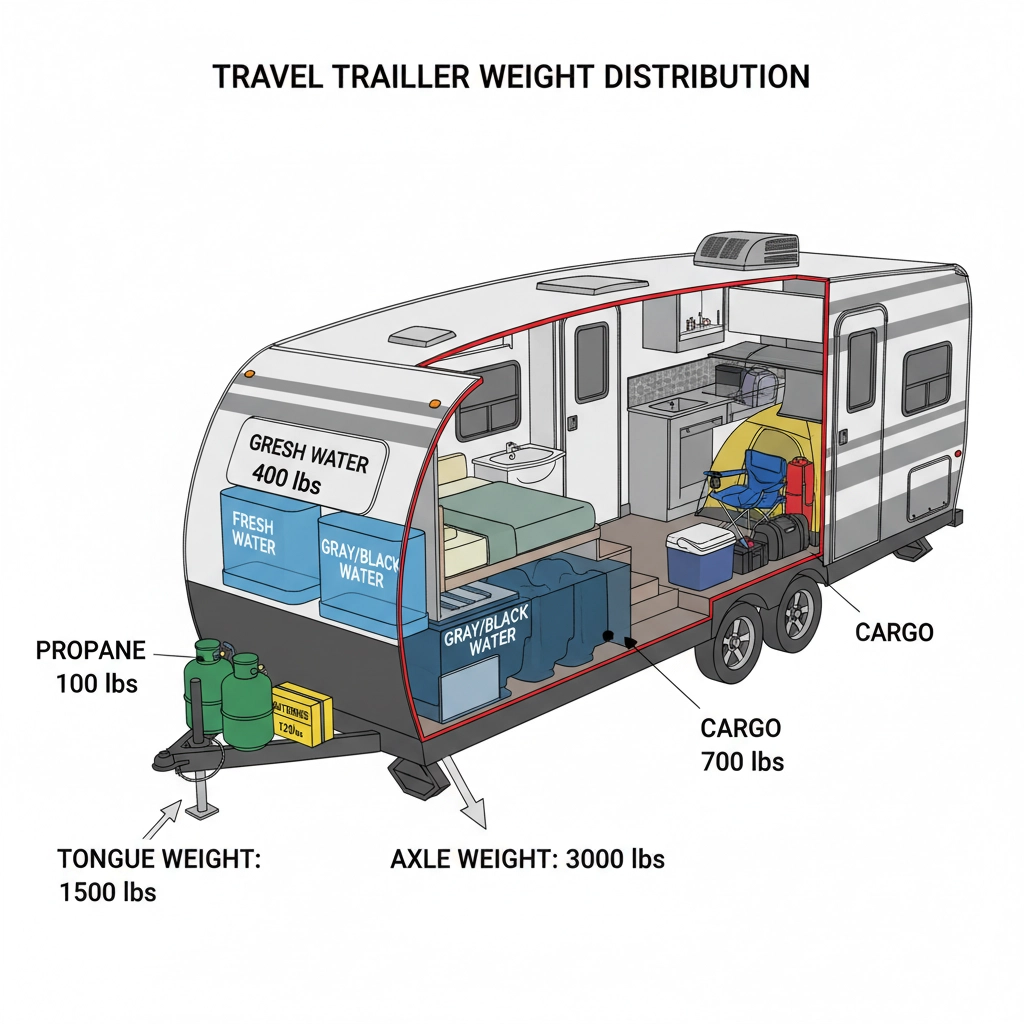
Marketing materials typically emphasize dry weight because it appears more “towable” to potential customers. However, real-world trailer weights approach 90–100% of GVWR when properly loaded for extended trips.
BlackSeries users typically carry additional off-road equipment including:
GVWR provides the foundation for:
Critical Rule: Always plan towing capacity using GVWR, never dry weight.
Example: BlackSeries HQ19
Each gallon of water weighs 8.34 lbs:
Off-road camping typically requires:
Tongue weight typically equals 10–15% of total loaded weight:
This tongue weight directly impacts your tow vehicle’s payload capacity and handling characteristics.
BlackSeries trailers feature enhanced GVWR ratings due to:
These design elements provide superior off-road capability while supporting higher payload capacities than standard travel trailers.

Note: Specifications vary by configuration and options
For detailed information about off-road trailer suspension systems and how they contribute to higher GVWR ratings, BlackSeries independent suspension design provides significant advantages over traditional solid axle systems.
✓ Always reference GVWR for towing compatibility
✗ Never use dry weight for towing calculations
✓ Calculate realistic tongue weight based on loaded GVWR
✓ Verify your vehicle’s payload can handle tongue weight plus passengers and cargo
✓ Plan cargo within CCC limits to avoid exceeding GVWR
✓ Consider water fill strategies for different camping scenarios
✓ Account for seasonal gear variations (winter equipment, sports gear, etc.)
✓ Match tow ratings to trailer GVWR with 10–20% safety margin
✓ Consider Gross Combined Weight Rating (GCWR) for your vehicle
✓ Evaluate payload capacity for tongue weight requirements
For comprehensive guidance on dispersed camping with proper weight management and equipment selection, proper understanding of GVWR helps ensure safe and legal camping on public lands.
Many buyers calculate towing needs using dry weight, then discover their loaded trailer exceeds their vehicle’s capacity by 1,000+ pounds.
Failing to calculate tongue weight based on GVWR can result in payload overloading and dangerous handling characteristics.
Underestimating the combined weight of water tanks, propane, batteries, and camping equipment leads to GVWR violations.
Not recognizing that Cargo Carrying Capacity includes ALL added weight: fluids, fuel, and gear: results in overloading.
Towing at 100% of rated capacity without safety buffers creates dangerous conditions, especially on mountain terrain or during emergency maneuvers.

GVWR represents the maximum safe operating weight, while dry weight only shows the empty trailer. Since you’ll be traveling with water, gear, and supplies, GVWR provides the realistic weight figure needed for safe towing calculations and vehicle compatibility.
Typical travel trailers gain 800–1,500 lbs when loaded for trips. Off-road capable trailers like BlackSeries often add 1,200–2,000+ lbs due to additional water capacity, heavy-duty equipment, and extended camping supplies required for remote adventures.
Dry weight specifications vary by manufacturer. Some include batteries and basic equipment, while others measure the completely empty trailer. Always verify specific manufacturer definitions and add these components to your weight calculations.
SUVs typically have lower towing capacities and payload ratings than trucks. Since tongue weight (10–15% of GVWR) directly impacts payload, higher GVWR trailers may exceed SUV payload limits even when within towing capacity, making trucks more suitable for heavier trailers.
Exceeding GVWR compromises safety systems, increases tire failure risk, stresses chassis components beyond design limits, and may void insurance coverage. It also creates legal liability issues and significantly degrades braking and handling performance.
Understanding GVWR versus dry weight enables informed decisions about trailer selection, towing vehicle requirements, and safe loading practices. When considering BlackSeries off-road trailers, their higher GVWR ratings reflect superior construction designed for challenging terrain and extended off-grid adventures.
GVWR vs dry weight最先出现在Black Series RV | Off-Road Travel Trailers, Toy Haulers & Camper Trailers | Off road rv | Off grid rv | Overland rv | Off road trailer | Off road travel trailer | Overland travel trailer。