High wind trailer towing involves controlling your travel trailer when crosswinds exceed 15-20 mph. Crosswinds are the greatest stability threat for trailers due to their large side profile creating dangerous sail effects. Success requires reduced speed, proper weight distribution, and knowing when conditions demand stopping completely.
What Is Considered “High Wind” When Towing a Trailer?
Understanding wind speed thresholds is critical for safe towing decisions. Wind affects trailers differently than passenger vehicles due to their height, length, and aerodynamic profile.
15-20 mph winds mark the beginning of noticeable trailer influence. At this level, you’ll feel subtle pushes requiring minor steering corrections. Most experienced towers can handle these conditions with increased attention and slightly reduced speeds.
25-30 mph winds enter the high-risk zone. Crosswinds at this intensity create significant lateral pressure on travel trailers, especially larger units. The average travel trailer weights between 5,000-8,000 pounds, but even lighter models like a 16 ft camper weight around 2,500-3,500 pounds can become unstable in sustained 25+ mph crosswinds.
40+ mph winds represent dangerous conditions where towing should cease immediately. At these speeds, even perfectly balanced trailers with optimal tongue weight face severe control challenges. Professional haulers and commercial drivers typically park when sustained winds reach this threshold.
Regional Wind Patterns: Western states like Utah, Wyoming, and Colorado present unique challenges. Interstate 80 through Wyoming regularly experiences sustained 40+ mph winds, forcing I-80 closures for high-profile vehicles including travel trailers. These corridors feature wide-open terrain with minimal wind breaks, creating particularly hazardous towing conditions.
The 30 foot rv weight typically ranges from 8,000-12,000 pounds, making these larger units especially susceptible to wind effects. Their extended length and height create massive side profiles that catch crosswinds like sails.
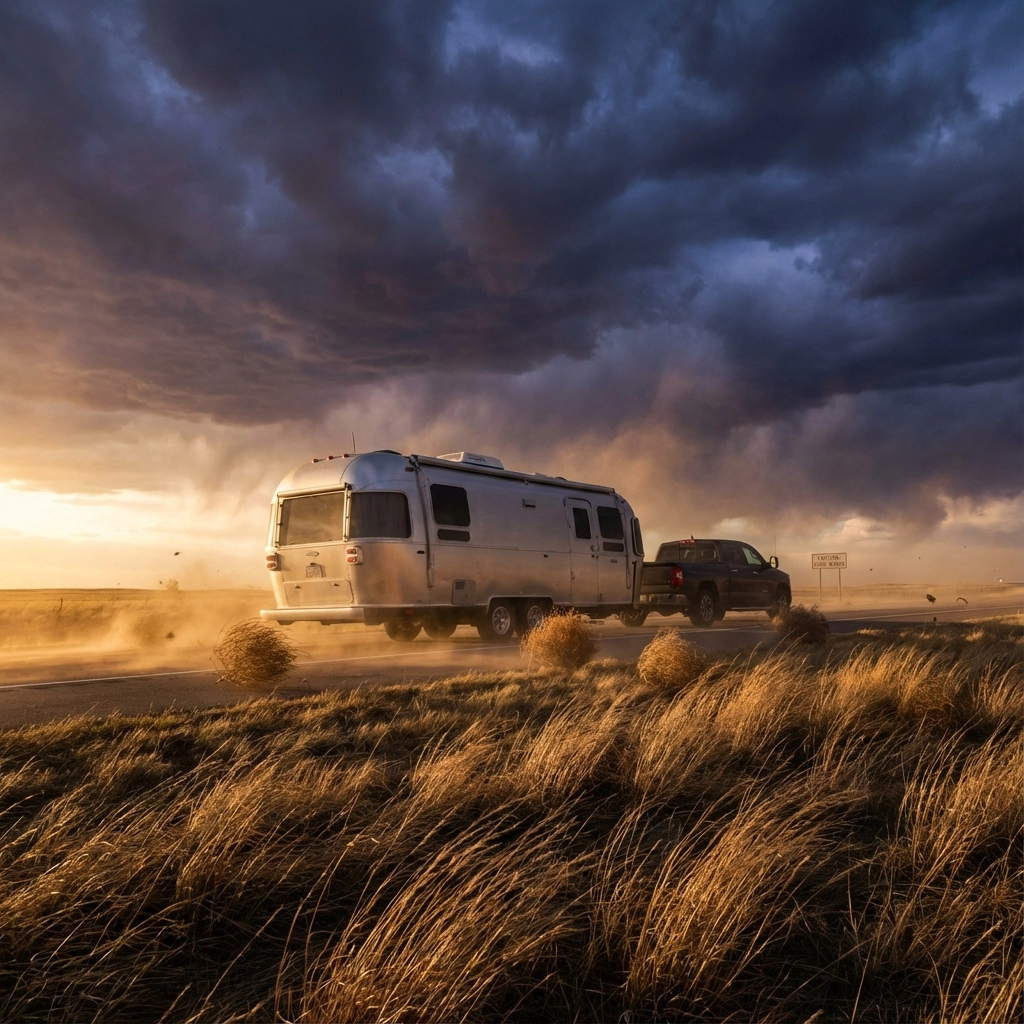
Why High Winds Are Dangerous for Travel Trailers
Large Side Profile & Sail Effect
Travel trailers present substantial lateral surface area to crosswinds. A standard 24 ft camper weight averages 6,000-7,500 pounds with approximately 200-250 square feet of side surface area. This creates an enormous “sail” that crosswinds can push with tremendous force.
The physics are straightforward: wind pressure increases exponentially with wind speed. At 20 mph, wind exerts roughly 2.5 pounds per square foot. At 40 mph, this pressure quadruples to 10 pounds per square foot. For a large travel trailer, this translates to hundreds of pounds of lateral force attempting to push your trailer sideways.
Trailer Sway & Loss of Control
Wind-induced trailer sway differs from typical road sway because it’s sustained and unpredictable. Normal trailer sway often self-corrects or responds to gradual speed reduction. Wind sway persists as long as crosswind conditions continue, requiring constant driver compensation.
Crosswinds can trigger oscillating sway patterns where the trailer begins swinging side-to-side with increasing amplitude. Once initiated, this sway can overwhelm even quality sway control systems. The combination of wind pressure plus trailer momentum creates a dangerous feedback loop that’s difficult to counter.
Passing Trucks & Gusts
Large commercial vehicles create dangerous wind blasts when passed or when passing your trailer. Semi-trucks displace massive air volumes, creating temporary high-pressure zones followed by sudden low-pressure voids. These pressure changes can jolt your trailer sideways without warning.
Interstate highway encounters with multiple trucks in windy conditions compound these effects. You might experience a crosswind gust, immediately followed by truck-generated wind pressure from the opposite direction. These rapid pressure changes overwhelm typical driver reaction times and can initiate severe trailer sway.
How to Tow a Travel Trailer in Windy Conditions
Reduce Speed Strategically
Effective wind towing isn’t simply about going slower, it’s about maintaining steady, controlled speeds that minimize wind impact while preserving vehicle stability. 55 mph represents a critical threshold for most travel trailer configurations in crosswinds above 20 mph.
Higher speeds amplify wind effects exponentially. The relative wind speed your trailer experiences combines actual wind speed plus your travel speed. A 25 mph crosswind becomes a 35 mph effective wind when traveling 60 mph, versus just 30 mph effective wind at 45 mph travel speed.
Maintain consistent speeds rather than fluctuating between fast and slow. Sudden speed changes can destabilize trailer tracking and trigger sway initiation. Use cruise control if conditions permit, but remain ready to disengage immediately if trailer movement requires speed adjustment.
Increase Following Distance
Wind affects braking performance significantly. Crosswinds can push your trailer sideways during braking, requiring additional distance to stop safely within your lane. Standard 3-second following distances should expand to 5-6 seconds minimum in windy conditions.
Consider that emergency braking in crosswinds may require steering corrections to maintain lane position. Extra following distance provides time to execute controlled stops rather than panic braking that could trigger trailer sway or jackknifing.
Steering & Lane Control
Maintain firm, two-handed steering grip throughout windy towing conditions. Wind gusts can jerk the steering wheel unexpectedly, and single-handed driving provides insufficient control for safe compensation.
Avoid sharp steering corrections when wind pushes your trailer. Instead, make gradual, smooth adjustments to return to proper lane position. Oversteering creates lateral momentum that wind can amplify into dangerous oscillations.
Plan lane changes carefully, executing them during relative wind calm periods when possible. Signal early and change lanes gradually, maintaining steady speeds throughout the maneuver.

High Wind Towing Safety Checklist
Pre-Trip Inspection:
- ✓ Verify tongue weight between 10-15% of trailer weight
- ✓ Check tire pressure on tow vehicle and trailer (cold pressure readings)
- ✓ Inspect sway control system mounting and tension
- ✓ Test trailer brakes and brake controller operation
- ✓ Secure all external cargo and ensure even weight distribution
Weather Monitoring:
- ✓ Check current wind conditions and hourly forecasts
- ✓ Download weather radar apps showing real-time wind speeds
- ✓ Identify high-wind corridor locations on your route
- ✓ Plan alternate routes avoiding known wind-prone areas
- ✓ Set wind speed alerts on weather apps (25+ mph threshold)
Equipment Verification:
- ✓ Confirm proper hitch ball size and torque specifications
- ✓ Check safety chains for proper length and attachment
- ✓ Verify trailer lights function correctly (especially turn signals)
- ✓ Test emergency breakaway system operation
- ✓ Ensure fire extinguisher and emergency kit accessibility
This systematic approach significantly improves towing safety and provides confidence for handling unexpected wind encounters. For additional safety preparation, review our comprehensive camping in high winds safety guide.
Best Setup for High Wind Trailer Towing
Weight Distribution Optimization:
Proper cargo loading dramatically affects wind stability. Place heavy items low and forward in the trailer, maintaining the 60/40 weight distribution rule, 60% of cargo weight forward of the trailer axles. This configuration lowers the center of gravity and reduces wind-induced lifting effects on the rear of the trailer.
For off-road travel trailer configurations, additional considerations apply. Off-road trailers often carry extra gear like water tanks, generators, and camping equipment. Secure these items in compartments rather than inside the trailer where shifting loads can affect handling.
Tow Vehicle Requirements:
Longer wheelbase tow vehicles provide superior stability in crosswinds. The extended distance between front and rear axles creates better directional stability and reduces the trailer’s ability to push the rear of the tow vehicle sideways.
Match your tow vehicle’s weight rating appropriately. An 18 ft camper weight of approximately 4,000-5,000 pounds requires a tow vehicle rated for at least 6,000-7,500 pounds to maintain adequate safety margins. Understated tow ratings become critical safety issues in windy conditions where additional control authority is essential.
Advanced Stability Systems:
Quality sway control systems eliminate trailer sway rather than merely dampening it. Friction-based systems common on lighter trailers often react too slowly for effective wind sway control. Weight-distribution hitches with integrated sway control provide superior performance for 30-foot camper weight applications exceeding 7,500 pounds.
BlackSeries Engineering Philosophy:
BlackSeries designs prioritize stability through low center of gravity construction and reinforced chassis systems. Our approach emphasizes structural integrity over weight savings, creating trailers that maintain better tracking in challenging conditions. Features like our reinforced A-frame construction and optimized axle placement specifically address wind stability concerns common in lightweight travel trailers.
This engineering focus proves especially valuable for adventure-oriented travelers who encounter varied weather conditions in remote locations where professional assistance isn’t readily available.
When You Should NOT Tow in High Winds
Official Guidelines vs. Real-World Experience:
National Weather Service high wind warnings typically trigger at sustained winds of 40+ mph with gusts to 58+ mph. However, travel trailer safety margins require more conservative thresholds. Experienced towers often establish personal limits at sustained 30 mph winds, well below official warning criteria.
Consider terrain effects on wind intensity. Mountain passes, canyons, and open plains can amplify base wind speeds by 20-50%. A forecast 25 mph wind can easily reach 35-40 mph in wind tunnel terrain common throughout western interstate corridors.
Decision Matrix Factors:
Wind Speed + Terrain + Traffic = Risk Assessment
- Base wind speeds above 25 mph + mountain terrain + heavy traffic = HIGH RISK
- Base wind speeds 20-25 mph + open plains + light traffic = MODERATE RISK
- Base wind speeds below 20 mph + protected terrain + any traffic = LOW RISK
Professional Approach:
Experienced commercial haulers and professional RV transporters routinely park during marginal wind conditions. This isn’t caution, it’s professional risk management. Waiting 2-6 hours for wind reduction often prevents potential accidents, cargo damage, and schedule delays caused by emergency roadside stops.
Develop pre-planned stopping locations along common routes. Identify truck stops, rest areas, and wide shoulder locations suitable for safely parking until conditions improve. Having predetermined safe havens eliminates decision-making pressure during deteriorating conditions.
Real-World Data & U.S. Statistics
Western State Wind Closures:
Wyoming Department of Transportation closes I-80 to high-profile vehicles (including travel trailers) approximately 40-60 days annually due to high winds. These closures typically affect the corridor between Laramie and Rawlins, where sustained 50+ mph winds with gusts exceeding 75 mph occur regularly.
Colorado’s I-25 corridor experiences similar patterns, with 15-25 annual closures affecting travel trailer operations. The Colorado State Patrol reports that 60% of wind-related accidents involving trailers occur during transition periods when winds increase from moderate to high levels, times when towers attempt to “push through” deteriorating conditions.
Accident Correlation Data:
Federal Motor Carrier Safety Administration data indicates crosswinds contribute to 15% of all trailer-related accidents nationwide. However, this percentage increases to 35% in western states where sustained high winds are more common.
Most wind-related trailer incidents occur at wind speeds between 25-35 mph, the range where drivers often continue towing despite marginal conditions. Accidents at higher wind speeds are less common simply because most drivers recognize extreme conditions and stop towing.
Economic Impact:
Industry estimates suggest wind-related trailer damage costs average $8,500-15,000 per incident, including vehicle damage, cargo loss, and emergency services. These costs significantly exceed expenses associated with delayed travel due to waiting for improved conditions.
FAQ – Towing Travel Trailer in High Winds
What wind speed is too dangerous to tow a travel trailer?
Sustained crosswinds above 30 mph create dangerous conditions for most travel trailers. Gusts exceeding 40 mph require immediate cessation of towing activities. However, factors like trailer size, weight distribution, and terrain can make lower wind speeds hazardous for specific configurations.
Is it safer to tow in headwind or crosswind?
Headwinds are significantly safer than crosswinds of equivalent speed. Headwinds primarily affect fuel economy and require modest speed reduction, while crosswinds create lateral forces that can trigger dangerous trailer sway and loss of control.
Can sway control help in high winds?
Quality sway control systems significantly improve trailer stability in moderate wind conditions (15-25 mph). However, they cannot overcome extreme crosswind forces above 30-35 mph. Sway control should complement, not replace, proper loading, appropriate speeds, and good judgment about when conditions are too dangerous for towing.
Should I pull over during gust warnings?
Yes, immediately seek safe stopping locations when sudden gust warnings are issued. Wind gusts can exceed sustained wind speeds by 20-30 mph, creating momentary forces that overwhelm trailer stability systems. Wait until gust warnings expire before resuming travel.
Do heavier trailers handle wind better?
Heavier trailers resist initial wind movement better than lighter units, but once destabilized, their greater momentum makes recovery more difficult. The 30 ft rv weight category around 8,000-10,000 pounds often provides the best compromise between wind resistance and controllability, though proper loading and equipment remain more important than absolute weight.
For comprehensive guidance on managing challenging weather conditions while camping, explore our detailed resources on winter RV preparation and off-road trailer adventures.

