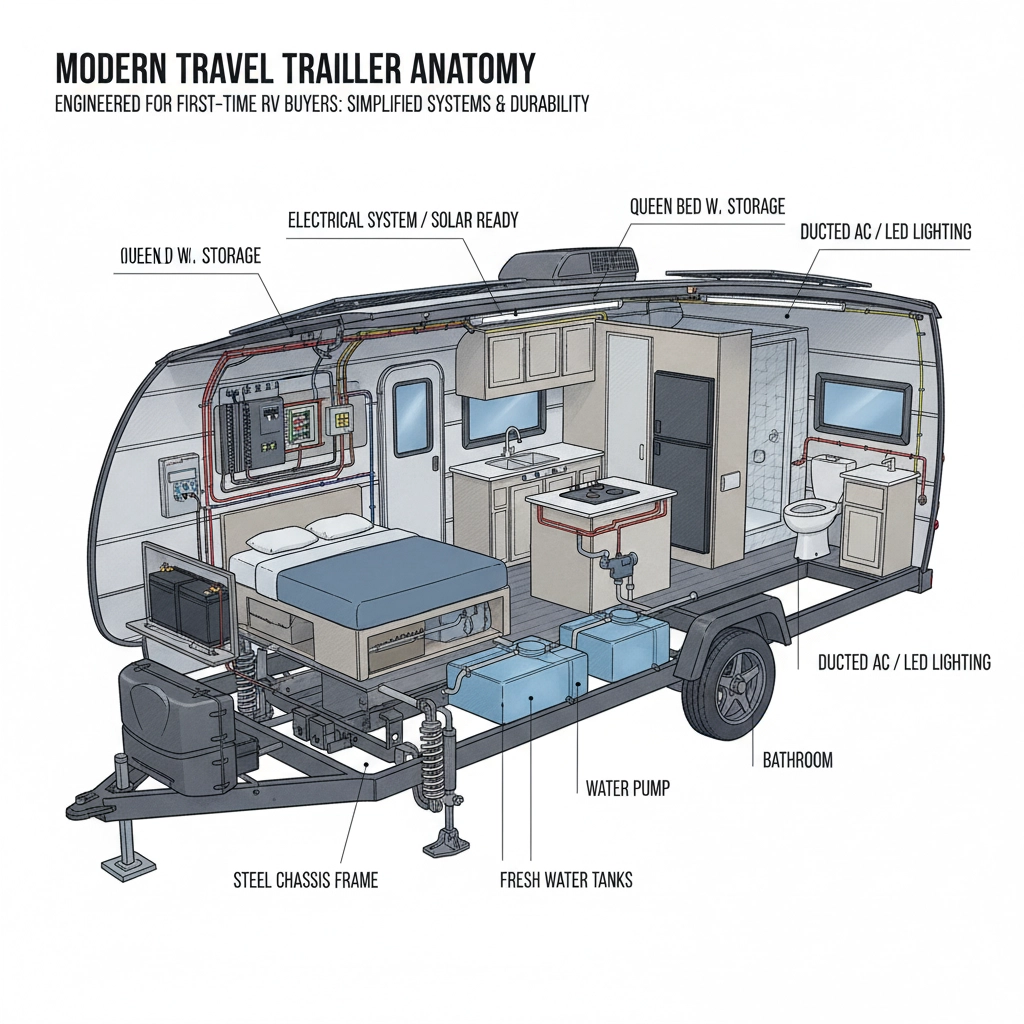
A travel trailer is a towable recreational vehicle designed to be pulled behind a car, SUV, or truck, offering all the essential amenities for comfortable camping without the complexity of a motorhome. Unlike self-propelled RVs, travel trailers give you the freedom to unhitch at your campsite and use your tow vehicle for local exploration, grocery runs, or sightseeing.
For first-time RV buyers, travel trailers offer several compelling advantages that make them the most popular choice among new RVers:
Affordability and Value: Travel trailers provide the widest price range in the RV market, from budget-friendly options under $15,000 to luxury models exceeding $100,000, allowing buyers to find something within almost any budget.
Flexibility and Independence: Once you arrive at your destination, you can disconnect your trailer and drive freely without worrying about RV-specific road restrictions, parking challenges, or fuel consumption.
Easier Learning Curve: Most travel trailers are more forgiving for new RVers to learn towing, backing, and basic RV systems compared to large motorhomes or complex fifth wheels.
Types of Travel Trailers for Beginners
Lightweight/Ultra-Light Trailers: Typically under 6,000 pounds, these models can be towed by most mid-size SUVs and offer excellent fuel economy while learning the basics of RV towing.
Conventional Travel Trailers: The most common type, ranging from 15-35 feet in length, offering full amenities including bathrooms, kitchens, and sleeping for multiple people.
Expandable/Hybrid Trailers: Popular among young families and first-time buyers, these feature expandable canvas ends that provide additional sleeping space while maintaining a compact towing profile.
Essential RV Terminology for First-Time Buyers
- GVWR (Gross Vehicle Weight Rating): Maximum weight your trailer can safely carry, including cargo
- Dry Weight: Weight of the trailer without water, propane, or cargo
- Tongue Weight: Downward force the trailer puts on your hitch ball (typically 10-15% of trailer weight)
- Payload: Maximum weight of cargo, water, and gear you can safely add to the trailer
- 30A vs 50A: Electrical service levels (30-amp for smaller trailers, 50-amp for larger units with more appliances)
The U.S. Travel Trailer Market at a Glance (2024-2025)
The American travel trailer market continues to show strong growth, driven by increasing interest in outdoor recreation and the flexibility that RV travel provides. Understanding current market trends helps first-time buyers make informed decisions about their investment.
Market Size and Growth: The global travel trailer market reached approximately $14-15 billion in 2024, with projections showing growth to $20-21 billion by 2034, representing a compound annual growth rate (CAGR) of 3.5%. The North American travel trailer market specifically shows stronger growth of approximately 7% CAGR through 2035.
Sales Volume: Travel trailers remain the best-selling RV category in the United States, with approximately 245,648 units sold in 2024, representing the largest segment of the RV market.
Buyer Demographics: RV ownership demographics are shifting younger, with the median age of RV owners dropping to 49 years in 2025. Significantly, 36% of current RV owners are first-time buyers, indicating a healthy influx of new enthusiasts entering the market.
Price Trends: Entry-level travel trailers typically start around $11,000-$25,000, while mid-range models with enhanced features run $25,000-$60,000. Premium and off-road capable trailers can exceed $80,000-$120,000, with specialized brands like BlackSeries commanding premium prices for rugged construction and off-road capability.
Key Market Insights for 2025
- Increased Boondocking Interest: More RVers are seeking off-grid camping experiences, driving demand for trailers with enhanced solar systems, lithium batteries, and larger freshwater capacity
- Lightweight Focus: Manufacturers continue developing lighter trailers that can be towed by popular mid-size SUVs and trucks
- Technology Integration: Modern trailers increasingly feature smartphone apps for monitoring systems, LED lighting, and USB charging stations throughout
Step-by-Step: How to Choose Your First Travel Trailer
Selecting your first travel trailer requires a systematic approach to ensure you choose a model that matches your camping style, budget, and towing capacity. Follow these seven essential steps to make a confident decision.
Step 1: Understand Your Camping Style
Before browsing trailers, clearly define how you plan to use your RV. Your camping style directly impacts the features and capabilities you’ll need:
Weekend Warriors: If you plan short trips to established campgrounds with hookups, focus on comfort features and ease of setup rather than extensive off-grid capabilities.
Extended Travelers: For longer trips or seasonal camping, prioritize storage space, comfortable living areas, and reliable systems that can handle regular use.
Boondocking Enthusiasts: If you’re drawn to dispersed camping or off-grid adventures, invest in trailers with robust solar systems, large freshwater tanks, and potentially off-road capable suspension systems.
Family Camping: Families need bunkhouse layouts, additional storage, and safety features that accommodate children and gear for multiple people.
Step 2: Match the Trailer to Your Tow Vehicle
Critical Weight Calculations: Never exceed 80% of your vehicle’s maximum towing capacity. Calculate the trailer’s dry weight, add cargo, water, and gear, then ensure this total stays within safe limits. Remember that tongue weight (typically 10-15% of trailer weight) also reduces your vehicle’s payload capacity.
Towing Equipment: Ensure your vehicle has proper towing equipment including a receiver hitch rated for your trailer’s weight, trailer brakes controller (for trailers over 3,000 pounds), and proper wiring harness.
Engine and Transmission Considerations: Smaller engines may struggle with larger trailers, especially in mountainous terrain. Consider your typical travel routes when matching trailer size to your vehicle’s capabilities.
Step 3: Set Your Budget Realistically
Purchase Price Ranges:
- Entry-level trailers: $11,000-$25,000
- Mid-range trailers with enhanced features: $25,000-$60,000
- Premium/luxury trailers: $60,000-$100,000+
- Specialized off-road trailers: $45,000-$150,000+
Total Ownership Costs: Budget beyond the purchase price for insurance ($200-$500 annually), registration fees, storage costs ($50-$200 monthly), routine maintenance, and emergency repairs.
New vs. Used Considerations: New trailers offer warranties and latest features but depreciate quickly. Quality used trailers can provide excellent value, especially from reputable manufacturers, but require thorough inspection.
Step 4: Choose the Right Size and Floor Plan
Length Considerations: Start smaller than you think you need. Shorter trailers (under 25 feet) are easier to maneuver, fit in more campsites, and require less towing experience.
Sleeping Arrangements:
- Couples: Queen bed layouts with dinette conversion provide flexibility
- Small families: Bunkhouse models maximize sleeping without excessive length
- Solo travelers: Compact layouts optimize storage and ease of use
Slide-Out Decisions: While slide-outs dramatically increase interior space, they add weight, complexity, and potential maintenance issues that first-time buyers should consider carefully.

Step 5: Evaluate Build Quality and Materials
Frame Construction: Look for welded steel frames rather than bolted assemblies. Quality manufacturers use properly treated lumber and avoid cost-cutting measures that compromise longevity.
Wall Construction: Traditional “stick-and-tin” construction (wood framing with aluminum siding) remains standard, while some premium manufacturers offer fiberglass or composite construction for enhanced durability.
Roof Systems: EPDM rubber roofs are common and serviceable, while fiberglass and aluminum roofs offer enhanced durability at higher cost.
Off-Road Considerations: If you anticipate venturing beyond paved roads, consider trailers with reinforced chassis, independent suspension, and higher ground clearance. Brands like BlackSeries specialize in this market segment with heavy-duty construction designed for challenging terrain.
Step 6: Decide on Must-Have Features vs Nice-to-Haves
Essential Features for Most First-Time Buyers:
- Adequate freshwater capacity (minimum 20-30 gallons)
- Reliable heating system for shoulder-season camping
- Sufficient storage for your typical trips
- Comfortable sleeping arrangements
- Basic kitchen with refrigerator and cooking capability
Desirable Upgrades:
- Solar panels and lithium batteries for off-grid camping
- Outdoor kitchens for extended outdoor living
- Washer/dryer preparation
- Enhanced insulation packages for four-season use
- Advanced suspension systems for rough road capability
Step 7: Plan for Ownership: Storage, Maintenance, and Resale
Storage Solutions: Determine where you’ll store your trailer when not in use. Options include home storage (requiring adequate space), storage facilities ($50-$200 monthly), or seasonal storage at campgrounds.
Maintenance Planning: Budget for annual maintenance including roof inspection and sealing, tire replacement every 3-5 years, brake servicing, and system winterization in cold climates.
Brand Reputation: Choose manufacturers with strong dealer networks and reputation for quality. Well-regarded brands maintain better resale values and offer superior warranty support.
Printable Checklist for Your First Travel Trailer
Tow Vehicle & Weight Compatibility
- Confirmed vehicle’s maximum towing capacity
- Calculated trailer dry weight + cargo stays under 80% of tow rating
- Verified tongue weight doesn’t exceed vehicle payload
- Ensured proper hitch equipment is installed or available
Layout & Family Needs
- Sufficient sleeping arrangements for all occupants
- Adequate storage for typical trip duration
- Comfortable dining/living area configuration
- Bathroom facilities meet family needs
- Pet-friendly features if traveling with animals
Build Quality & Structure
- Frame construction inspected (welded vs. bolted)
- Roof condition checked (especially on used trailers)
- Door and window operation verified
- Sealant condition around all penetrations examined
Systems & Utilities
- Freshwater capacity appropriate for camping style
- Gray and black tank sizes adequate
- Heating system suitable for expected conditions
- Electrical system meets campground compatibility needs
- Propane capacity sufficient for cooking and heating
Total Cost of Ownership
- Insurance quote obtained
- Storage arrangements planned and budgeted
- Annual maintenance costs estimated
- Registration and licensing fees researched
Best Types of Travel Trailers for First-Time Buyers
Best for Budget-Conscious Beginners
Lightweight Travel Trailers under 5,000 pounds offer the most accessible entry point into RV ownership. These compact models can be towed by most mid-size SUVs, provide excellent fuel economy, and typically cost between $15,000-$35,000 new.
Key Benefits: Lower purchase price, reduced towing stress, easier maneuvering, and lower ongoing costs for storage and maintenance.
Ideal For: Couples or small families planning weekend trips to developed campgrounds with hookups.
Best for Young Families
Bunkhouse Floor Plans and expandable travel trailers remain extremely popular among young families and represent a high percentage of first-time buyers. These layouts maximize sleeping capacity while maintaining manageable towing weights and overall lengths.
Key Features: Multiple sleeping areas, family-friendly storage solutions, and often include entertainment systems and spacious dinettes.
Considerations: Expandable sections require setup time and weather protection, but provide excellent space efficiency when towing.
Best for Future Off-Road Adventures
For buyers who know they’ll eventually want to explore beyond paved campgrounds, starting with a more capable trailer eliminates the need to upgrade later. Off-road capable travel trailers feature reinforced chassis, enhanced suspension systems, and higher ground clearance.
BlackSeries Advantage: For buyers prioritizing durability and off-road capability from day one, brands like BlackSeries offer rugged construction with independent suspension, reinforced frames, and genuine four-season capability. While these trailers command premium prices, they eliminate the need to upgrade when your adventures expand beyond developed campgrounds.
Long-term Value: Starting with enhanced capability prevents the common progression of upgrading from entry-level to more capable models as experience grows.
Best for Remote Workers and Extended Travelers
Large Travel Trailers with dedicated workspace areas, enhanced electrical systems, and superior comfort features serve buyers planning extended stays or working remotely from their RV.
Essential Features: Reliable internet connectivity options, adequate desk space, enhanced climate control, and larger freshwater/waste capacities for extended off-grid stays.
Investment Consideration: Higher initial cost pays dividends through reduced campground fees and increased comfort during extended use.
Real-World First Travel Trailer Stories (U.S. Owners)
Case Study 1: The Retirement Couple’s Journey
Background: After years of renting RVs for annual vacations, Jim and Sarah from Colorado decided to purchase their first travel trailer at ages 62 and 60.
Decision Process: They started by listing their must-haves: queen bed, comfortable dinette, reliable heating for shoulder seasons, and manageable towing with their half-ton pickup truck.
Choice: A 24-foot conventional travel trailer with slide-out, priced at $42,000 new, offering the comfort they wanted while staying within their truck’s towing capacity.
Lesson Learned: “We’re glad we didn’t go bigger initially. This size lets us access most campgrounds and we’re comfortable towing in various conditions. We can always upgrade later if our needs change.”
Case Study 2: The Young Family’s Smart Start
Background: Mike and Jennifer, both 34, wanted to introduce their two children (ages 6 and 9) to camping beyond tent camping, seeking more comfort and convenience.
Decision Process: They prioritized bunkhouse layouts, family storage needs, and a trailer their mid-size SUV could safely tow.
Choice: A 26-foot expandable hybrid trailer with rear bunks and front queen bed, purchased used for $28,000, providing sleeping for six when expanded.
Outcome: “The kids love having their own space, and we appreciate the hard-sided comfort. The expandable sections give us much more room than a comparable solid-wall trailer of the same towing weight.”
Case Study 3: The Adventure-Seeking Couple
Background: Tom, age 29, and Lisa, age 27, from Utah wanted a trailer that could handle their weekend adventures to remote locations throughout the Southwest.
Decision Process: Knowing they’d quickly outgrow limitations, they prioritized off-road capability, solar power, and four-season construction over initial cost savings.
Choice: A premium off-road trailer with independent suspension, high ground clearance, and comprehensive off-grid systems, investing $75,000 for long-term capability.
Philosophy: “We bought once instead of buying twice. This trailer goes everywhere we want to go, and we’re not limited to developed campgrounds. The premium price paid for itself in versatility and reliability.”
First Travel Trailer Maintenance & Safety Basics
Pre-Trip Inspection Routine
Tire Safety: Check tire pressure monthly and before each trip. Inspect for wear, cracking, or damage. Carry a spare tire and know how to change it safely.
Electrical Connections: Verify all lights function properly – brake lights, turn signals, running lights, and hazard flashers. Clean connections prevent road safety issues.
Hitch System: Inspect hitch ball, coupler, safety chains, and breakaway switch. Ensure proper tongue weight distribution and secure connection.
Fluid Levels: Check brake fluid (if equipped with electric brakes), wheel bearing grease, and propane tank levels.
On-Road Safety Fundamentals
Towing Speed: Maintain lower speeds than normal driving, typically 10-15 mph below posted limits. Allow extra stopping distance and avoid sudden maneuvers.
Weather Awareness: High winds significantly affect trailer stability. Be prepared to stop and wait out severe conditions rather than risk safety.
Backing and Maneuvering: Practice in empty parking lots before heading to campgrounds. Use a spotter when possible, and take your time with tight maneuvers.
Grade Management: Use lower gears on steep descents to maintain control and prevent brake overheating.
Seasonal Maintenance Essentials
Winterization: In freezing climates, properly drain water systems or use RV antifreeze to prevent freeze damage. This critical maintenance prevents thousands of dollars in repairs.
Roof Maintenance: Inspect and reseal roof seams annually. Most water damage results from neglected roof maintenance, making this the most important annual task.
Battery Care: Maintain 12V batteries with proper charging and storage practices. Consider upgrading to lithium batteries for improved performance and longevity.
Appliance Service: Have propane appliances serviced annually for safety and efficiency. This includes furnace, water heater, and refrigerator systems.
Frequently Asked Questions About Choosing Your First Travel Trailer
How much should I budget for my first travel trailer in the U.S.?
Budget $15,000-$45,000 for most first-time buyers, including the trailer, basic accessories, and initial setup costs. Entry-level models start around $11,000 used, while new mid-range trailers with good features typically cost $25,000-$45,000. Don’t forget ongoing costs like insurance ($200-$500 annually), storage, and maintenance.
Is a travel trailer a good choice for first-time RV owners?
Yes, travel trailers are excellent for beginners because they’re generally more affordable than motorhomes, offer the flexibility to unhitch and explore with your tow vehicle, and come in sizes that work well for learning RV systems and towing skills. They also retain value better than motorhomes and have lower ongoing maintenance costs.
What size travel trailer is best for a family of four?
A 26-32 foot bunkhouse layout typically works well for families of four, providing separate sleeping areas for parents and children, adequate storage, and comfortable living space. Look for models with rear bunks or expandable sections that can accommodate children while maintaining reasonable towing weights for most family vehicles.
Can my current SUV or truck tow a travel trailer safely?
Check your vehicle’s towing capacity in the owner’s manual, then ensure the loaded trailer weight (dry weight plus cargo, water, and gear) stays under 80% of this rating. Most mid-size SUVs can safely tow 3,500-5,000 pounds, while half-ton trucks typically handle 7,000-11,000 pounds depending on configuration.
Should I buy new or used for my first travel trailer?
Used trailers offer better value for budget-conscious buyers and avoid initial depreciation, but require careful inspection for hidden problems. New trailers provide warranties, latest features, and peace of mind, but cost significantly more. For first-timers, quality used trailers from reputable manufacturers often provide the best balance of value and reliability.
How long does a travel trailer usually last?
Well-maintained travel trailers typically last 15-20 years or more, depending on usage frequency and maintenance quality. Premium manufacturers and models with better construction can exceed 25 years with proper care. The key factors are regular maintenance, proper winterization, and addressing small problems before they become major issues.
What are the most important features to look for in a first travel trailer?
Focus on reliable basic systems (plumbing, electrical, heating), comfortable sleeping arrangements, adequate storage for your typical trips, and build quality that matches your intended use. Avoid getting overwhelmed by luxury features until you understand your actual camping preferences through experience.
Are off-road travel trailers a good idea for first-time buyers?
Off-road capable trailers make sense if you know you’ll want to access remote locations or rough roads. While more expensive initially, they eliminate the common need to upgrade later as your adventures expand. However, if you plan to stick to developed campgrounds initially, standard trailers offer better value for learning the basics.
How much will it cost to maintain a travel trailer each year?
Budget $500-$1,500 annually for routine maintenance, depending on trailer size and usage. This includes tire replacement every 3-5 years, annual roof sealing, brake service, and system maintenance. Emergency repairs can add significant costs, making regular preventive maintenance essential for controlling long-term expenses.
Do I really need solar and lithium batteries for my first trailer?
Solar and lithium systems are helpful if you plan to camp without electrical hookups (boondocking), but aren’t essential for campground camping with electrical connections. Start with basic systems and upgrade based on your actual usage patterns. Many first-time buyers add solar capability after determining their off-grid camping preferences through experience.
Choosing your first travel trailer is an investment in years of memorable adventures. By following this comprehensive guide, matching your specific needs to the right trailer features, and starting with realistic expectations, you’ll be well-equipped to make a confident decision that provides years of enjoyable RV experiences across America’s diverse camping destinations.

