Joshua Tree National Park presents one of the most challenging desert RV camping environments in the United States. Summer temperatures frequently exceed 100°F, creating extreme heat conditions that can make poorly prepared RV camping dangerous and uncomfortable. The main challenges include intense daytime radiant heat, dramatic nighttime temperature swings, and limited shade coverage across the park’s terrain.
The bottom line: Well-insulated trailer construction beats oversized air conditioning systems every time. While most RVers focus on A/C capacity, the real solution lies in preventing heat buildup through proper insulation and thermal management: with air conditioning serving as backup rather than the primary cooling strategy.
What Makes Joshua Tree Desert Camping So Challenging?
Joshua Tree’s Mojave Desert environment creates a perfect storm of heat-related challenges that standard RV systems struggle to handle effectively.
The park’s elevation ranges from 1,300 to 5,800 feet, but even at higher elevations, summer daytime temperatures regularly reach 100-110°F. Unlike coastal or forested camping areas, Joshua Tree offers virtually no natural shade coverage. The sparse Joshua trees and desert vegetation provide minimal relief from direct solar radiation, meaning your RV becomes a heat magnet from sunrise to sunset.
Radiant heat versus nighttime cooling creates the desert’s signature temperature swing. While daytime heat can be brutal, nighttime temperatures may drop 30-40 degrees, creating condensation and thermal stress on RV systems. This constant expansion and contraction cycle challenges both your cooling equipment and trailer construction.
Most Joshua Tree campgrounds compound the heat challenge with limited or no electrical hookups. Popular boondocking spots like Jumbo Rocks and Skull Rock offer no power connections, while only three developed campgrounds: Black Rock, Indian Cove, and Cottonwood: provide electrical hookups essential for running air conditioning systems.
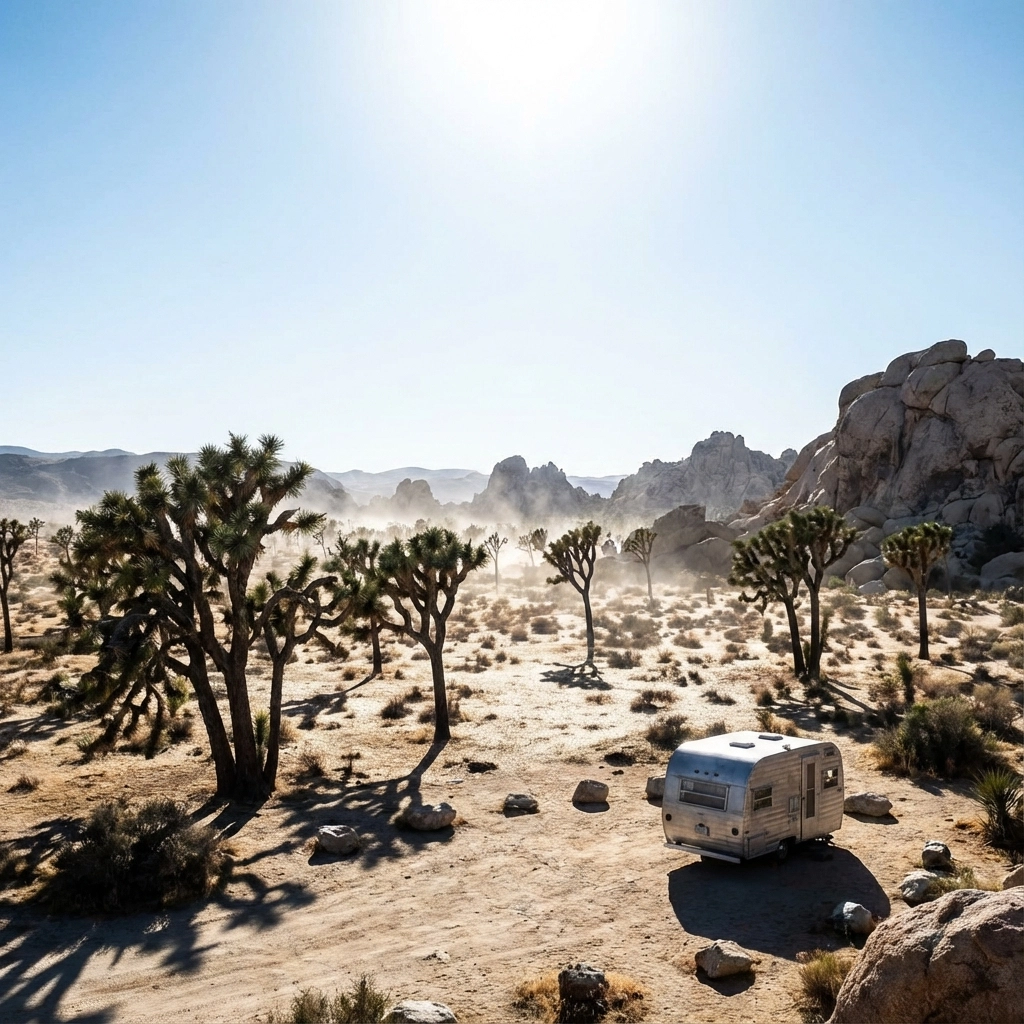
How Heat Affects RV Camping in Joshua Tree
Interior Temperature Build-Up Explained
Standard RV construction creates a greenhouse effect in desert conditions. Aluminum siding, fiberglass roofing, and minimal wall insulation allow heat to transfer rapidly into the interior space. A typical travel trailer’s internal temperature can reach 120-130°F when exterior temperatures hit 100°F: making the space uninhabitable without active cooling.
Metal trailer heat conduction works against you in multiple ways. The aluminum frame acts as a thermal bridge, conducting exterior heat directly through the wall structure. Roof-mounted components like air conditioners, vents, and solar panels create additional heat absorption points. Even with window coverings, large RV windows become heat radiators that overwhelm interior cooling efforts.
The thermal mass of your RV’s contents: furniture, appliances, and personal belongings: continues radiating stored heat hours after sunset, preventing natural nighttime cooling from providing relief.
Why Air Conditioning Alone Is Not Enough
Air conditioning systems face significant efficiency limits in extreme heat environments. A standard 15,000 BTU rooftop unit that easily cools a trailer in 80°F weather may struggle to maintain livable temperatures when fighting 110°F exterior heat plus solar radiation load.
Generator and battery strain becomes critical during extended desert camping. Running A/C systems continuously in extreme heat can drain a 400Ah lithium battery bank in 6-8 hours, while generators must work harder and consume more fuel to power cooling equipment fighting uphill battles against heat infiltration.
This is why insulation represents the primary solution, with air conditioning serving as backup. Preventing heat entry requires far less energy than removing heat that’s already accumulated inside your living space.
Insulation Explained: What Actually Works in the Desert
What Is True RV Insulation?
Effective RV insulation goes beyond the thin foam padding found in most mass-produced trailers. True thermal barriers require comprehensive wall, roof, and floor insulation systems that address both radiant heat transfer and thermal bridging.
Thermal bridging occurs when conductive materials like aluminum framing create pathways for heat transfer through insulated walls. Standard stick-and-tin RV construction allows aluminum studs to conduct exterior heat directly into interior spaces, rendering wall insulation largely ineffective.
Professional-grade insulation systems use continuous insulation barriers that wrap around thermal bridges, combined with reflective barriers that redirect radiant heat rather than absorbing it.
Why Insulated Off-Road Campers Perform Better
Composite sandwich panel construction found in premium off-road trailers creates superior thermal performance compared to traditional RV building methods. These closed-cell foam cores, bonded between interior and exterior skins, eliminate thermal bridges while providing R-values 3-4 times higher than standard RV insulation.
The sealed construction approach prevents air infiltration that compromises cooling efficiency in traditional trailers. Every penetration for windows, doors, and utilities receives proper thermal sealing, creating a true thermal envelope rather than the air-leaky boxes that characterize most RVs.

Air Conditioning Performance for Desert RV Camping
Rooftop versus split-system air conditioners each offer distinct advantages for desert camping. Rooftop units provide easier installation and lower initial costs, but split systems deliver higher efficiency and better temperature control in extreme conditions.
Judging cooling capacity requires understanding that BTU ratings assume standard test conditions, not 110°F desert heat with solar loading. A 15,000 BTU unit may deliver only 10,000-12,000 BTUs of effective cooling when fighting extreme heat, making proper sizing critical for desert performance.
Battery and solar integration becomes essential for off-grid Joshua Tree camping. Lithium battery banks of 600-800Ah capacity, combined with 800+ watts of solar panels, provide the power reserves needed for extended A/C operation during peak heat periods.
Soft-start technology reduces A/C startup power draws, allowing smaller inverters and generators to run cooling equipment efficiently while preserving battery capacity for other essential systems.
How BlackSeries Campers Handle Joshua Tree Heat
BlackSeries off-road trailers incorporate military-grade insulated construction specifically designed for extreme environment camping. The composite sandwich panel walls, roof, and floor create thermal barriers that maintain stable interior temperatures even during prolonged desert heat exposure.
Advanced climate control systems in BlackSeries trailers include high-efficiency air conditioning, strategic ventilation placement, and thermal management features that work together rather than fighting heat infiltration independently. The sealed construction prevents the air leaks that sabotage cooling efforts in conventional RVs.
This integrated thermal design makes BlackSeries trailers equally capable in desert heat and alpine cold, providing four-season comfort that standard RVs cannot match. The superior insulation also reduces energy consumption, extending boondocking capability essential for remote Joshua Tree camping.
For extreme weather preparation strategies, including desert heat management, explore our comprehensive Subzero Prep: Winterizing RV for Extreme Camping guide.
Best Practices for Joshua Tree RV Camping in Summer (Checklist)
Campsite Selection Strategy:
- Choose sites with eastern shade if available (rare but valuable)
- Position your RV to minimize afternoon sun exposure on entry door and main windows
- Select elevated spots that catch desert breezes
- Avoid low-lying areas that trap heat
Optimal Timing Schedule:
- Stay inside air-conditioned space from 10 AM to 6 PM during peak heat
- Plan outdoor activities for early morning (before 8 AM) and evening (after 7 PM)
- Use nighttime hours for hiking and exploration when temperatures drop
Nighttime Ventilation Protocol:
- Open roof vents and windows after 8 PM to purge accumulated heat
- Run exhaust fans to accelerate hot air removal
- Close all openings by 7 AM to prevent morning heat infiltration
Electrical and Cooling Checklist:
- Confirm campground electrical hookups before arrival
- Carry backup power solutions (generator, large battery bank)
- Pre-cool trailer interior before disconnecting from shore power
- Monitor power consumption to avoid system overloads
For comprehensive off-grid power management strategies, check our Dry Camping & Boondocking Guide: Summer Destinations.
Joshua Tree RV Camping: Real-World Scenarios
Shoulder Season Strategy (March-May, October-November):
Shoulder seasons offer the best balance of comfortable temperatures and park accessibility. Daytime highs reach 70-85°F, making outdoor activities enjoyable while nights cool to 40-55°F. Standard RV air conditioning easily manages these conditions, and you can enjoy extended outdoor time without heat stress.
Summer Survival Approach (June-September):
Summer camping requires tactical planning around heat avoidance. Successful summer campers arrive before dawn, establish camp quickly, then retreat indoors during daylight hours. Evening and pre-dawn activities become the norm, with midday reserved for indoor rest or air-conditioned travel to other destinations.
Desert Off-Road Plus Camping Routes:
Combining Joshua Tree RV camping with off-road exploration requires capable equipment and heat-conscious planning. Popular routes include Geology Tour Road, Queen Valley, and Covington Flat, best tackled during cooler morning hours with well-insulated base camp trailers providing comfortable retreat spaces.
FAQ: Joshua Tree RV Camping & Desert Heat
Is RV camping safe in Joshua Tree during summer?
Summer RV camping is safe with proper preparation, adequate air conditioning, and realistic expectations. Avoid summer camping in RVs without reliable cooling systems or sufficient electrical power. Always carry extra water and have communication devices for emergencies.
Do I need air conditioning at Joshua Tree?
Air conditioning is essential for summer camping and highly recommended for shoulder seasons. Even spring and fall can see temperatures reach 90°F during midday. Only winter camping (December-February) allows comfortable RVing without A/C systems.
How hot does an RV get in the desert?
Poorly insulated RVs can reach 120-130°F interior temperatures when exterior heat hits 100°F. Well-insulated trailers may only reach 85-95°F under the same conditions, demonstrating the critical importance of proper thermal design.
Are insulated campers worth it for desert camping?
Absolutely. Premium insulated trailers use 40-60% less energy for cooling while maintaining more stable interior temperatures. The improved comfort and reduced power consumption more than justify the initial investment for serious desert camping enthusiasts.
Conclusion
Successfully staying cool during Joshua Tree RV camping depends more on preventing heat infiltration than fighting it with oversized air conditioning. Well-insulated trailer construction, strategic campsite selection, and realistic activity timing create comfortable desert camping experiences that standard RVs simply cannot provide.
BlackSeries trailers offer the advanced thermal design and rugged construction needed for extreme environment camping, including Joshua Tree’s challenging desert conditions. Our composite insulated construction and integrated climate systems deliver the performance serious desert adventurers demand.
Ready to experience superior desert camping comfort? Contact BlackSeries today to explore our full line of thermal-engineered off-road trailers designed for extreme environment adventures.

