Off-road towing fundamentally differs from highway driving, requiring specialized skills and equipment to navigate challenging terrain safely. Common risks include jackknifing, traction loss, and rollover situations that can damage both vehicle and trailer. BlackSeries off-road travel trailers are engineered for these demanding conditions, but proper driving techniques remain essential for safe adventures.
What Is Off Road Trailer Driving?
Off-road trailer driving involves towing a trailer across terrain that’s significantly more challenging than paved roads. This includes:
Dirt roads and gravel paths – Often uneven with loose surfaces that affect traction
Sand dunes and beaches – Requiring momentum management and flotation techniques
Rocky terrain – Demanding precise wheel placement and articulation
Forest and BLM trails – Featuring tight turns, steep grades, and natural obstacles
The key difference from highway towing lies in the unpredictable terrain, reduced traction, and need for constant speed and momentum adjustments. Unlike smooth pavement where you can maintain steady speeds, off-road conditions require reading the terrain ahead and adapting your driving style continuously.
Regular travel trailers simply aren’t built for this abuse. Off-road capable trailers need reinforced frames, independent suspension systems, higher ground clearance, and rugged construction to handle the constant impacts and articulation demands of rough terrain.
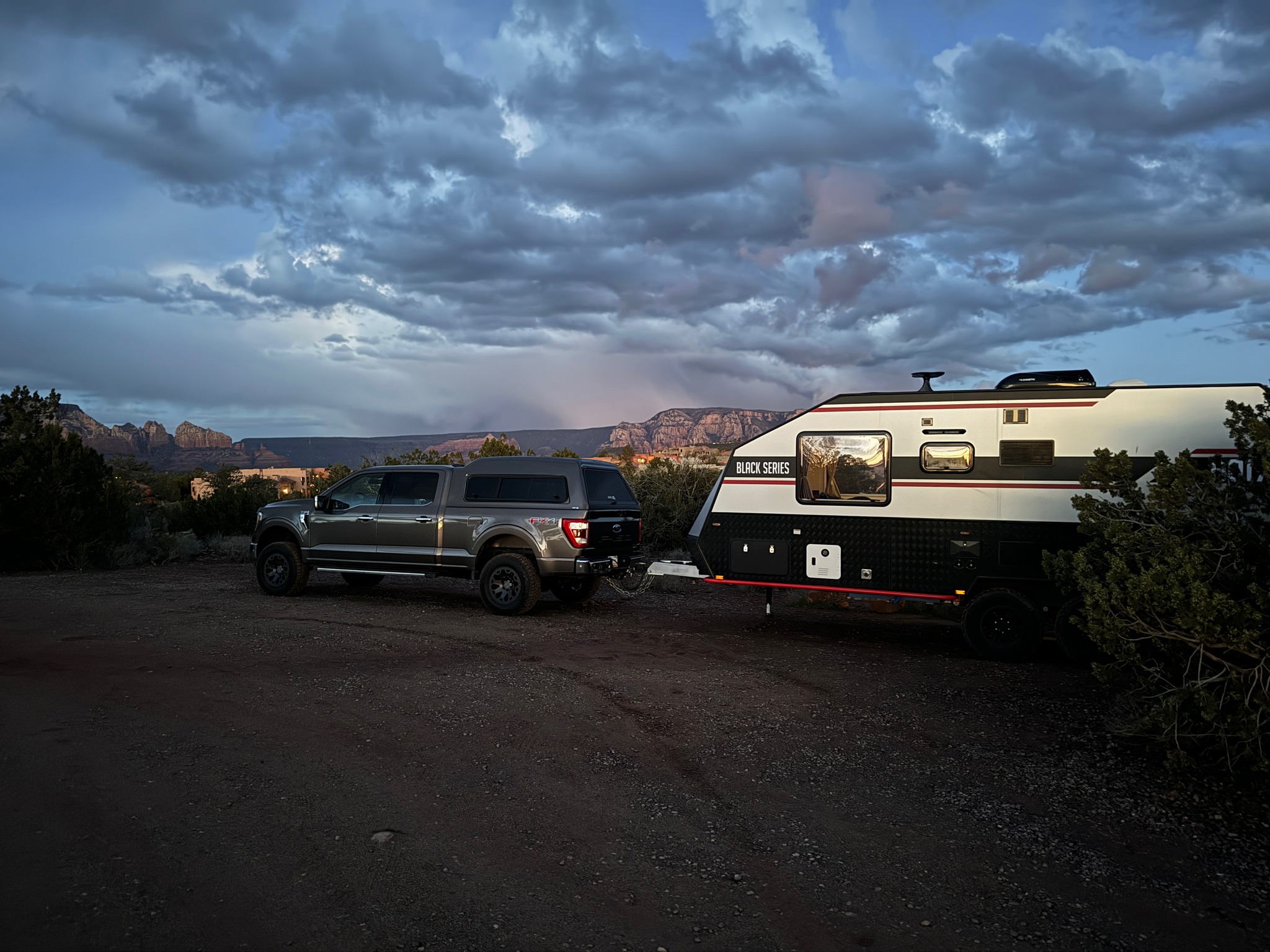
Why Driving Off Road with a Trailer Is Challenging
Traction variables create the biggest challenge when towing off-road. Your vehicle’s wheels and trailer wheels encounter different surface conditions simultaneously. While your truck might have good grip, the trailer could be sliding on loose gravel, creating unpredictable handling dynamics.
Increased turning radius becomes problematic on narrow trails. The trailer’s wheels follow a different path than your vehicle’s wheels, requiring wider turns and careful planning around switchbacks and tight corners. What seems like adequate clearance for your truck might leave your trailer sliding off the trail’s edge.
Weight distribution changes affect your vehicle’s center of gravity, making rollover risks higher on off-camber terrain. The trailer’s mass can push your vehicle in unexpected directions during side-hill traverses or when crossing ditches at angles.
Braking control becomes more complex on steep descents. The trailer’s momentum can push your vehicle faster than intended, while uneven surfaces can cause wheels to lose contact, reducing braking effectiveness when you need it most.
These challenges multiply with heavy, well-equipped off-road travel trailers. A 4,000-pound trailer behaves very differently than a 1,500-pound utility trailer, especially when loaded with water, gear, and supplies for extended adventures.
Preparing Your Vehicle & Trailer for Off-Road Towing
Tow Vehicle Requirements
Your vehicle needs more than just adequate towing capacity. Four-wheel drive with low-range gearing is essential for maintaining control on steep climbs and descents. Low range provides engine braking and precise throttle control that’s impossible to achieve in normal drive modes.
Ensure your cooling system can handle the extra stress. Off-road towing often means sustained low-speed operation with high engine loads – conditions that can quickly overheat both engine and transmission.
Trailer Setup Essentials
Independent suspension systems allow each wheel to move independently, keeping your trailer stable over uneven terrain. Leaf spring setups work but don’t provide the same level of control and comfort.
Adjust tire pressure appropriately for conditions. Slightly lower pressure increases the contact patch and improves ride quality over rocks and rough surfaces, but don’t go too low or risk damaging sidewalls.
Articulating hitches with multi-axis movement prevent binding when your vehicle and trailer are at different angles. Standard ball hitches can bind up on steep terrain, making turning difficult and potentially damaging the hitch components.
Safety Equipment Checklist
- Recovery straps and shackles rated for your combined vehicle weight
- Portable air compressor for adjusting tire pressure
- Spare tire that fits both vehicle and trailer
- Fire extinguisher (required for propane-equipped trailers)
- First aid kit and emergency communication device
- Extra water and basic tools

Off Road Towing Tips Before You Hit the Trail
Lower tire pressure moderately – Reduce pressure by 5-10 PSI from highway settings to improve traction and ride quality. Monitor pressure throughout the day as tires heat up from flexing over rocks and obstacles.
Secure all cargo inside both vehicle and trailer. Items that stay put on highways will shift and bounce aggressively off-road. Use cargo nets, tie-downs, and storage bins to prevent damage and maintain proper weight distribution.
Check articulation clearance between your vehicle and trailer. Ensure brake lines, safety chains, and electrical connections have adequate slack for extreme articulation without stretching or binding.
Plan recovery points before you need them. Identify potential turnaround spots, winch anchor points, and alternate routes. Know your rig’s limitations and have exit strategies planned for challenging sections.
How to Tow a Trailer Off Road
Driving on Dirt & Gravel
Maintain steady momentum without rushing. Gravel roads can change from firm to loose without warning, requiring smooth throttle inputs to maintain traction. Keep your speed consistent rather than accelerating and braking frequently, which can cause the trailer to push your vehicle sideways on loose surfaces.
Watch for washboard surfaces that can cause violent shaking. Sometimes it’s better to slow down significantly rather than trying to “float” over corrugations that could damage your rig or make you lose control.
Towing a Trailer on Sand
Sand requires momentum management more than raw power. Enter sand sections with adequate speed but avoid wheel spin that digs you deeper. If you start losing momentum, ease off the throttle rather than pressing harder.
Lower tire pressure significantly for sand – sometimes down to 15-20 PSI depending on load. The increased contact patch helps you float over soft surfaces instead of digging in.
Rock Crawling with a Trailer
Rock crawling demands precise wheel placement and patience. Walk the route first when possible, identifying the line each wheel needs to take. Remember that your trailer wheels follow a completely different path than your vehicle wheels.
Use a spotter when navigating technical sections. Clear communication prevents expensive mistakes when threading narrow passages or climbing over large obstacles.
Hill Climbs & Descents
Approach climbs with adequate momentum but avoid excessive speed that could cause loss of control. Use low-range gearing to maintain steady power delivery without lugging the engine.
On descents, rely primarily on engine braking in low gear. Apply trailer brakes gradually if equipped, but avoid hard braking that could cause skidding or jackknifing. Descend slowly enough that you could stop if needed.
Tight Turns & Switchbacks
Plan tight turns carefully, understanding that your trailer needs much more room than your vehicle. Sometimes backing up and taking multiple attempts is safer than trying to force a tight turn that could put your trailer off the trail edge.
Practice three-point turns in safe areas before attempting challenging switchbacks. Know how your specific trailer responds to backing maneuvers with different steering inputs.
Off Road Trailer Driving Techniques That Prevent Damage
Balance momentum vs control – Too little speed leaves you stuck, but too much speed leads to loss of control and potential rollovers. Find the sweet spot for each terrain type where you maintain forward progress without bouncing violently.
Master throttle management – Smooth, steady inputs work better than aggressive acceleration. Your trailer needs time to respond to your vehicle’s movements, and sudden changes can cause instability.
Practice brake modulation – Learn to use a combination of engine braking, gentle service brake application, and trailer brakes (if equipped) to control descent speed without overheating components or losing traction.
Establish spotter communication – Develop hand signals and radio protocols for navigating technical terrain. A good spotter positioned where they can see your trailer’s path can prevent damage and dangerous situations.
Know when to stop – Some terrain simply isn’t safe for your particular vehicle and trailer combination. There’s no shame in turning around rather than risking damage or getting stuck in a remote location.
Common Mistakes When Driving Off Road with a Trailer
Treating it like highway towing – The biggest mistake is assuming off-road towing is just slower highway driving. The physics are completely different, requiring new skills and awareness.
Excessive speed for conditions – Speed that feels comfortable in your vehicle alone becomes dangerous with a trailer. The trailer’s inertia amplifies every bump, turn, and slope change.
Poor line choice – Failing to plan your route through obstacles leads to high-centering, damage, or getting stuck. Always consider where your trailer wheels will track, not just your vehicle.
Ignoring trailer breakover angle – Many drivers focus only on their vehicle’s clearance while forgetting that trailers have different approach, departure, and breakover angles. A trail that’s fine for your truck might high-center your trailer.
Not disconnecting when necessary – Sometimes the smart move is unhitching and driving your vehicle through a difficult section alone, then reconnecting on the other side. Don’t let pride create dangerous situations.
Best Trailers for Off Road Towing (BlackSeries Insight)
Independent suspension systems are crucial for off-road travel trailers. Traditional leaf spring setups can work but don’t provide the wheel articulation needed for rough terrain. Independent systems keep all wheels in contact with the ground, improving traction and reducing stress on the frame.
Ground clearance matters significantly – Look for trailers with at least 12 inches of clearance, more if you plan serious rock crawling. Higher clearance protects tanks, plumbing, and electrical components from damage.
Robust construction separates true off-road trailers from standard models. Reinforced frames, quality hitches, and protected systems handle the constant stress of rough terrain. BlackSeries engineers our trailers specifically for these demanding conditions, using aircraft-grade aluminum construction and proven suspension designs.
The difference becomes apparent when you’re 50 miles from the nearest paved road. A well-built off-road travel trailer like our HQ series opens up camping possibilities that regular trailers simply can’t reach safely.
FAQ
Can you drive off road with a trailer safely?
Yes, with proper preparation, equipment, and driving techniques. The key is matching your trailer’s capabilities to the terrain difficulty and developing off-road towing skills through practice in progressively more challenging conditions.
Do I need 4WD to tow a trailer off road?
Four-wheel drive with low-range gearing is essential for safe off-road towing. The low range provides engine braking control on descents and precise throttle control for technical terrain that’s impossible to achieve with 2WD.
How fast should you tow a trailer off road?
Speed depends entirely on conditions, but generally much slower than highway towing. On rough terrain, 5-15 mph is often the maximum safe speed. The goal is maintaining control and preventing damage, not making time.
Should trailer tires be aired down off road?
Yes, reducing tire pressure by 5-10 PSI for most terrain improves traction and ride quality. For sand, you may need to drop 15-20 PSI. Always have a portable compressor to re-inflate before returning to pavement.
When should I unhitch and drive separately?
Disconnect when terrain becomes too technical for safe towing, when turning radius is inadequate for tight switchbacks, or when the risk of damage outweighs the convenience of staying connected. Sometimes the smart move is making two trips through a difficult section.

