Towing a travel trailer typically reduces your vehicle’s fuel efficiency by 30-40%, with most setups achieving 8-12 miles per gallon depending on trailer weight, aerodynamics, and driving conditions. Understanding the key factors affecting travel trailer fuel consumption helps you optimize efficiency and reduce costs on your adventures.
Three immediate actions to improve your travel trailer mpg:
- Maintain 55-65 mph for optimal fuel economy (avoiding the exponential drag increase above 70 mph)
- Check tire pressure monthly on both your tow vehicle and trailer to reduce rolling resistance
- Reduce unnecessary weight by carrying only essential gear and emptying water tanks when traveling
What Affects Travel Trailer Fuel Efficiency?
1. Weight & Load Distribution
Gross vehicle weight rating (GVWR) is the most critical factor in travel trailer fuel efficiency. Every 1,000 pounds of additional weight can reduce fuel economy by 2-3 mpg. BlackSeries trailers utilize lightweight aluminum construction and strategic weight distribution to minimize this impact while maintaining off-road durability.
The key is understanding your total loaded weight, including water tanks, gear, and supplies. A fully loaded 8,000-pound travel trailer will consume significantly more fuel than the same trailer at 6,000 pounds.
2. Aerodynamic Drag
Wind resistance increases exponentially with speed, making aerodynamics crucial for fuel economy. Traditional boxy travel trailers create substantial drag, forcing your engine to work harder. The square front profile acts like a parachute, dramatically increasing fuel consumption above 65 mph.
Speed vs. Fuel Economy:
- 55 mph: Baseline efficiency
- 65 mph: 15-20% increase in consumption
- 75 mph: 35-45% increase in consumption
3. Tire Pressure & Rolling Resistance
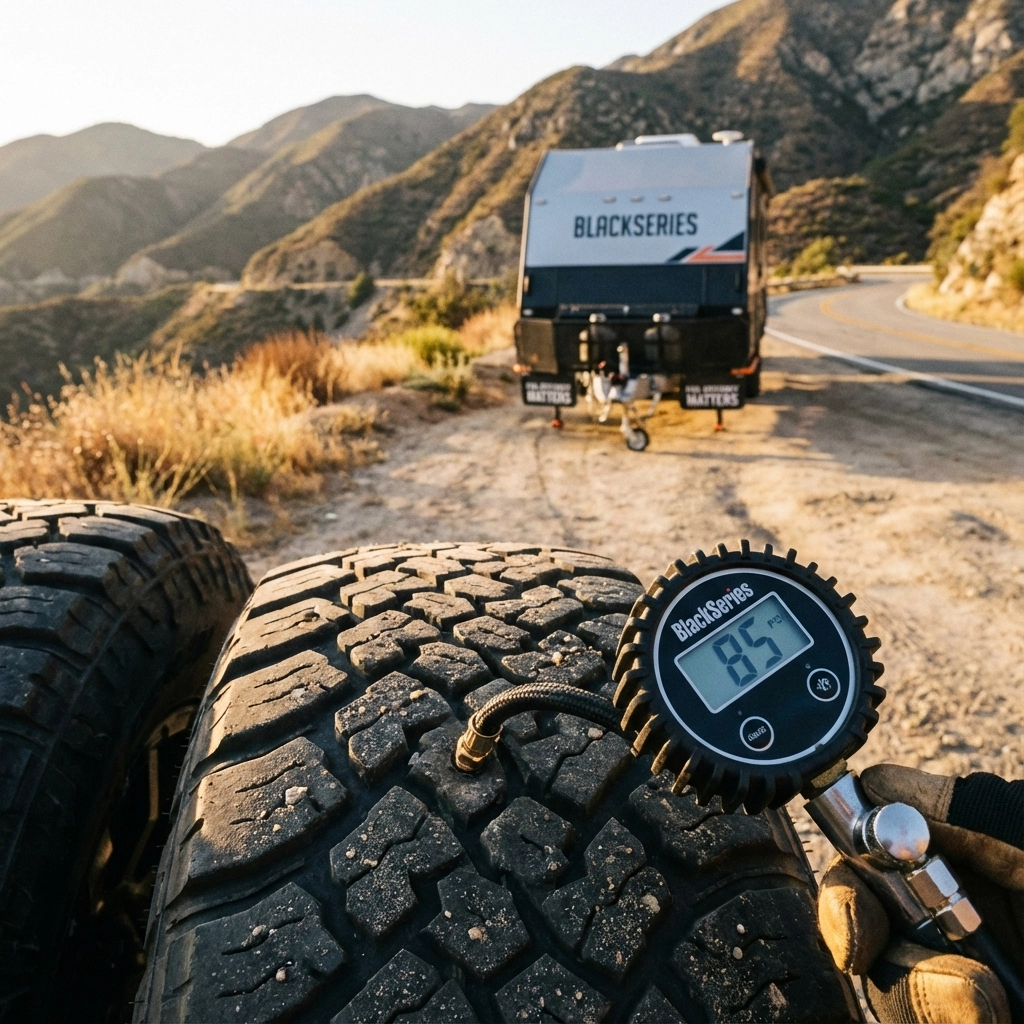
Proper tire pressure on both your tow vehicle and trailer significantly impacts fuel efficiency. Under-inflated tires increase rolling resistance, forcing your engine to work harder. Most American RV owners benefit from investing in a Tire Pressure Monitoring System (TPMS) to maintain optimal pressure.
Recommended PSI ranges:
- Tow vehicle: Follow manufacturer specifications (typically 35-45 PSI)
- Travel trailer: Usually 50-80 PSI depending on tire rating
4. Tow Vehicle Power & Engine Type
Diesel engines consistently outperform gasoline engines in towing scenarios, delivering 20-30% better fuel economy. The higher torque output and energy density of diesel fuel make these engines more efficient for heavy loads.
Real-world comparison:
- Gas V8 towing 7,000 lbs: 8-10 mpg
- Diesel V8 towing 7,000 lbs: 11-13 mpg
5. Speed & Driving Behavior
The 55-65 mph range represents the sweet spot for travel trailer mpg. This speed range balances reasonable travel time with optimal fuel efficiency, as aerodynamic drag hasn’t yet reached exponential levels.
How to Improve Travel Trailer Fuel Economy
Step 1 , Reduce Weight the Smart Way
Create a comprehensive weight reduction checklist:
Water Management:
- Travel with empty fresh water tank (fill at destination)
- Empty gray/black tanks before departure
- Carry minimal drinking water for the journey
Gear Optimization:
- Use lightweight camping equipment
- Eliminate duplicate items
- Store heavy items in your tow vehicle rather than the trailer
Step 2 , Optimize Tire Pressure
Install a quality TPMS system and check pressures weekly. Cold tire pressure should match manufacturer specifications exactly. Under-inflated tires by just 5 PSI can reduce fuel economy by 2-3%.
Step 3 , Tow at the Optimal Speed
Maintain 60-65 mph on highways for best fuel efficiency. This speed range provides:
- Optimal aerodynamic efficiency
- Reasonable travel times
- Maximum fuel economy
- Reduced engine stress
Step 4 , Maintain the Tow Vehicle
Monthly maintenance checklist:
- Engine oil and filter changes every 5,000 miles when towing
- Air filter inspection and replacement
- Transmission service every 30,000 miles
- Cooling system maintenance
Step 5 , Improve Aerodynamic Efficiency
Reduce wind resistance through strategic modifications:
- Remove roof-mounted cargo when not needed
- Retract awnings and antennas while traveling
- Consider aerodynamic accessories like bed covers
- Maintain proper following distance to avoid wind turbulence
Step 6 , Choose a Fuel-Efficient Route
Plan routes that minimize elevation changes and heavy traffic. Mountain passes can reduce fuel economy by 40-50% compared to flat interstate highways. Use trip planning apps to identify the most fuel-efficient routes.
Step 7 , Select a Fuel-Efficient Trailer
BlackSeries off-road trailers combine lightweight construction with aerodynamic efficiency. The independent suspension system reduces bouncing and sway, creating more stable towing that improves fuel economy. When planning adventures to remote locations like those covered in our dispersed camping guide, choosing an efficient trailer becomes even more critical.

Best Practices for Reducing Travel Trailer Fuel Consumption
Top 10 Fuel Economy Checklist
- Maintain proper tire pressure – Check monthly with quality gauge
- Drive 60-65 mph maximum – Avoid speed-induced drag penalties
- Minimize trailer weight – Carry only essentials
- Perform regular maintenance – Keep engine in peak condition
- Use cruise control – Maintain steady speeds when possible
- Plan efficient routes – Avoid mountains and heavy traffic
- Choose aerodynamic trailers – Consider BlackSeries streamlined designs
- Avoid excessive idling – Turn off engine during extended stops
- Monitor weather conditions – Headwinds significantly impact economy
- Use high-quality fuel – Top-tier gas stations provide better additives
Travel Trailer Fuel Cost Breakdown
500-Mile Trip Cost Analysis (2026 US Averages)
*Based on $5.00/gallon average (California 2026)
Regional Fuel Price Variations
Most expensive states (2026):
- California: $5.20/gallon
- Hawaii: $5.15/gallon
- Washington: $4.95/gallon
Most affordable states (2026):
- Texas: $4.25/gallon
- Louisiana: $4.30/gallon
- South Carolina: $4.35/gallon
Case Study: How BlackSeries Owners Save Fuel on Long Trips
Owner Profile: Los Angeles to Zion National Park
Setup Details:
- 2025 Ford F-250 diesel
- BlackSeries HQ19 trailer (6,800 lbs loaded)
- 525-mile round trip
Results:
- Highway segments (65 mph): 12.5 mpg
- Mountain sections (45-55 mph): 9.8 mpg
- Overall trip average: 11.2 mpg
- Total fuel cost: $235 (versus $294 estimated for equivalent traditional trailer)
Owner Profile: Off-Road Adventure in Colorado
Setup Details:
- 2024 Ram 2500 diesel
- BlackSeries HQ15 trailer (5,200 lbs)
- Mixed highway/off-road terrain
Key Efficiency Factors:
- BlackSeries independent suspension reduced bouncing and drag
- Lightweight aluminum construction saved 800 lbs versus comparable steel trailers
- Aerodynamic profile improved highway efficiency
Results: 13% better fuel economy than previous steel trailer setup, saving approximately $180 per 1,000 miles traveled.
FAQ Section
What is a good MPG when towing a travel trailer?
Achieving 8-12 mpg is considered good when towing a travel trailer, with 10 mpg being the average for most mid-size setups. Diesel engines typically achieve the higher end of this range, while gasoline engines tend toward the lower end. Factors like trailer weight, driving speed, and terrain significantly impact these numbers.
How much does weight affect travel trailer fuel efficiency?
Every 1,000 pounds of additional weight typically reduces fuel economy by 2-3 mpg. This makes weight management one of the most effective ways to improve efficiency. The difference between a 5,000-pound and 8,000-pound trailer can mean 3-4 mpg difference in real-world driving.
Is diesel better than gas for towing?
Yes, diesel engines consistently deliver 20-30% better fuel economy when towing heavy loads. Diesel fuel contains more energy per gallon and diesel engines produce higher torque at lower RPMs, making them more efficient for towing applications. However, diesel fuel costs more and diesel vehicles have higher purchase prices.
Does speed dramatically change fuel consumption?
Absolutely. Fuel consumption increases exponentially above 65 mph due to aerodynamic drag. Driving 75 mph versus 60 mph can increase fuel consumption by 35-40%. The 55-65 mph range provides the best balance of efficiency and reasonable travel time.
How can I calculate my fuel cost for a long trip?
Divide your total mileage by your expected mpg (use 10 mpg for conservative planning), then multiply by current fuel prices. For example: 1,000 miles ÷ 10 mpg = 100 gallons × $5.00 = $500. Add 10-15% buffer for route variations and fuel price differences.
Do off-road trailers like BlackSeries consume more fuel?
Not necessarily. While off-road trailers may have slightly higher profiles, modern designs like BlackSeries focus on lightweight construction and aerodynamic efficiency. The independent suspension actually improves towing stability, which can enhance fuel economy compared to bouncing, swaying trailers.
What is the cheapest state to fuel up in?
Texas consistently offers the lowest fuel prices, often 15-20% below the national average. Other affordable states include Louisiana, South Carolina, and Alabama. Plan fuel stops in these states when possible, but don’t make significant detours as the extra mileage often negates savings.
How much should I budget for fuel on a cross-country RV trip?
Budget approximately $0.50-$0.65 per mile for fuel costs when towing a travel trailer, based on 2026 fuel prices. A 3,000-mile cross-country trip would cost $1,500-$1,950 in fuel. This assumes 10 mpg average and $5.00/gallon fuel prices. Add 20% buffer for price variations and route changes.

