Towing with an SUV is the ultimate way to bring the whole family along on your next adventure. Unlike heavy-duty trucks, modern SUVs offer a perfect balance of daily drivability and weekend warrior capability. But here’s the reality: that versatility comes with a catch. You need the right hitch setup to handle the job safely.
At BlackSeries, we design our off-road travel trailers to be compatible with modern SUVs, provided you’ve done your homework on towing capacity and hitch specs. A proper setup means you can confidently pull a 16 ft camper weight trailer through mountain passes, navigate twisty forest roads, and arrive at your remote campsite without white-knuckling the steering wheel.
In this guide, we’ll walk you through everything you need to know: from understanding hitch classes to avoiding the most common (and dangerous) mistakes SUV owners make when towing. Let’s get into it.
Why Hitch Setup is Critical for SUVs
Unlike pickup trucks with stiff leaf-spring suspensions designed specifically for hauling, many SUVs come equipped with softer, comfort-oriented suspension systems. That’s great for daily commutes and grocery runs, but it creates a challenge when you hook up a travel trailer.
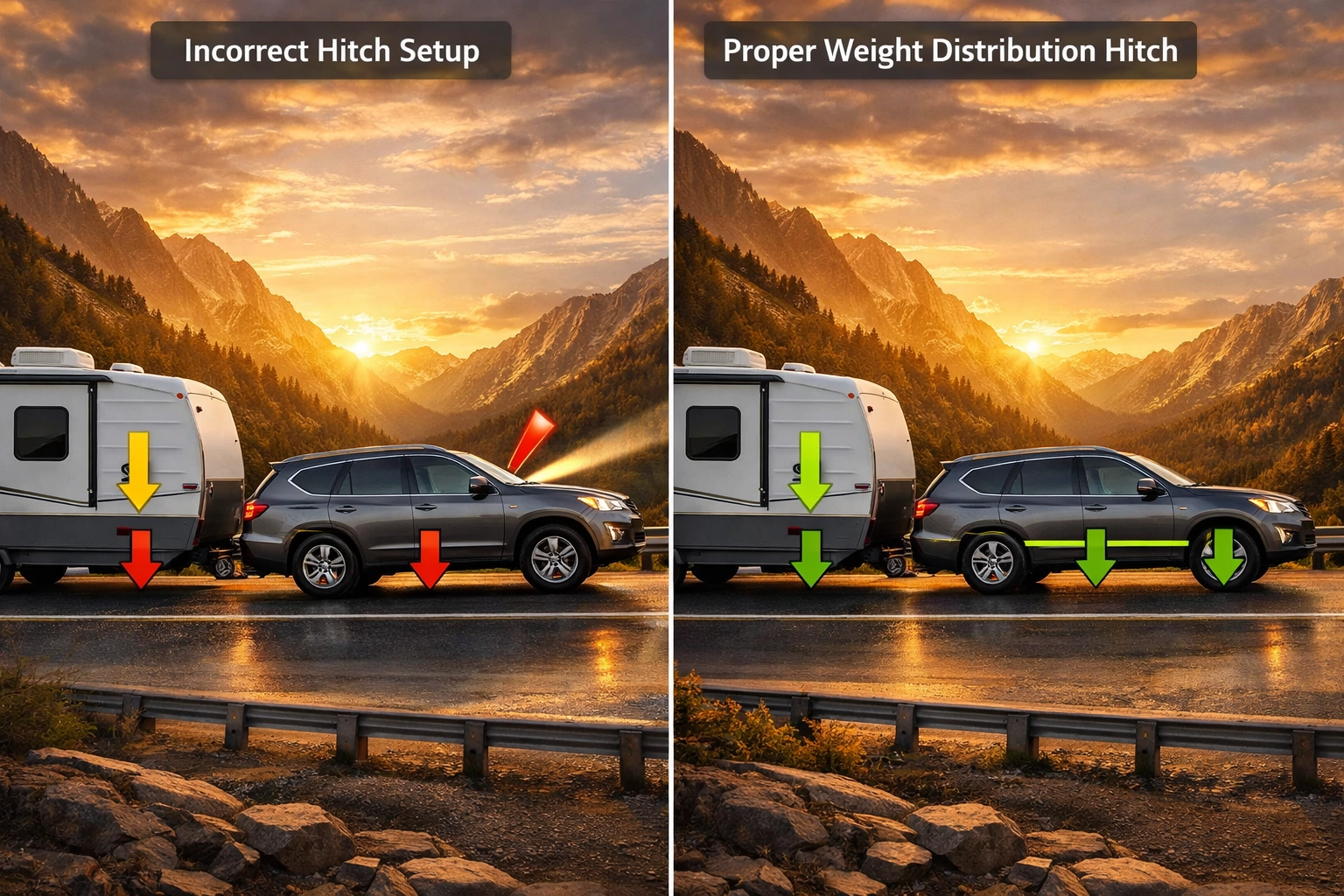
The problem? When you add the average weight of camper trailers, especially something in the 18 ft camper weight or 24 ft camper weight range, an improperly set up hitch can cause rear-end sag and front-end lift. Your headlights start pointing at the sky, your steering feels vague, and your braking distance increases. None of that is good.
A proper hitch setup ensures:
- Safety: The weight is distributed evenly across your SUV’s axles, keeping all four tires planted and your braking effective.
- Handling: Your SUV stays level, which means better cornering stability and more predictable steering response.
- Legal Compliance: Many states have weight limits and equipment requirements. An overloaded or improperly equipped SUV can result in fines, or worse, liability in an accident.
The bottom line: a good hitch setup keeps you legal, safe, and confident on the highway.
Understanding Hitch Classes: What Your SUV Actually Needs
Not all hitches are created equal. The industry uses a class system to categorize hitches based on their weight capacity. For most SUV owners towing travel trailers, you’ll be looking at Class III or Class IV hitches.
Class III Hitches
- Towing Capacity: Up to 8,000 pounds
- Receiver Size: 2-inch square
- Best For: Mid-size SUVs towing trailers in the 16 ft camper weight to 24 ft camper weight range
Class III is the sweet spot for most modern SUVs. It’s strong enough to handle a fully loaded off-road travel trailer, but not so heavy that it adds unnecessary weight to your vehicle. If your SUV has a towing capacity in the 5,000–7,000 pound range (think Honda Passport, Jeep Grand Cherokee, or Toyota 4Runner), a Class III hitch is your starting point.
Class IV Hitches
- Towing Capacity: Up to 10,000 pounds
- Receiver Size: 2-inch square (same as Class III, but reinforced)
- Best For: Full-size SUVs towing heavier trailers, including 30 foot rv weight rigs
If you’re driving a Chevy Tahoe, Ford Expedition, or Nissan Armada, you’ll likely need a Class IV hitch. These are built with thicker steel and additional bracing to handle the stress of towing heavier loads over long distances.
The Polyblock Articulating Hitch (Off-Road Game Changer)
Here’s where things get interesting for BlackSeries customers. Standard receiver hitches are rigid, they don’t flex. That’s fine on pavement, but when the road ends and the trail begins, a rigid connection can create dangerous binding forces between your SUV and trailer.
A polyblock articulating hitch allows the trailer to move independently on uneven terrain. It absorbs the shock from rocks, ruts, and off-camber sections, reducing stress on your SUV’s frame and keeping your rig stable. If you’re planning serious off-road use, this upgrade is non-negotiable.
Step-by-Step Hitch Setup for SUVs
Ready to get your SUV trail-ready? Here’s the process, broken down into five actionable steps.
Step 1: Determine Your SUV’s Towing Capacity
Before you buy a hitch, or a trailer, you need to know your SUV’s maximum towing capacity. This number is typically listed in your owner’s manual or on a sticker inside the driver’s door jamb.
Here’s the key rule: Never exceed 80% of your rated capacity. If your SUV is rated to tow 7,000 pounds, your real-world limit should be closer to 5,600 pounds. This safety buffer accounts for passengers, gear, water tanks, and any additional cargo you’ll be hauling.
For example:
- A 16 ft camper weight trailer might weigh 3,000–3,500 pounds dry, but add water, food, and gear, and you’re closer to 4,500 pounds.
- An 18 ft camper weight rig could easily hit 5,000 pounds fully loaded.
- A 24 ft camper weight trailer? You’re looking at 6,000–7,500 pounds.
Don’t forget: passengers and cargo inside your SUV count toward your vehicle’s Gross Vehicle Weight Rating (GVWR), which reduces how much trailer weight you can safely tow.

Step 2: Choose the Right Hitch Type and Size
Once you know your capacity, match it to the appropriate hitch class. Pay attention to two critical numbers:
- Gross Trailer Weight (GTW): The total weight of your trailer when fully loaded.
- Tongue Weight (TW): The downward force the trailer exerts on the hitch ball. This should be 10–15% of your GTW.
For a 5,000-pound trailer, expect roughly 500–750 pounds of tongue weight pressing down on your hitch. If your SUV’s hitch is only rated for 500 pounds of tongue weight, you’re already overloaded before you even add cargo.
Step 3: Install the Hitch Receiver
If you’re mechanically inclined and have the right tools, you can install a bolt-on receiver hitch yourself. Most kits include:
- The hitch receiver
- Mounting hardware (bolts, washers, lock nuts)
- Detailed instructions
Important: The hitch must bolt directly to your SUV’s frame, not the bumper. If you’re not confident, have a professional install it. A poorly installed hitch can fail catastrophically at highway speeds.
Step 4: Attach the Trailer and Set Up Weight Distribution
Here’s where most SUV owners make their first mistake. They hook up the trailer, see the rear end squat, and think, “Eh, good enough.”
Not good enough.
A Weight Distribution System (WDS) uses spring bars to transfer some of the tongue weight forward, leveling out your SUV and improving steering response. This is especially critical for 18 ft camper weight or larger trailers.
To set up a WDS:
- Measure your SUV’s front and rear fender heights with the trailer attached but without the WDS engaged.
- Engage the spring bars and adjust tension until the front and rear measurements are roughly equal.
- Aim for a 60/40 weight distribution (60% on the SUV’s rear axle, 40% on the front).
Step 5: Perform Safety Checks
Before you hit the road, verify:
- Safety chains: Crossed under the tongue in an “X” pattern, with enough slack for turns but not dragging on the ground.
- Brake controller: If your trailer weighs over 3,000 pounds, you need an electronic brake controller installed in your SUV.
- Lights: Test brake lights, turn signals, and running lights. A faulty connection can leave you invisible to other drivers.
- Breakaway cable: This emergency cable activates the trailer’s brakes if it detaches from the hitch.
Weight Distribution and Sway Control: The Non-Negotiables
Even with a perfect hitch setup, physics can work against you. Crosswinds, passing semi-trucks, and uneven road surfaces can all cause trailer sway: that terrifying side-to-side oscillation that makes you feel like you’ve lost control.
Why Sway Happens
Sway is caused by a mismatch between your SUV’s center of gravity and the trailer’s. When the trailer starts to push or pull laterally, your SUV’s softer suspension allows it to shift, amplifying the movement.
Sway Control Systems
Modern sway control systems use friction or hydraulic resistance to dampen lateral movement. There are two main types:
- Friction Sway Control: A friction pad presses against the trailer tongue, resisting side-to-side movement. Simple and affordable, but less effective at high speeds.
- Integrated Sway Control (built into WDS): Uses geometry and tension to prevent sway before it starts. More expensive, but far more effective.
If you’re towing a 30 foot rv weight or 30 ft camper weight trailer with an SUV, integrated sway control isn’t optional: it’s essential.
Common Hitch Setup Mistakes (And How to Avoid Them)
Even experienced RVers make these errors. Don’t be one of them.
Mistake #1: Underestimating Average Travel Trailer Weights
Manufacturers list “dry weight,” which is the trailer’s weight with empty tanks and no cargo. Real-world weight is always higher. Add:
- Water (8.34 pounds per gallon)
- Propane (4.2 pounds per gallon)
- Food, clothing, camping gear, bikes, etc.
A 4,000-pound dry weight trailer can easily become a 5,500-pound loaded rig.
Mistake #2: Ignoring Tongue Weight
Even if your total trailer weight is within spec, an incorrect tongue weight can ruin your towing experience. Too little tongue weight (under 10%) causes sway. Too much (over 15%) overloads your rear axle and lifts the front end.
Mistake #3: Forgetting About Passengers and Gear
Your family, your dog, your cooler full of drinks: they all count against your SUV’s payload capacity. If you’re maxing out your towing capacity, you might not have enough payload left for everyone to ride safely.
Frequently Asked Questions
How do I know if my SUV is capable of towing a travel trailer?
Check your owner’s manual for the maximum towing capacity and payload rating. Compare those numbers to the trailer’s Gross Vehicle Weight Rating (GVWR) and tongue weight. If your SUV can handle both: with a 20% safety buffer: you’re good to go.
What size hitch do I need for my SUV?
Most SUVs use a 2-inch receiver hitch (Class III or IV). Confirm your vehicle’s towing capacity and match it to the appropriate hitch class.
How do I install a hitch receiver on my SUV?
Bolt-on receiver hitches attach directly to your SUV’s frame using pre-drilled mounting points. If you’re not comfortable working under your vehicle, have a professional handle the installation to ensure proper alignment and torque specs.
How do I ensure my trailer stays stable while towing?
Use a Weight Distribution System to level your SUV, install sway control to dampen lateral movement, and never exceed 80% of your rated towing capacity.
What are the best towing accessories for SUVs?
Essential accessories include:
- Electronic brake controller
- Weight distribution hitch with integrated sway control
- Extended side mirrors for better visibility
- Tire pressure monitoring system (TPMS) for trailer tires
Conclusion: Tow Smart, Tow Safe
A proper hitch setup transforms your SUV from a daily driver into an adventure-ready tow vehicle. Whether you’re pulling a nimble 16 ft camper weight rig or pushing the limits with a 30-foot camper weight trailer, the fundamentals remain the same: match your equipment to your capacity, distribute weight correctly, and prioritize safety at every step.
At BlackSeries, we design our off-road travel trailers to be SUV-compatible: but the responsibility for safe towing starts with you. If you’re ready to find the perfect trailer-SUV match, visit BlackSeries and talk to our team about your towing goals. We’ll help you choose a rig that fits your vehicle, your lifestyle, and your next great adventure.
Now get out there and explore. The trail is waiting. 🚙✨

