A proper travel trailer setup ensures safety, comfort, and system reliability, especially for first-time owners setting up at campgrounds or off-grid sites. The difference between a successful trip and a frustrating experience often comes down to following the right setup sequence and avoiding common beginner mistakes that can damage your trailer or compromise your safety.
What Is a Travel Trailer Setup?
Travel trailer setup is the complete process of positioning, stabilizing, leveling, and connecting all systems to make your trailer safe and functional for camping. This goes far beyond simply parking, it’s a systematic approach that ensures your refrigerator works properly, your slide-outs operate safely, and your trailer remains stable in all weather conditions.
Many beginners confuse “parking” with “setup,” but a complete setup involves eight critical steps that must be done in the correct order. Skipping steps or doing them out of sequence can lead to equipment damage, safety hazards, or system malfunctions.
The three most commonly misunderstood aspects for new trailer owners are:
- Leveling requirements – Your trailer must be level for appliances to function correctly
- Hookup priorities – Water, electrical, and sewer connections have a specific order
- Stabilizer function – These prevent movement but don’t replace proper leveling
Before You Arrive: Pre-Setup Preparation
Smart travel trailer setup starts before you reach your campsite. Your site selection and pre-arrival preparation determine how smooth your setup process will be.
When choosing your site, consider these factors:
- Terrain and slope – Look for the most level spot available
- Wind direction – Position your trailer to minimize wind impact on slide-outs and awnings
- Entry and exit space – Ensure you have room to maneuver your tow vehicle
- Hookup proximity – Check distances to electrical, water, and sewer connections
Complete these five essential checks before attempting setup:
- Walk the entire site for obstacles, holes, or hazards
- Locate all hookups and measure distances to your trailer connections
- Check overhead clearance for slide-outs and awnings
- Identify the high and low points of your site for leveling strategy
- Confirm your trailer’s systems are ready (propane off, slide-outs retracted)
The most overlooked rookie mistake is failing to survey the site thoroughly before backing in. Many new owners discover obstacles, insufficient space, or impossible hookup distances only after they’ve positioned their trailer, forcing them to restart the entire process.
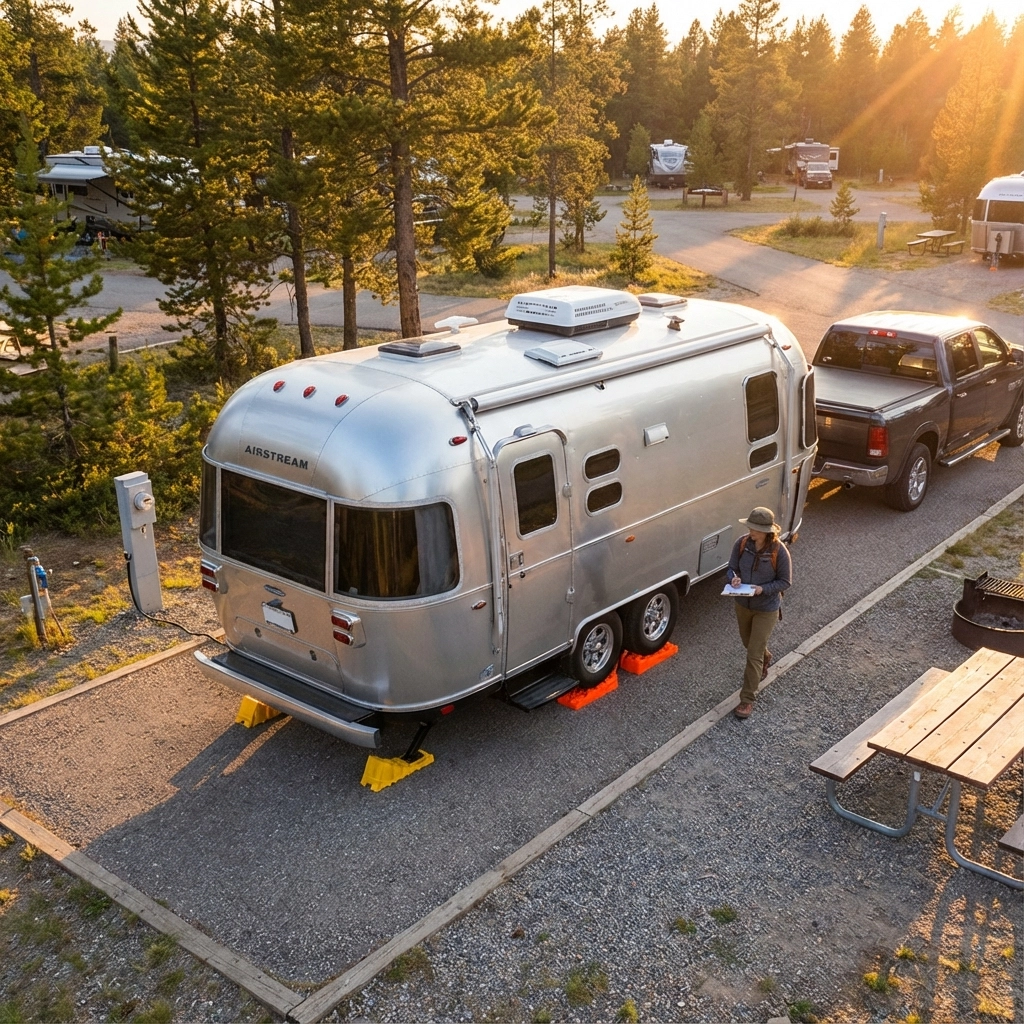
Travel Trailer Setup Checklist
Follow this sequential checklist for every setup. Each step builds on the previous one, so maintain this order:
1. Parking & Positioning
- Survey site completely before backing in
- Position trailer considering hookup distances and obstacles
- Leave adequate space for slide-outs and awning deployment
- Ensure level ground as much as possible
2. Leveling the Trailer
- Level side-to-side first using leveling blocks if needed
- Check level with bubble levels on multiple points
- Verify refrigerator will operate properly when level
3. Chocking the Wheels
- Place wheel chocks on both sides of trailer tires
- Use front and rear chocks for maximum stability
- Ensure chocks are snug against tires
4. Stabilizer Jacks
- Lower all four corner stabilizer jacks
- Use jack pads on soft ground to prevent sinking
- Extend until snug but don’t over-tighten
5. Power, Water, Sewer Hookups
- Connect electrical with surge protector first
- Attach water regulator and hose
- Connect sewer hose if available (save for last)
6. Safety & Final Checks
- Test all electrical connections and GFCI outlets
- Verify water pressure and check for leaks
- Ensure all systems are functioning before use
This checklist works for both campground and boondocking setups, though off-grid sites may require additional leveling blocks and different stabilizing strategies.
How to Set Up a Travel Trailer (Step-by-Step)
Standard Campground Setup:
Step 1: Site Survey and Positioning
Walk your site completely, identifying hookup locations and any obstacles. Back your trailer into position, allowing at least 8 feet on the slide-out side and 3 feet clearance around the entire perimeter.
Step 2: Initial Leveling
Check your trailer’s level using bubble levels placed on the floor inside. Level side-to-side first by driving one side onto leveling blocks if needed. Don’t attempt front-to-back leveling until you unhitch.
Step 3: Secure and Stabilize
Place wheel chocks on both sides of your trailer tires, both front and rear of each tire. Lower your tongue jack using a tongue jack pad, then unhitch your tow vehicle. Adjust the tongue jack to level front-to-back.
Step 4: Deploy Stabilizers
Lower all four corner stabilizer jacks until they contact the ground firmly. Use jack pads on soft surfaces. The goal is to eliminate bounce and movement, not to lift the trailer.
Step 5: Connect Utilities
Start with electrical, always use a surge protector. Connect your water regulator and hose next, then test water pressure. If you have sewer hookups, connect that hose last since it involves the messiest connection.
Off-Grid and Non-Paved Setup Differences:
- Carry extra leveling blocks for uneven terrain
- Use larger jack pads to distribute weight on soft ground
- Consider wind exposure more carefully when positioning
- Verify adequate ground clearance before committing to a spot
The setup order matters because each step depends on the stability achieved in previous steps. Attempting to level after deploying stabilizers, for example, can damage your jacks or create an unstable setup.
First Time Travel Trailer Setup (Beginner Guide)
New travel trailer owners commonly make these five critical mistakes:
- Rushing the positioning – Take time to survey and plan before backing in
- Ignoring the level – An unlevel trailer affects refrigerator operation and door function
- Over-torquing stabilizers – These prevent movement but shouldn’t bear the trailer’s weight
- Forgetting wheel chocks – Essential safety equipment that prevents rolling
- Wrong hookup sequence – Always connect electrical with surge protection first
Solo vs. Team Setup Considerations:
Solo setup is entirely possible but requires more planning. Use wheel chocks immediately after positioning, and consider investing in powered stabilizer jacks to reduce physical effort. Having a second person helps primarily with spotting during backing and handling hose connections.
Reducing First-Time Anxiety:
Practice your setup routine at home or in a large parking lot before your first camping trip. Time yourself going through each step, and create a written checklist you can follow until the process becomes automatic. Most first-time setups take 45-60 minutes, but experienced owners can complete the process in 15-20 minutes.
Remember that everyone learns through experience. Don’t hesitate to ask neighboring campers for advice, the RV community is known for helping newcomers.

Travel Trailer Setup Tips for Off-Grid & Overland Use
Off-grid setup requires different thinking than campground camping. When you’re setting up on uneven, natural terrain, your approach must account for challenging conditions.
Leveling on Uneven Terrain:
- Carry a full set of interlocking leveling blocks, not just single blocks
- Use a torpedo level and bubble level apps on your phone for accuracy
- Consider lynx levelers or curved leveling blocks for extreme angles
- Accept “good enough” leveling, perfection isn’t always possible off-grid
Weather and Ground Condition Strategies:
- Wind management – Position your trailer’s narrow end into prevailing winds
- Sand and soft ground – Use large pads under all jacks and consider sand anchors for your awning
- Muddy conditions – Carry boards or mats for stable footing and jack placement
- Rocky terrain – Inspect your site carefully for sharp rocks that could damage hoses or electrical cords
Why Off-Road Trailers Need Different Setup Thinking:
Traditional travel trailers assume level campground pads with hookups. Off-road capable trailers like BlackSeries models are designed with higher ground clearance, reinforced frames, and independent suspension systems that actually work better on uneven terrain. These design differences mean you can set up successfully in locations that would be impossible with conventional trailers.
The key difference is accepting that off-grid setup prioritizes functionality over perfection. Your trailer doesn’t need to be perfectly level, just level enough for appliances to work and comfortable enough for sleeping.
Common Setup Mistakes to Avoid
Unchocked Wheels
This is the most dangerous oversight. Even on level ground, thermal expansion and contraction can cause trailers to move. Wind loading on awnings or slide-outs can also create movement. Always use wheel chocks on both sides of your trailer, regardless of conditions.
Overreliance on Stabilizers
Stabilizer jacks prevent bouncing and movement, they’re not designed to support your trailer’s weight or correct major leveling issues. Over-extending stabilizers can damage the jacks, your trailer frame, or create an unstable setup. Use leveling blocks first, then stabilizers to eliminate movement.
Ignoring Power and Load Checks
Before connecting shore power, verify the campground’s electrical system with a multimeter or outlet tester. Reversed polarity, missing grounds, or incorrect voltage can damage your trailer’s electrical system. Similarly, know your trailer’s power requirements before running high-draw appliances simultaneously.
Always test GFCI outlets after connection and verify your surge protector is functioning. Electrical problems in RV parks are more common than most campers realize.
Why Trailer Design Matters for Easy Setup
Not all travel trailers are created equal when it comes to setup ease and reliability. The design decisions made during manufacturing directly impact how successfully you can set up in various conditions.
Structural Stability and Setup Success
Trailers with reinforced chassis, quality suspension systems, and well-designed stabilizer mounting points set up more reliably and remain stable longer. A flexible or under-built frame fights against your leveling efforts and creates ongoing stability issues.
Off-Road vs. Standard Travel Trailer Differences
Standard travel trailers assume campground use with level pads, hookups, and paved access. Off-road trailers incorporate higher ground clearance, skid plates, reinforced water and electrical systems, and independent suspension that actually performs better on uneven terrain.
BlackSeries trailers, for example, feature reinforced aluminum construction, independent torsion suspension, and thoughtfully positioned utilities that make setup possible in challenging locations where conventional trailers simply can’t go. The design philosophy prioritizes durability and off-grid capability over maximum interior space.
Design Determines Setup Difficulty
Features like easy-access utility connections, quality stabilizer jacks, accessible leveling points, and durable exterior components make setup faster and more reliable. Investing in a well-designed trailer pays dividends every time you set up camp, especially in challenging conditions.
The difference becomes obvious when you’re trying to set up in sand, on a slope, or in windy conditions. Quality design handles these challenges; poor design makes them nearly impossible.
FAQ
How long does it take to set up a travel trailer?
First-time setup typically takes 45-60 minutes as you learn the process. Experienced owners can complete setup in 15-20 minutes. Off-grid setups may take longer due to terrain challenges and the need for more careful positioning.
Do I need leveling blocks for every setup?
Not every setup requires leveling blocks, but you should carry them for every trip. Most campsites have some slope, and even minor unlevel conditions can affect refrigerator operation and door function. Interlocking leveling blocks are the most versatile option.
Can one person set up a travel trailer?
Absolutely. Solo setup is common and completely manageable with proper planning. The key is following your checklist methodically and using wheel chocks immediately after positioning. Powered stabilizer jacks make solo setup easier but aren’t necessary.
Is travel trailer setup different for boondocking?
Yes, boondocking setup requires more attention to positioning for wind protection, solar panel orientation, and terrain challenges. You’ll likely need more leveling blocks and jack pads, and you won’t have hookups to guide your positioning. Focus on finding the most level spot possible and protecting your trailer from weather.
What should beginners practice first?
Practice hitching and unhitching in a safe area like your driveway or an empty parking lot. Get comfortable with backing up and positioning your trailer. Create and follow a written setup checklist until the process becomes automatic. Most importantly, practice using your leveling system and stabilizer jacks before your first camping trip.

