When the days get shorter, every photon counts. For the off-grid adventurer, winter doesn’t mean stopping; it means adapting. BlackSeries trailers are built for the deep freeze, but to keep your batteries humming, you need to master the winter solar tilt. The good news? Cold weather is actually your friend when it comes to solar panel efficiency.
Why the Winter Tilt Matters More Than You Think
In winter, the sun hangs low on the horizon like a lazy campfire that never quite warms up. If your panels are flat on the roof of your HQ21, you’re leaving serious energy on the table. Whether you’re managing the power needs of a 30 foot rv weight rig loaded with lithium batteries and a diesel heater, or a nimble 16 ft camper weight setup perfect for quick weekend escapes, maximizing solar input is the difference between a warm night and a cold one.
Here’s the kicker: while summer gives you long days, winter actually makes your panels more efficient. Studies show that solar panels operate 10-13% more efficiently at 32°F compared to their rated capacity. That’s because solar panels generate electricity from sunlight, not heat, and electrons move more freely in cooler temperatures with less electrical resistance. In extreme cold (around 0°C), panels can produce 5-7% more power than their rated output.
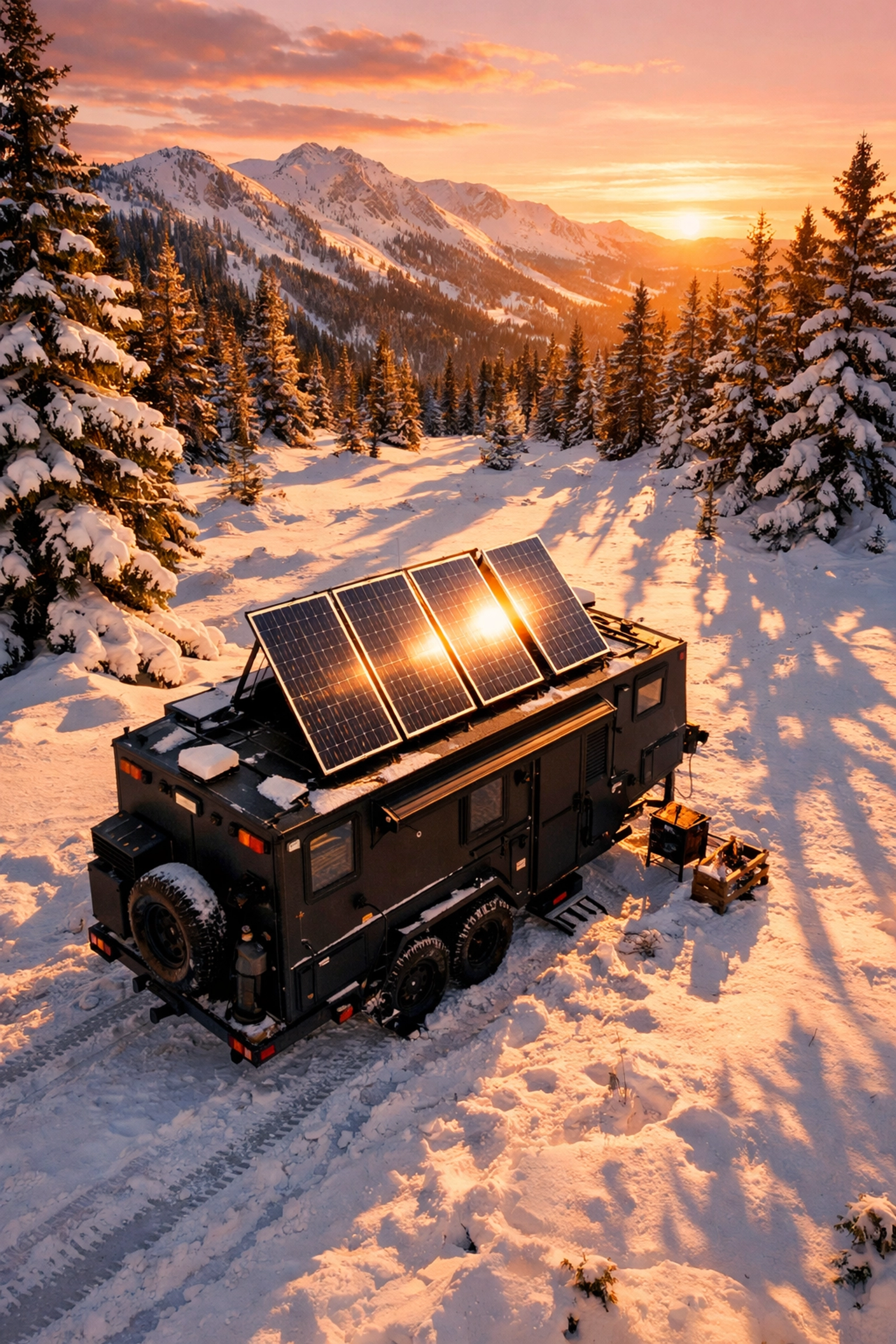
But that efficiency boost only matters if your panels can actually see the sun. A flat-mounted panel on a 24 ft camper weight trailer in Montana will spend most of January under a blanket of snow. That’s where tilt comes in.
The Science of the Angle: Latitude + 15 Degrees
The golden rule for winter solar is simple: Latitude + 15 degrees.
Here’s why this steep angle works magic:
- It captures the low-hanging winter sun. When the sun is at a lower angle in the sky, a steeper panel tilt faces it directly, maximizing exposure.
- Snow slides right off. At angles steeper than 40 degrees, snow naturally sheds as soon as the dark panel surface warms up, even slightly. This self-cleaning feature is critical.
- The albedo effect kicks in. Fresh snow reflects sunlight like a mirror, bouncing extra photons onto your tilted panels and increasing output on clear winter days.
For context, if you’re camping in Colorado (latitude ~39°N), your winter tilt should be around 54 degrees. In Southern California (34°N), you’d aim for 49 degrees. The farther north you go, the steeper the angle.
Step-by-Step: Adjusting Your Solar Panels for Winter
Step 1: Find Your Latitude
Your phone can do this instantly. Open your map app, drop a pin on your location, and check the coordinates. You only need the latitude (the first number). If you’re parked at a remote boondocking spot in Idaho, you might see something like 44°N.
Step 2: Calculate the Tilt
Add 15 degrees to your latitude. So if you’re at 44°N, your optimal winter tilt is 59 degrees. Yes, that’s steep. That’s the point.
If your panels are mounted on a roof rack with adjustable brackets, you’re in business. If they’re fixed-mount, consider upgrading to an adjustable system: especially if you plan to spend winters off-grid.
Step 3: Adjust the Brackets
Most BlackSeries trailers come solar-ready with 400W–600W systems, and many owners upgrade to tilting mounts for exactly this reason.
Here’s how to adjust safely:
- Park on level ground. Use your trailer’s leveling jacks to ensure stability.
- Loosen the bracket bolts (typically 2–4 per panel). Don’t remove them completely: just enough to pivot.
- Tilt the panel to your calculated angle. Use a digital angle finder app or a simple protractor.
- Retighten the bolts. Double-check that everything is secure: winter winds are no joke.
If you’re working with a larger setup on an 18 ft camper weight trailer or bigger, consider doing one panel at a time to avoid overwhelming yourself.

Step 4: Test and Monitor
After adjustment, monitor your system for 2–3 days. Use a battery monitor (like a Victron BMV or similar) to track:
- Amp-hours coming in during peak sunlight (usually 10 AM–2 PM)
- Battery state of charge at the end of each day
- Voltage readings to ensure your batteries are reaching absorption stage
If you’re not seeing improvements, double-check your angle and make sure no shadows are hitting the panels during peak hours.
Step 5: Maintenance Throughout Winter
Snow is sneaky. Even a light dusting can drop your output to zero, which is a major bummer when you’re towing an average travel trailer weights setup into the mountains and relying on that power for heaters, lights, and the all-important coffee maker.
Pro tip: Keep a soft-bristled broom or snow brush in your gear box. A quick sweep in the morning after fresh snowfall takes 60 seconds and can restore 100% of your solar capacity. Never use metal tools or sharp objects: you’ll scratch the panel surface and reduce efficiency permanently.
Winterizing Your Entire Power System
Solar angle is only half the battle. To survive (and thrive) off-grid in winter, you need to protect the rest of your electrical system.
Battery Protection: Keep Those Lithiums Happy
Lithium batteries are standard in most modern BlackSeries builds, and they’re finicky about temperature. Below 32°F, lithium cells can’t accept a charge: and forcing it can cause permanent damage.
The solution? Heated battery compartments. Many BlackSeries trailers come with insulated, climate-controlled battery bays that keep your power bank in the “happy zone” (40–80°F). If you’re DIY-upgrading an older rig, consider adding:
- Battery blankets or heating pads (low-wattage, thermostat-controlled)
- Insulated battery boxes with foam or reflective barriers
- A secondary AGM battery for cold-weather charging (they’re more forgiving)
Even a compact 30 ft camper weight rig needs at least 200Ah of usable capacity to run a diesel heater, LED lights, and a 12V fridge overnight without solar input. Plan accordingly.
Clearing Debris: The Enemy You Can’t Ignore
Pine needles, leaves, ice buildup, and road grime all cut into your solar efficiency. Make it a habit to inspect and clean your panels weekly during winter camping trips. Use:
- Warm (not hot) water and a soft sponge
- A 50/50 mix of water and white vinegar for stubborn grime
- A squeegee for final drying
Avoid harsh chemicals: they can damage the anti-reflective coating on modern panels.
Common Mistakes That Kill Winter Solar Performance
Mistake #1: Using Fixed Mounts Year-Round
If you never adjust your panels, you’re losing 30–50% of potential winter output. Fixed flat mounts are fine for summer road trips, but they’re a liability once November hits. Even a 30-foot camper weight rig with 600W of solar can feel underpowered if the panels aren’t angled right.
Mistake #2: Forgetting to Clean the Panels
A layer of snow isn’t the only problem. Road salt spray, dust storms, and morning frost all create a film that blocks light. Clean panels = more watts. It’s that simple.
Mistake #3: Underestimating Your Power Draw
People always forget how much energy winter camping requires. Running a diesel heater for 8 hours can pull 30–40Ah. Add in a 12V fridge (another 20Ah), LED lights (5Ah), phone charging (3Ah), and a laptop (10Ah), and you’re burning through 70–80Ah per night: even when you’re “taking it easy.”
For an off-road travel trailer with a 30 ft rv weight or larger, plan for at least 300Ah of lithium and 600W+ of solar if you’re serious about boondocking through January.
The BlackSeries Advantage: Built for Boondocking
BlackSeries trailers aren’t just tough: they’re smart. Our solar-ready systems are designed with off-grid winter warriors in mind:
- High-capacity lithium banks (up to 600Ah in flagship models like the HQ21)
- Pre-wired for expansion so you can add panels or upgrade to MPPT controllers without rewiring
- Insulated battery compartments standard on most models
- Roof-mounted tilt brackets available as dealer-installed options
Whether you’re hauling a 16 ft camper weight HQ12 through the Sierras or piloting a fully-loaded 24 ft camper weight HQ19 into the Yukon, our trailers give you the foundation to go farther and stay longer. The average weight of camper in our lineup is optimized for modern SUVs and half-ton trucks, so you’re not sacrificing drivability for off-grid capability.
And here’s the best part: even in the dead of winter, our owners regularly report net-positive energy days when conditions are right. Cold air, tilted panels, and that beautiful albedo effect from snow-covered ground can turn your rig into a power-generating machine.
Frequently Asked Questions
How do I know if my solar panels are tilted at the correct angle for winter?
Use a digital angle finder app (most smartphones have one built-in) or a simple protractor. Your target is latitude + 15 degrees. If you’re getting strong charging performance even on partly cloudy days, you’re dialed in.
Can I leave my solar panels at a fixed angle year-round?
You can, but you’ll lose 30–50% of potential winter output and risk snow accumulation. For serious off-gridders, adjustable mounts are worth every penny.
What happens if I don’t adjust my solar panels for winter?
Your panels will still work, but they’ll collect significantly less energy. In extreme cases, snow will pile up and block 100% of your output until you manually clear it: which defeats the purpose of “passive” solar.
Are there any special solar panel systems designed for winter camping?
Not really: standard monocrystalline panels work great in cold weather (they’re actually more efficient when it’s cold). The key is the mounting system, not the panel itself. Invest in adjustable tilt brackets and a good MPPT charge controller.
How can I optimize solar energy usage in cold climates without constant adjustments?
Set your panels to the winter angle (latitude + 15°) in November and leave them there until March. Keep them clean, monitor your battery health, and reduce phantom loads (unplug devices you’re not using). A well-tuned system shouldn’t need daily tweaking.
Conclusion: Don’t Let the Winter Sun Escape
Winter camping doesn’t have to mean rationing power or running your generator every night. With the right tilt angle, clean panels, and a properly winterized electrical system, your BlackSeries trailer can stay off-grid indefinitely: even when the thermometer drops below zero.
The science is clear: cold temperatures boost efficiency, steep angles shed snow and capture low-angle sunlight, and modern lithium systems give you the capacity to power through long winter nights. All you have to do is tilt those panels and let physics do the rest.
Ready to upgrade your off-grid setup? Explore our solar-ready off-road trailers and discover why BlackSeries owners spend more time adventuring and less time worrying about power. Winter is calling: and your batteries are ready to answer.

