Whether you’re towing a compact 16 ft camper weight class trailer or hauling a full-size 30 foot rv weight beast, the trade-in process has become remarkably streamlined. Dealers handle the paperwork, the valuation, and even your existing loan payoff. You show up with your current rig, and you leave with something better.
But here’s the real question most owners should be asking: Should I trade my RV? And more importantly, what should I trade it for?
This guide breaks down everything you need to know about trading your RV in 2026, from the step-by-step process to the financial math that makes it worthwhile.
Can I Trade My RV? (The Direct Answer)
Yes. Almost every RV type qualifies for a trade-in:
- Travel trailers (from 16 ft camper weight models to 24 ft camper weight mid-size rigs)
- Fifth wheels
- Motorhomes (Class A, B, and C)
- Pop-up campers and toy haulers
And here’s what surprises most owners: you can trade in a financed RV too. The dealer simply pays off your remaining loan balance, applies any positive equity toward your new purchase, and handles the title transfer.
The trade-in process typically completes within 1-2 business days, a fraction of the time (and stress) of a private sale.
Whether you’re moving up from a standard camper to an off-road travel trailer or simply swapping for something with better off-grid capability, trading in is the path of least resistance.
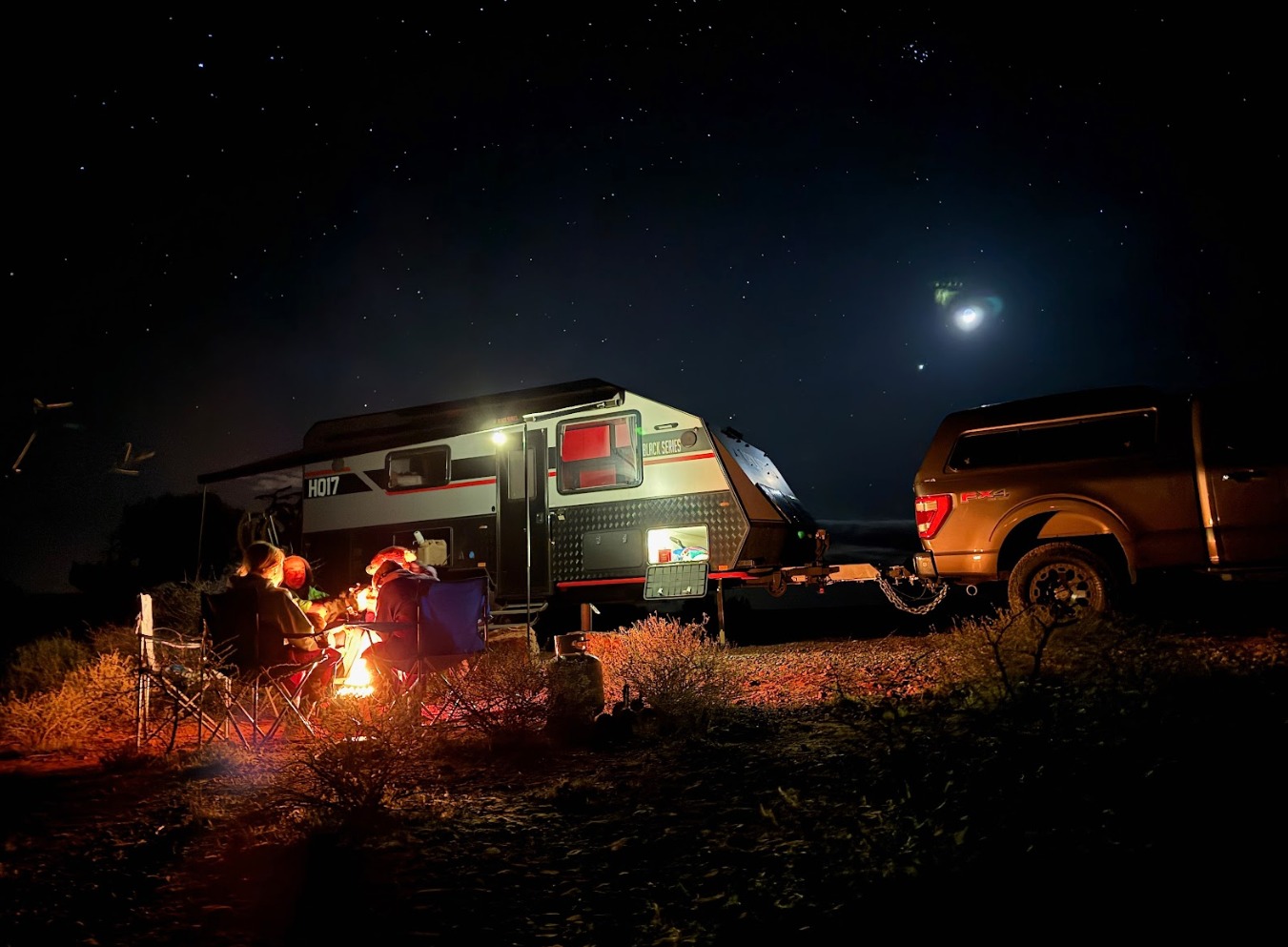
How to Trade My RV: Step-by-Step
Trading your RV isn’t complicated, but a little preparation goes a long way toward maximizing your value.
Step 1: Gather Your RV Information
Before you contact any dealer, collect the basics:
- Year, make, and model
- Current mileage (for motorhomes)
- Condition assessment (be honest about wear, damage, and upgrades)
- Maintenance records (this is where prepared sellers win)
Dealers need this information to provide an accurate quote. The more documentation you have, receipts, service records, even photos, the stronger your negotiating position.
Step 2: Get a Trade-In Value Estimate
There are two approaches to understanding your RV’s worth:
Market estimation tools: NADA Guides and RV Trader listings give you a baseline for what similar units sell for in your region. This is useful for setting expectations.
Dealer evaluation: The dealer will assess your RV based on condition, market demand, and their current inventory needs. Their offer may differ from online estimates, sometimes higher, sometimes lower, depending on timing and demand.
For a deeper dive on valuation factors, check out our RV Trade-In Value guide.
Step 3: Choose What You’re Trading Into
This is where most owners get it wrong. They focus on size instead of capability.
Trading your 18 ft camper weight trailer for a 24 ft camper weight model might give you more space, but if you’re still stuck on paved campgrounds, you haven’t really upgraded your experience.
The real question: What do you want your next RV to do that your current one can’t?
- Access remote campsites?
- Run off-grid for a week without hookups?
- Handle forest service roads without white-knuckling it?
If the answer is yes to any of these, you’re not looking for a bigger RV. You’re looking for a better one.
Step 4: Apply Your Trade-In Credit
Once you’ve agreed on a trade-in value, that amount is subtracted from your new RV’s purchase price. This creates two immediate benefits:
- Lower out-of-pocket cost (or lower financing amount)
- Tax savings in most states, you only pay sales tax on the difference between your trade-in value and the new RV price
For example: If your trade-in is worth $25,000 and your new RV costs $65,000, you pay taxes on $40,000, potentially saving you thousands.

Where Can I Trade My RV?
You have three main options. Each has trade-offs.
The bottom line: If your goal is to upgrade to a specific RV, especially a capability-focused rig like a BlackSeries, the dealer trade-in route is almost always the smartest play. You trade convenience and certainty for a slightly lower raw price, but the tax savings and reduced hassle often make up the difference.
For a full breakdown of dealer programs, see our RV Trade-In Program overview.
Trade My RV for a New One: Is It Worth It?
This is the $50,000 question (sometimes literally). Here’s how to think about it:
Consider Your Usage Frequency
If you’re camping 3-4 weekends per year, a trade-up might not make financial sense. But if you’re out monthly, or planning extended trips, the math changes dramatically.
The formula: More usage = more value from capability upgrades.
Calculate Total Cost of Ownership (TCO)
Don’t just compare sticker prices. Factor in:
- Depreciation curves (RVs lose 10-20% in year one, 36-38% by year five)
- Maintenance costs (older rigs cost more to keep running)
- Campground fees saved (off-grid capable RVs eliminate hookup costs)
- Fuel efficiency (average weight of camper directly impacts towing MPG)
Value vs. Price
Here’s the counterintuitive truth: A more expensive RV can be cheaper to own.
A well-built off-road travel trailer with premium materials, independent suspension, and integrated solar will hold value longer, require less maintenance, and unlock free camping that a budget rig simply can’t access.
For high-frequency campers, “more expensive but more capable” often means “better value per adventure.”
Can I Trade My RV If It’s Financed?
Yes: and it’s more common than you’d think.
Here’s how it works:
- The dealer contacts your lender to get the exact payoff amount
- They compare payoff to trade-in value to determine your equity position
- Positive equity (trade-in worth more than you owe) gets applied to your new RV
- Negative equity (you owe more than it’s worth) can often be rolled into your new loan
When to Avoid Trading a Financed RV
- You’re deeply underwater (owing significantly more than the RV’s value)
- You’re within the first year of ownership (maximum depreciation hit)
- The new monthly payment doesn’t align with your usage plans
If you’re close to breaking even or have positive equity, trading makes sense. If you’re upside-down by $15,000, it might be worth waiting another year.
Why Many Owners Trade Their RV for BlackSeries
Let’s talk about what happens when you trade up instead of just trading in.
The average travel trailer weights around 5,000-7,000 lbs for a mid-size unit. Most are built for paved campgrounds, occasional gravel roads, and life plugged into shore power.
BlackSeries rigs: like the HQ17 and HQ21: are built for a fundamentally different purpose:
Off-Road & Off-Grid as Standard
- Independent suspension handles terrain that would destroy conventional trailers
- All-aluminum construction resists corrosion and reduces weight
- Integrated solar and lithium batteries enable week-long boondocking without generators
It’s a Capability Upgrade, Not Just a Size Upgrade
Trading a 30 foot rv weight fifth wheel for a BlackSeries HQ21 might mean less interior square footage: but it unlocks access to places that massive rig could never reach.
That’s not downsizing. That’s upgrading your entire camping experience.
Long-Term Value Retention
BlackSeries rigs hold value exceptionally well on the secondary market. When you’re ready to trade again in 5-7 years, you’re not starting from scratch: you’re trading from a position of strength.
For the full picture on upgrading strategies, explore our Upgrade RV pillar page.
Common Mistakes When You Trade My RV
1. Comparing Only the Offer Price
A $2,000 higher private sale price doesn’t account for the weeks of listing, tire-kickers, and the tax savings you forfeit.
2. Ignoring Tax Advantages
In most states, trade-in tax benefits can save you $1,500-$4,000. That often closes the gap with private sale prices.
3. Trading in the Off-Season
Spring commands the highest trade-in values as buyers gear up for camping season. Trading in December? You’re leaving money on the table.
4. Upgrading Size Instead of Capability
Moving from an 18 ft camper weight trailer to a 24 ft camper weight trailer gives you more space: but if both are stuck on the same paved roads, you haven’t actually upgraded your freedom.
Frequently Asked Questions
Can I trade my RV for a different type of RV?
Yes. You can trade a travel trailer for a fifth wheel, a motorhome for a towable, or any combination. Dealers accept trade-ins across RV categories: what matters is your trade-in’s value, not its type.
Is it better to trade my RV or sell it privately?
It depends on your priorities. Private sales typically yield 10-15% more but require significant time and carry buyer risk. Trade-ins are faster, safer, and offer tax benefits that can offset the lower offer price.
How long does it take to trade my RV?
Most dealer trade-ins complete within 1-2 business days. If you’re financing the new RV, add another day or two for loan processing.
Can I trade my RV for a BlackSeries model?
Absolutely. BlackSeries accepts trade-ins of all RV brands and types. Many customers trade standard travel trailers to upgrade into the HQ17 or HQ21 for enhanced off-road and off-grid capability.
Ready to see what your current RV is worth toward a BlackSeries? Contact our team to start the conversation: and discover what it feels like to own a rig built for wherever the road (or trail) takes you.

