When towing any trailer, whether it’s a compact 16 ft camper weight setup or a substantial 30 ft RV weight configuration, understanding air vortex formation behind your trailer is crucial for safe, efficient travel. As 2026 brings increased focus on fuel costs and towing stability, the aerodynamic behavior behind trailers has become more critical than ever for both weekend warriors and full-time adventurers.
An air vortex behind trailer formations can significantly impact your towing experience, from fuel consumption to high-speed stability. This comprehensive guide explores how these aerodynamic phenomena affect different trailer sizes, why off-road travel trailers face unique challenges, and how engineering-focused manufacturers like BlackSeries address these issues through thoughtful design.
What Is an Air Vortex Behind a Trailer?
An air vortex behind a trailer is a turbulent, swirling airflow pattern that forms when fast-moving air separates from the trailer’s rear surface. Unlike the relatively smooth airflow behind modern passenger cars with tapered rear designs, trailers typically feature flat, vertical rear walls that create an abrupt barrier for airflow.
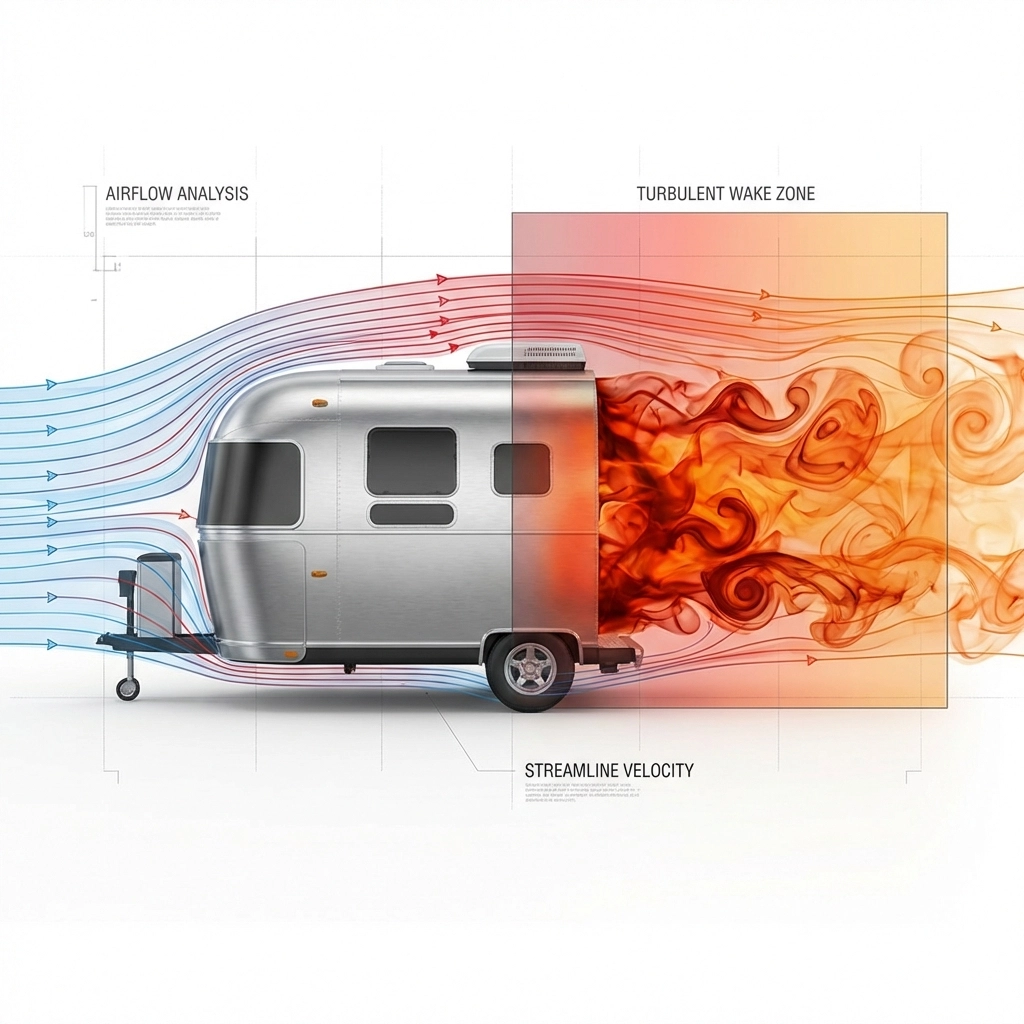
When air traveling at highway speeds encounters this blunt rear surface, it cannot smoothly transition and instead “detaches” from the trailer body. This separation creates a low-pressure zone immediately behind the trailer, where air spins and churns in circular patterns, forming what aerodynamicists call wake turbulence or trailing vortices.
The physics differs significantly from passenger vehicle aerodynamics. While cars are designed with gradually tapering rear sections that allow air to slowly rejoin behind the vehicle, trailers prioritize interior space and structural simplicity over aerodynamic efficiency. This fundamental design difference makes trailer vortex formation both more pronounced and more problematic than typical automotive wake turbulence.
This phenomenon occurs regardless of trailer size, whether you’re pulling a lightweight setup with an 18 ft camper weight or managing a heavy-duty configuration with a 30-foot camper weight. However, the intensity and impact vary considerably based on trailer dimensions, speed, and environmental conditions.
Why Air Vortices Form Behind Trailers
Several key factors contribute to air vortex formation behind trailers, each amplifying the aerodynamic challenges inherent in towing large, boxy structures.
Boundary Layer Separation: As air flows along the trailer’s sides, top, and bottom surfaces, it develops what’s called a boundary layer, a thin region where air velocity transitions from zero (at the surface) to full speed (in the free airstream). When this boundary layer encounters the trailer’s sharp rear edges, it cannot negotiate the sudden direction change required to follow the vertical surface, causing immediate separation and vortex formation.
Blunt Rear Profile: Unlike streamlined vehicles, most trailers feature flat rear doors or walls designed for maximum interior accessibility rather than aerodynamic efficiency. This creates an effective “air wall” that forces sudden pressure changes and promotes turbulent separation.
Scale and Proportions: Trailer aerodynamics become increasingly challenging as size increases. A 24 ft camper weight configuration presents a much larger frontal area and longer body than smaller units, creating more extensive separation zones. When dealing with average travel trailer weights in the 30-foot range, the sheer scale of the blunt rear surface amplifies vortex intensity significantly.
Crosswind Interaction: Side winds don’t just push trailers sideways, they also interact with rear vortex formation. Crosswinds can shift vortex patterns asymmetrically, creating uneven pressure distributions that contribute to trailer sway and reduced stability.
Ground Effect Complications: Unlike aircraft wake vortices that dissipate freely in open air, trailer vortices interact with ground proximity, creating additional turbulence patterns and pressure imbalances that affect both aerodynamic drag and vehicle stability.
How an Air Vortex Affects Trailer Performance
The performance impacts of rear air vortex formation extend far beyond simple aerodynamic drag, affecting multiple aspects of the towing experience that directly impact safety, efficiency, and comfort.
Aerodynamic Drag Increase: The low-pressure zone behind a trailer effectively creates a “suction” force that the tow vehicle must overcome. Research indicates that this vacuum effect can account for 40-60% of a trailer’s total aerodynamic drag at highway speeds. For a typical setup with average weight of camper configurations, this translates to measurable fuel economy penalties that compound over long-distance travel.
Towing Stability Challenges: Vortex-induced pressure imbalances create the conditions for trailer sway and instability. As crosswinds interact with these turbulent zones, they can generate asymmetric forces that promote side-to-side oscillations. This effect becomes particularly pronounced with larger trailers, a 30 ft camper weight setup experiences more dramatic stability challenges than smaller configurations due to increased lever arm effects and vortex intensity.
High-Speed Handling Issues: At interstate cruising speeds, strong rear vortices can create pressure fluctuations that affect both the trailer and tow vehicle. Drivers often report increased steering effort, reduced directional stability, and heightened sensitivity to crosswinds when towing trailers with poor aerodynamic management.

Fuel Consumption Impact: The energy required to overcome vortex-induced drag directly translates to increased fuel consumption. Studies suggest that effective rear vortex management can improve towing fuel economy by 15-25%, a significant consideration for long-distance expedition travel or frequent weekend trips.
Following Vehicle Effects: Strong trailer vortices don’t just affect the towing setup, they create turbulent air conditions for vehicles traveling behind. This can reduce visibility during wet conditions and create buffeting effects for motorcyclists or smaller vehicles.
Air Vortex Behind Travel Trailers vs Off-Road Trailers
The distinction between conventional travel trailers and off-road travel trailer configurations introduces significant differences in vortex behavior and aerodynamic management challenges.
Ground Clearance Considerations: Off-road trailers typically feature higher ground clearance to navigate rough terrain, but this creates more complex underbody airflow patterns. The increased gap between the trailer bottom and ground allows more air to flow underneath, creating additional turbulence that interacts with rear vortex formation. A conventional travel trailer with lower ground clearance experiences more predictable airflow patterns.
External Equipment Impact: Off-road configurations commonly feature spare tires, recovery gear, solar panels, and utility racks mounted on the rear. These accessories significantly complicate vortex behavior by creating multiple separation points and turbulence sources. Each external component can generate its own wake pattern, which then interacts with the primary trailer vortex in unpredictable ways.
Operating Environment Differences: Conventional travel trailers primarily operate on smooth highways with relatively stable airflow conditions. Off-road trailers encounter varied terrain, elevation changes, and natural wind patterns that create more dynamic and challenging aerodynamic conditions. Desert crosswinds, mountain passes, and forest environments each present unique vortex behavior patterns.
Structural Design Variations: Many off-road trailers prioritize durability and utility over aerodynamic efficiency, featuring more angular profiles and functional extensions that promote turbulent separation. The robust construction necessary for off-road use often conflicts with optimal aerodynamic shapes.
When comparing a standard 16 ft camper weight travel trailer to an equivalent off-road travel trailer, the off-road version typically experiences 20-30% more complex vortex patterns due to these combined factors, making aerodynamic management both more challenging and more critical for stable towing performance.
How to Reduce Air Vortex Behind a Trailer
Effective vortex management requires understanding both the aerodynamic principles involved and the practical constraints of trailer design and operation. Several proven strategies can significantly reduce rear turbulence and improve overall towing performance.
Rear Airflow Management Strategies:
- Boat Tail Extensions: Tapered rear sections that gradually reduce trailer cross-section can minimize abrupt pressure changes
- Rear Spoilers: Properly designed spoilers can guide airflow separation to reduce vortex intensity
- Side Skirts: Extensions that smooth the transition from trailer sides to rear can reduce edge effects
Gradual Pressure Recovery Design:
- Rounded Rear Corners: Eliminating sharp edges allows air to separate more gradually
- Stepped Rear Profiles: Multiple surface levels can stage pressure recovery instead of creating abrupt changes
- Rear Window Integration: Strategic glazing can help visualize and optimize airflow patterns
Surface Transition Management:
- Smooth Panel Joints: Minimizing surface discontinuities reduces premature boundary layer separation
- Integrated Utility Access: Designing rear doors and panels to minimize aerodynamic disruption
- Progressive Geometry: Gradually changing trailer cross-section toward the rear
Rooftop and Rear-Mounted Accessory Optimization:
- Aerodynamic Equipment Placement: Positioning solar panels, vents, and utilities to minimize airflow disruption
- Integrated Storage Solutions: Designing external storage to work with rather than against natural airflow patterns
- Strategic Spare Tire Mounting: Optimizing tire placement to reduce wake turbulence
For detailed guidance on implementing these strategies, our comprehensive article on drag coefficient and travel trailer aerodynamics provides specific technical approaches and real-world applications.
How BlackSeries Designs Minimize Rear Air Vortices
BlackSeries approaches trailer aerodynamics with an engineering-first philosophy that prioritizes real-world performance over purely aesthetic considerations. This methodology becomes particularly evident in how our designs address the complex challenge of rear vortex management in off-road applications.
Engineering-First Design Philosophy: Rather than treating aerodynamics as an afterthought, BlackSeries integrates airflow management into the fundamental design process. Every exterior element, from body curves to accessory mounting points, is evaluated for its impact on rear wake behavior. This approach recognizes that effective vortex management requires holistic design integration rather than add-on solutions.
Testing and Validation Methodology: Our design process relies on empirical validation rather than assumptions. Through a combination of computational fluid dynamics analysis and real-world testing, we validate aerodynamic performance across the range of conditions our trailers actually encounter. This includes everything from highway cruising with average travel trailer weights to challenging off-road scenarios where external equipment and varying ground clearance create complex airflow interactions.
Multi-Condition Optimization: Unlike trailers designed primarily for highway use, BlackSeries units must perform effectively across diverse operating environments. Our rear vortex management strategies account for the reality that an off-road travel trailer may encounter mountain crosswinds, desert thermal conditions, and forest environments all within a single expedition. This requires robust designs that maintain aerodynamic efficiency across varying conditions rather than optimizing for a single scenario.
Integrated Equipment Design: The external equipment necessary for off-road expeditions, spare tires, recovery gear, solar installations, is integrated into the overall aerodynamic strategy rather than simply mounted without regard for airflow impact. This holistic approach helps minimize the vortex complexity that typically plagues heavily equipped off-road trailers.
The practical result is trailers that maintain better stability and efficiency in real-world towing conditions, whether you’re managing a compact setup with 16 ft camper weight considerations or handling larger configurations in the 30 ft RV weight category. For insights into our complete approach to off-road trailer design, explore our detailed off-road travel trailer buying guide.
FAQ – Air Vortex Behind Trailer
What causes an air vortex behind a trailer?
Air vortices form when fast-moving air encounters the blunt rear surface of a trailer and cannot smoothly transition, creating turbulent, low-pressure zones. The flat, vertical rear walls typical of most trailers, from 18 ft camper weight units to larger 30-foot camper weight configurations, force abrupt airflow separation that generates spinning, churning air patterns immediately behind the trailer.
Does an air vortex increase trailer sway?
Yes, rear air vortices significantly contribute to trailer sway by creating asymmetric pressure patterns that interact with crosswinds. The turbulent, low-pressure zone behind the trailer makes it more susceptible to side wind forces and reduces overall stability, particularly at highway speeds. This effect becomes more pronounced with larger trailers due to increased surface area and lever arm effects.
Can aerodynamic design reduce rear turbulence?
Absolutely. Strategic design approaches including tapered rear sections, rounded corners, integrated spoilers, and optimized accessory placement can dramatically reduce vortex intensity. Even modifications like boat tail extensions or proper equipment positioning can improve aerodynamic performance by 15-25%, resulting in better fuel economy and enhanced towing stability.
Is an air vortex worse on boxy trailers?
Yes, rectangular, boxy trailer profiles create the most intense rear vortices because they present the most abrupt airflow obstacles. The sharp edges and flat surfaces typical of conventional trailer construction promote immediate boundary layer separation and maximum wake turbulence. More streamlined profiles with gradual transitions experience significantly reduced vortex formation.
How does BlackSeries address trailer airflow issues differently?
BlackSeries integrates aerodynamic considerations into the fundamental design process rather than treating airflow as an afterthought. Our engineering approach combines computational analysis with real-world validation to optimize designs for the complex conditions off-road travel trailers actually encounter: including varied terrain, external equipment, and diverse environmental conditions that affect vortex behavior.
Understanding and managing air vortex formation behind trailers represents a critical aspect of safe, efficient towing in 2026 and beyond. Whether you’re planning weekend adventures with a compact setup or embarking on extended expeditions with larger configurations, effective aerodynamic management enhances both performance and safety while reducing the environmental and financial impact of increased fuel consumption.

