If you’ve spent time in RV forums or browsed aftermarket accessories, you’ve probably encountered claims about vortex generators improving everything from fuel economy to towing stability. These small aerodynamic devices promise big benefits for a relatively modest investment. But do vortex generators actually work on RVs, or are they just expensive placebo effects?
The reality is more nuanced than most manufacturers want you to believe. While vortex generators can provide measurable benefits in specific applications like aircraft and race cars, their effectiveness on recreational vehicles faces significant limitations due to scale, speed, and design constraints.
In this comprehensive guide, we’ll examine the science behind vortex generators, analyze their real-world performance on RVs, and explore why integrated aerodynamic design often delivers better results than bolt-on solutions.
What Are Vortex Generators for RVs?
Vortex generators (VGs) are small, triangular or fin-shaped devices mounted on the roof or rear surfaces of vehicles to manipulate airflow. Originally developed for aircraft in the 1940s, these devices create controlled turbulence that energizes the boundary layer: the thin layer of air flowing directly over a surface.
In aviation, vortex generators serve a critical purpose: they delay flow separation on wings and control surfaces, maintaining lift and control authority at high angles of attack. Racing applications use similar principles to manage airflow over spoilers and diffusers at speeds exceeding 100 mph.
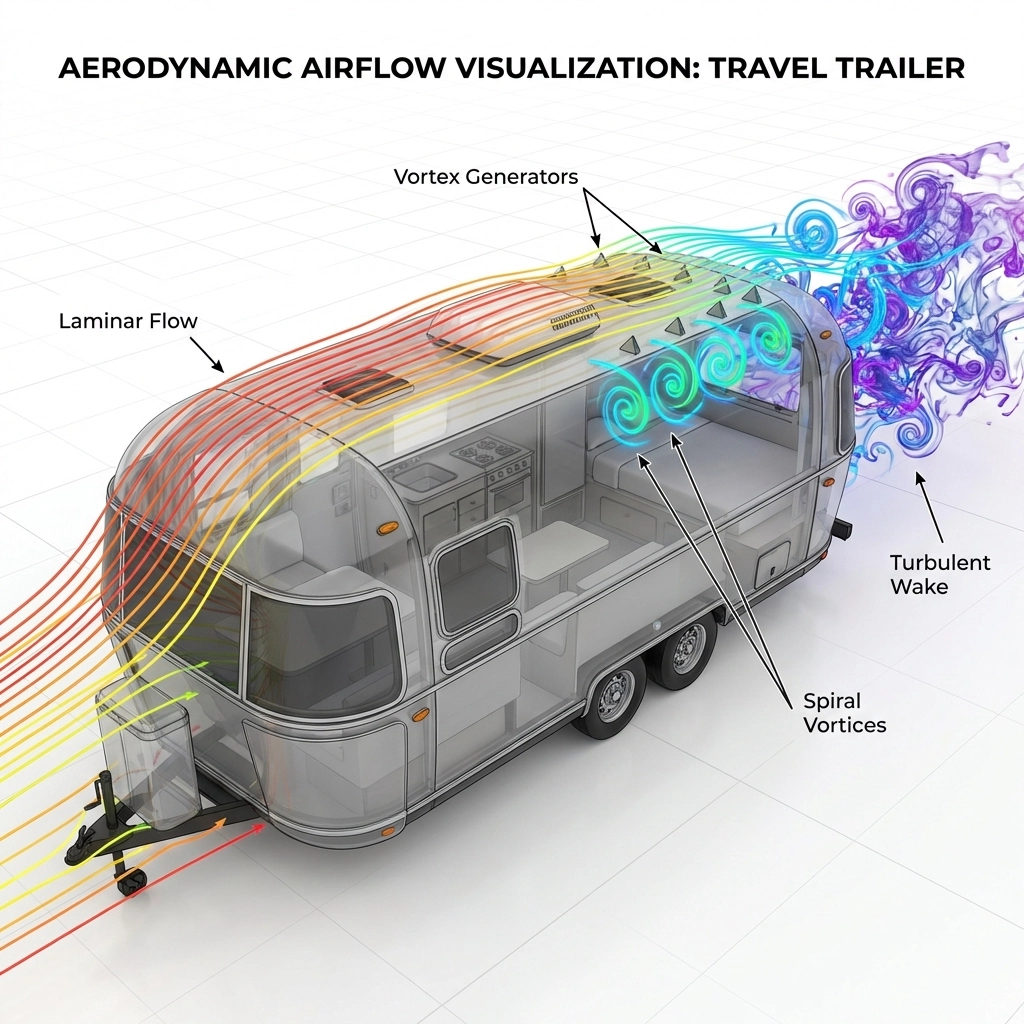
However, RVs operate in a fundamentally different aerodynamic environment than aircraft or race cars. The average 30-foot travel trailer weighs between 7,000-9,000 pounds and travels at highway speeds of 55-75 mph: significantly slower than the 150+ mph speeds where vortex generators show their greatest effectiveness.
Key differences include:
- Scale: RV surfaces are much larger than aircraft control surfaces
- Speed: Highway speeds versus flight or racing speeds
- Shape: Blunt, box-like geometry versus streamlined profiles
- Operating conditions: Variable crosswinds and turbulence versus controlled environments
How Vortex Generators Work on RVs
The theory behind vortex generators involves boundary layer management. As air flows over any surface, it gradually slows due to friction, forming the boundary layer. When this layer becomes too thick or encounters adverse pressure gradients, it separates from the surface, creating turbulent wake and increased drag.
Vortex generators work by creating small vortices that mix higher-energy air from outside the boundary layer with slower-moving air near the surface. This energization helps the airflow remain attached longer, theoretically reducing flow separation and associated drag.
On RVs, manufacturers typically install vortex generators in these locations:
- Roof leading edge: To manage airflow over rooftop equipment
- Rear wall: To reduce wake turbulence behind the trailer
- Side walls: To control crosswind sensitivity
However, the effectiveness depends heavily on several factors:
Speed sensitivity: Vortex generators become more effective as speed increases. At typical RV cruising speeds of 60-65 mph, the energy available for boundary layer control is limited compared to aircraft or racing applications.
Size scaling: Larger surfaces require proportionally larger or more numerous vortex generators. A 30-foot RV presents vastly more surface area than a wing or spoiler, potentially requiring dozens of devices for meaningful effect.
Flow complexity: RVs operate in complex ground effect conditions with turbulence from the tow vehicle, surrounding traffic, and terrain features: factors that can overwhelm the localized effects of vortex generators.

Do Vortex Generators Improve RV Stability?
Crosswind stability represents one area where vortex generators might provide measurable benefits, particularly for lighter travel trailers. When a strong side wind hits an RV, it creates uneven pressure distributions that can initiate trailer sway or make the vehicle feel unstable.
In theory, vortex generators on the windward side could help maintain attached flow, reducing the pressure differential that causes instability. Some RV owners report subjective improvements in crosswind handling after installing vortex generators, particularly during desert highway driving where sustained crosswinds are common.
However, several factors complicate this assessment:
Placebo effect: The psychological impact of making a modification can influence perception of improvement, even without measurable changes in vehicle behavior.
Variable conditions: Wind patterns, trailer loading, tow vehicle setup, and driver experience all significantly impact stability: making it difficult to isolate vortex generator effects.
Marginal gains: Any stability improvements from vortex generators are likely small compared to proper weight distribution, quality sway control systems, and appropriate tow vehicle selection.
For off-road travel trailers specifically, the stability equation becomes even more complex. Higher ground clearance, external equipment like spare tires and jerry cans, and irregular driving surfaces create turbulent airflow patterns that may overwhelm localized vortex generator effects.
Bottom line: While vortex generators may provide marginal improvements in certain conditions, they are not a substitute for proper aerodynamic design, appropriate towing equipment, or safe loading practices.
Vortex Generators and RV Drag Reduction
Fuel economy represents another common selling point for vortex generators, but the reality rarely matches the marketing claims. Understanding why requires examining how drag affects RV fuel consumption.
At highway speeds, aerodynamic drag becomes the dominant force requiring energy to overcome. For a typical travel trailer, drag accounts for 60-80% of the total energy required for steady-state cruising. Any meaningful reduction in drag coefficient should theoretically improve fuel economy.
However, vortex generators face several challenges in delivering measurable drag reduction:
Limited separation control: Most RV drag comes from pressure differences between the front and rear of the vehicle. Vortex generators can only address localized flow separation, not the fundamental pressure imbalance created by blunt trailer geometry.
Induced drag: The vortices themselves create small amounts of additional drag, which can offset benefits in some speed ranges.
Installation location: Vortex generators placed incorrectly may actually increase drag by creating unnecessary turbulence in areas where flow would remain naturally attached.
Real-world testing suggests that properly designed and positioned vortex generators might reduce overall drag by 2-5% under ideal conditions: translating to perhaps 1-3% improvement in fuel economy. However, factors like driving conditions, trailer loading, and installation quality significantly impact these results.
For perspective, proper tire pressure maintenance, speed reduction, and elimination of unnecessary external accessories typically provide larger fuel economy improvements than vortex generators.
Vortex Generators vs Integrated RV Aerodynamic Design
The fundamental limitation of vortex generators becomes clear when comparing add-on solutions to integrated aerodynamic design. While VGs attempt to fix airflow problems after the fact, proper design prevents those problems from occurring.
Integrated aerodynamic features that provide superior results include:
- Rounded leading edges: Reduce flow separation at roof and corner transitions
- Tapered rear sections: Minimize pressure differential and wake turbulence
- Smooth underbody: Eliminate unnecessary airflow disruptions
- Integrated equipment mounting: Position accessories to minimize drag impact
Roofline management represents a critical area where integrated design surpasses add-on solutions. Rather than using vortex generators to manage airflow around air conditioners, vents, and solar panels, proper design integrates these components into smooth transitions that maintain attached flow.
Wake management provides another clear advantage for integrated approaches. Instead of trying to energize separated flow behind a blunt rear wall, tapered trailer designs gradually slow airflow, allowing pressure recovery and reducing wake turbulence.
How BlackSeries Approaches RV Aerodynamics Without Gimmicks
At BlackSeries, our engineering philosophy prioritizes fundamental aerodynamic principles over quick fixes. Rather than relying on add-on devices to address airflow problems, we design aerodynamics into every aspect of our off-road travel trailers from the ground up.
Systems-level thinking guides our approach. Instead of treating aerodynamics as an afterthought, we consider airflow patterns throughout the design process. This includes analyzing how ground clearance affects underfloor airflow, positioning external equipment to minimize drag impact, and optimizing body transitions for stable high-speed cruising.
Real-world validation ensures our designs perform as intended. While computer simulations provide valuable insights, we validate aerodynamic performance through extensive real-world testing across diverse conditions: from Interstate highway crosswinds to mountain pass ascents with heavy loads.
Focus on stability over marketing claims reflects our commitment to driver safety and confidence. Rather than chasing marginal fuel economy improvements, we prioritize towing stability and predictable handling characteristics that matter during thousands of miles of adventure travel.
Engineering for extremes distinguishes our approach from conventional RV manufacturers. Off-road trailers face more challenging aerodynamic conditions: higher speeds on rough terrain, exposure to sustained crosswinds in remote areas, and operation with external equipment that affects airflow. Our designs account for these real-world conditions rather than idealized test scenarios.
This comprehensive approach delivers measurable benefits:
- Enhanced crosswind stability for confident highway cruising
- Reduced wake turbulence that can affect following vehicles
- Optimized external equipment integration that minimizes drag impact
- Consistent handling characteristics across varying load conditions
FAQ – Vortex Generators for RVs
Do vortex generators actually work on RVs?
Vortex generators can provide marginal improvements in specific conditions, typically 2-5% drag reduction under optimal circumstances. However, their effectiveness is limited by RV operating speeds, surface scaling, and complex airflow conditions. The benefits rarely justify the cost compared to other aerodynamic improvements.
Are vortex generators worth it for travel trailers?
For most travel trailer applications, vortex generators represent questionable value. The modest potential improvements in fuel economy (1-3% under ideal conditions) and stability are often outweighed by proper weight distribution, tire pressure maintenance, and driving technique improvements that cost less and provide larger benefits.
Can vortex generators reduce trailer sway?
Vortex generators may provide slight improvements in crosswind stability by helping maintain attached airflow on the windward side of the trailer. However, they cannot address the primary causes of trailer sway: improper loading, inadequate sway control systems, or inappropriate tow vehicle selection.
Do vortex generators improve fuel efficiency?
Under optimal conditions, properly installed vortex generators might improve fuel efficiency by 1-3%. However, this improvement is often within the margin of measurement error and can be easily offset by factors like headwinds, road grade, or driving style. More significant fuel economy improvements come from speed reduction, tire pressure optimization, and elimination of external accessories.
Why doesn’t BlackSeries rely on vortex generators?
BlackSeries prioritizes integrated aerodynamic design over add-on solutions. Our engineering approach addresses aerodynamic challenges through fundamental design principles: rounded leading edges, optimized equipment integration, and wake management: rather than attempting to fix airflow problems after the fact. This holistic approach delivers superior and more reliable results across diverse operating conditions.
By understanding both the capabilities and limitations of vortex generators, RV owners can make informed decisions about aerodynamic improvements. While these devices may provide marginal benefits in specific applications, integrated design approaches typically offer superior performance and value for serious adventurers seeking reliable, stable towing experiences.

