When you’re towing a 30-foot RV at highway speeds through crosswinds or navigating mountain passes with your off-road travel trailer, aerodynamic stability isn’t just about fuel economy, it’s about safety. RV wind tunnel testing reveals how your trailer behaves in real-world conditions, identifying pressure zones, drag coefficients, and crosswind vulnerabilities that can make the difference between a smooth journey and a dangerous sway situation.
Unlike passenger cars that undergo extensive aerodynamic validation, many RVs enter the market with minimal wind testing. This gap becomes critical when you consider that the average travel trailer weights between 5,000-8,000 pounds, while a 30 ft RV weight can exceed 12,000 pounds, creating massive wind-catching surfaces that challenge even experienced towers.
What Is RV Wind Tunnel Testing?
RV wind tunnel testing involves placing a scale model or full-sized recreational vehicle in a controlled airflow environment to measure how air moves around, over, and under the vehicle. Unlike testing passenger cars or trucks, RV aerodynamics present unique challenges due to their large frontal areas, squared-off profiles, and significantly higher ride heights.
The fundamental principle remains consistent: air is forced over a stationary vehicle (or the vehicle moves through stationary air) while sensors measure pressure differentials, force vectors, and airflow patterns. However, RV testing requires specialized equipment capable of handling larger test subjects and higher drag coefficients.
Key differences in RV wind tunnel testing include:
- Scale considerations: A 24 ft camper weight and size require larger test facilities than typical automotive wind tunnels
- Speed ranges: RVs typically cruise at 55-75 mph, requiring different test protocols than high-performance vehicles
- Attachment effects: Unlike standalone vehicles, travel trailers must account for the aerodynamic interaction with their tow vehicles
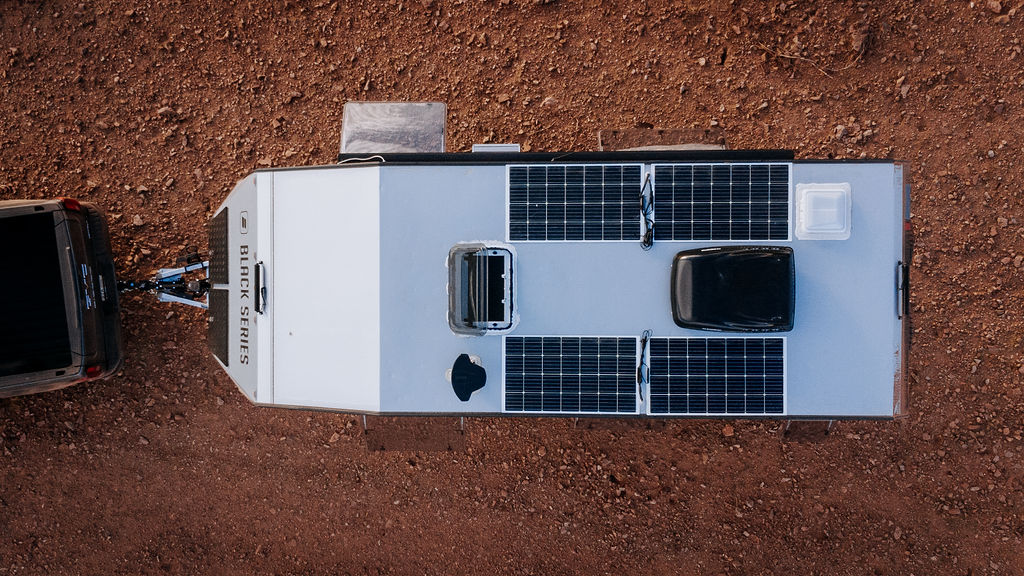
- Accessory impact: Solar panels, awnings, spare tires, and roof-mounted equipment significantly alter airflow patterns
Modern RV wind tunnel testing incorporates both physical testing and computational fluid dynamics (CFD) to create comprehensive aerodynamic profiles. This dual approach helps manufacturers understand not just overall drag, but specific problem areas where air separation occurs.
What Does Wind Tunnel Testing Measure on an RV?
Wind tunnel testing captures multiple aerodynamic factors that directly impact your RV’s road performance, stability, and towing dynamics. Understanding these measurements helps explain why some trailers track smoothly behind your vehicle while others feel unstable or create excessive drag.
Primary measurements include:
Aerodynamic Drag: The resistance force opposing forward motion, typically measured as a drag coefficient (Cd). While passenger cars achieve Cd values of 0.25-0.35, most RVs range from 0.6-1.2 due to their boxy profiles and large frontal areas.
Crosswind Side Forces: Lateral forces that push the RV sideways during windy conditions. These forces vary significantly based on wind angle, with 30-45 degree crosswinds often producing the highest side loads.
Lift and Pressure Zones: Areas where air pressure changes create upward or downward forces. Excessive lift can reduce tire contact pressure, while negative pressure zones can create instability.
Turbulence and Wake Behavior: The disturbed air region behind the RV affects following vehicles and can indicate separation problems that increase drag and reduce stability.
Additional measurements crucial for RV performance:
- Yaw moment: Rotational forces that can trigger trailer sway
- Pressure distribution: Identifies high-pressure areas that increase drag
- Underbody airflow: Critical for high-clearance off-road trailers
- Accessory drag: Individual contribution of external equipment
These measurements translate directly to real-world performance. High drag coefficients mean reduced fuel economy and increased towing loads, while excessive crosswind sensitivity can make highway driving stressful and potentially dangerous.
How Wind Tunnel Testing Improves RV Stability
RV stability depends on managing the complex airflow patterns that develop around large, tall vehicles moving at highway speeds. Wind tunnel testing reveals how these patterns create forces that can destabilize your trailer, particularly during crosswind events or when passing large vehicles.
Crosswind Management: When lateral winds hit an RV, they create a pressure differential between the windward and leeward sides. Wind tunnel testing measures these pressure variations across different wind angles, helping engineers design features that minimize side forces. For tall RVs with high centers of gravity, even modest crosswinds can generate significant overturning moments.
Trailer Sway Reduction: Sway occurs when aerodynamic forces combine with suspension dynamics to create oscillating motion. Wind tunnel data helps identify pressure points and flow separation areas that can trigger sway, particularly around the rear corners where air reattaches to the trailer body.
Tow Vehicle Integration: The aerodynamic interaction between your tow vehicle and trailer significantly affects stability. Wind tunnel testing of complete vehicle-trailer combinations reveals how the gap distance, relative heights, and width differences influence overall aerodynamic balance.
High-Speed Stability: At interstate speeds, small aerodynamic imbalances become amplified. Testing identifies critical speeds where airflow patterns change, often revealing why some RVs become unstable above certain velocities.
For off-road adventures where you might encounter sudden wind gusts in exposed terrain, this stability data becomes even more valuable. Understanding your trailer’s crosswind limits helps you make informed decisions about when to seek shelter or reduce speed.

Wind Tunnel Testing vs CFD Simulation for RVs
Both wind tunnel testing and Computational Fluid Dynamics (CFD) simulation play important roles in RV aerodynamic development, but they serve different purposes and have distinct advantages and limitations.
Wind Tunnel Testing Advantages:
- Real-world accuracy: Physical testing captures all the complex interactions that occur in actual airflow
- Accessory effects: Easy to test how solar panels, bike racks, or awnings affect aerodynamics
- Validation standard: Provides definitive data for regulatory compliance and performance claims
- Turbulence replication: Can simulate realistic atmospheric turbulence and wind shear
CFD Simulation Advantages:
- Cost efficiency: Much less expensive than building and testing physical models
- Design iteration speed: Can test multiple design variations quickly during development
- Detailed visualization: Shows airflow patterns and pressure distributions impossible to see in physical testing
- Parametric studies: Easy to test how small changes affect overall performance
Comparison Table:
The Integrated Approach: Modern RV development typically uses CFD for initial design exploration and optimization, followed by wind tunnel validation of final designs. This combination leverages the speed and cost benefits of simulation while ensuring real-world accuracy through physical testing.
For manufacturers focused on off-road capability, wind tunnel testing becomes particularly important because CFD struggles to accurately model the complex ground effects and underbody airflow that occur when traveling over varied terrain at speed.
Why Off-Road RVs Require More Advanced Wind Tunnel Testing
Off-road travel trailers face unique aerodynamic challenges that don’t affect conventional RVs designed primarily for paved highway use. These challenges require specialized testing approaches to ensure safety and performance in demanding environments.
High Ground Clearance Effects: Off-road RVs typically feature 12-16 inches of ground clearance compared to 6-8 inches for highway trailers. This increased height creates a larger underbody cavity where complex airflow patterns develop. Wind tunnel testing must account for ground effect changes and the potential for underbody turbulence to affect stability.
External Equipment Integration: Off-road capable RVs carry extensive external gear, oversized spare tires, recovery equipment, additional fuel and water tanks, solar arrays, and roof-mounted storage. Each accessory disrupts airflow differently, and their combined effects can significantly alter the trailer’s aerodynamic behavior.
Variable Speed Profiles: While highway RVs maintain relatively constant speeds, off-road adventures involve frequent speed changes, climbing grades, and exposure to natural wind patterns in open terrain. Testing must evaluate performance across broader speed ranges and in more varied conditions.
Structural Robustness vs. Aerodynamics: Off-road RVs prioritize durability over streamlined design, resulting in more angular profiles, external reinforcements, and protective features that challenge aerodynamic optimization. Wind tunnel testing helps balance these competing requirements.
Extended Cruise Scenarios: Off-road adventures often involve long highway transits to reach remote destinations, making aerodynamic efficiency crucial for range and towing comfort.
Advanced testing for off-road RVs also considers extreme scenarios like sudden wind exposure when emerging from forest cover or the effects of altitude changes on air density and aerodynamic forces.
How BlackSeries Uses Wind Tunnel Testing in RV Design
BlackSeries approaches wind tunnel testing from an engineering-first philosophy that prioritizes real-world performance over theoretical optimization. Rather than relying solely on computational models or industry-standard assumptions, the company validates aerodynamic performance through comprehensive physical testing.
Beyond Minimum Requirements: While many RV manufacturers test only for regulatory compliance, BlackSeries conducts expanded testing protocols that evaluate performance under extreme conditions. This includes crosswind testing at speeds and angles that exceed typical highway scenarios, ensuring trailers remain stable during unexpected weather events or challenging terrain transitions.
Stability Over Efficiency: The company’s testing priorities reflect their off-road focus, while fuel economy matters, trailer stability and predictable handling take precedence. This philosophy influences design decisions like accepting slightly higher drag coefficients in favor of features that improve crosswind stability or reduce sway tendency.
Integrated Systems Testing: BlackSeries evaluates complete trailer configurations including all standard equipment and accessories. Rather than testing a bare shell and extrapolating results, they assess how solar panels, spare tire mounting, and external storage affect real-world aerodynamics.
Validation Philosophy: The company treats wind tunnel data as validation rather than design direction. Initial designs prioritize functionality, durability, and off-road capability, with aerodynamic testing used to identify and address any stability or performance issues rather than drive the fundamental design approach.
This methodology ensures that aerodynamic considerations enhance rather than compromise the trailer’s core off-road and adventure capabilities, resulting in RVs that perform predictably across diverse conditions.
FAQ – RV Wind Tunnel Testing
Is wind tunnel testing necessary for RVs?
While not legally required, wind tunnel testing is essential for RVs due to their large size, high profiles, and significant crosswind exposure. Unlike cars, RVs create substantial wake regions and experience much higher drag forces that can affect stability and safety at highway speeds.
How accurate is RV wind tunnel testing?
Modern wind tunnel testing achieves excellent accuracy for RV applications, typically within 5-10% of real-world conditions. The larger size and lower speeds of RVs actually make them ideal candidates for wind tunnel testing, as scaling effects and measurement challenges are minimized compared to high-speed automotive applications.
Does wind tunnel testing improve RV safety?
Yes, significantly. Wind tunnel testing identifies potential stability issues, crosswind sensitivity, and sway-inducing characteristics before they become dangerous real-world problems. This testing is particularly important for safe towing practices in challenging conditions.
Are off-road RVs tested differently?
Off-road RVs require modified testing protocols that account for higher ground clearance, external equipment, and varied operating conditions. Testing must evaluate performance with all accessories installed and consider the broader speed ranges and environmental conditions these trailers encounter.
Does BlackSeries use real wind tunnel data?
Yes, BlackSeries conducts comprehensive physical wind tunnel testing rather than relying solely on computational models. This approach ensures their trailers meet real-world performance standards for stability and safety across diverse operating conditions.
Understanding wind tunnel testing helps you make informed decisions when selecting an RV for your adventures. Whether you’re considering the HQ19 for weekend getaways or the HQ21 for extended boondocking, aerodynamic validation ensures your investment delivers safe, stable performance on every journey.

