Trailer water crossing can be risky without proper preparation. This guide explains how to safely cross water with an off-road trailer, what to inspect, and common mistakes to avoid.
What Is Trailer Water Crossing?
Trailer water crossing, also known as water fording with a trailer, involves safely navigating your tow vehicle and trailer through streams, creeks, or shallow water obstacles on off-road trails. Unlike simple water fording with a single vehicle, towing a trailer through water presents unique challenges that require specialized knowledge and techniques.
Water fording typically refers to crossing deeper water where your vehicle’s undercarriage becomes partially submerged, while shallow crossing involves navigating through puddles or very low water levels. When towing a trailer, even shallow crossings become more complex due to the added weight, altered vehicle dynamics, and increased risk of equipment damage.
The primary reason trailer water crossing is more dangerous than solo vehicle fording lies in the physics involved. Your trailer adds significant weight, affecting your vehicle’s balance and braking capabilities. Additionally, trailers can create unpredictable drag forces in moving water, and their lower ground clearance often means critical components like axles, brakes, and electrical systems face greater exposure to water damage.
Is It Safe to Cross Water with a Trailer?
The safety of crossing water with a trailer depends entirely on conditions, preparation, and your equipment’s capabilities. Generally, water crossings are safe when the water depth remains below your trailer’s axle height and the current is minimal or non-existent.
You should avoid water crossings entirely when water depth exceeds 12-18 inches (depending on your specific trailer), when you can observe fast-moving current, during storms or flash flood conditions, or when you cannot clearly see the bottom substrate. Swift-moving water poses the greatest danger: water flowing at just 6 mph exerts tremendous force that can easily push a trailer off course.
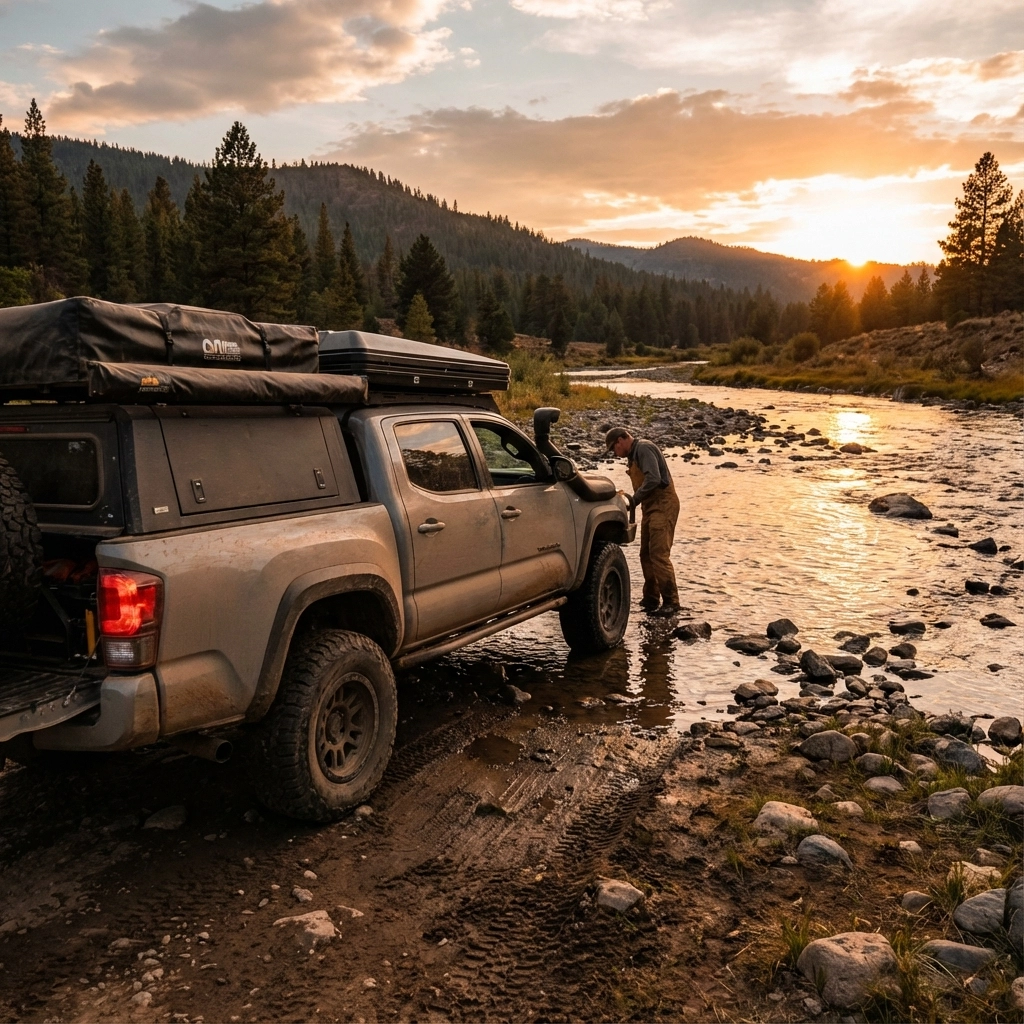
Common risks include electrical system water intrusion, which can damage lighting, brakes, and charging systems. Trailer brake systems are particularly vulnerable since most off-road trailers use electric brakes that can fail when submerged. Water can also penetrate wheel bearings, causing premature failure and expensive repairs. Additionally, prolonged exposure can lead to frame corrosion and damage to suspension components.
Real-world incidents often occur when overlanders underestimate current strength or attempt crossings during unexpected weather events. Desert flash floods and mountain snowmelt can transform seemingly safe crossings into dangerous torrents within minutes.
Trailer Water Crossing Safety Checklist
Before Crossing
Start by measuring water depth against your trailer’s axle height: water should not exceed the bottom of your wheel rims. Check weather conditions upstream and assess current speed by dropping a stick and timing its movement.
Seal all electrical connections using dielectric grease or waterproof tape, paying special attention to trailer brake connections and lighting harnesses. Inspect your trailer brakes by testing them before the crossing: you’ll want full functionality for the exit.
Secure all doors, vents, and access panels on both your tow vehicle and trailer. Check that your tow vehicle is in the appropriate mode (4WD low range) and that your trailer is properly hitched with safety chains connected.
During Crossing
Maintain a steady walking pace throughout the crossing: typically 2-3 mph. This speed creates a small bow wave that helps push water away from critical components while maintaining control.
Avoid sudden braking or acceleration, which can cause water to splash into engine components or create waves that overwhelm your trailer. Keep your steering inputs minimal and maintain a straight line through the water.
Monitor your trailer in mirrors to ensure it’s tracking properly and not creating unusual drag or instability.
After Crossing
Immediately test your trailer brakes in a safe area: pump them several times to expel any water from the brake assemblies. Inspect wheel bearings for water intrusion by checking for milky or contaminated grease around seals.
Check all electrical connections and test trailer lights, brakes, and charging systems. Look for any signs of water intrusion in storage compartments or living areas.
Allow electrical systems to dry thoroughly before storing your trailer, and consider applying additional protective treatments to exposed metal components.
How to Cross Water with a Trailer (Step-by-Step)
Begin by scouting the crossing on foot, walking the entire route to identify obstacles, measure depth, and assess substrate conditions. Look for the firmest ground with the most gradual entry and exit angles.
Select your tow vehicle’s low-range 4WD mode and reduce tire pressure if crossing soft sand or mud approaches. Position your vehicle for a straight approach to the water, avoiding sharp angles that could cause your trailer to track poorly.

Enter the water slowly and steadily, maintaining consistent throttle. Keep your RPM steady to prevent exhaust backpressure issues, and resist the urge to accelerate if you feel resistance: steady momentum is key.
Exit the water promptly but smoothly, avoiding sudden acceleration that could cause wheel spin or loss of control. Immediately perform your post-crossing inspection checklist before continuing your journey.
Off-Road Trailer Design Features That Matter
Modern off-road trailers incorporate specific design elements that enhance water crossing capability. Ground clearance is perhaps the most critical factor: higher chassis designs keep vital components above typical water levels.
BlackSeries off-road trailers feature elevated electrical systems and sealed battery compartments that protect against water intrusion. Their independent suspension systems provide superior clearance compared to traditional leaf spring setups, reducing the risk of component submersion.
Quality off-road trailers also include reinforced chassis construction with corrosion-resistant materials, sealed wheel bearings designed for harsh conditions, and waterproof storage compartments. The electrical systems often feature marine-grade connections and elevated routing to minimize water exposure.
Advanced drainage systems in the chassis allow any water that does enter to exit quickly, preventing accumulation that could cause long-term damage.
Best Practices from Experienced Overlanders
Veteran overlanders consistently emphasize the importance of turning around rather than taking unnecessary risks. The overlanding community’s motto of “better to be disappointed than dead” applies especially to water crossings.
Successful long-distance travelers recommend carrying a probe rod to check depth and substrate conditions before committing to a crossing. Many also travel in groups specifically for water crossing situations, where one vehicle can provide recovery assistance if needed.
Different water depths require different strategies: ankle-deep water (under 6 inches) poses minimal risk but still requires inspection afterward; knee-deep water (6-12 inches) demands careful speed control and immediate post-crossing brake testing; deeper water approaching axle height requires expert-level assessment and should generally be avoided.
Seasonal considerations matter significantly: spring snowmelt can transform gentle crossings into raging torrents, while monsoon seasons in the American Southwest create flash flood risks that can appear with little warning.
Common Mistakes to Avoid
One of the most dangerous mistakes is overestimating your tow vehicle’s capability when factoring in trailer weight. Your truck might handle a crossing solo, but the added mass and drag of a trailer can quickly overwhelm your vehicle’s traction and control.
Many drivers ignore water current assessment, focusing only on depth. However, moving water creates lateral forces that can push your entire rig off course, especially if your trailer begins to hydroplane or lose ground contact.
Skipping post-crossing inspections is another costly error. Water damage often doesn’t manifest immediately, and continuing to use compromised brake or electrical systems can lead to catastrophic failures in dangerous situations.
Finally, attempting water crossings without proper recovery equipment or backup plans puts you at risk of being stranded in remote locations where help may be hours or days away.
FAQ – Trailer Water Crossing Safety
How deep can a trailer safely cross water?
Generally, water depth should not exceed the bottom of your trailer’s wheel rims: typically 12-18 inches depending on your specific trailer model. Always measure against your trailer’s actual axle height rather than relying on general guidelines.
Can electric trailer brakes get wet?
Electric trailer brakes can handle brief submersion but will lose effectiveness when waterlogged. Test your brakes immediately after any water crossing and allow them to dry completely before relying on full braking performance.
Should I avoid water crossings entirely?
Not necessarily. Many water crossings can be navigated safely with proper preparation and technique. However, when in doubt, finding alternate routes is always the safer choice, especially when traveling solo or in unfamiliar territory.
Are off-road trailers waterproof?
Quality off-road trailers feature water-resistant construction but aren’t completely waterproof. They’re designed to handle splashing and brief submersion of lower components, but prolonged exposure or submersion of living areas should be avoided.
Understanding trailer water crossing safety transforms potentially dangerous situations into manageable challenges. With proper preparation, the right equipment, and respect for natural forces, you can safely navigate water obstacles while protecting your investment and ensuring memorable adventures for years to come.

