Towing a trailer in sand requires lowering tire pressure for better flotation, maintaining steady momentum, and using recovery boards correctly to prevent or recover from getting stuck. Whether you’re heading to California’s Oceano Dunes, Texas beaches along the Gulf Coast, or Nevada’s desert backroads, understanding proper sand towing techniques can mean the difference between an epic adventure and an expensive recovery operation.
Why Towing a Trailer in Sand Is Challenging
Why Sand Behaves Differently Than Dirt or Gravel
Sand presents unique challenges that catch many RV enthusiasts off guard. Unlike packed dirt or gravel, loose sand provides minimal surface tension and shifts constantly under weight. When your tires hit sand, they encounter a fluid-like medium that offers little resistance to sideways movement but creates significant drag when trying to move forward.
The physics of sand towing becomes even more complex when you add a trailer. Your tow vehicle must now push through increased resistance while pulling additional weight that wants to dig into the soft surface behind you. This combination creates a compounding effect where the trailer’s wheels can actually push sand forward, creating berms that make progress increasingly difficult.
Added Resistance From Trailer Weight
A typical off-road trailer adds 3,000 to 6,000 pounds of concentrated weight distributed across fewer contact points than your tow vehicle. This weight concentration means your trailer tires create deeper impressions in sand, increasing rolling resistance significantly. The phenomenon is particularly pronounced on single-axle trailers where the entire weight sits on just two tires.
Research from off-road driving instructors indicates that trailer towing in sand can increase fuel consumption by 40-60% compared to normal highway driving, primarily due to this increased resistance and the need for lower gear operation.
Common Mistakes That Cause Trailers to Bog Down
The most frequent error is maintaining street tire pressures when transitioning to sand. Many RVers successfully navigate beach access roads at normal pressures, only to find themselves stuck when they hit deeper, softer sand near their camping spot. Another critical mistake is sudden throttle application when feeling resistance, which causes tires to dig rather than float.
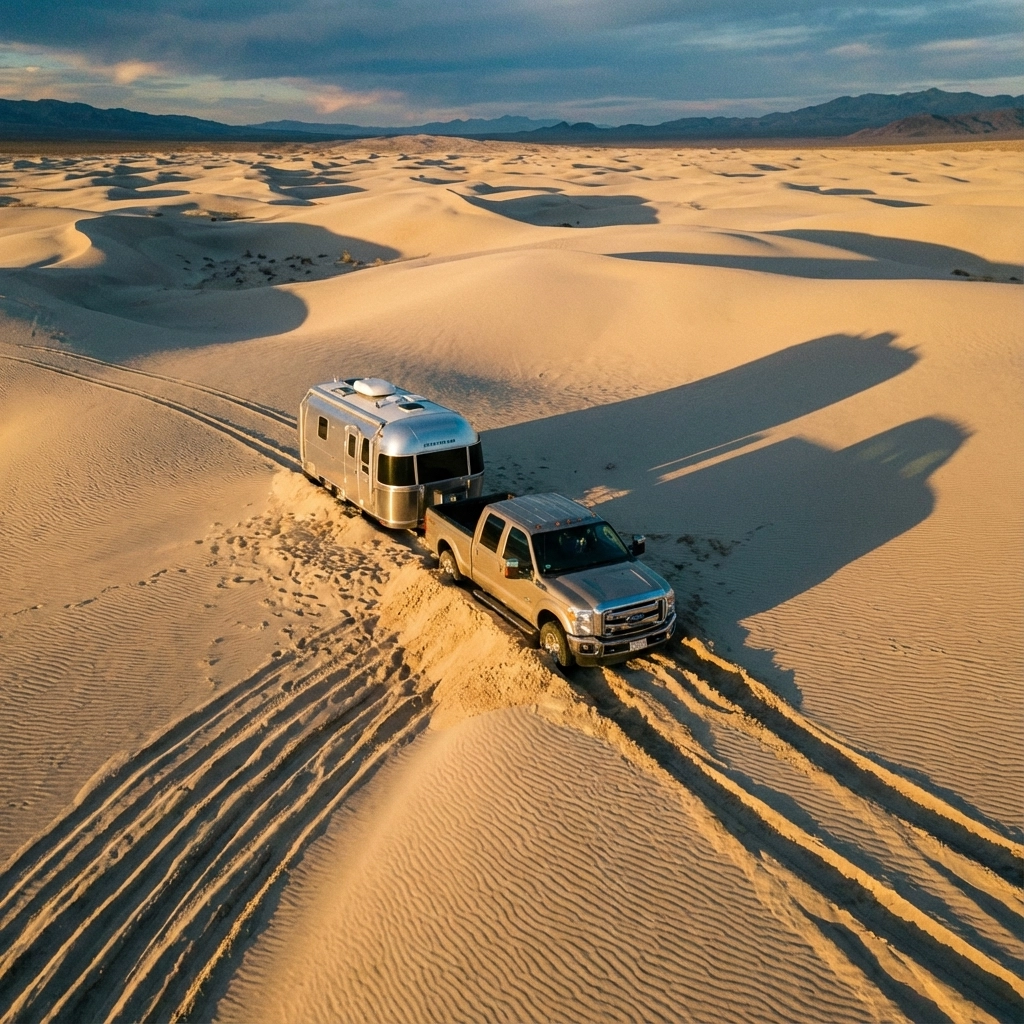
What Does “Towing Trailer in Sand” Really Mean? (Definitions & Terms)
Loose Sand vs Packed Sand
Packed sand refers to compacted surfaces you’ll find on well-traveled beach access roads or areas where tide and weather have created firm driving surfaces. These areas typically support normal tire pressures and conventional driving techniques.
Loose sand describes the soft, dry material found in dunes, above high-tide lines, or in desert environments. This sand shifts easily under weight and requires specialized techniques to traverse successfully. Most sand-related getting stuck happens in loose sand conditions.
Flotation vs Traction
Flotation means your tires ride on top of the sand surface rather than cutting through it. This is achieved by reducing tire pressure to increase the contact patch, spreading weight over a larger area. Think of it like switching from high heels to snowshoes.
Traction refers to your tire’s ability to grip and push against the sand to create forward motion. In sand, traction comes from tire tread pattern interaction with sand particles, not from the hard surface grip you experience on pavement.
Tow Vehicle vs Trailer Dynamics
Your tow vehicle has the advantage of engine power and potentially four-wheel drive to maintain momentum. However, it’s also responsible for pulling your trailer through the same challenging conditions. The trailer, meanwhile, relies entirely on momentum from the tow vehicle and cannot contribute power to overcome resistance.
This dynamic creates a situation where your tow vehicle might have sufficient power to continue moving, but the trailer becomes an anchor that eventually stops forward progress. Understanding this relationship is crucial for successful sand navigation.
Tire Pressure for Towing in Sand (What You Need to Know)
Why Lowering Tire Pressure Works
Reducing tire pressure fundamentally changes how your tires interact with sand. At normal highway pressures (typically 35-45 PSI), your tires present a small contact patch that concentrates weight and causes them to cut into sand like a knife. When you lower pressure to 15-20 PSI, the tire deforms and creates a much larger “footprint” that distributes weight across more surface area.
This increased contact patch serves multiple purposes: it prevents the tire from sinking as deeply, reduces rolling resistance, and provides more surface area for traction. The tire essentially becomes a balloon that floats on top of the sand rather than cutting through it.
Recommended Tire Pressure Ranges
Tow Vehicle Tires:
- Starting point: 18-20 PSI for most pickup trucks
- Soft conditions: 15-18 PSI
- Extreme conditions: 12-15 PSI (driven wheels only)
Trailer Tires:
- Starting point: 20-25 PSI (typically 2-5 PSI higher than tow vehicle)
- Soft conditions: 18-22 PSI
- Extreme conditions: 15-20 PSI
How to Air Down Safely
Timing is everything. Air down before you encounter soft sand, not after you’re already stuck. Most beach access points provide hard-packed surfaces perfect for pressure reduction. Carry a quality tire pressure gauge and deflator tools to ensure accuracy.
Speed limitations are critical. At reduced pressures, your tires generate more heat and flex more dramatically. Limit speeds to 15-25 mph on sand to prevent tire damage. Never exceed 35 mph with significantly reduced tire pressures.
For comprehensive trailer maintenance that supports sand adventures, check out our guide on preventive off-road maintenance to ensure your rig is ready for challenging conditions.
Driving Techniques for Towing a Trailer on Sand
Maintain Steady Momentum
Momentum is your friend in sand, but it’s a delicate balance. Too little momentum and you’ll bog down in soft spots. Too much and you risk losing control or flipping your trailer on steep dune faces. The key is maintaining steady, consistent speed that keeps your rig moving without creating dramatic acceleration or deceleration.
When approaching soft sections, build momentum gradually on firmer sand beforehand. Once you’re in the soft material, avoid sudden speed changes. If you feel the rig starting to slow down, gently add power rather than making dramatic throttle inputs.
Avoid Sharp Steering Inputs
Sharp turns in sand can cause your trailer to “side bite” and dig in laterally. This is especially dangerous because it can cause trailer sway or even rollover in extreme cases. Make all steering inputs gradually and smoothly, giving your trailer time to follow the tow vehicle’s path.
When navigating around obstacles, plan your path well in advance. Wide, sweeping turns work much better than sharp corrections. If you must make a tight turn, reduce speed significantly and be prepared to stop if the trailer starts to slide sideways.
Gentle Throttle Application
Sand driving requires throttle finesse that’s completely different from highway driving. Sudden acceleration causes your tires to break through the sand surface they’re floating on and start digging. Once digging begins, more throttle only makes the problem worse.
Use steady, progressive throttle application. If you feel your rig starting to struggle, ease off the throttle slightly before trying more power. Often, allowing your tires to “reset” their flotation for a few seconds before trying again yields better results than sustained power.

How to Use Recovery Boards with a Trailer (Step-by-Step)
When Recovery Boards Are Necessary
Recovery boards become essential when you’ve lost forward momentum and your tires are spinning without movement. The telltale signs include: engine RPM increasing without corresponding vehicle movement, visible tire spinning, or feeling the vehicle settle deeper into sand despite throttle application.
Don’t wait until you’re completely buried. If you notice increased resistance and slower progress, stop immediately and assess the situation. It’s much easier to use recovery boards for prevention than extraction.
Step-by-Step Recovery Board Use
Step 1: Stop All Movement Immediately
The moment you feel tires spinning without progress, stop accelerating. Continued spinning only digs you deeper and makes recovery more difficult. Set the parking brake and assess the situation.
Step 2: Clear Sand in Front of Tires
Use a shovel to remove sand from directly in front of each stuck tire. Dig down to the bottom of the tire and create a gentle slope leading up and away from the stuck position. This prevents the boards from being pushed down into the sand.
Step 3: Position Recovery Boards Correctly
Place boards directly in front of each tire, ensuring they’re centered and stable. For dual-axle trailers, you may need boards for multiple tires. The boards should create a firm surface extending at least 3 feet in front of your tires.
Step 4: Apply Slow, Controlled Throttle
Engage 4WD low range if available and apply gradual throttle pressure. The goal is to drive onto the boards smoothly, not to launch over them. Maintain steady pressure until all tires are on solid sand beyond the boards.
Step 5: Drive Forward and Collect Equipment
Once free, continue moving forward to solid ground before stopping to collect your recovery boards. Stopping immediately after extraction risks getting stuck again in the disturbed sand.
Best Practices for Trailer Recovery in Sand
Placement Strategy for Dual-Axle Trailers
Dual-axle trailers require special consideration because both sets of wheels may be stuck simultaneously. In most cases, focus on the rear axle first, as it typically carries more weight and creates the primary resistance. Place recovery boards for both tires on the rear axle, then assess whether the front axle needs assistance.
Sometimes the rear axle extraction provides enough momentum to pull the front axle through without additional boards. However, have additional boards ready and don’t hesitate to use them if progress stalls.
Using Boards with Limited Space
Desert camping often presents space constraints with rocks, vegetation, or other obstacles limiting your recovery options. In confined spaces, consider unhitching your trailer temporarily to recover the tow vehicle first, then using the freed tow vehicle to assist trailer extraction.
This technique requires careful planning and proper equipment, including trailer jack stands rated for sand use. For detailed guidance on trailer maintenance that supports these recovery operations, our trailer suspension maintenance guide provides essential information.
Coordinating Tow Vehicle and Trailer Movement
Successful sand recovery requires understanding how your tow vehicle and trailer work together. The tow vehicle must provide steady pulling force while the trailer needs to float rather than plow through sand. This coordination becomes critical during recovery operations.
Use a spotter outside the vehicle to watch trailer behavior during recovery attempts. The spotter can identify when the trailer starts to dig in and signal for throttle adjustment before the situation worsens.
Common Mistakes When Towing a Trailer in Sand
Not Adjusting Tire Pressure
The single most common mistake is attempting sand travel at street pressures. Many RVers successfully drive on packed beach access roads at normal pressures and assume they’re prepared for all sand conditions. When they encounter soft sand areas, the dramatically increased rolling resistance catches them off guard.
This mistake is particularly costly because correction requires full recovery and pressure adjustment while potentially stuck. Always air down before entering questionable terrain, not after encountering problems.
Over-Throttling
When resistance increases, the natural response is to add more power. In sand, this often makes problems worse by causing tires to break through the surface they were floating on. Once tires start cutting into sand rather than floating, additional power only digs deeper holes.
The correct response to increased resistance is to ease off the throttle, allow tires to regain flotation, then try again with steady pressure. Sometimes backing up slightly to get onto undisturbed sand provides a better starting point than continued forward pressure.
Poor Recovery Board Placement
Many first-time users place recovery boards too close to stuck tires or fail to clear sand adequately before positioning boards. This causes boards to be pushed into sand rather than providing a firm surface for recovery.
Proper placement requires digging down to tire level and creating a gentle ramp leading away from the stuck position. The boards should rest on firm sand, not loose material that will compress under vehicle weight.
Ignoring Trailer Tire Behavior
Focusing solely on tow vehicle tires while ignoring trailer behavior is a costly oversight. Trailer tires operate under different conditions and may require different pressure adjustments. Single-axle trailers, in particular, concentrate significant weight on just two tires, making them more susceptible to digging in.
Monitor trailer tire behavior through mirrors or by having a spotter watch from outside the vehicle. Signs of trailer tire issues include unusual tracking, visible sand being thrown up, or increased resistance that doesn’t correlate with tow vehicle tire behavior.
Essential Gear for Sand Towing and Recovery
Tire Deflators
Quality tire deflators save time and ensure accuracy when adjusting pressures for multiple tires. Automatic deflators can be set to desired pressures and left to work while you prepare other equipment. This is particularly valuable when managing both tow vehicle and trailer tire pressures.
Manual deflators work well but require more attention and time. For frequent sand travelers, the investment in automatic deflators pays off quickly in convenience and consistency.
Portable Air Compressors
A reliable 12V air compressor is essential for re-inflating tires before returning to paved roads. Choose compressors rated for your tire size and desired speed of inflation. Larger tires on heavy-duty trucks require more powerful compressors than passenger car units.
Consider compressors with multiple attachments and gauges for versatility. Some units include LED lighting for nighttime use and automatic shut-offs at preset pressures.
Recovery Boards
Modern recovery boards like MaxTrax or similar products provide superior traction and durability compared to older sand ladders. Choose boards rated for your vehicle’s weight and consider carrying enough boards to handle multiple stuck tires simultaneously.
Quality boards feature aggressive traction surfaces, built-in handles, and interlocking capabilities for extended reach. While expensive, they’re far less costly than professional recovery services in remote areas.
Shovel and Traction Aids
A folding shovel designed for vehicle recovery provides essential capability for clearing sand around stuck tires and preparing surfaces for recovery board placement. Military-style folding shovels offer good durability in a compact package.
Consider additional traction aids like sand tracks, carpet strips, or even floor mats for emergency use. These items won’t replace proper recovery boards but can provide assistance in less severe situations.
How to Avoid Getting Stuck in Sand While Towing
Route Selection
Choosing the right path through sand terrain dramatically reduces your chances of getting stuck. Look for signs of previous vehicle travel, as these paths often indicate firmer sand conditions. Avoid areas with visible soft sand, recent wind disturbance, or steep approach angles.
Beach driving requires understanding tidal patterns and sand conditions. Drive during low tide when more firm sand is exposed, and avoid areas where recent high tides have left soft, saturated sand.
Reading Sand Conditions
Learning to assess sand conditions visually can prevent many stuck situations. Firm sand typically shows evidence of wind packing, previous vehicle tracks, or natural compaction. Soft sand appears loose, shows wind ripples, or has been recently disturbed.
Color can also indicate sand firmness. Darker sand often contains more moisture and provides better compaction, while light, dry sand tends to be softer and more challenging to navigate.
Pre-Trip Preparation Checklist
Before heading into sand terrain, complete a comprehensive preparation checklist:
- Check and adjust tire pressures
- Ensure recovery equipment is accessible
- Verify 4WD system operation
- Plan route and identify bailout points
- Check weather conditions and tidal charts (for beach driving)
- Inform others of your travel plans
For comprehensive pre-trip preparation, including trailer-specific maintenance items, refer to our off-road maintenance checklist for detailed guidance.
Knowing When to Turn Around
Recognizing when conditions exceed your capability prevents dangerous situations and expensive recoveries. Turn around when you encounter:
- Consistently soft sand requiring maximum power to maintain progress
- Steep terrain that compromises trailer stability
- Weather conditions reducing visibility or creating unsafe driving conditions
- Equipment failures that compromise recovery capability
Pride often prevents good judgment in these situations. Remember that turning around preserves your equipment and safety for future adventures.
FAQs About Towing a Trailer in Sand
How much should I lower tire pressure when towing a trailer in sand?
Start with 18-20 PSI for your tow vehicle and 20-25 PSI for your trailer as baseline pressures for loose sand conditions. You can go as low as 12-15 PSI for tow vehicle tires and 15-18 PSI for trailer tires in very soft conditions, but limit speeds to 15 mph and re-inflate before driving on pavement.
Can I use the same tire pressure for both my truck and trailer in sand?
No, trailers typically need 2-5 PSI higher pressure than tow vehicles due to different weight distribution and tire construction. Trailer tires often carry more concentrated weight per tire and may require slightly higher pressures to achieve similar flotation characteristics.
Do recovery boards work effectively with trailers?
Yes, recovery boards work well for trailer recovery, but you need to consider that trailers have no power assistance. Focus on the axle creating the most resistance (usually the rear on dual-axle trailers) and ensure your tow vehicle has sufficient traction to pull the trailer onto the boards.
Is it safe to tow a trailer in sand dunes?
Towing in sand dunes requires extreme caution and experience. Steep grades can cause trailer sway or rollover, and the combination of reduced tire pressures and steep angles creates stability challenges. Stick to gentler terrain until you gain experience, and always have a spotter for navigation in challenging dune terrain.
What’s the biggest mistake people make when stuck in sand with a trailer?
The biggest mistake is continuing to apply throttle when tires start spinning. This only digs deeper holes and makes recovery more difficult. Stop immediately when you feel loss of traction, assess the situation, and use proper recovery techniques rather than trying to power through.
Why BlackSeries Trailers Are Built for Sand Towing
BlackSeries trailers are specifically engineered for the challenges of off-road adventures, including sand travel. Our trailers feature independent suspension systems that maintain wheel contact with uneven surfaces, reducing the likelihood of individual wheels digging into soft sand. The robust chassis design distributes weight effectively, while aggressive tire options provide superior sand performance.
The elevated ground clearance on BlackSeries models prevents chassis dragging in soft sand conditions that might stop conventional trailers. Our attention to weight distribution and low center of gravity design enhances stability during the challenging maneuvers often required in sand terrain.
For owners venturing into remote sand environments, proper preparation is essential. Our comprehensive approach to trailer durability extends beyond initial design to include maintenance guidance that keeps your rig ready for challenging conditions like beach and desert travel.
Understanding sand towing techniques, combined with proper equipment and a well-designed trailer, opens up incredible adventure opportunities across America’s diverse landscapes. From the dunes of Michigan to the beaches of the Outer Banks, proper preparation and technique make these destinations accessible while maintaining safety and equipment longevity.

