Towing downhill requires controlled braking, proper gear selection, and trailer brake management. This guide explains how to safely control speed on long downhill descents while towing.
What Is Towing Downhill Braking?
Towing downhill braking refers to the specialized techniques and equipment management needed when descending steep grades while pulling a trailer. Unlike regular vehicle braking, this involves coordinating your tow vehicle’s braking system with your trailer’s independent brake system to maintain safe control.
The key distinction lies between engine braking and service brakes. Engine braking uses your transmission and engine compression to slow the vehicle without applying the brake pedal, while service brakes are your traditional foot-operated brake system. When towing downhill, engine braking becomes your primary speed control method.
Why is downhill towing more dangerous than uphill? Physics works against you in multiple ways. Gravitational force accelerates your combined vehicle and trailer weight, while momentum makes it harder to stop once you gain speed. Additionally, continuous brake use generates heat that can lead to brake fade – a dangerous condition where your brakes lose effectiveness when you need them most.
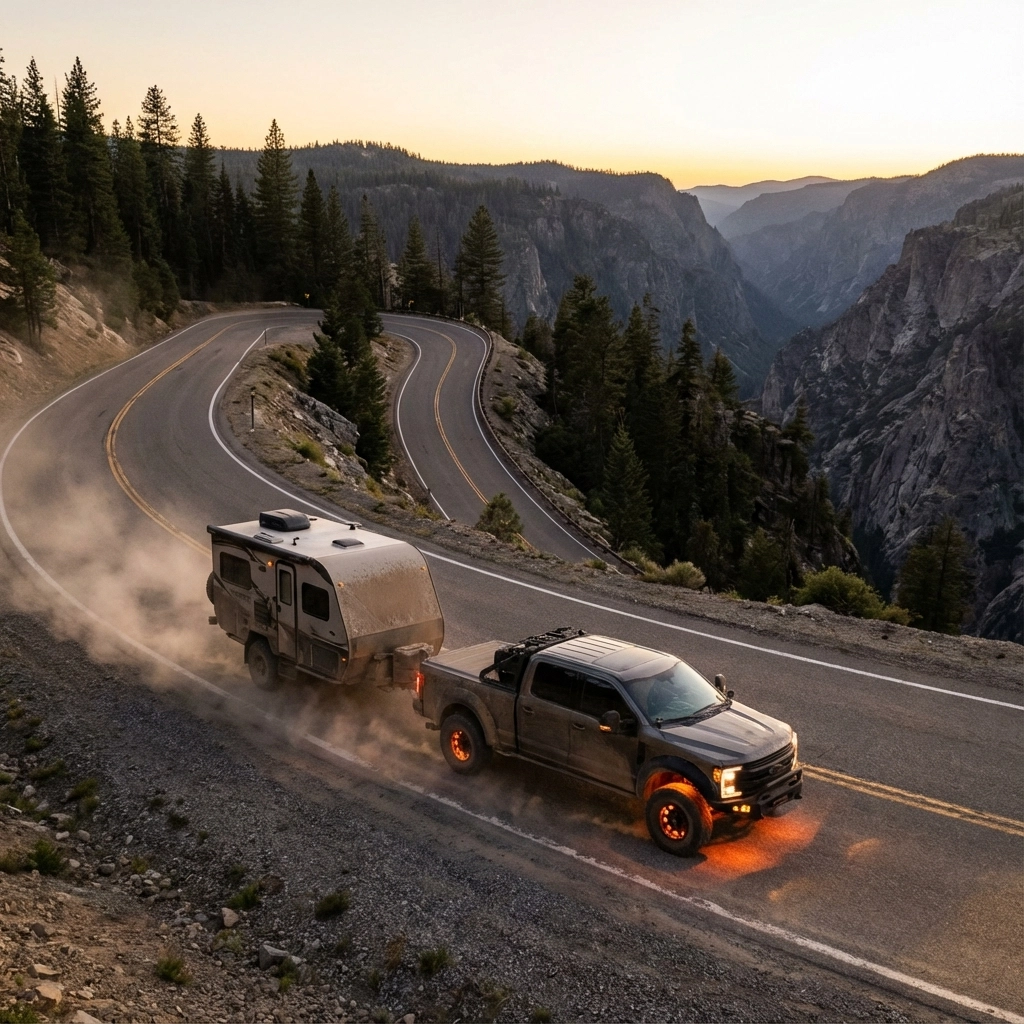
Why Downhill Towing Is High Risk
Brake fade represents the most serious threat when towing downhill. As brake pads and rotors heat up from continuous use, their friction coefficient decreases dramatically. What starts as normal stopping power can deteriorate to nearly zero braking effectiveness within minutes of sustained use. This thermal breakdown occurs faster when towing due to the additional weight and momentum of your trailer.
The trailer push effect creates another dangerous scenario. As you brake going downhill, your trailer’s momentum wants to continue forward, potentially pushing your tow vehicle faster than intended. This can lead to a jackknife situation where the trailer swings sideways, causing complete loss of control.
According to Federal Motor Carrier Safety Administration data, approximately 30% of truck-related accidents in mountainous regions involve brake-related failures, with many occurring on grades exceeding 6%. For recreational towing, similar principles apply – the combination of steep grades, heavy loads, and inexperienced drivers creates a perfect storm for accidents.
Common mountain passes like I-70 through Colorado’s Eisenhower Tunnel or California’s Grapevine on I-5 see numerous towing incidents annually, often involving overheated brakes and loss of control. These real-world examples underscore why proper downhill technique isn’t optional – it’s essential for safety.
How to Brake When Towing Downhill
Before the Descent
Select a lower gear before you begin your descent, not during it. For automatic transmissions, shift to “2” or “1” depending on the grade steepness. Manual transmission drivers should downshift to third or second gear. This allows your engine to provide the primary braking force through compression.
Set your trailer brake controller gain appropriately. Start with a moderate setting and be prepared to adjust based on conditions. Your trailer should provide about 20-25% of total braking force under normal conditions, but steep grades may require increasing this to 30-40%.
Increase your following distance to at least 8-10 seconds behind the vehicle ahead. Your stopping distance increases significantly when towing, especially on grades where heat buildup affects brake performance.
Test your trailer brake function using the manual activation button on your brake controller. Ensure both tow vehicle and trailer brakes are working properly before committing to a long descent.
During the Descent
Use engine braking as your primary speed control. Let your transmission do the work. Your selected gear should keep you at a safe, steady speed without touching the brake pedal for extended periods.
Apply firm, short brake pressure when needed – this technique is called “stab braking.” Press the brakes firmly for 2-3 seconds, then release completely for 5-10 seconds to allow cooling. Never ride the brakes continuously.
Maintain a steady, controlled speed rather than trying to slow down and speed up repeatedly. Consistent speed reduces brake heating and maintains better vehicle control.
Avoid sudden steering inputs or lane changes while braking. The combination of downhill momentum and active braking creates instability that sudden movements can trigger into a loss of control.
After the Descent
Check for brake smell or visible heat immediately after reaching level ground. A sharp, metallic smell indicates overheated brakes. Blue-tinted brake rotors or smoking wheels are signs of dangerous overheating.
Test your brakes gently at low speed to ensure they still respond normally. Overheated brakes may have reduced effectiveness even after cooling.
Allow adequate cooling time before your next challenging descent. Severely overheated brakes need 15-30 minutes to return to safe operating temperatures.
Trailer Brake Control Downhill
Modern trailer brake controllers use either time-delayed or proportional activation systems. Time-delayed controllers apply trailer brakes based on a preset timing after detecting tow vehicle braking. Proportional controllers sense deceleration forces and apply trailer brakes accordingly – these provide smoother, more natural braking feel.
Manual control becomes crucial on steep grades. Most brake controllers feature a manual activation lever that allows you to apply trailer brakes independently. This helps when you need additional stopping power without overworking your tow vehicle’s brakes.
Adjusting gain for downhill requires understanding your specific setup. Start conservatively and increase gain gradually if you notice brake fade or inadequate stopping power. However, too much gain can cause trailer wheel lockup, creating handling problems.
Common controller mistakes include setting gain too low (forcing tow vehicle brakes to do all the work) or too high (causing trailer wheels to lock up and skid). The ideal setting allows smooth, coordinated braking between both vehicles.
Downhill Towing Safety Checklist
Best Practices for Long Downhill Descents
Rocky Mountain and Sierra Nevada experiences teach us that grade management starts with route planning. Professional drivers recommend studying elevation profiles before traveling and identifying the steepest sections where technique becomes most critical.
Heavy off-road trailers like those designed for overlanding present unique challenges. Their higher gross weights and specialized suspensions require different approaches compared to lightweight travel trailers. The additional momentum means starting your descent slower and being more conservative with speed limits.
Weather conditions dramatically affect braking requirements. Rain reduces friction between tires and road, requiring gentler inputs and longer stopping distances. Snow or ice conditions may require chains and extremely conservative speeds. Hot weather reduces brake cooling efficiency, making thermal management even more critical.
For extended mountain travel, many experienced towers recommend upgrading to larger brake rotors, adding auxiliary transmission coolers, and installing brake temperature monitoring systems.
Common Mistakes to Avoid
Riding the brakes represents the most dangerous mistake novice towers make. Continuous light brake pressure generates maximum heat while providing minimal speed control. This leads directly to brake fade and potential loss of control.
Over-relying on tow vehicle brakes while ignoring trailer brake adjustment forces your primary vehicle to handle excessive braking loads. This accelerates brake wear and increases heat buildup beyond safe limits.
Ignoring trailer brake maintenance means discovering brake problems when you need stopping power most. Regular inspection and adjustment of trailer brake systems prevents failures during critical situations.
Downshifting too late often occurs when drivers wait until they’re already going too fast before selecting appropriate gears. Engine braking works best when implemented early in the descent while speeds are manageable.

How Trailer Design Affects Downhill Control
Modern off-road trailer engineering significantly impacts downhill stability and control. Lower center of gravity designs reduce the likelihood of trailer sway and improve overall handling during braking. Longer wheelbase configurations provide more stability but require wider turning radii.
Independent suspension systems found on premium off-road trailers like BlackSeries off-road trailers maintain better tire contact with the road during braking, improving traction and control. This becomes especially important on uneven mountain roads where suspension articulation affects braking effectiveness.
High-quality brake systems with proper heat dissipation features handle sustained use better than basic drum brake setups. Electric-over-hydraulic systems provide more precise control and faster response times compared to traditional electric-only systems.
Balanced weight distribution through thoughtful chassis design ensures that trailer brakes receive appropriate weight transfer during deceleration, maximizing their effectiveness without causing instability.
FAQ – Towing Downhill Braking
Should I use engine braking when towing downhill?
Yes, engine braking should be your primary speed control method when towing downhill. Select an appropriate lower gear before beginning your descent and let your transmission handle most of the speed control work.
How fast should I go downhill with a trailer?
Travel 10-15 mph below the posted speed limit for regular vehicles. Posted limits apply to cars, not vehicles towing trailers. Your actual safe speed depends on grade steepness, trailer weight, and current conditions.
Can trailer brakes overheat?
Absolutely. Trailer brakes can overheat just like tow vehicle brakes, leading to brake fade and potential failure. Use proper technique with intermittent braking and allow cooling periods during long descents.
What gear should I use when towing downhill?
For automatic transmissions, use “2” for moderate grades and “1” for steep grades. Manual transmissions should use 3rd gear for gentle slopes and 2nd gear for steeper descents. Select your gear before starting down, not during the descent.

