Yes, you can tow a travel trailer on the Alaska Highway , but only if it’s built for rough road conditions, long distances, and remote travel. The Alaska Highway demands more than standard recreational vehicles can handle. You need a trailer engineered for frost heaves, gravel sections, steep mountain grades, and thousands of miles with limited services.
What Is the Alaska Highway (ALCAN Highway)?
The Alaska Highway stretches 1,387 miles from Dawson Creek, British Columbia, to Delta Junction, Alaska. Originally built in 1942 as a military supply route, this legendary highway connects the continental United States to Alaska through some of North America’s most challenging and spectacular terrain.
For travel trailer owners, the Alaska Highway represents the ultimate test of equipment durability and preparation. The route crosses through British Columbia, Yukon Territory, and Alaska, featuring elevation changes from sea level to over 4,000 feet, temperature swings from summer heat to sudden frost, and stretches of up to 300 miles between fuel stops.
Many RV enthusiasts underestimate this highway’s demands. Unlike typical interstate travel, the Alaska Highway requires vehicles and trailers capable of handling sustained rough conditions, emergency repairs, and extended off-grid periods.
Alaska Highway Road Conditions (What You Must Prepare For)
Frost Heaves and Surface Challenges
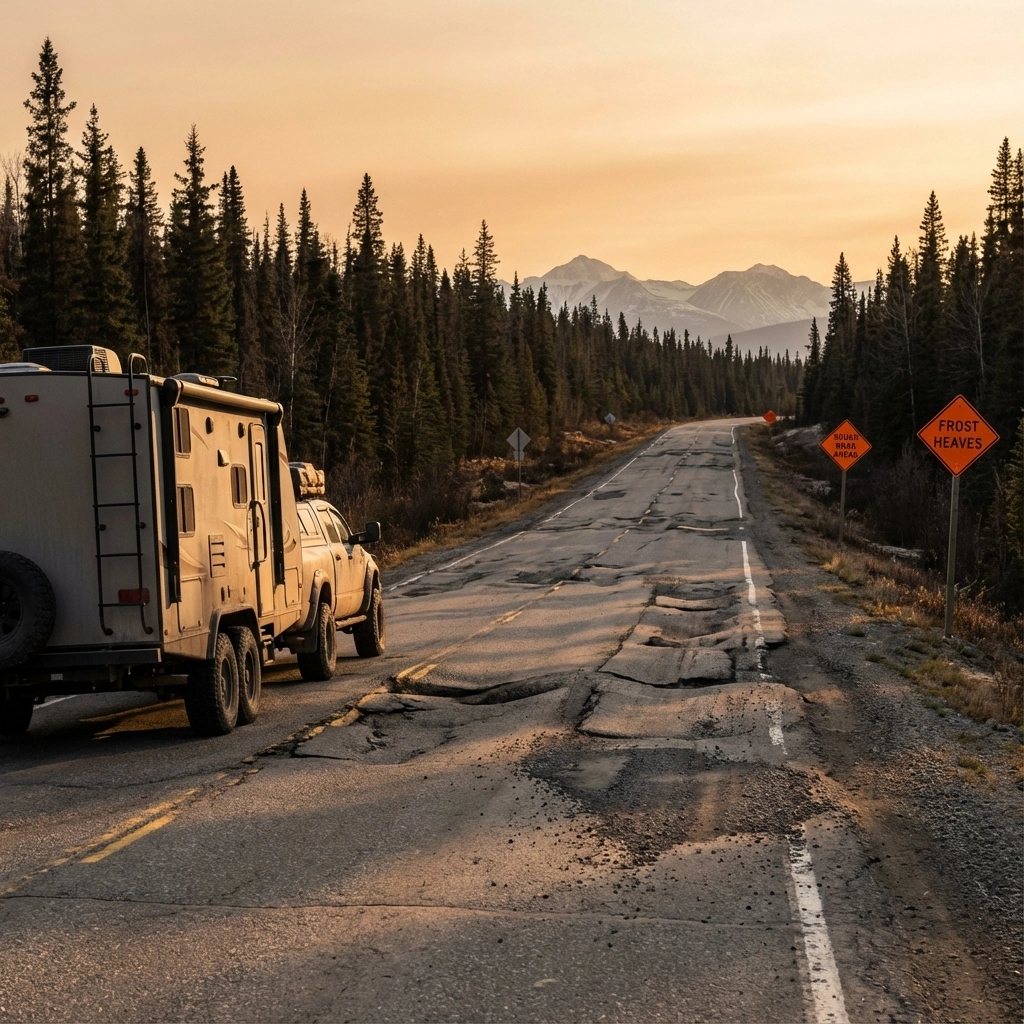
Frost heaves create the Alaska Highway’s most notorious hazard. These pavement disruptions occur when ground moisture freezes and thaws, causing road surfaces to buckle and create jarring bumps. Standard travel trailers often suffer suspension damage, loose connections, and interior damage from sustained frost heave impact.
Construction zones appear somewhere along the highway nearly every summer, creating delays and temporary gravel detours. These sections can extend for miles, requiring trailers with adequate ground clearance and robust undercarriage protection.
Remote Service Intervals
Gas stations and repair services can be 200-300 miles apart. Cell phone coverage remains spotty or nonexistent across vast stretches. When mechanical issues arise, you’re often on your own for hours or days before reaching professional help.
Weather Extremes
Summer temperatures can swing 40+ degrees within hours. Mountain passes may experience sudden storms, while valleys bake in intense heat. Your travel trailer must handle these extremes while maintaining interior comfort and system reliability.
Can Any Travel Trailer Handle the Alaska Highway?
Absolutely not. Lightweight, mass-market travel trailers face systematic failures on the Alaska Highway. Common failure points include:
- Suspension collapse from sustained rough road impact
- Frame stress fractures at weak mounting points
- Axle bearing failures from overheating on long grades
- Interior component loosening from constant vibration
- Plumbing disconnections and appliance mounting failures
Standard recreational trailers design prioritizes weight savings and cost reduction over durability. The Alaska Highway exposes these compromises ruthlessly. Even expensive conventional trailers often lack the engineering fundamentals needed for sustained rough-road travel.
This is why off-road capable travel trailers have become essential for serious Alaska Highway travelers. These trailers feature reinforced chassis, independent suspension systems, and components rated for continuous duty cycles rather than weekend camping.
Key Features of the Best Travel Trailer for Alaska Highway
Heavy-Duty Chassis & Reinforced Frame
The best travel trailer for Alaska Highway travel starts with a chassis engineered for overland expeditions rather than highway-only use. Look for fully-welded steel construction with cross-member reinforcement at stress points. Aluminum frames simply cannot withstand sustained impact loading.
Frame geometry matters critically. Conventional trailers use ladder-frame construction optimized for weight, not strength. Expedition-grade trailers feature box-beam construction with integrated skid plates protecting vulnerable undercarriage components.
Independent Suspension & Ground Clearance
Independent suspension systems dramatically outperform traditional leaf-spring setups on rough roads. Each wheel responds independently to surface irregularities, reducing chassis stress and improving ride quality. This technology prevents the frame-twisting forces that destroy conventional trailers.
Ground clearance of 12+ inches enables confident navigation through construction zones and rocky terrain without costly undercarriage damage.
All-Terrain Tires & Full-Size Spare
Highway tires fail rapidly on gravel sections and rough pavement. Alaska Highway off-road travel trailers require aggressive tread patterns designed for mixed surfaces. Load-range E tires provide puncture resistance and sustained high-temperature performance on long mountain grades.
Carrying two full-size spares (not compact temporary spares) is mandatory. Tire repair facilities may be 500+ miles away when failures occur.
Large Water & Power Capacity (Off-Grid Ready)
Extended distances between campgrounds with full hookups make self-sufficiency critical. Look for 40+ gallon fresh water tanks, efficient gray/black water management, and solar charging systems capable of indefinite off-grid operation.
Many Alaska Highway travelers spend multiple consecutive days boondocking in remote locations, making robust off-grid capabilities essential rather than optional.
Cold-Weather & Insulation Considerations
Northern latitudes create surprising cold-weather challenges even in summer. Proper insulation, heated tanks, and cold-weather appliance operation become critical for comfortable travel. Winterizing systems before departure prevents costly freeze damage at high elevations.

Why BlackSeries Travel Trailers Are Built for the Alaska Highway
BlackSeries engineering philosophy centers on expedition-grade construction rather than recreational convenience. This approach creates natural alignment with Alaska Highway demands.
Independent Suspension Excellence: BlackSeries trailers feature fully-independent suspension systems with adjustable damping. Each wheel responds individually to surface variations, dramatically reducing chassis stress compared to solid-axle competitors.
Overbuilt Chassis Design: While competitors optimize for weight savings, BlackSeries prioritizes strength through fully-welded steel construction with integrated skid plate protection. The chassis can handle sustained abuse that would destroy conventional frames.
Proven Off-Grid Systems: Large-capacity water storage, comprehensive solar charging, and efficient power management enable extended remote operation. These aren’t aftermarket additions , they’re integrated design elements tested in real expedition conditions.
Real-World Testing: BlackSeries develops products through actual overland expeditions, not computer simulations. This testing methodology ensures components perform reliably under sustained rough-road conditions.
Alaska Highway Travel Trailer Preparation Checklist
Pre-Departure Vehicle Inspection
- Complete chassis lubrication service
- Inspect all suspension components and torque specifications
- Verify brake system operation and adjust electric brake controller
- Test all trailer lighting and electrical connections
- Inspect tire condition and set proper inflation pressures
- Verify hitch weight distribution and sway control setup
Essential Spare Parts & Tools
- Two full-size spare tires with wheels
- Complete bearing repack kit with grease gun
- Electrical repair kit (wire, connectors, fuses)
- Basic hand tools including torque wrench
- Emergency patches for plumbing repairs
- Spare brake parts (shoes, magnets, hardware)
Route Planning & Communication
- Download offline GPS maps for entire route
- Research fuel stop locations and distances
- Identify repair facilities along planned route
- Establish check-in schedule with emergency contacts
- Purchase satellite communication device for emergencies
Understanding dispersed camping regulations becomes crucial when planning overnight stops in remote areas.
Frequently Asked Questions (FAQ)
Is the Alaska Highway safe for travel trailers?
Yes, when properly equipped. The highway is primarily paved with adequate shoulders for large vehicles. However, rough pavement conditions, construction zones, and remote distances require trailers built for sustained tough conditions rather than recreational use.
Do I need an off-road travel trailer for Alaska?
While the Alaska Highway doesn’t require true off-road capability, it demands expedition-grade durability. Trailers with independent suspension, reinforced chassis, and overbuilt components significantly outperform conventional recreational trailers on this route.
What size travel trailer is best for the Alaska Highway?
Size matters less than construction quality. However, trailers under 25 feet offer advantages in construction zones and mountain driving. The BlackSeries HQ19 represents an optimal balance of capability and manageability for Alaska Highway travel.
Can I boondock along the Alaska Highway?
Absolutely. Extended boondocking capability is essential due to limited campground availability. Successful Alaska Highway travel requires trailers with large water capacity, efficient power systems, and waste management designed for extended off-grid operation.
The Alaska Highway rewards proper preparation and punishes shortcuts. Choose your travel trailer based on engineering capability rather than price point, and this legendary route becomes an achievable adventure rather than a costly disaster.

