Backcountry RV living combines remote work income with mobile homeschooling by relying on robust off-grid power systems, satellite internet, large water capacity, and four-season insulation. For modern families, the “office” is wherever the dirt road ends, and the classroom is the world itself.
Why Families Are Moving Work and School Off-Grid
The traditional American lifestyle is shifting. Driven by remote work normalization and the “roadschooling” movement, families are trading suburban lawns for public land access. The pandemic accelerated what was already brewing: a desire for independence, flexibility, and a return to nature-based learning.
By escaping congested campgrounds, families gain privacy, nature-based education for children, and a significantly lower cost of living, provided they have the right equipment. Regular campgrounds charge $40-70 per night. BLM dispersed camping? Free. National Forest permits for extended stays? Often just $20-50 for an entire season.
The growth is real. U.S. remote work participation remains at record highs post-2020, and homeschooling registrations have grown by over 30% in many states. This shift has led to a 140% increase in dispersed camping permits, highlighting the demand for working remotely from an off-grid RV setups that actually deliver.
But there’s a catch: not every RV is built for this lifestyle.
Core Requirements for Backcountry Work & Education
Living deep in the backcountry requires a different set of tools than weekend camping. Here’s what matters:
Power: You need 400–800W of solar paired with high-capacity lithium batteries to run laptops, charge devices, and power Starlink. Cloud cover happens, your battery bank needs 3-4 days of autonomy to weather storms without shutting down your workday.
Connectivity: Starlink or high-gain cellular boosters are the lifeline for remote work. The backcountry no longer means being “unplugged.” With a dedicated Starlink mount and redundant LTE boosters, “Zooming” from a canyon in Idaho is a legitimate reality.
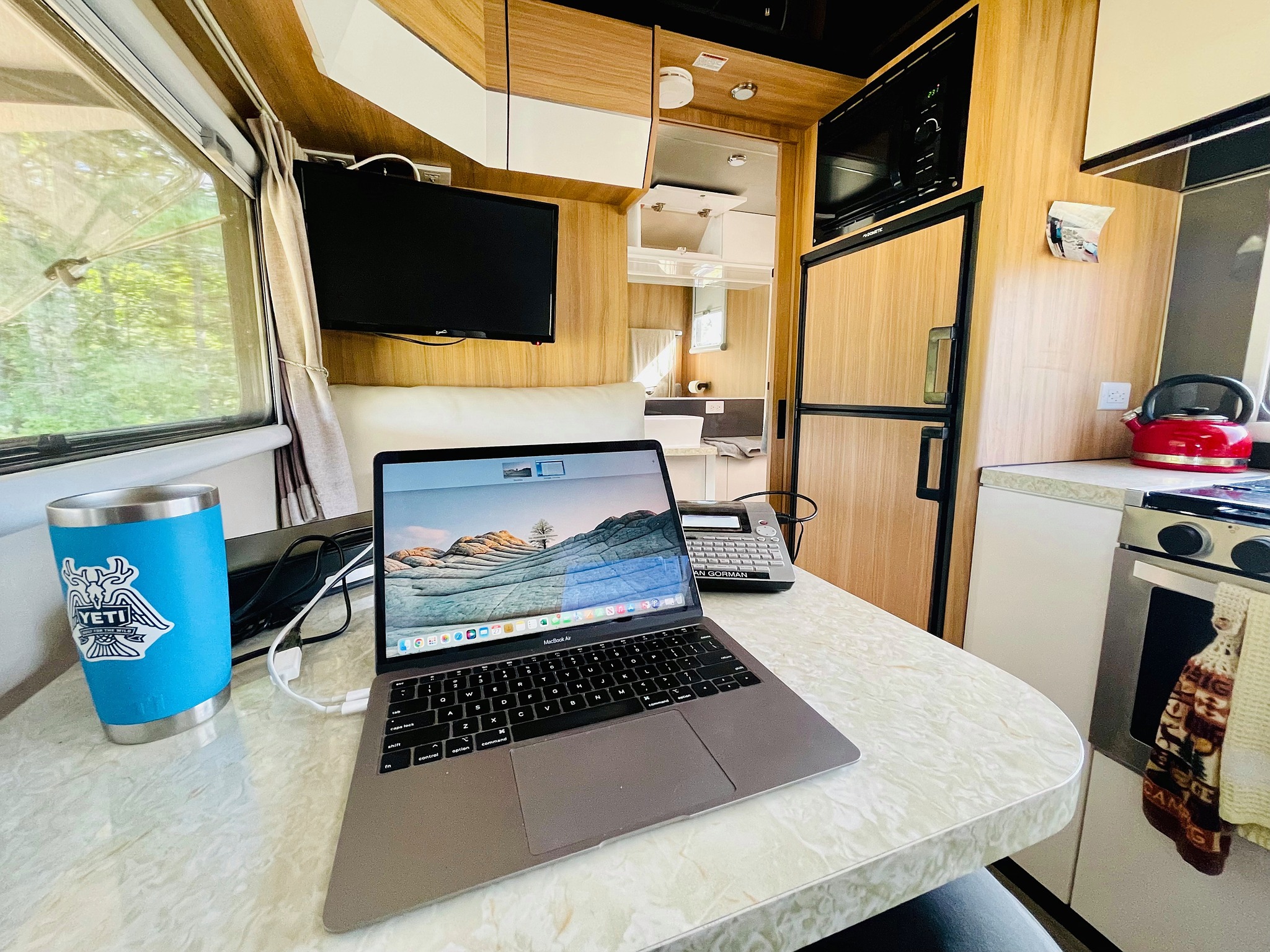
Workspace: A convertible dinette that doubles as a desk is essential for ergonomics. Kids need space to spread out schoolwork in the morning; you need it for spreadsheets in the afternoon.
Resources: 50+ gallon fresh tanks and heated holding tanks ensure you don’t have to break camp every two days. Water management becomes the pacing mechanism for how long you can stay put.
Four-Season Capability: Standard RVs are built for campgrounds, not January in Montana. Four-season insulation and diesel heaters, standard features in Black Series off-road travel trailers, allow for year-round comfort, even in high-altitude environments.

Off-Grid Specs That Make It Possible
Power System Design
Working remotely from an off-grid RV requires a daily amp-hour calculation. A laptop pulls 50-75Ah per day depending on usage. Starlink adds another 50-80Ah. Lights, water pump, fans, phone charging, it adds up fast.
The goal? Battery autonomy for 3-4 days of cloud cover. That means a 400Ah lithium bank minimum, paired with at least 600W of solar. Black Series trailers come standard with robust solar arrays and lithium battery systems designed for exactly this use case.
Internet Solutions
Starlink has revolutionized the game for off-grid internet setup for RV families. It pulls roughly 50-75W during active use and can handle video calls, cloud uploads, and streaming with surprisingly low latency. Pair it with a portable cellular booster (WeBoost or similar) for redundancy, and you’ve got a professional-grade setup.
Pro tip: use apps like Starlink’s coverage map and CellMapper to scout your next camp location before you arrive.
All-Season Capability
Here’s where most standard RVs fail. Thin walls, unheated tanks, and poor insulation mean you’re stuck chasing 70-degree weather year-round. Black Series off-road trailers are built with thick insulation, heated holding tanks, and diesel heaters that keep you comfortable in sub-zero temps, or desert heat.
That means you’re not competing with snowbirds for Arizona BLM spots in January. You can camp Montana in March, Colorado in November, or Wyoming in February while everyone else is stuck in crowded RV parks.
Step-by-Step – Setting Up a Backcountry Work & School System
1. Map Solar Exposure: Use apps like The Photographer’s Ephemeris or Sun Surveyor to find campsites with clear southern sky views. Solar exposure is your lifeblood, don’t camp under pine trees.
2. Calculate Weekly Water: Plan your consumption to match your tank capacity. A family of four uses roughly 10-15 gallons per day. With a 60-gallon fresh tank, you’re looking at 4-5 days of autonomy if you’re conservative.
3. Install Satellite Internet: Mount Starlink on a portable stand or roof rack. Test connectivity before committing to a multi-day stay.
4. Dedicated Workspace: Set up a dual-purpose area, school in the morning, work in the afternoon. Use collapsible organizers to keep supplies tidy.
5. Flexible Schedule: Build your travel days around your meeting schedule. Move camp on Fridays. Stay put Monday–Thursday when connectivity matters most.
Best U.S. Regions for Backcountry RV Living
Idaho National Forests: Massive dispersed camping access with lower crowd density than coastal areas. The Sawtooth, Salmon-Challis, and Boise National Forests offer thousands of free campsites with reliable solar exposure and epic nature-based homeschooling opportunities.
Montana Public Lands: Ideal for long-term stays with incredible scenery. The Lewis and Clark National Forest and areas around the Bob Marshall Wilderness provide world-class backcountry access. Just be ready for cold, even in summer, nights drop below freezing at elevation.
Arizona BLM Desert: Perfect for winter solar optimization and open spaces that make for great “classrooms.” The kids can study geology by literally touching volcanic rock formations. Areas around Quartzsite, Anza-Borrego, and the Arizona Strip offer endless dispersed camping zones.
Case Study – A Family Setup Using an Off-Road Trailer
A city-based family relies on the municipal grid, fixed school districts, and predictable routines. A “Backcountry Family” uses the sun for power and the terrain for science class.
Using a rugged solution like the Black Series HQ21, families can maintain high-level professional output, closing deals, managing teams, creating content, while their children learn geography firsthand in the mountains of Utah or the deserts of Arizona. The HQ21’s 60+ gallon fresh tank, 800W solar array, and four-season insulation mean you’re not constantly chasing resources.
One family we spoke with spent 8 months traveling through Wyoming, Montana, and Idaho while both parents worked full-time as software engineers. Their kids completed a full school year using online curriculum, supplemented by field trips to Yellowstone, Craters of the Moon, and Glacier National Park. Total campground cost? Under $500 for the entire year.
That’s the power of homeschooling while full-time RVing with the right equipment.
Data – Remote Work & Roadschooling Growth
The numbers don’t lie. Remote work participation in the U.S. has stabilized at around 35-40% of knowledge workers post-pandemic. Homeschooling registrations surged from 3.5 million students in 2019 to over 5 million by 2023. Dispersed camping permits issued by the BLM increased 140% from 2019 to 2024.
What does this mean? The infrastructure and cultural acceptance for best RV for remote work and homeschool lifestyles are stronger than ever. Families aren’t waiting for permission, they’re simply going.
FAQ
Is it realistic to homeschool from an RV full-time?
Yes. Thousands of families (known as roadschoolers) use the environment as their curriculum. Most states allow homeschooling with minimal oversight, and online programs like Time4Learning, Khan Academy, and Outschool make it easy to stay on track academically while adding real-world experiences.
How much solar power is needed for remote work?
At least 400W–600W is recommended for a full work day with high-speed internet. If you’re running Starlink, laptops, and charging devices, aim for 600-800W of solar with a 400Ah lithium battery bank.
Can satellite internet work in deep backcountry?
Absolutely. Starlink has revolutionized connectivity for RV families. As long as you have a clear view of the northern sky (in the U.S.), you’ll get reliable, high-speed internet even miles from cell towers.
What size RV works best for a family off-grid?
A 19 to 21-foot off-road trailer offers the best balance of maneuverability and interior living space. The Black Series HQ19 and HQ21 are purpose-built for this lifestyle, with independent suspension, large tanks, and robust solar systems that don’t require upgrades.
The backcountry isn’t just a weekend escape anymore. For families ready to embrace it, it’s a full-time lifestyle that combines income, education, and adventure in ways that were impossible a decade ago. You just need the right rig to make it work.

