Ranch camping requires independence from hookups, higher ground clearance for dirt roads, extended water capacity, and reliable solar power. Off-grid RV specifications solve all four constraints, making a specialized off-road trailer the ultimate tool for private land exploration.
If you’ve ever dreamed of parking your RV on a working ranch, surrounded by wide-open spaces, grazing cattle, and zero neighbors, you already know the reality: standard campground trailers aren’t built for this. Ranch camping is a different game entirely, and the RVs that excel here are purpose-built for independence, durability, and self-sufficiency.
What Makes Ranch Camping Different from Campground Camping?
Camping on a working ranch isn’t like pulling into a paved KOA lot with full hookups and Wi-Fi. Here’s how the variables change:
No Municipal Power: There are no electrical pedestals waiting for you. You are your own utility company, which means you need high-output solar panels and a lithium battery bank that can sustain multi-day operation without a generator.
Well Water or No Water: Many ranches have well water, but it’s often reserved for livestock or agriculture. You must arrive with a full freshwater tank and the capacity to stay off-grid for 3–5 days without resupply.
Unimproved Roads: Ranch tracks are often just two ruts in the dirt, scattered with rocks, washouts, and steep grades. High ground clearance and rugged suspension are non-negotiable if you want to avoid damage to your undercarriage.
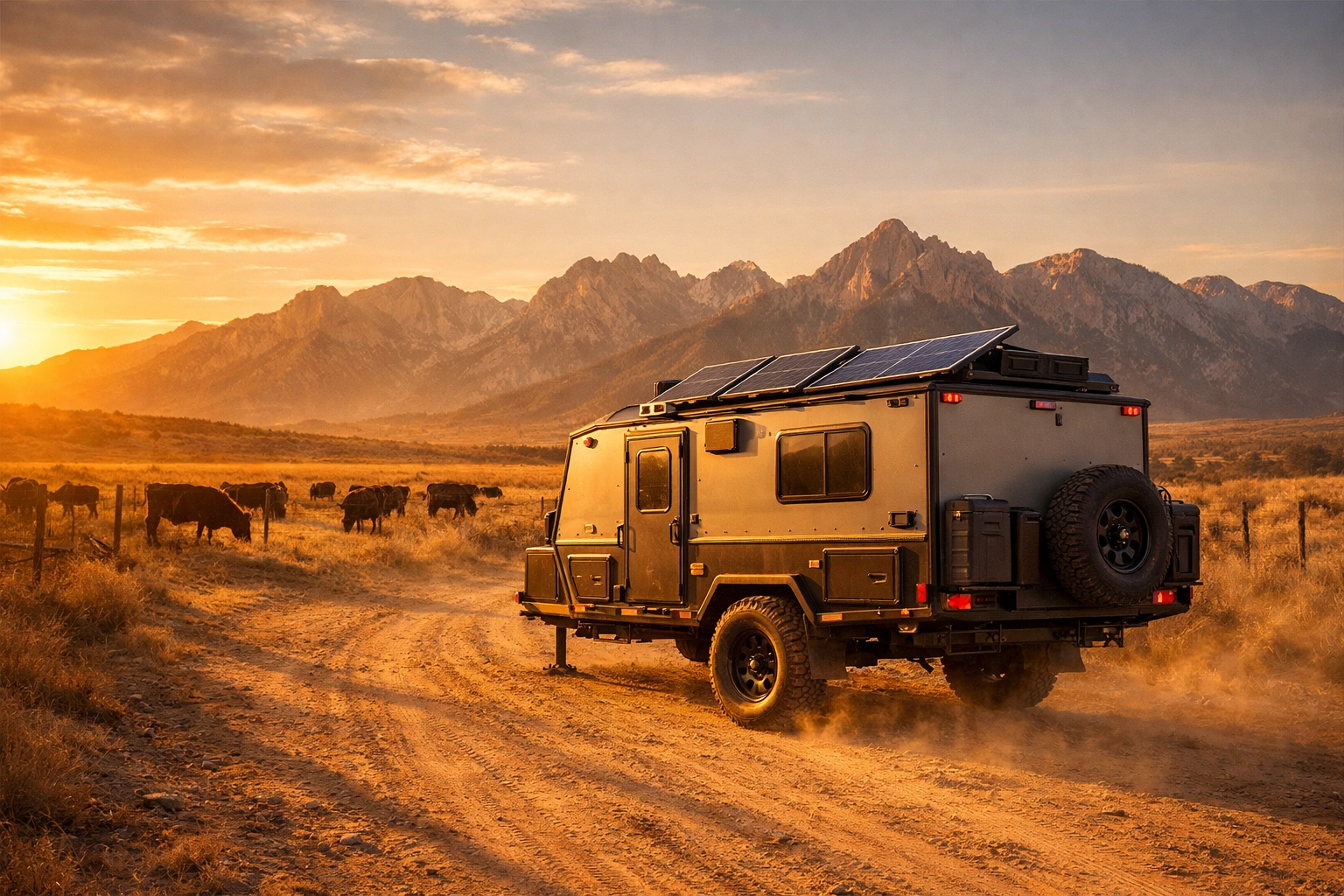
Dust and Livestock: The environment is harsh. You need a trailer with superior sealing to keep dust out of living spaces and a hot-dipped galvanized chassis to prevent corrosion from manure, mud, and moisture.
Isolation: You’re far from the nearest grocery store, gas station, or dump station. This requires long-range battery capacity, efficient power management, and careful planning for food storage and waste disposal.
In short, ranch camping is boondocking on private ranch land, and it demands a self-sufficient travel trailer designed for the job.
Off-Grid Specifications That Matter on a Ranch
Power Systems
To be truly self-sufficient, look for an off-grid RV for ranch camping with a 400W–600W solar array paired with a large lithium battery bank. This configuration ensures you can run lights, a compressor fridge, water pumps, and even air conditioning without the constant drone of a generator disturbing the peace, or the cattle.
Lithium batteries are critical here. They recharge faster, hold more usable capacity, and last significantly longer than lead-acid alternatives. A 200Ah lithium system can comfortably support a 3–4 day ranch stay without sunlight, assuming moderate usage.
Water Systems
Ranch stays often lack hookups entirely. A 60+ gallon freshwater tank and an on-demand hot water heater allow for extended stays without the “water anxiety” common in smaller standard trailers. Pair this with a grey water tank of similar capacity, and you can enjoy hot showers, dishwashing, and general comfort without constantly worrying about your reserves.
For perspective, a family of four using water conservatively can stretch 60 gallons over 3–4 days. If you’re planning a week-long stay, consider a trailer with dual tanks or an auxiliary water bladder system.
Suspension & Chassis
A hot-dipped galvanized chassis and independent trailing arm suspension, standard on Black Series off-road travel trailers, absorb the vibrations and impacts of washboard ranch roads, protecting your interior cabinetry, appliances, and peace of mind.
Traditional leaf-spring axles are fine for paved highways, but they transfer every bump and rut directly into the trailer frame. Independent suspension systems articulate over uneven terrain, keeping all wheels in contact with the ground and dramatically reducing stress on the chassis.

Step-by-Step – How to Set Up for Ranch Camping
1. Confirm Road Conditions: Before you commit, ask the rancher about access road conditions. Are there low-hanging branches? Tight creek crossings? Steep grades? This intel determines whether you need to scout the route first or if your rig can handle it as-is.
2. Calculate Power Needs: Ensure your battery state of charge (SOC) is at 100% before arriving. Run the numbers: how many amp-hours will your fridge, lights, and electronics consume per day? Do you have enough solar to replenish that draw?
3. Fill Water Before Arrival: Don’t count on ranch well water. It might be high in minerals, limited in supply, or simply not available for RV use. Top off your freshwater tank at the last reliable source before you enter the property.
4. Site Selection: Park on level ground away from livestock paths. Cows, horses, and sheep don’t care about your awning, or the mess they leave behind. Choose a spot with good solar exposure and natural windbreaks if possible.
5. Waste Management Plan: Always have a plan for grey and black water disposal. Some ranches have dump stations; most don’t. Know where the nearest RV dump is, and don’t overstay your tank capacity.
Best U.S. Regions for Ranch Camping
Texas Hill Country: Massive private acreages with long, winding gravel drives that require durable suspension and high clearance. Ranches here are often 500+ acres, giving you true solitude. Expect caliche roads, occasional water crossings, and plenty of wildlife.
Montana Working Ranches: Cold-weather insulation is critical in this region, along with high ground clearance for navigating mountain meadows and forest service roads. Snow and mud are common even in late spring, so plan accordingly.
Arizona Desert Ranches: Dust resistance and solar optimization are the priorities in the high-heat, high-sun environment of the Southwest. Ranch roads are often sandy washes or rocky trails, and summer temperatures can exceed 110°F, making shade and efficient cooling systems essential.
Case Study – Off-Grid Ranch Living with an Off-Road Trailer
A standard RV is designed for “City-to-Campground” travel: smooth roads, electrical hookups, and nearby amenities. An off-grid ranch RV, like the Black Series HQ series, is designed for “City-to-Wilderness.”
Consider this real-world comparison: A couple from Colorado wanted to spend two weeks on a friend’s 8,000-acre cattle ranch in Wyoming. Their first attempt with a standard 25-foot travel trailer ended after three days. The roads beat up the suspension, the generator ran constantly (annoying both humans and livestock), and their 30-gallon water tank ran dry after two days.
They upgraded to a Black Series HQ19, equipped with 400W of solar, 200Ah of lithium, and 60 gallons of fresh water. The second trip lasted the full two weeks. Solar kept the batteries topped off, the independent suspension handled the rough ranch roads without issue, and the extended water capacity eliminated the need for mid-trip resupply runs.
The difference isn’t just comfort, it’s capability. While a regular unit struggles with power management and road vibration, a self-sufficient travel trailer allows you to park in the middle of 10,000 acres and live as comfortably as you do at home.
Data – Growth of Private Land & Ranch Camping
According to data from Hipcamp, private land camping, including ranch stays, has grown by over 300% since 2020. As National Parks become more crowded and reservations more difficult to secure, the “Western States Ranch Lease” model is becoming the preferred way for adventure seekers to find true solitude.
Platforms like Harvest Hosts and Hipcamp now list thousands of private ranches, farms, and rural properties where RV camping is permitted. Many hosts specifically note that off-road travel trailers are preferred due to the condition of access roads and the lack of on-site utilities.
This trend mirrors the broader rise of overlanding and dispersed camping, where travelers are actively seeking ways to escape crowded campgrounds and experience authentic rural environments.
FAQ
Can you camp on private ranch land with an RV?
Yes, through platforms like Harvest Hosts, Hipcamp, or direct arrangement with property owners. Always confirm access permissions, road conditions, and any property-specific rules before arrival.
How much water capacity is enough for ranch camping?
For a 3–4 day stay, 50–70 gallons is ideal for a family of four. Solo travelers or couples can manage with 40–50 gallons if they practice conservative water use.
Is solar mandatory for ranch RV camping?
Unless you want to listen to a generator all day (and risk disturbing the rancher and livestock), solar is effectively mandatory for the ranch experience. A 300–400W array is the minimum for comfortable off-grid living.
What suspension type is best for ranch dirt roads?
Independent trailing arm suspension is superior to traditional leaf-spring axles. It prevents the “trailer sway” and “cabin shake” typical of solid axles, especially on washboard and rutted roads.
Ranch camping is one of the most rewarding ways to experience the American West: but only if your RV can handle the conditions. Standard campground trailers are built for pavement and pedestals. Off-grid RVs, like those from Black Series, are built for freedom. If you’re serious about exploring private land, investing in the right specifications isn’t optional: it’s the only way to unlock the full potential of ranch camping.

