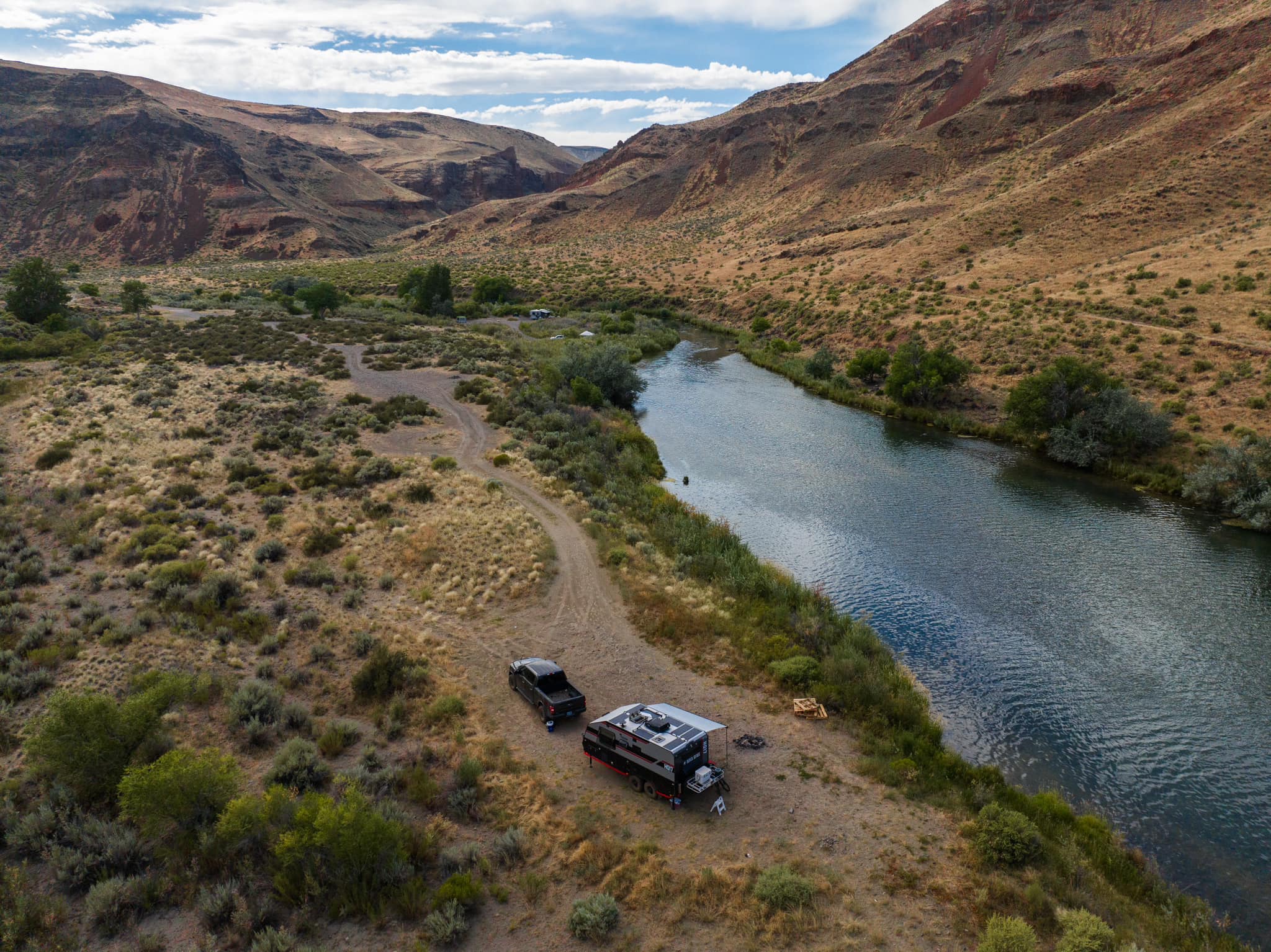
Regular RVs are limited by ground clearance, axle design, and weight. Off-road trailers with independent suspension, reinforced chassis, and higher departure angles unlock true remote access to places where standard trailers simply cannot go.
If you’ve ever watched a family in a massive Class A motorhome get turned around at the entrance to a BLM road, you already know the problem. Standard RVs are designed for pavement and pull-through sites. But the best camping spots, the ones with zero neighbors and million-dollar views, require something more capable.
Why Regular RVs Can’t Reach Remote Camping Areas
Most travel trailers are engineered for comfort, not terrain. That’s fine if you’re camping at an RV resort with full hookups, but it becomes a serious limitation when the road turns to washboard gravel or sand.
Here’s what stops most standard RVs from reaching remote locations:
Low Ground Clearance: The average travel trailer sits 6–8 inches off the ground. Plumbing lines, gray water tanks, and electrical components hang even lower. Hit a rock or a deep rut, and you’re dealing with expensive damage, or worse, you’re stuck.
Leaf-Spring Axles: Traditional suspension systems don’t allow wheels to move independently. When one wheel drops into a hole, the opposite wheel lifts off the ground, losing traction. This creates a bouncing, unstable ride that can crack interior cabinets and shake loose plumbing connections.
Long Wheelbases and Poor Angles: Standard RVs are long. That’s great for interior space, but terrible for breakover angle. Drive over a mound or a drainage berm, and the center of the trailer will high-center, leaving you grounded.
Weight Distribution: The average travel trailer weights for luxury models range from 5,000 to 10,000+ pounds, depending on size. When that weight is sitting on narrow tires designed for highway use, soft sand or muddy trails become instant deal-breakers.
What Makes an Off-Road RV Different?
An off-road travel trailer isn’t just a standard RV with bigger tires. The entire platform is engineered differently.
Independent Suspension: Systems like the coil-spring setup on the Black Series HQ19 allow each wheel to articulate vertically without affecting the opposite side. This keeps the trailer stable and prevents the violent bouncing that occurs with leaf springs.
Articulating Hitch Systems: A standard ball hitch only allows for side-to-side movement. An articulating hitch rotates 360 degrees, preventing the trailer from binding when the tow vehicle climbs or descends steep angles. This is critical for navigating rocky trails or steep forest roads.
Hot-Dipped Galvanized Chassis: The frame on an off-road trailer is built to handle torsional stress. A galvanized steel chassis resists corrosion from mud, salt, and water crossings while maintaining structural integrity under load.
Off-Grid Power Systems: True remote access requires self-sufficiency. Off-grid RVs with solar and lithium batteries eliminate the need for noisy generators or crowded campgrounds with electrical hookups.
Higher Ground Clearance: Off-road trailers typically sit 15–20 inches off the ground, with components tucked high into the frame. This allows you to clear rocks, logs, and deep ruts without scraping.
Step-by-Step: How to Find Off-Grid RV Locations
Finding remote camping spots isn’t just about having the right trailer, it’s about knowing where to look and how to plan.
1. Use Public Land Maps: Start with BLM (Bureau of Land Management) and National Forest Service maps. These agencies manage millions of acres of dispersed camping areas. Download the MVUM (Motor Vehicle Use Maps) for the specific forest or BLM district you’re targeting.
2. Check Terrain Difficulty Ratings: Apps like onX Offroad or Gaia GPS provide color-coded trail ratings. Green trails are typically accessible by 2WD vehicles, while black-diamond trails require high-clearance 4WD. Match the rating to your tow vehicle and trailer capability.
3. Scout Satellite Elevation Profiles: Look for elevation changes, washouts, or narrow sections that might be problematic. Google Earth and satellite imagery can show you the condition of a road before you commit to driving it.
4. Verify Trailer Specs vs. Terrain: Check your trailer’s departure angle, approach angle, and ground clearance against the route you’re planning. If the trail description mentions “steep grades” or “deep ruts,” make sure your rig can handle it.
5. Carry Recovery Equipment: Even the most capable setup can get stuck. Traction boards, a shovel, and a portable winch or recovery straps are essential for self-recovery in remote areas.

Best Off-Grid Camping Regions in the U.S.
Some of the best dispersed camping in the country requires high-clearance or 4WD access. Here are three iconic regions where off-road capability makes the difference.
Moab, Utah: Famous for its red rock landscape and “rock crawling” trails. Dispersed camping near Arches and Canyonlands National Park requires navigating rocky terrain and steep washes. A standard RV won’t make it past the first set of ledges. High-clearance trailers like the Black Series HQ21 are designed for exactly this kind of terrain.
Big Bend National Park, Texas: The backcountry roads leading to primitive campsites in Big Bend are rough, narrow, and unforgiving. Standard RVs are restricted from most of these routes. With an off-road trailer, you gain access to some of the darkest skies and most remote landscapes in the continental U.S.
Anza-Borrego Desert State Park, California: Deep sand washes and steep ravines define this desert region. Soft sand is a nemesis for heavy, standard RVs. Off-road trailers with larger tires and independent suspension can handle the shifting terrain without getting stuck.
Case Study: How Off-Road RV Owners Travel Differently
There’s a fundamental difference in how off-road RV owners approach travel compared to standard RV users.
Standard RV Users: Campground dependent. Reservations required. Hookups necessary. Limited to paved roads and established RV parks. Travel plans are dictated by availability and proximity to infrastructure.
Off-Road Trailer Users: Dispersed camping. Freedom to stop anywhere it’s legal. Self-sufficient power and water systems. Access to remote trails and forest roads. Travel plans are dictated by adventure, not amenities.
While a heavy 30 ft camper weight might limit some rigs to pavement, a ruggedized Black Series HQ19 uses its weight-balanced chassis and independent suspension to handle dirt roads that would shake a standard unit apart. The result is a completely different travel experience, one defined by solitude, flexibility, and access to landscapes that regular RVs will never see.
Data: Growth of Overlanding in the U.S.
The overlanding and off-grid camping segment is exploding. According to Google Trends, searches for “remote boondocking” have risen 140% since 2021. This shift is driven by several factors:
- Privacy: Campgrounds are crowded. Dispersed camping offers isolation and quiet.
- Technology: Lithium battery systems and solar panels have made true off-grid living practical.
- Adventure: People want access to landscapes that feel untouched, and they’re willing to invest in the equipment to get there.
The RV Industry Association (RVIA) reports that off-road trailers represent the fastest-growing segment in the towable category. This isn’t a trend, it’s a permanent shift in how people want to experience the outdoors.
FAQ
Can regular travel trailers go off-road?
Only on very well-maintained gravel roads. True off-roading, navigating rocks, sand, steep grades, or deep ruts, requires independent suspension, high ground clearance, and a reinforced frame. Standard trailers are not built for this.
What ground clearance is needed for remote camping?
Ideally, 15–20 inches of ground clearance to avoid scraping on rocks, logs, and ruts. Most standard RVs have 6–8 inches, which is insufficient for anything beyond paved or lightly graded roads.
Is boondocking legal on public land?
Yes, on most BLM and National Forest Service lands, dispersed camping is permitted for up to 14 days in a 28-day period. However, some areas have restrictions, so always check the local MVUM or contact the district office.
Do I need 4WD to tow an off-road trailer?
For extreme terrain, deep sand, steep climbs, or loose gravel, 4WD is highly recommended. The low-range torque helps pull the trailer through challenging conditions without spinning out or losing control.
Does off-grid capability affect resale value?
Yes. Off-road trailers with solar, lithium batteries, and reinforced chassis hold their value better than standard RVs. Travel trailer depreciation is significantly lower for off-grid-capable models because demand continues to grow.
If you’re serious about reaching the places regular RVs can’t, the equation is simple: independent suspension, high clearance, and self-sufficient power. Everything else is just camping in a parking lot with a nicer view.

