
Your cart (0)
Your cart is empty
Tax included and shipping calculated at checkout
Your cart is empty
Tax included and shipping calculated at checkout

In real-world off-grid conditions, a properly sized RV solar and lithium system can sustain refrigeration, lighting, Starlink, and daily appliance use indefinitely, if solar input matches daily consumption.
That’s the simple answer. But spec sheets don’t tell the whole story. We tested BlackSeries trailers in Arizona deserts, Colorado mountains, and Texas ranch land to see what actually happens when you disconnect from the grid and rely entirely on solar and lithium power.
Spec sheets are built in labs under perfect conditions. The real world doesn’t work that way.
Here’s what changes when you leave the showroom floor and hit the dirt:
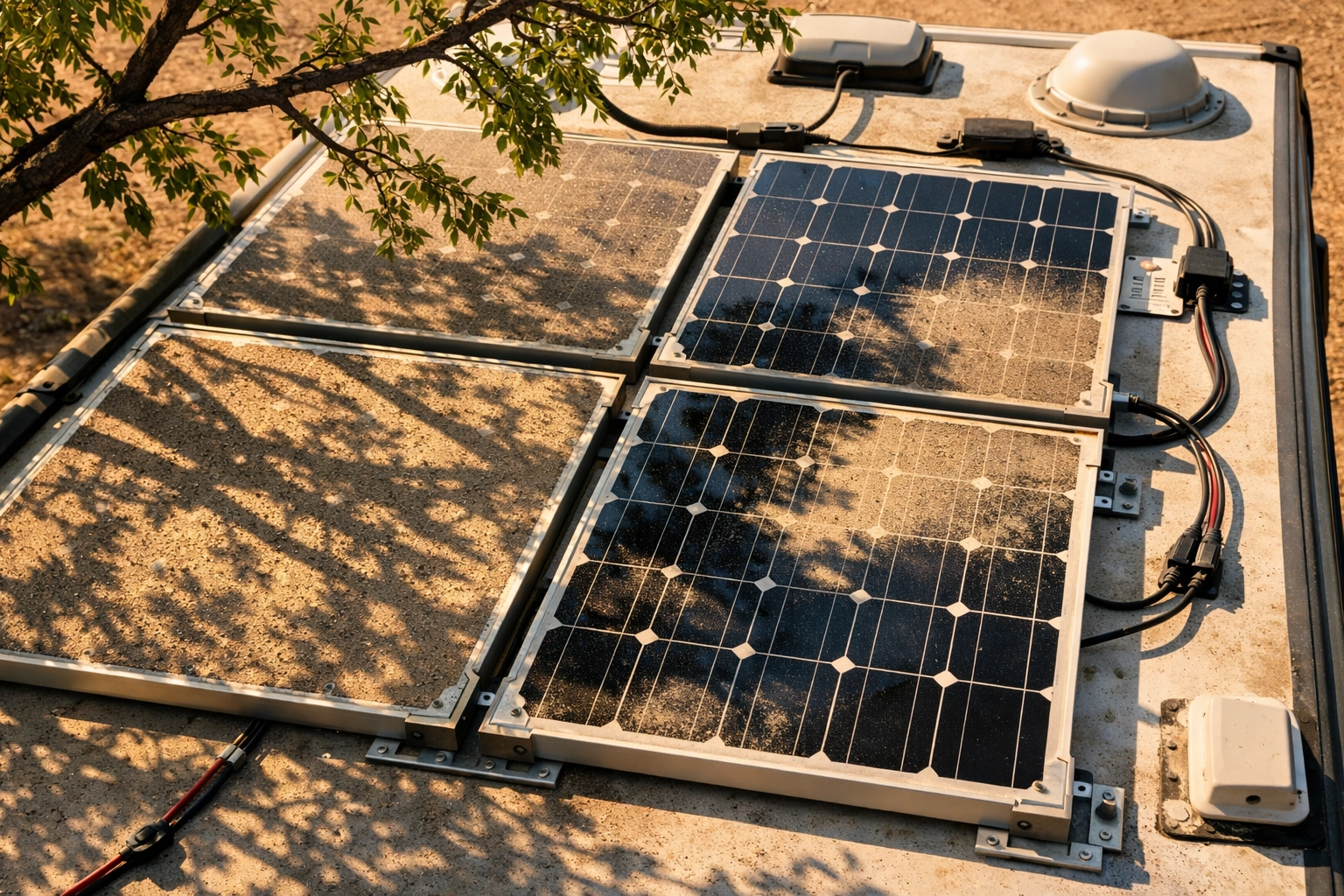
Rated Wattage vs. Reality: A 400W solar panel rarely outputs 400W. Dust accumulation, tree shadows, and panel angle all reduce actual production. We’ve seen panels operate at 60-70% of rated capacity in less-than-ideal conditions.
Temperature Impacts: High heat degrades solar controller efficiency. Ironically, cold weather actually improves solar panel performance, but shortens daylight hours. These variables matter when calculating real-world RV solar performance test outcomes.
Battery Behavior: Lithium batteries charge at approximately 80-85% efficiency, meaning a 1000W solar input delivers around 950 watts of usable power to the battery bank. Lead-acid systems only capture 800-850 watts from the same input.
Discharge Depth: Real-world “how long do lithium RV batteries last off-grid” calculations depend on your discharge habits. Lithium tolerates 80-100% depth of discharge without damage. AGM batteries can only safely discharge to 50% capacity before lifespan degrades.
The bottom line: lab numbers are starting points. Real performance depends on environment, load management, and system design.
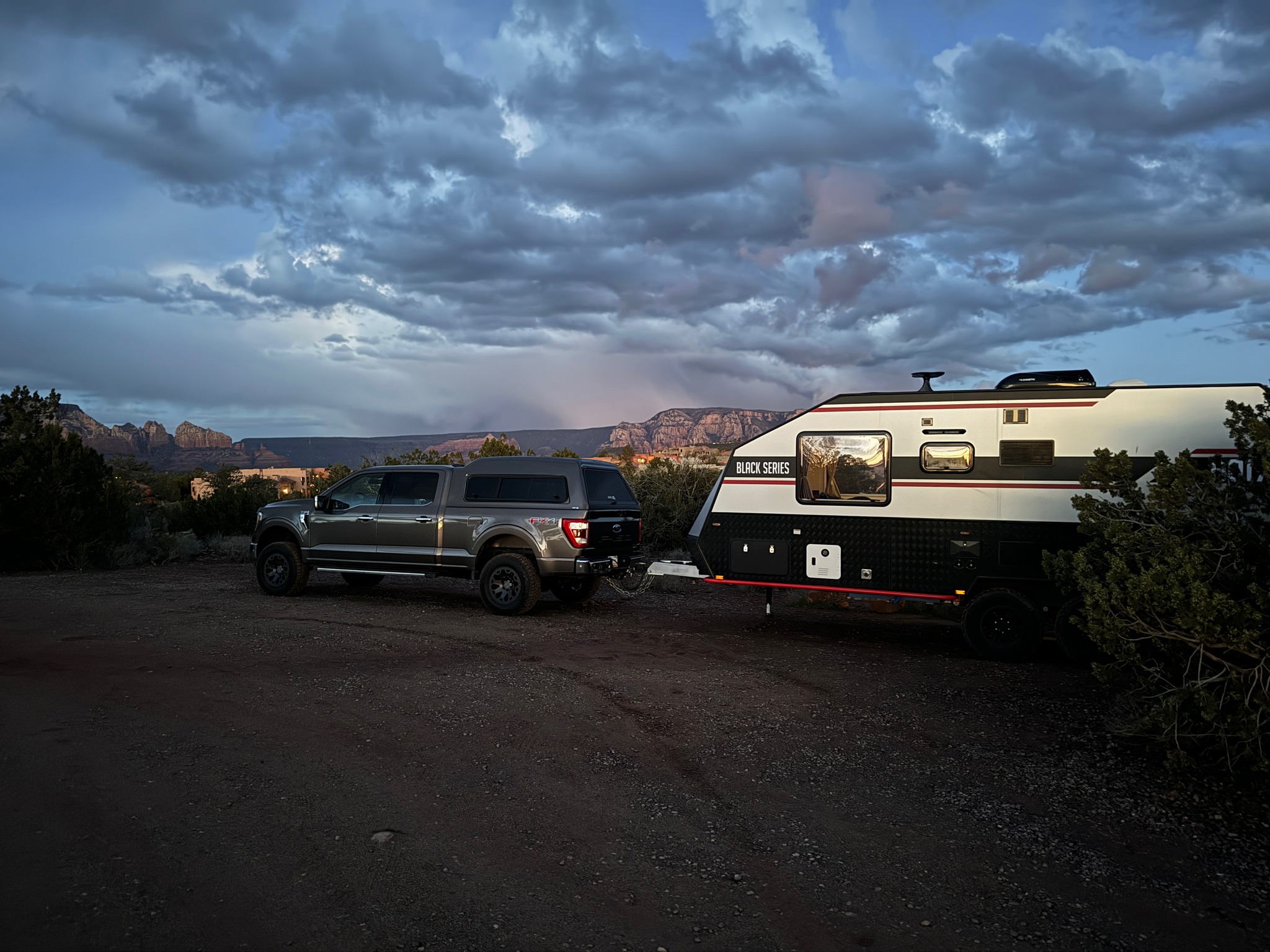
We didn’t run these tests on a dealership lot. We took fully equipped BlackSeries off-road travel trailers into three distinct U.S. climates to simulate actual adventure conditions:
Arizona Desert (BLM Land): High solar exposure, extreme daytime heat, minimal shade. This is the “best case” scenario for solar, with 5-6 peak sun hours daily during winter months.
Colorado Mountains: High altitude, cold temperatures, shorter effective sun hours. This environment tests battery performance in freezing temps and solar efficiency with limited daylight.
Texas Ranch Land: Partial tree cover, dusty conditions, variable weather. This represents the “average” boondocking experience most RV travelers encounter.
Our test load simulated real life:
No generator backup. No shore power. Just solar, lithium, and the BlackSeries off-grid system working as designed.
The results confirmed what we already knew: properly sized off-grid RV solar setup results beat expectations when matched correctly to consumption.
Battery Autonomy: Our 200Ah lithium bank consumed 90-120Ah daily under normal use. That gave us roughly 1.8 to 2.2 days of autonomy without any solar input, enough to ride out a cloudy stretch or travel day.
Solar Recharge Rates: The 400W solar array performed differently across regions:
Voltage Stability: Lithium batteries maintain a flat voltage discharge curve throughout the cycle. Unlike lead-acid systems that show noticeable voltage sag under load, our appliances received consistent power from 100% down to 20% state of charge.
Charging Speed: Lithium batteries recharged approximately 4x faster than equivalent AGM systems in side-by-side testing. This speed advantage is critical during short winter days when every hour of sunlight counts.
You don’t need an engineering degree to figure out if your system will work. Here’s the simple formula we use:
Step 1: List Daily Consumption
Write down every device and its amp-hour draw:
Step 2: Total Your Load
Add it up. In this example: 110Ah per day.
Step 3: Calculate Usable Capacity
Lithium batteries give you 80-100% usable capacity. A 200Ah lithium bank provides roughly 180-200Ah of actual power. AGM batteries? Only 50% is safely usable, so a 200Ah AGM really gives you 100Ah.
Step 4: Match Input to Output
If you consume 110Ah daily and your solar array produces 120Ah on an average day, you’re sustainable indefinitely. If your array only produces 80Ah, you’ll slowly drain reserves and need to adjust consumption or add panels.
This is the math that separates off-grid dreams from off-grid reality.
The performance gap between lithium and AGM batteries becomes obvious after a week off-grid. Here’s the breakdown:
Usable Capacity: Lithium delivers 80-100% usable capacity. AGM maxes out at 50%. That means a 200Ah lithium bank effectively replaces a 400Ah AGM bank.
Weight: Lithium batteries weigh 40-50% less than lead-acid equivalents. That weight savings translates directly into better fuel economy and increased payload capacity for gear.
Lifespan: Lithium batteries support 3,000-5,000+ charge cycles. AGM batteries typically fail after 300-800 cycles. Over a five-year period, lithium systems cost less per cycle despite higher upfront prices.
Charge Efficiency: Lithium systems recover over 950 watts from a 1000W solar input. AGM systems capture 800-850 watts from the same input, a 15% efficiency loss that compounds over time.
Partial Charging Tolerance: Lithium batteries tolerate partial charging without capacity degradation. AGM batteries lose power over time if not regularly charged to 100%, which is nearly impossible in variable solar conditions.
For serious off-grid travel, lithium isn’t just better, it’s mandatory.

Not all boondocking locations are created equal for solar performance. Here’s where your system will shine, and where you’ll face challenges:
Arizona Desert (BLM Land)
The gold standard for solar. Clear skies, high-angle sun, and minimal vegetation interference deliver 5-6+ peak sun hours during fall, winter, and spring. Summer heat can reduce panel efficiency by 10-15%, but overall production remains excellent year-round.
Utah Canyon Country
Exceptional solar exposure with dramatic scenery. Heat de-rating becomes a factor in summer, and red dust accumulation requires frequent panel cleaning. Even with these challenges, Utah’s high desert delivers reliable solar performance.
Colorado Mountain Camping
Cold temperatures actually improve solar panel efficiency, but shorter winter days and frequent afternoon cloud cover limit total energy harvest. Plan for 3-4 effective sun hours in shoulder seasons. Summer provides longer days and better overall production.
Montana/Idaho National Forest Areas
Low population density and wide-open dispersed camping areas offer good solar potential, but tree cover and northern latitude reduce winter performance. Summer provides extended daylight hours that compensate for lower sun angles.
Texas/New Mexico Ranch Land
Variable terrain creates mixed results. Open desert areas perform like Arizona. Wooded sections require careful site selection to avoid shade. Dust storms can temporarily reduce efficiency by 20-30% until panels are cleaned.
We documented a week-long test with a BlackSeries HQ series trailer on Arizona BLM land. The setup included:
Results:
The integrated rugged chassis allowed access to remote locations other trailers couldn’t reach, and the off-grid system eliminated reliance on crowded campgrounds. This is the freedom properly designed off-road travel trailers provide.

How many solar watts do I need for full-time RVing?
For most full-time travelers, 400W is the minimum baseline. Heavy users running air conditioning, microwaves, or multiple devices should target 600-800W. Calculate your actual consumption first, then add 30% overhead for weather variables and system inefficiency.
Can lithium batteries run air conditioning?
Yes, but it requires significant capacity. A 13,500 BTU rooftop air conditioner draws 120-150Ah per hour of runtime. You’ll need a minimum 600Ah lithium bank and 800W+ solar to sustain AC use during peak summer heat. Most boondockers rely on passive cooling and strategic travel timing instead.
What reduces solar efficiency in real use?
Dust accumulation (10-20% loss), partial shading from trees or equipment (up to 50% loss on affected panels), high ambient temperatures (5-15% loss), aging panel degradation (0.5-1% annually), and incorrect panel angle all reduce real-world output below rated specifications.
Is 400W enough for boondocking?
For most travelers, yes. A 400W array paired with a 200Ah lithium bank supports standard refrigeration, lighting, water pump, and laptop/phone charging indefinitely in good sun conditions. Adjust consumption during extended cloudy weather or add portable panels for backup capacity.
The data is clear: properly sized solar and lithium systems deliver true off-grid independence. BlackSeries trailers integrate these systems with rugged chassis design and payload capacity to reach the locations where that independence matters most. Calculate your load, match your input, and the math works: no generator required.