
Your cart (0)
Your cart is empty
Tax included and shipping calculated at checkout
Your cart is empty
Tax included and shipping calculated at checkout

RV batteries split into two categories: starting batteries (engine/chassis) and house batteries (deep cycle RV battery) that power your living space. Most U.S. campers are shifting toward lithium systems for their superior capacity, weight savings, and boondocking performance.
Key considerations for 2025:
Starting batteries deliver high cranking amps to start your engine but aren’t designed for sustained discharge. Deep cycle RV batteries power your lights, appliances, and electronics through repeated charge-discharge cycles.
Flooded Lead-Acid: Traditional liquid electrolyte batteries requiring regular maintenance (water top-offs, terminal cleaning). Cheapest upfront but shortest lifespan.
AGM (Absorbed Glass Mat): Sealed lead-acid with glass fiber separators. No maintenance required, better vibration resistance, can be mounted in any position.
Gel: Uses silica gel electrolyte, handles deep discharge better than other lead-acid types. Requires specific charging profiles and costs more than AGM.
Lithium (LiFePO4): Lithium iron phosphate chemistry offering the highest energy density, fastest charging, and longest lifespan. Premium price point but often lower total cost of ownership.
The North American RV battery market is experiencing rapid transformation. Industry data shows lithium adoption accelerating among serious boondockers and full-time RVers, driven by weight savings and extended off-grid capability.
Key 2025 Trends:
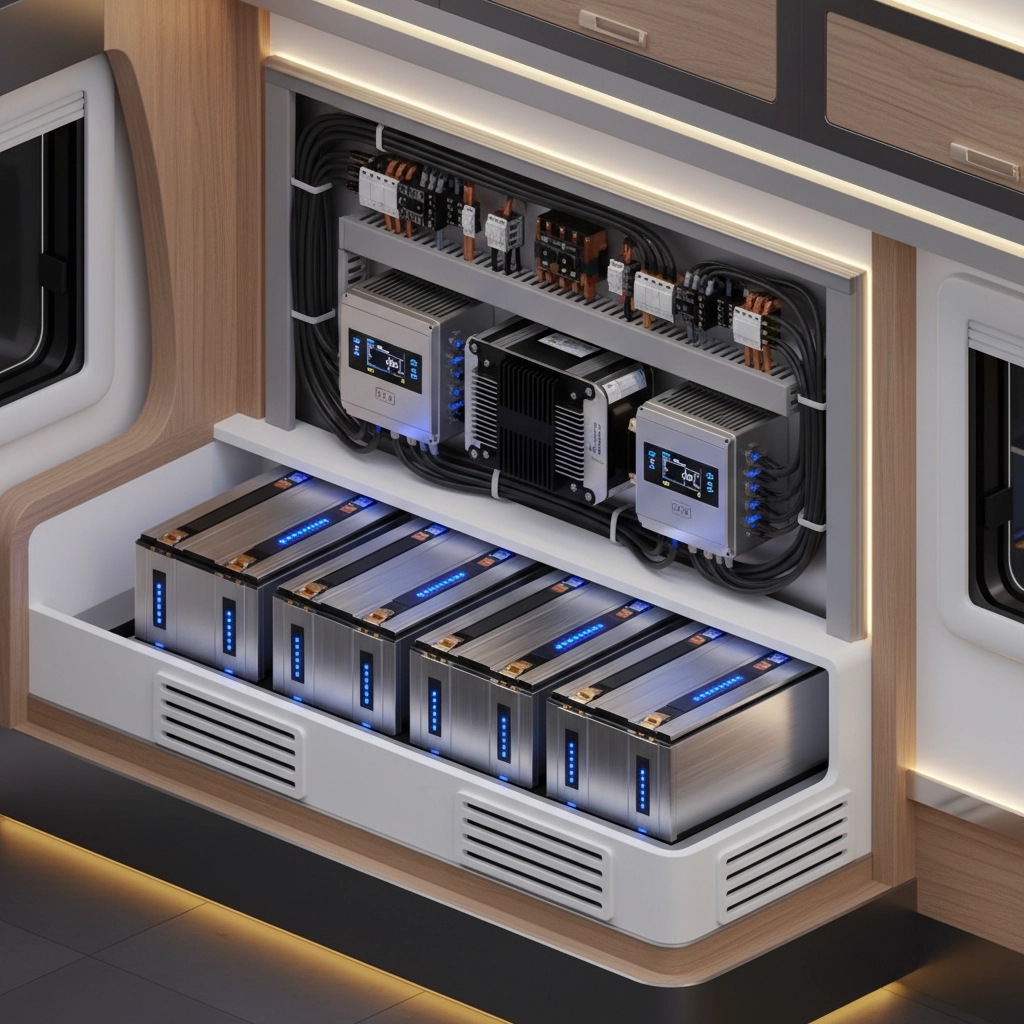
The shift toward lithium particularly affects off-road and expedition-style RV users who prioritize weight reduction and extended boondocking capacity – exactly the market segment served by manufacturers focused on rugged, adventure-ready designs.
Pros: Lowest initial cost, widely available, well-understood technology
Cons: Requires maintenance, venting gases, limited to 50% usable capacity, 3-5 year lifespan
Best for: Budget-conscious occasional campers, seasonal use
Pros: Maintenance-free, better cold weather performance, no gas venting
Cons: Still limited to 50% usable capacity, heavier than lithium, 4-6 year lifespan
Best for: Weekend warriors wanting reliability without maintenance
Pros: Handles deeper discharge cycles, excellent in hot climates
Cons: Requires specific charging parameters, more expensive than AGM
Best for: Hot climate camping, extended storage periods
Pros: 80-90% usable capacity, 10+ year lifespan, ultra-lightweight, fast charging
Cons: Higher upfront cost, cold weather charging limitations
Best for: Serious boondockers, weight-conscious travelers, long-term RV living
For true off-grid adventures, lithium RV batteries provide unmatched capability. Their superior depth of discharge means a 200Ah lithium bank delivers more usable power than a 400Ah lead-acid setup while weighing 60% less.
Weekend Warriors: 100-200Ah lithium + 200W solar
Extended Boondockers: 400-600Ah lithium + 400-800W solar
Full-Time Off-Grid: 800Ah+ lithium + 1000W+ solar + backup generator
The weight savings matter enormously for off-road capable RVs designed to access remote locations. When every pound affects suspension performance and fuel economy, lithium’s 3:1 weight advantage over lead-acid becomes crucial for off-road trailer applications.
A typical RV uses 100-150Ah daily for basics (lights, water pump, propane fridge). Add air conditioning, and consumption jumps to 300-500Ah daily. With lithium’s 90% usable capacity, a 400Ah bank provides 3-4 days of power without recharging – perfect for long weekend adventures.
Calculate your needs systematically:
List every electrical device and its daily usage:
Divide total watt-hours by 12V: 3,030Wh ÷ 12V = 252.5Ah daily
Add 20% safety margin: 252.5Ah × 1.2 = 303Ah daily requirement

AGM 200Ah dual-battery setup: Reliable, maintenance-free, handles moderate loads for 2-3 days. Budget-friendly at $400-600 total.
Lithium 400Ah system: Provides week-long autonomy with moderate solar charging. Weight savings crucial for off-road access.
Flooded lead-acid 220Ah golf cart batteries: Cheapest per amp-hour, but requires regular maintenance and ventilation.
Heated lithium batteries: Self-heating elements prevent cold-weather charging damage. Essential for winter camping below 32°F.
Rugged lithium with reinforced cases: Handles vibration and impacts better. Perfect match for expedition-style RVs built for extreme terrain.
Lead-Acid: Check water levels monthly, clean terminals, equalization charging
AGM/Gel: Minimal maintenance, monitor voltage, avoid overcharging
Lithium: Virtually maintenance-free, monitor BMS alerts, avoid freezing temps during charging
What’s the difference between starting and deep cycle RV batteries?
Starting batteries deliver high current for engine cranking but can’t handle repeated deep discharge. Deep cycle batteries provide steady power over extended periods and handle repeated charge-discharge cycles.
How long do RV batteries last?
Flooded lead-acid: 3-5 years, AGM: 4-6 years, lithium: 10+ years. Lifespan depends heavily on usage patterns, charging practices, and maintenance.
How many batteries do I need for boondocking?
Depends on power consumption and desired autonomy. Typical range: 200-400Ah for weekend trips, 400-800Ah for extended off-grid camping.
Can I mix different battery types?
Never mix different chemistries or battery ages in the same bank. All batteries should be identical type, age, and capacity for proper charging and longevity.
Do I need lithium for solar charging?
Not required, but lithium batteries charge much faster from solar and accept charge more efficiently than lead-acid types, maximizing your solar investment.
The right RV battery system transforms your camping experience from power-conscious to power-abundant. Whether you’re weekend camping or embarking on extended off-grid adventures, matching your battery choice to your specific needs ensures reliable power when and where you need it most.
Best Lithium RV Battery for Boondocking & Bank Sizing Guide最先出现在Black Series RV | Off-Road Travel Trailers, Toy Haulers & Camper Trailers | Off road rv | Off grid rv | Overland rv | Off road trailer | Off road travel trailer | Overland travel trailer。