
Your cart (0)
Your cart is empty
Tax included and shipping calculated at checkout
Your cart is empty
Tax included and shipping calculated at checkout

The most common signs of failing trailer wheel bearings are excessive hub heat, grinding or humming noises, grease leakage on the wheels, and wheel play (wobble). If you notice a burning smell or smoke coming from your hubs, stop towing immediately to avoid catastrophic axle failure. Ignoring these symptoms can lead to brake damage, wheel detachment, and serious safety risks on the highway.
Think of your wheel bearings as the unsung heroes working overtime beneath your trailer. They’re deceptively simple, just a set of steel rollers or balls held in a cage, packed with grease, but they perform a critical job: allowing your wheels to spin freely while supporting the entire average weight of camper setups, which can easily exceed 5,000–8,000 pounds.
Unlike passenger vehicles with sealed bearing assemblies and sophisticated monitoring systems, most travel trailers use serviceable tapered roller bearings. They work in a hostile environment: constant vibration, temperature swings from 20°F mountain mornings to 110°F desert afternoons, dust infiltration, and the occasional water crossing if you’re running an off-road travel trailer.
When bearings fail, it’s rarely a single-point breakdown. It’s a chain reaction. Heat destroys the grease seal, grease leaks out, metal grinds on metal, and temperatures spike past 400°F. At that point, you’re one bump away from the bearing seizing completely, which can weld the wheel to the spindle or worse, cause the wheel to detach entirely.
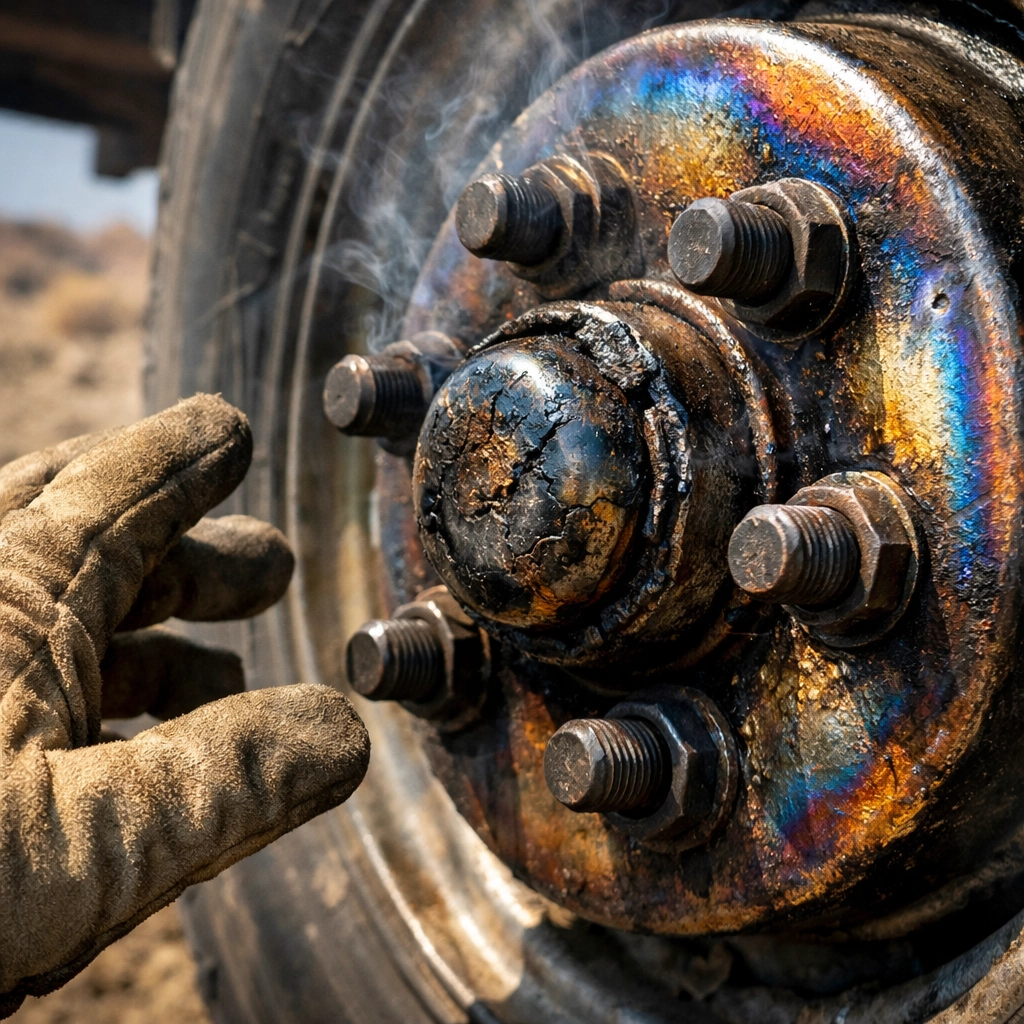
Every time you pull into a rest area or gas station, make it a habit: do a quick lap around your trailer and carefully touch each wheel hub. They should be warm, friction naturally generates heat, but never so hot you can’t hold your hand on them for a few seconds.
If one hub is noticeably hotter than the others, especially on a heavy 30 foot rv weight rig, you’ve got a problem developing. Temperature imbalances between hubs on the same axle are a red flag. One study of trailer failures found that hubs running 200°F hotter than their counterpart were universally linked to bearing distress.
Pro Tip: Infrared thermometers are cheap (under $30) and take the guesswork out of the equation. Hubs should typically run between 150–250°F under normal highway towing conditions.
If you hear a low-frequency humming, growling, or grinding sound that changes pitch with your speed, don’t turn up the radio and pretend it’s the road surface. That’s the sound of metal complaining, specifically, the sound of worn bearing rollers making uneven contact with their races.
This noise often becomes more pronounced during turns or when you apply the brakes, because the lateral forces shift load across the damaged sections of the bearing. On a 30-foot camper weight trailer, these sounds can be harder to pinpoint because they’re transmitted through the frame, but they’re always there if you’re listening.
If you walk around your trailer and see dark, oily gunk splattered on your rims, inner fender wells, or worse, running down the sidewall of your tire, your grease seal has catastrophically failed. This is a double emergency because:
Fresh grease is typically honey-colored or amber. If you’re seeing black, burnt-smelling residue, the bearing has been overheating for a while.

Jack up your trailer and grab the tire at the 12 o’clock and 6 o’clock positions. Rock it back and forth. There should be zero play, no clicking, no movement, nothing. If you feel any wobble or hear a clunk, the bearing has worn to the point where it can no longer hold the wheel assembly true to the spindle.
This is often accompanied by a vibration felt through the trailer body while towing, and you might notice the trailer “wandering” or feeling unstable at highway speeds. On heavier rigs like an 18 ft camper weight off-road model loaded with gear and water, this instability becomes even more pronounced.
If you smell burning or see smoke coming from a wheel hub, pull over immediately. Do not pass go, do not collect $200, do not try to limp to the next exit. A bearing that’s smoking has already crossed into catastrophic failure territory.
At this stage, the grease has completely burned off, metal is welding to metal, and you’re minutes away from a seized wheel or axle fire. Temperature readings at this point can exceed 600°F, hot enough to ignite brake fluid or damage suspension components.
Building a simple inspection routine into your travel day can save you thousands in repairs and prevent dangerous situations:
Every fuel stop (150–200 miles):
Every morning before departure:
After rough terrain or water crossings:
For those running a 30 ft rv weight or larger setup, consider adding bearing temperature monitors, wireless sensors that alert you to hub overheating before it becomes critical.

A failed wheel bearing on your daily driver is bad news. On a trailer, it’s potentially catastrophic. Here’s why:
No warning systems: Most trailers lack the ABS sensors and stability control that would alert you to a wheel speed discrepancy in a modern car. By the time you feel something wrong with your 16 ft camper weight trailer, significant damage has already occurred.
Cascade failures: A seized bearing can lock the wheel, causing instant brake overheating, tire blowout, and axle tube damage. The repair bill escalates from a $150 bearing repack to a $3,000+ axle replacement.
Highway speeds: Trailer bearing failures happen most often at sustained highway speeds (65+ mph), where heat buildup is maximized and the energy released during a seizure is immense.
Limited control: Unlike a car where you can feel a problem developing through the steering wheel, trailers give you almost no feedback until the situation is severe. A wandering trailer at 70 mph is one of the most dangerous highway scenarios you’ll encounter.
Letting a trailer sit unused for months is surprisingly hard on bearings. Grease settles to the bottom, moisture infiltrates through microscopic seal imperfections, and the first time you hit the road, dry bearing surfaces are grinding against each other until the grease redistributes.
Prevention: Rotate wheels every 2–3 months during storage, or better yet, repack bearings annually regardless of mileage.
Pushing past the average travel trailer weights puts immense pressure on the small contact patches inside your bearings. A bearing designed for 3,500 pounds doesn’t respond well to 4,200 pounds, it responds with heat and accelerated wear.
Tongue-heavy loads shift more weight to the rear axle, causing uneven bearing stress. Proper weight distribution isn’t just about sway control, it’s about longevity.
If you’re into backcountry adventures with an off-road travel trailer, you’re subjecting bearings to the worst-case scenario: dunking a 300°F hub into a cold stream. This thermal shock creates a vacuum effect that can pull water directly past the seal and into the bearing cavity.
Once water mixes with grease, it emulsifies into a gray sludge with no lubricating properties. The bearing is effectively running dry, and failure can happen in a matter of miles.
Using the wrong grease, over-torquing the spindle nut, reusing old seals, or improper bearing preload during installation are all common mistakes that lead to premature failure. This is why professional bearing service is often worth the cost, especially before major trips.

Our trailers are engineered to handle terrain that would stop most conventional RVs cold, rocky trails, washboard roads, steep mountain passes, and yes, the occasional unavoidable water crossing. But this capability comes with a hidden tax: your bearings are working double-time.
Whether you’re running a nimble 18 ft camper weight HQ15 or a flagship 30 ft rv weight HQ19, the vibrations and impacts from off-roading act like a hammer test on every component. Bearings that might last 50,000 highway miles could need service every 10,000 miles of backcountry use.
BlackSeries owners should:
This isn’t a weakness: it’s physics. The more capable your trailer, the harder every system works. Being proactive about bearing maintenance isn’t just good practice; it’s a requirement for the backcountry lifestyle. For more insights on maintaining your off-road setup, check out our off-road trailer maintenance guide.
Before your next trip, run through this simple but comprehensive checklist:
Visual Inspection:
Temperature Check:
Physical Test:
Maintenance History:
Pre-Trip Planning:

How fast do trailer bearings fail once symptoms appear?
It varies dramatically. A bearing making noise could run for another 1,000 miles or fail catastrophically in the next 10. Heat is the critical variable: once temperatures exceed 350°F, failure accelerates exponentially. Never gamble on “just making it” to your destination.
Can I tow with bad wheel bearings?
Absolutely not. A failing bearing can seize without warning, locking the wheel and potentially causing it to detach. Even if it doesn’t fully fail, you’re risking brake damage, axle tube warping, and tire blowouts. The tow to a repair shop will cost far less than the alternative.
Are wheel bearing failures sudden or gradual?
Most bearing failures are gradual, giving you warning signs (heat, noise) over days or weeks. However, the final failure can be sudden: especially if you ignore the warnings. A bearing that’s been running hot can go from “concerning” to “seized” in a matter of minutes under heavy load.
How often should trailer bearings be inspected?
Visually inspect before every trip. Touch-test hubs every 150–200 miles while traveling. Full disassembly and repack should happen annually or every 10,000–12,000 miles for highway use, more frequently for off-road conditions. If you notice any unusual heat, noise, or leaking, inspect immediately.
Should all trailer tires be the same DOT year?
While not directly related to bearings, mismatched tire ages can mask bearing problems because older tires behave differently, creating vibrations that mimic bearing issues. It’s best practice to keep tires within 1–2 years of each other for consistent performance and easier diagnosis of mechanical problems.
Wheel bearings are small, cheap components that rarely get the attention they deserve: until they fail spectacularly. Whether you’re hauling a lightweight weekender or exploring the backcountry in a fully-loaded 30-foot camper weight beast, those bearings are the only thing between your wheels and catastrophic failure. Learn the warning signs, trust your instincts, and never ignore the symptoms. Your safety: and everyone else’s on the road: depends on it.
For more essential RV maintenance tips and guides, explore our blog or learn about the benefits of living the RV lifestyle.