
Your cart (0)
Your cart is empty
Tax included and shipping calculated at checkout
Your cart is empty
Tax included and shipping calculated at checkout

To back up a travel trailer, turn the steering wheel in the direction you want the trailer to go, move slowly, use a spotter when possible, and make small adjustments. Beginners should focus on control, not speed, to avoid jackknifing or oversteering.
Let’s be real, the first time you try to back up a travel trailer, it feels like the laws of physics have turned against you. You turn left, the trailer goes right. You overcorrect, and suddenly you’re doing the RV equivalent of a pretzel twist in the middle of a crowded campground with 47 people watching.
Here’s why: it’s all about the pivot point. Because the trailer pivots on the hitch ball behind your vehicle, your steering feels reversed. This “experience gap” is why beginners often overcorrect, turning a simple back-in into a zig-zag nightmare that has you sweating through your shirt by noon.
The good news? Once you understand the mechanics, backing up becomes predictable. Whether you’re maneuvering a compact 16 ft camper weight trailer or wrestling a full-size 30 foot rv weight beast into a tight spot, the principles stay the same.
Here’s the single best trick for beginners, and it works whether you’re in an empty Walmart parking lot or backing into a tricky off-grid site in the Rockies:
Put your hand at the bottom of the steering wheel.
Now, whichever way you move your hand is the way the trailer will go. Move your hand left, the trailer goes left. Move it right, the trailer goes right. It’s that simple.
This technique eliminates the “mirror effect” confusion that trips up most newbies. No more trying to reverse-engineer which direction to turn in your head while simultaneously checking mirrors, avoiding trees, and not crushing your spouse’s camp chair collection.
It works on every size rig, whether you’re parking an 18 ft camper weight unit at a state park or positioning a 24 ft camper weight model on uneven terrain.
Let’s break this down into bite-sized, non-intimidating steps.
Start with your tow vehicle and trailer in as straight a line as possible. If you’re approaching the campsite at a weird angle, pull forward, reposition, and start fresh. There’s zero shame in a reset, even pros do it multiple times per trip.
Check your mirrors and make sure you can actually see the trailer’s corners. If you can’t, adjust your mirrors before you shift into reverse.
Whether it’s an 18 ft camper weight model or a 30 ft camper weight setup, small steering movements are your best friend. Large, dramatic turns lead to jackknifing, the thing where your trailer and tow vehicle form a sharp V-shape that’s nearly impossible to recover from without pulling forward.
The bigger the trailer, the more this matters. A 30-foot camper weight rig has more leverage and less forgiveness for sloppy inputs. Keep your movements small, deliberate, and slow.
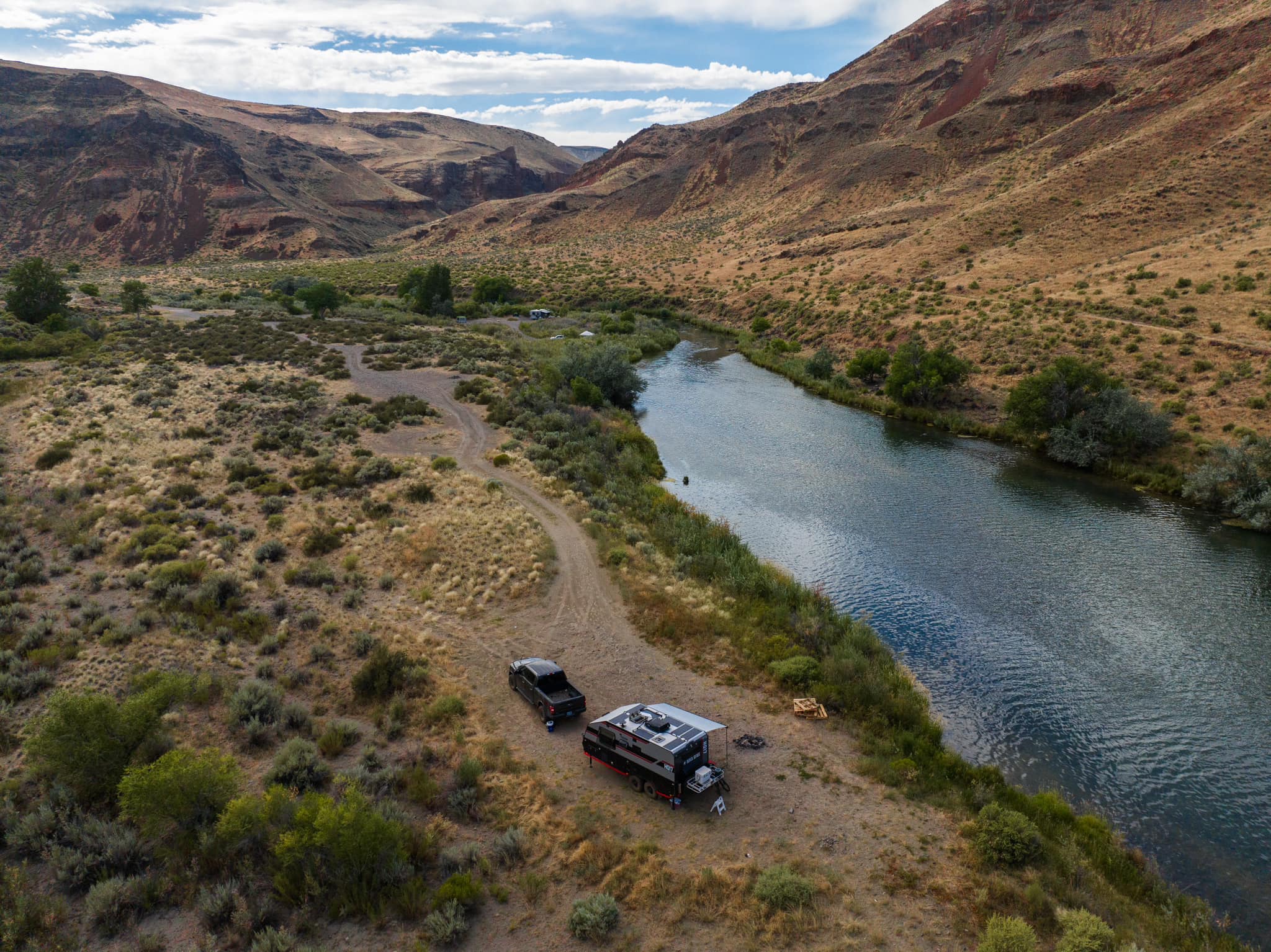
Mirrors are great. Backup cameras are better. But a spotter with clear hand signals is best.
If you’re traveling with someone, have them stand outside the vehicle where you can see them in your side mirror. They should stand to the driver’s side (never directly behind the trailer) and use simple hand signals:
Even with a spotter, get out and look (GOAL) frequently. Walk around the trailer, check for obstacles, and reassess your path. It’s slower, but it prevents $3,000 mistakes.
If you get crooked, and you will, don’t keep backing. Pull forward 10–15 feet, straighten out, and try again. Even seasoned RVers with decades of experience do this multiple times per trip.
The reset is not failure. It’s smart driving. It’s especially common when backing a longer rig like a 30 ft rv weight trailer into a tight, angled site with trees on both sides.
Turning the wheel too fast. Slow is smooth, smooth is fast. Make tiny adjustments and give the trailer time to respond before correcting again.
Ignoring mirror alignment. If you can’t see both sides of the trailer in your mirrors, you’re flying blind. Adjust them before you start moving.
Not having a plan. Before you shift into reverse, get out and walk the site. Identify obstacles, pick your final parking spot, and visualize the path. Don’t just wing it.
Overestimating your trailer’s turn radius. A 30-foot camper weight trailer needs a wide turning radius. If the site looks tight, it probably is. Don’t force it.
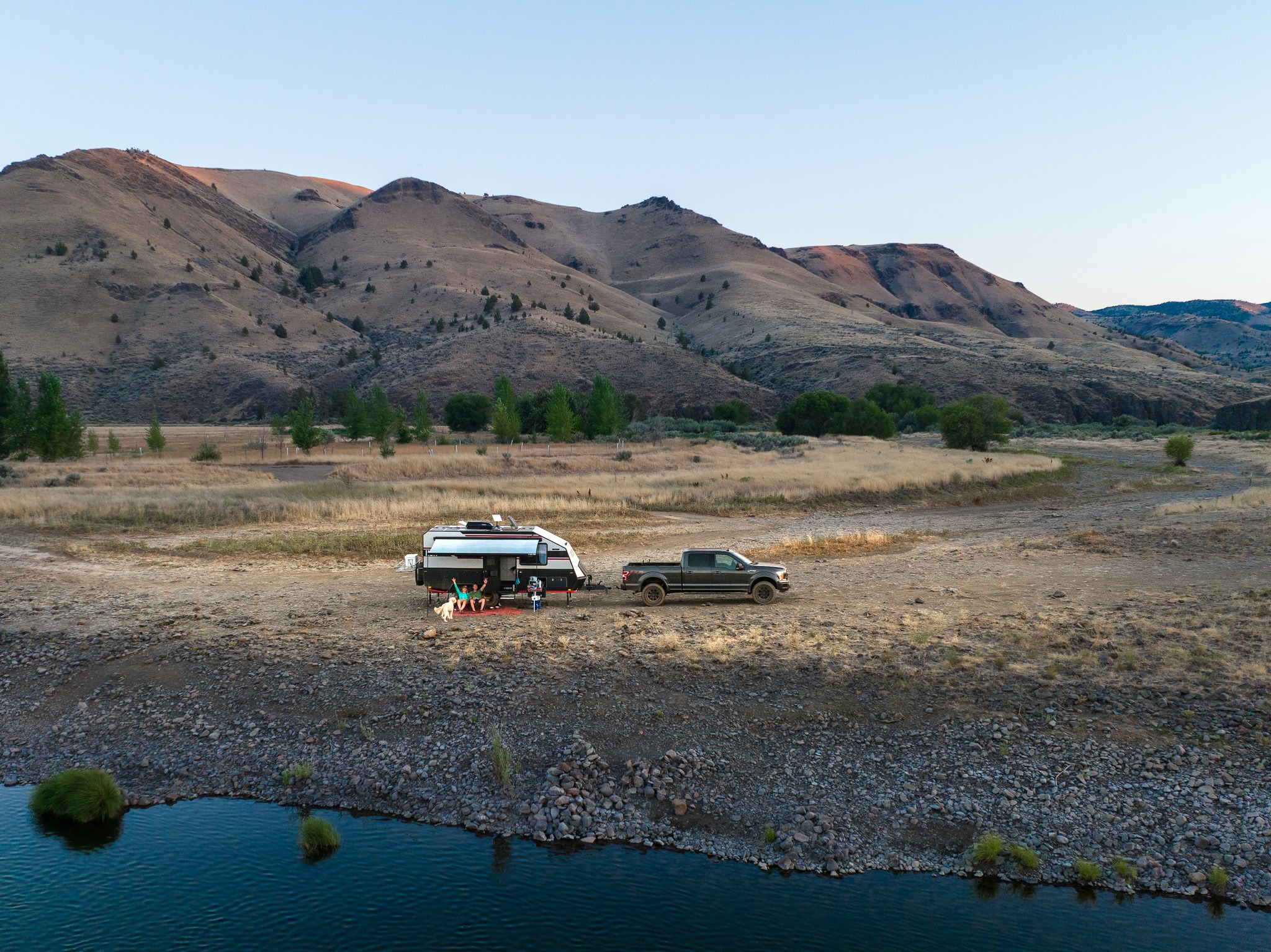
The #1 thing that separates confident RVers from stressed-out beginners? Practice.
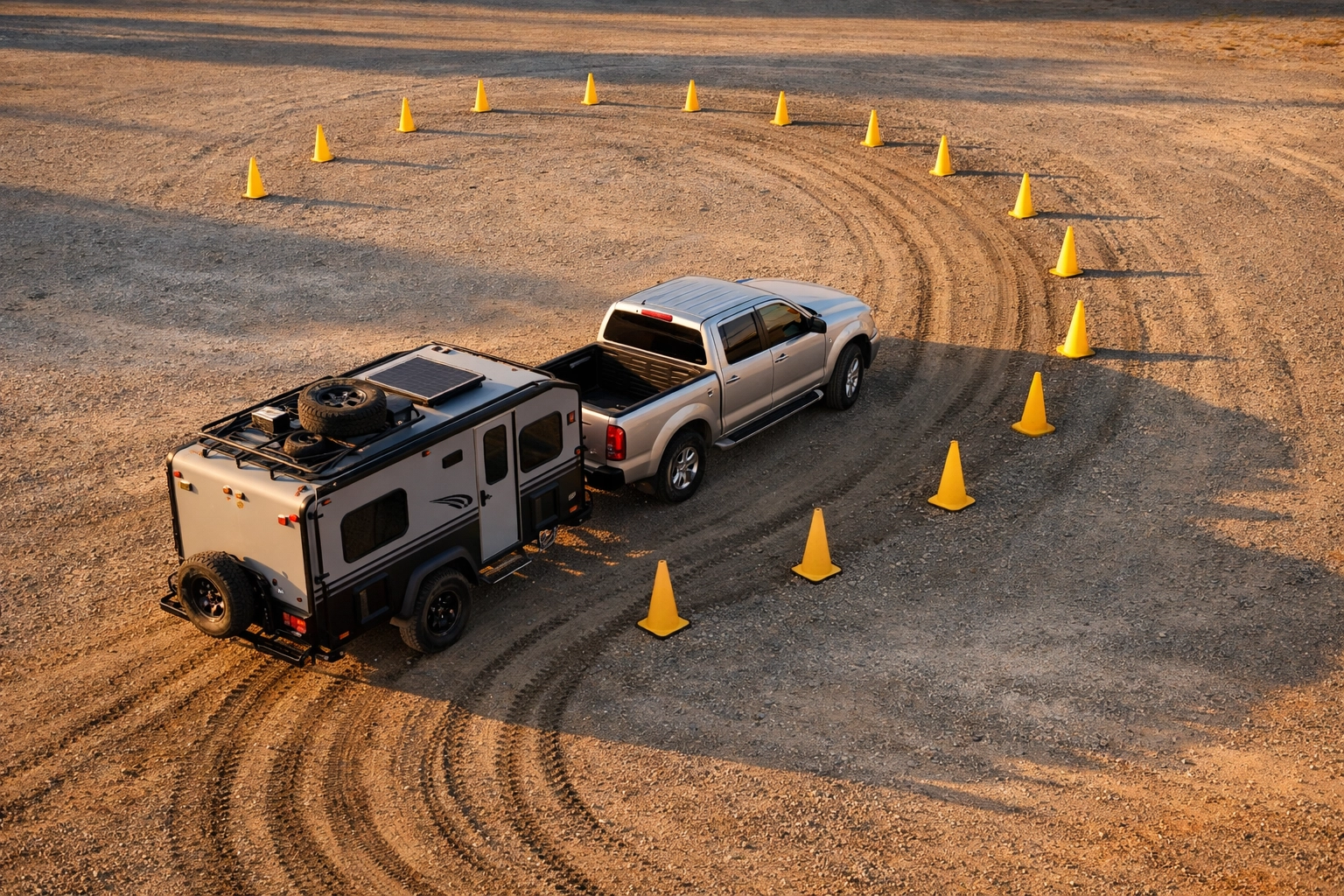
Find an empty parking lot on a weekday morning, a church, school, or shopping center works great, and spend 30 minutes just backing up. Set up cones, cardboard boxes, or camp chairs as “obstacles” and practice until the hand-at-the-bottom trick becomes second nature.
Bonus: practice unhitching and re-hitching while you’re there. The more comfortable you are with the basics, the less stressful your first real campsite arrival will be.
Which way do I turn the wheel?
Use the hand-at-the-bottom trick: move your hand left, trailer goes left. Move it right, trailer goes right. It removes all the mental gymnastics.
Should I practice before my first trip?
Yes! Find an empty parking lot and spend 30 minutes getting comfortable. It’s the single best investment you can make before hitting the road.
Can I do it alone without a spotter?
Absolutely. It’s slower, but totally doable. Get out and look (GOAL) frequently, and use your mirrors and backup camera as much as possible. Don’t rush.
What if I jackknife?
Pull forward, straighten out, and reset. Jackknifing happens when you turn too sharply while backing. The fix is always the same: pull forward and start over.
Do I need a backup camera?
Not required, but highly recommended. It eliminates blind spots and gives you a bird’s-eye view of what’s directly behind the trailer. Many newer trailers come with them standard, or you can add an aftermarket system for a few hundred bucks.
Look, backing up is never going to feel like a walk in the park: especially the first dozen times. But BlackSeries trailers are designed with precision-engineered suspension, responsive handling, and clear sightlines that make them more predictable when you’re threading the needle into those tight, off-road spots.
Our rigs are built to handle rugged terrain, which means they’re stable, balanced, and easier to control whether you’re on pavement or gravel. We make the trailer tough so the parking doesn’t have to be.
And because our community is full of off-grid adventurers who camp in places where “pull-through sites” don’t exist, you’re in good company. Tight spots? Uneven ground? Trees on three sides? That’s just Tuesday for a BlackSeries owner.
Backing up a travel trailer is a skill, not a talent. It takes practice, patience, and a willingness to pull forward and reset when things get wonky. But once you nail it, the freedom to camp anywhere: from crowded state parks to remote boondocking sites: is absolutely worth it.
Start with the hand-at-the-bottom trick, go slow, and remember: every pro was once a beginner who refused to give up. You’ve got this.