
Your cart (0)
Your cart is empty
Tax included and shipping calculated at checkout
Your cart is empty
Tax included and shipping calculated at checkout

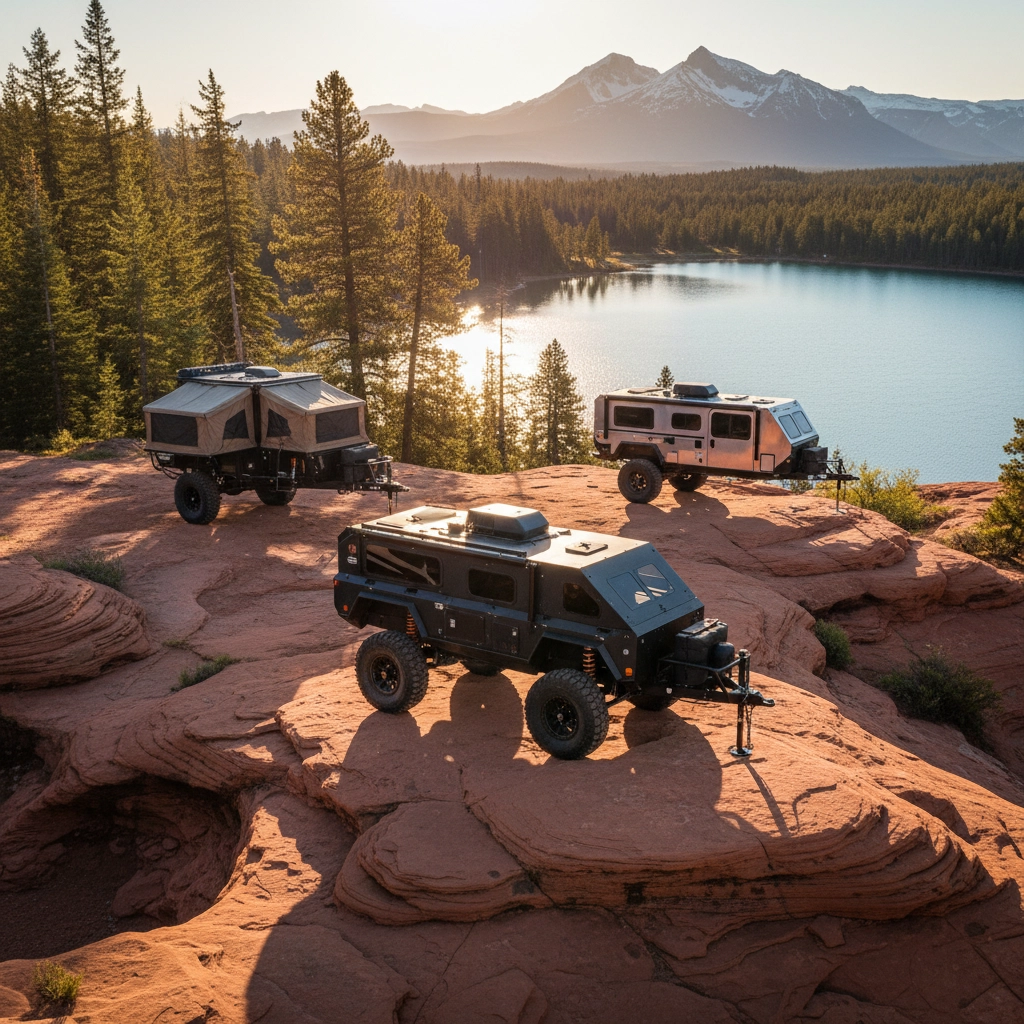
For Rocky Mountain adventures, choose trailers with independent suspension and high ground clearance like BlackSeries models with their patented trailing arm suspension system. Arizona desert overlanding demands robust chassis protection and extensive solar capacity: BlackSeries delivers with military-grade steel frames and up to 800W solar systems. Pacific Northwest trail explorers need all-weather capability and reliable electrical systems for wet conditions.
BlackSeries differentiators: Independent trailing arm suspension (smoother ride than solid axles), honeycomb composite panels (lighter yet stronger than aluminum), 12+ inches ground clearance, and comprehensive off-grid power systems starting at 200Ah lithium batteries.
An off road camper comparison reveals fundamental structural differences from park-model RVs. While standard travel trailers use leaf spring suspension and prioritize interior space, true off-road campers feature:
Independent Suspension Systems: BlackSeries uses trailing arm independent suspension instead of solid axles, providing better articulation over rocks and washboard roads. This suspension technology dramatically improves ride quality and component longevity.
Reinforced Chassis Construction: Military-grade steel frames withstand impacts from rocks and rough terrain that would damage standard RV frames. BlackSeries employs hot-dipped galvanized steel with additional skid plate protection.
Higher Ground Clearance: True off-road campers maintain 12-15 inches clearance versus 8-10 inches for park models. This clearance enables access to BLM lands, forest service roads, and remote camping areas.
Off-Grid Power Systems: Integrated solar panels, lithium batteries, and 12V appliances enable extended dispersed camping without hookups.
Rugged Tire and Wheel Packages: All-terrain tires and reinforced wheels handle rocky terrain and maintain traction in sand or mud.
Off-Road Camper Trailers
These traditional towables range from compact teardrops to family-sized expedition trailers. BlackSeries HQ series exemplifies this category with sizes from 12-21 feet, featuring hard-sided construction and comprehensive amenities.
Hybrid Off-Road Campers
Combining hard-sided protection with expandable tent sections, hybrids like OPUS models maximize interior space while maintaining trail capability. Best suited for families needing sleeping space for 4-6 people.
Teardrop Off-Road Campers
Ultra-lightweight options under 3,000 pounds, perfect for smaller tow vehicles. Limited interior space but excellent fuel economy and easy maneuvering on tight trails.
Expedition Trailers
Heavy-duty units designed for extreme conditions and extended off-grid living. Feature robust chassis, large water/power capacity, and premium components. BlackSeries HQ19 and HQ21 represent this category.
Overlanding Micro Campers
Minimalist designs prioritizing mobility and simplicity. Often modular with removable components for maximum flexibility across different adventures.
Steel vs Aluminum: Steel frames like BlackSeries provide superior impact resistance but add weight. Aluminum frames reduce weight but may flex under extreme stress.
Galvanization Process: Hot-dipped galvanizing prevents rust far better than powder coating. BlackSeries uses this premium process throughout their chassis.
Independent vs Solid Axle: Independent systems (BlackSeries trailing arm design) provide better ride quality and reduced maintenance. Solid axles offer simplicity but transmit more vibration.
Shock Absorber Quality: Premium shocks like Bilstein or Fox Racing handle repeated impacts better than basic units.
Minimum 12 Inches: Necessary for forest service roads and rocky terrain. BlackSeries maintains 13+ inches across their range.
Breakover Angle: Short wheelbase trailers navigate steep terrain better than long units.
Load Range E Tires: Essential for heavy trailers and sharp rocks. BlackSeries includes these as standard equipment.
Wheel Construction: Steel wheels withstand impacts better than alloy but add weight.
GVWR Range: Most off-road campers range from 3,000-8,000 pounds dry weight.
Tongue Weight Percentage: Should be 10-15% of trailer weight for stable towing.
Sleeping Capacity: Ranges from 2 (compact) to 6+ (family expedition trailers).
Storage Solutions: Off-road camping requires more gear storage than park camping.
Battery Type: Lithium provides more usable capacity and faster charging than lead-acid.
Solar Capacity: 400-800W handles most off-grid needs depending on usage.
Fresh Water Capacity: 20-40 gallons typical for extended camping.
Grey/Black Water Management: Some models feature full three-tank systems.
Cabinet Construction: Hardwood frames and quality hardware prevent failures on rough roads.
Appliance Mounting: Proper securing prevents damage from vibration.
Warranty Coverage: Look for comprehensive coverage on major components.
Service Network: Important for repairs during extended travels.

Off-Road Campers: Access remote BLM lands, forest service roads, and backcountry campsites. Ground clearance and suspension enable navigation of washboard roads, rock gardens, and steep grades.
Standard RVs: Limited to developed campgrounds and paved roads. Low clearance and basic suspension restrict access to premium camping locations.
Trailers: Unhitch at base camp for day trips and exploration. Tow vehicle remains available for supply runs or emergency evacuation.
Motorhomes: Everything moves together, requiring full breakdown for simple errands. However, no separate tow vehicle needed.
Desert Camping: Off-road trailers excel in Arizona and Utah’s remote camping areas where motorhomes cannot access prime locations.
Mountain Exploration: Colorado and Montana’s forest service roads favor high-clearance trailers over motorhomes.
Coastal Adventures: Pacific Coast and Great Lakes remote beaches often require off-road capability for best camping spots.
Initial Investment: Quality off-road trailers ($45,000-$85,000) cost significantly less than comparable motorhomes ($150,000-$300,000).
Maintenance: Trailers have fewer mechanical systems requiring service compared to motorhomes with engines, transmissions, and chassis maintenance.

Representative Models: OPUS Air, basic teardrop trailers
Representative Models: BlackSeries HQ12, TAXA Cricket, inTech Sol
Representative Models: BlackSeries HQ19/HQ21, Patriot Campers
Representative Models: Patriot X3, Earthroamer trailers
BlackSeries occupies the premium segment with military-grade construction at mid-premium pricing. While more expensive than basic brands, the Australian-proven design and comprehensive off-grid systems provide exceptional value for serious overlanders.
BlackSeries pioneered trailing arm independent suspension in off-road trailers, providing superior ride quality and reduced maintenance compared to solid axle designs. This system, proven in Australia’s harsh Outback conditions, handles America’s varied terrain from Moab’s slickrock to Michigan’s forest trails.
Hot-dipped galvanized steel frames exceed industry standards for corrosion resistance and impact protection. This construction withstands years of exposure to road salt, coastal moisture, and desert sand.
BlackSeries’ proprietary panel construction provides superior insulation and impact resistance while reducing weight compared to traditional aluminum siding. This technology originated in aerospace applications.
Standard equipment includes 200-800Ah lithium battery systems, 400-800W solar arrays, and complete 12V appliance packages. These systems enable weeks of off-grid camping without compromise.
Colorado Overland Family: “Our HQ19 has handled everything from Colorado’s Alpine Loop to Utah’s White Rim Trail. The independent suspension makes rough roads comfortable enough for our kids to sleep while traveling.”
Arizona Desert Explorers: “Six months off-grid in our HQ21 proved the electrical system’s reliability. Solar kept up with our fridge, fans, and electronics even during cloudy winter days.”
What is the best off-road camper for beginners?
BlackSeries HQ12 offers an ideal entry point with genuine off-road capability, comprehensive amenities, and manageable size. The independent suspension and quality construction provide confidence for new overlanders while the compact footprint makes towing easier.
How much does a quality off-road camper cost in the US?
Expect $45,000-$85,000 for a well-built off-road camper with independent suspension, military-grade construction, and comprehensive off-grid systems. Budget models start around $25,000 but may lack true off-road capability.
What tow vehicle do I need for an off-road trailer?
Most quality off-road campers require 1/2-ton or larger pickup trucks with proper towing packages. BlackSeries HQ12 (4,500 lbs) works with properly equipped F-150s, while larger models like HQ21 (7,500 lbs) require 3/4-ton trucks.
Why choose BlackSeries over traditional RVs?
BlackSeries trailers access remote camping locations impossible for standard RVs. Independent suspension, high ground clearance, and off-grid power systems enable true backcountry adventures while maintaining comfort and reliability.
Are off-road campers suitable for full-time living?
Larger models like BlackSeries HQ19 and HQ21 provide adequate space and systems for full-time living. However, the compact layouts require lifestyle adjustments compared to residential RVs. The trade-off is access to premium camping locations year-round.
How long do off-grid systems last between charges?
With proper solar sizing, lithium battery systems can maintain indefinite off-grid capability in sunny conditions. A 400Ah battery with 600W solar typically supports a couple’s needs including refrigeration, lighting, and electronics without grid charging.
What maintenance do off-road campers require?
Regular bearing service, brake adjustments, and suspension inspection are essential. BlackSeries’ independent suspension requires less frequent service than solid axle systems. Annual professional inspections ensure reliability for remote adventures.
Off Road Camper Comparison: Brands, Trailers vs RVs, Prices USA最先出现在Black Series RV | Off-Road Travel Trailers, Toy Haulers & Camper Trailers | Off road rv | Off grid rv | Overland rv | Off road trailer | Off road travel trailer | Overland travel trailer。