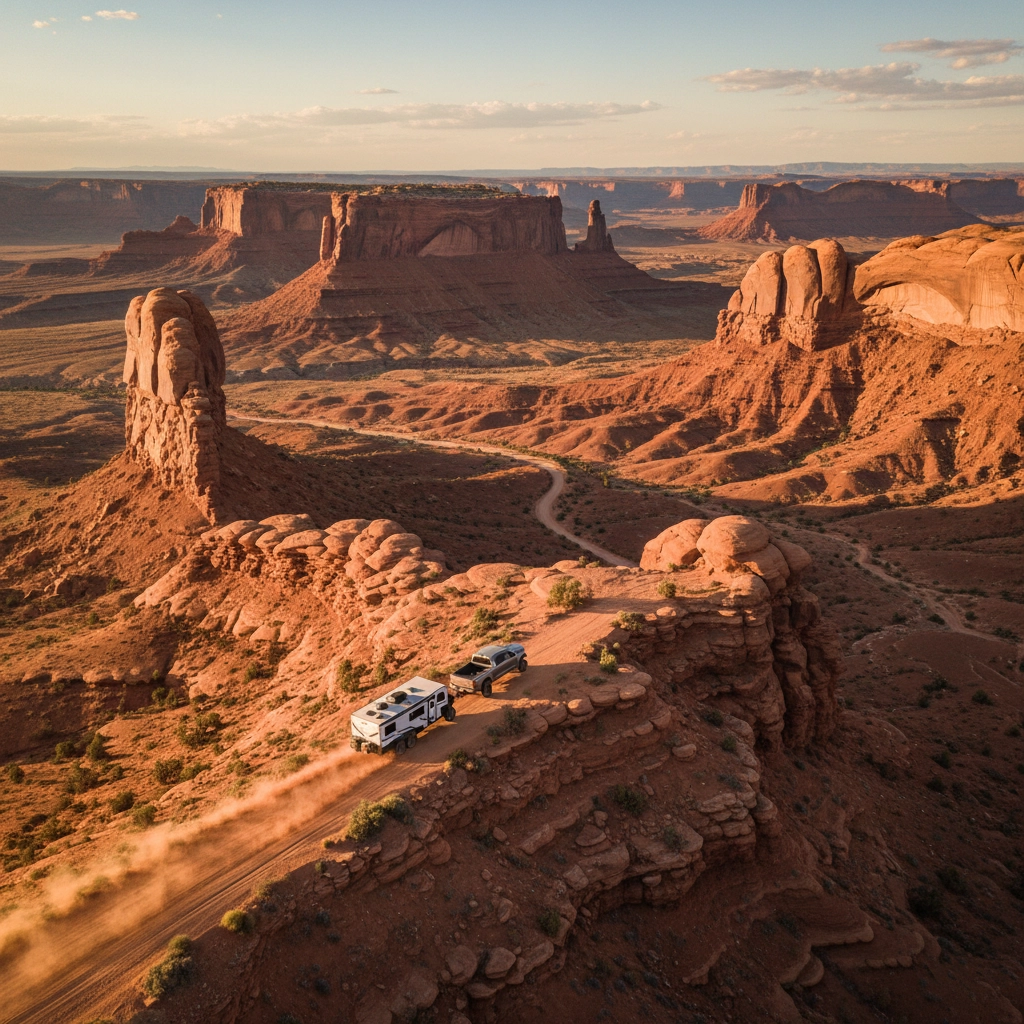
An off road camper is a heavy-duty, reinforced trailer designed to handle rough terrain, extended off-grid living, and long-distance overlanding adventures that standard travel trailers simply cannot manage. In America, these specialized campers have gained massive popularity as outdoor recreation participation continues growing year after year, with more adventurers seeking independence beyond traditional campgrounds. A real off road camper must be built for rough terrain, off-grid travel, and long-distance overlanding with four essential components: proper ground clearance, independent suspension, heavy-duty chassis, and comprehensive off-grid capability.
• Ground clearance: 14-20 inches minimum
• Independent suspension: Dual shock absorption systems
• Heavy-duty chassis: All-welded steel construction
• Off-grid capability: Solar, battery, and water systems
What Is an Off Road Camper?
Off Road Camper vs Standard Camper
The fundamental difference between an off road camper and a standard travel trailer lies in their construction philosophy and capability. Standard campers are built for highways and maintained campgrounds, featuring lightweight frames, basic suspension systems, and minimal ground clearance. Off road campers, conversely, are engineered specifically for punishment, featuring reinforced steel or aluminum chassis, independent suspension systems, and elevated ground clearance that allows navigation through forest roads, rocky trails, desert terrain, snow, sand, and remote off-grid environments.
Most U.S. terrains demand this specialized construction. Whether you’re tackling Utah’s Moab slickrock, navigating Colorado’s high-altitude passes, or crossing Arizona’s desert washes, the difference between a purpose-built off road camper and a standard trailer becomes immediately apparent when the pavement ends.
Overlanding, Off-Grid & Boondocking: Understanding the Differences
American outdoor enthusiasts often confuse these terms, but each represents distinct camping styles:
Overlanding refers to long-distance, self-reliant travel where the journey itself is the destination. Overlanders typically spend weeks or months on the road, combining highway travel with off-road exploration.
Off-grid camping means camping without hookups, no electrical, water, or sewer connections. This can happen at established dispersed camping areas or completely remote locations.
Boondocking is essentially off-grid camping but often refers to free camping on public lands, particularly in the American West where Bureau of Land Management and National Forest lands offer abundant opportunities.
An off road camper serves all three scenarios by providing the durability for rough terrain, the systems for self-sufficiency, and the comfort for extended adventures.
U.S. Market Overview
America’s outdoor recreation economy has exploded in recent years, with camping participation reaching historic highs. The combination of spacious public lands, a strong pickup truck culture, and growing interest in self-reliant travel has created ideal conditions for off road camper adoption. Unlike European markets that prioritize compact, lightweight trailers due to narrow roads and different towing regulations, American consumers prefer larger, more capable units that can handle everything from weekend desert trips to month-long Alaska expeditions.
Key Features of a True Off Road Camper
1. Heavy-Duty Chassis & Reinforced Frame
The foundation of any legitimate off road camper starts with its frame construction. Premium units feature all-welded steel construction rather than the bolt-together frames common in standard travel trailers. This welded approach creates a unified structure that can absorb and distribute the stresses of washboard roads, rock impacts, and extreme articulation without failure.
Anti-corrosion treatments are essential given the diverse climates these campers encounter, from salt-laden coastal environments to the alkaline dust of desert regions. The frame must also incorporate reinforced mounting points for suspension components, water tanks, battery systems, and exterior accessories like rock guards and recovery points.
2. Independent Suspension System
Understanding trailer suspension systems is crucial when evaluating off road campers. Independent suspension represents the gold standard for off-road performance, offering several critical advantages over traditional leaf spring setups:
Independent suspension systems utilize individual wheel control, allowing each wheel to respond independently to terrain variations. This means when one wheel hits a rock or drops into a hole, the other three wheels maintain contact and stability.
Leaf spring systems, while simpler and less expensive, connect both wheels on an axle, meaning impacts on one side affect the entire axle assembly. This creates a rougher ride and increases stress on the trailer’s frame and contents.
The practical difference becomes apparent on technical terrain where independent suspension maintains better tire contact, reduces stress on the frame, and provides a more controlled, comfortable ride for occupants and equipment alike.
3. High Ground Clearance
Ground clearance in the 14-20 inch range represents the minimum for serious off-road capability. This measurement accounts for not just the axle height, but also considers vulnerable components like water tanks, electrical systems, and propane tanks that must clear obstacles.
Higher ground clearance directly impacts your ability to navigate rocky terrain, cross water features, and avoid high-centering on desert washes or forest roads. However, increased height also affects highway stability and loading convenience, creating a balance that manufacturers must carefully consider.
4. Off-Grid Systems
Comprehensive off-grid capability separates true expedition campers from weekend warriors. Essential systems include:
Electrical Systems: Lithium battery banks (200-400Ah capacity) paired with solar charging systems (300-800 watts) and efficient inverters (2000W+) that can handle household appliances and electronics during extended remote stays.
Water Systems: Large fresh water capacity (20-50 gallons) with equally sized grey water storage. Quality filtration systems allow for water procurement from natural sources, extending range between resupply opportunities.
Climate Control: Four-season insulation and heating systems that function without electrical hookups are essential for year-round adventures. Propane heating systems, quality insulation, and adequate ventilation prevent condensation issues common in cold weather camping.

5. Exterior Protection
Rocky terrain, desert brush, and forest debris demand serious exterior protection:
Rock guards protect vulnerable components like propane tanks, batteries, and plumbing from impact damage. These guards should be easily removable for maintenance access while providing comprehensive coverage.
Stone guard coatings applied to the trailer’s front and lower surfaces prevent paint damage and potential structural issues from constant rock and debris impacts.
Upgraded tires in all-terrain or mud-terrain compounds provide the grip and puncture resistance necessary for varied terrain conditions.
6. Interior Durability & Layout
The interior of an off road camper must withstand constant motion and vibration while maintaining livability. All furniture, appliances, and storage systems require secure mounting that can handle the stresses of rough road travel. Latches, hinges, and hardware must be commercial-grade to prevent failure during extended adventures.
Layout considerations should prioritize functionality over luxury, with easy-to-clean surfaces, secure storage solutions, and efficient use of space that accommodates both travel mode compactness and camp mode comfort.
Best Off Road Campers in the U.S.
1. Compact Off Road Campers (Under 4,000 lbs)
Advantages: Lightweight units that mid-size trucks and SUVs can safely tow, easier maneuverability on technical terrain, lower initial cost, and reduced fuel consumption impacts.
Disadvantages: Limited interior space, smaller water and electrical systems, reduced storage capacity for extended trips.
Ideal for: Weekend adventures, couples, owners of mid-size tow vehicles, and those prioritizing agility over amenities.
2. Full-Size Off Road Campers (4,000-8,000 lbs)
Advantages: Comfortable layouts suitable for families or extended stays, larger off-grid systems supporting longer remote periods, substantial storage capacity, and better comfort amenities.
Disadvantages: Requires full-size truck for safe towing, higher purchase and operating costs, more challenging on extremely technical terrain.
Ideal for: Long-term overlanding, families, extended off-grid stays, and those with appropriate tow vehicles.
3. Expedition-Grade Campers (8,000+ lbs)
Advantages: Ultimate durability and off-grid capability, suitable for extreme environments like Alaska or Death Valley, comprehensive amenities including bathrooms and full kitchens.
Disadvantages: Highest cost, requires heavy-duty tow vehicle, limited access to some technical trails due to size and weight.
Ideal for: Serious expedition travel, full-time living scenarios, extreme climate conditions.
How to Choose an Off Road Camper
Step 1 , Identify Your Terrain & Travel Style
Your intended destinations should drive your camper selection. Utah’s slickrock requires different capabilities than Colorado’s alpine trails or California’s desert washes. Weekend warriors need different features than full-time overlanders planning transcontinental adventures.
Consider typical trip duration, group size, and comfort expectations. A couple planning week-long adventures has different needs than a family seeking weekend comfort or solo travelers prioritizing minimal environmental impact.
Step 2 , Match Your Tow Vehicle
Proper tow vehicle matching is critical for safety and legality. The basic formula: trailer GVWR should not exceed 80% of your vehicle’s towing capacity. However, this simple calculation doesn’t account for tongue weight, payload considerations, or real-world performance factors.
Popular tow vehicles include:
- Ford F-150: 5,000-13,200 lb towing capacity depending on configuration
- Toyota Tacoma: 6,800 lb maximum towing capacity
- Jeep Gladiator: 7,650 lb towing capacity with excellent off-road capability
Step 3 , Evaluate Suspension & Ground Clearance
Use this checklist to assess suspension quality:
- Independent suspension vs. solid axle design
- Dual shock absorbers per wheel
- Adequate ground clearance (14+ inches)
- Quality shock absorber brands (Bilstein, Fox, etc.)
- Reinforced mounting points
- Easy maintenance access
- Spare parts availability
- Manufacturer warranty coverage
Step 4 , Assess Off-Grid Requirements
Calculate your electrical and water needs based on realistic usage scenarios. For example, a couple planning 3-day desert camping trips needs approximately:
- Electrical: 150-200Ah battery capacity with 300W solar charging
- Water: 20-30 gallons fresh water capacity
- Waste: Equal grey water storage capacity
Longer trips or larger groups scale these requirements proportionally.
Step 5 , Consider Durability & Long-Term Maintenance
Examine construction quality through:
- Welded vs. bolted frame construction
- Quality of materials used throughout
- Accessibility of components for maintenance
- Availability of replacement parts
- Manufacturer reputation and longevity
Step 6 , Check Warranty & After-Sales Network
American consumers prioritize comprehensive warranty coverage and accessible service networks. Review warranty terms carefully, understanding what’s covered, duration of coverage, and service location requirements.
Quality manufacturers offer multi-year structural warranties, comprehensive component coverage, and nationwide service networks that support your adventures regardless of location.
Real Use Cases & U.S. Scenarios
Case 1: Utah Moab Overlanding Loop
Moab’s slickrock and sandstone terrain demands maximum ground clearance, puncture-resistant tires, and robust underbody protection. The desert environment requires large water capacity and efficient cooling systems, while the remote nature necessitates comprehensive off-grid electrical systems.
Case 2: Colorado Rocky Mountain Pass
High-altitude adventures combine challenging terrain with extreme weather variability. Four-season insulation, reliable heating systems, and cold-weather battery performance become critical. Steep grades test tow vehicle capability and trailer braking systems.
Case 3: Arizona Desert Expedition
Desert travel emphasizes heat management, dust protection, and water conservation. Extended distances between resupply points require maximum off-grid capability, while extreme temperatures test all systems and occupant comfort features.
Off Road Camper FAQs
What is an off road camper?
An off road camper is a heavy-duty trailer specifically designed with reinforced construction, independent suspension, high ground clearance, and comprehensive off-grid systems to handle rough terrain and extended remote camping.
Do I need a special tow vehicle for an off road camper?
While you don’t need a “special” vehicle, you do need adequate towing capacity, payload capability, and preferably four-wheel drive for accessing remote locations where off road campers excel.
How much ground clearance is recommended?
Minimum 14 inches of ground clearance is recommended for serious off-road capability, with 16-20 inches preferred for technical terrain and rock crawling scenarios.
Is an off road camper good for winter camping?
Quality off road campers with four-season insulation, efficient heating systems, and cold-weather battery performance excel in winter conditions, providing comfort and safety in extreme environments.
What suspension type is best for off-roading?
Independent suspension systems provide superior off-road performance compared to traditional leaf spring setups, offering better wheel control, improved ride quality, and reduced stress on the trailer structure.
How long can an off road camper stay off-grid?
With proper electrical and water systems, modern off road campers can support 7-14 days of comfortable off-grid living for a couple, with conservation practices extending this duration significantly.
Are off road campers safe for highways?
Yes, quality off road campers are engineered for highway travel and often provide superior stability compared to standard trailers due to their lower center of gravity and advanced suspension systems.
What is the typical price range in the U.S.?
Off road campers range from $15,000 for basic compact units to over $100,000 for premium expedition-grade models, with most quality units falling in the $30,000-60,000 range.
How to maintain an off road camper after rough trails?
Post-trip maintenance should include cleaning, inspection of suspension components, checking for damage, lubricating moving parts, and addressing any issues before they become major problems.
What features matter most for overlanding?
For overlanding, prioritize reliable suspension, adequate off-grid systems, durable construction, sufficient storage, and comfortable sleeping arrangements that support extended travel periods.

