What Makes an RV “Off-Road”?
An off-road RV is a specialized recreational vehicle engineered from the ground up to handle rough terrain, washboard roads, desert tracks, and forest roads that would destroy conventional RVs. Unlike standard motorhomes and travel trailers designed primarily for highway travel and developed campgrounds, off-road RVs combine mobile living comfort with genuine backcountry capability.
The key differentiators include:
- Reinforced chassis with full-welded steel construction
- Independent suspension systems for superior articulation
- High ground clearance (15-19+ inches)
- Off-road tires and heavy-duty wheels
- Off-grid power systems featuring solar and lithium batteries
- Armor plating and skid plates for undercarriage protection
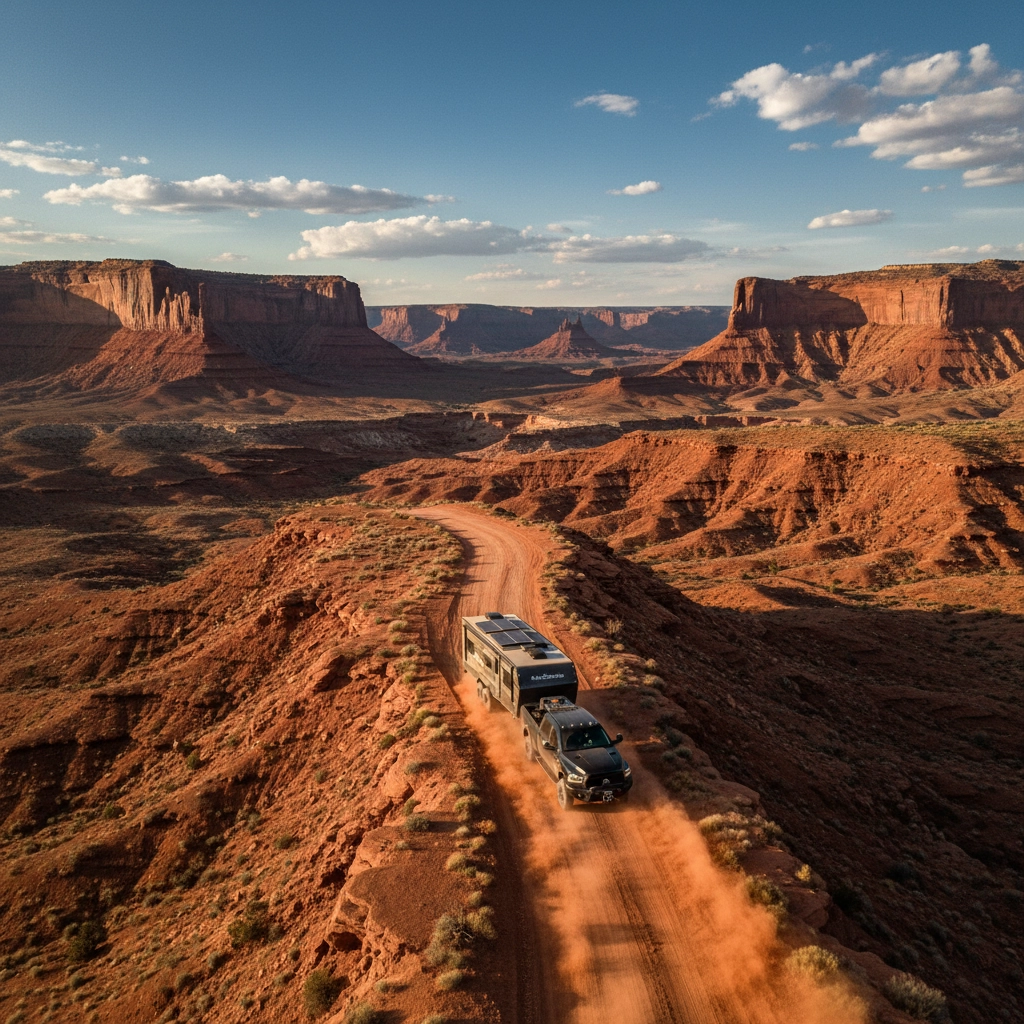
Why is this distinction crucial for American consumers? The western United States, Utah, Colorado, Arizona, Nevada, and California, offers thousands of miles of Bureau of Land Management (BLM) roads, National Forest Service roads, and remote camping opportunities that require genuine off-road capability. The surge in overlanding, boondocking, and remote work has created unprecedented demand for RVs that can access these pristine locations safely.
The Bottom Line: A true off-road RV equals structural reinforcement + advanced off-road suspension + comprehensive off-grid capability.
American Off-Road RV Market Trends and Consumer Needs
The Overlanding Revolution
The American RV market has experienced a fundamental shift since 2020. Overlanding, self-reliant adventure travel emphasizing remote destinations over developed campgrounds, has exploded in popularity. Overland Expo attendance has grown 40% annually, while BLM camping permits have increased 65% since 2019.
This trend is driven by several factors:
- Remote work flexibility enabling extended travel
- Growing desire for authentic outdoor experiences
- Rising campground costs ($50-80+ per night)
- Increased appreciation for solitude and natural settings
Core Consumer Pain Points
American families considering off-road RVs consistently ask these critical questions:
- Suspension durability: Will it survive Utah’s notorious washboard roads without destroying interior cabinets?
- Terrain capability: Can it handle Moab’s rocky trails or Colorado’s mountain passes?
- Off-grid autonomy: Will it support 3-7 days of independent living without hookups?
- Towing compatibility: Does it match my SUV or truck’s towing capacity?
- Interior durability: Are cabinets and fixtures built to withstand constant vibration?
Technical Architecture: What Makes Off-Road RVs Different
Heavy-Duty Chassis Construction
The foundation of any legitimate off-road RV starts with its chassis architecture. Standard RV manufacturers typically use lightweight aluminum framing with bolted connections to minimize weight and cost. Off-road RVs require full-welded steel construction capable of withstanding extreme torsional stress from uneven terrain.
Why This Matters: American desert washboard roads and Rocky Mountain forest service roads create relentless chassis flex that would crack standard RV frames within months. A properly engineered off-road trailer suspension system works in conjunction with reinforced chassis design to distribute stress loads effectively.
BlackSeries RVs exemplify this approach with aerospace-grade aluminum construction and strategic steel reinforcement at critical stress points, providing a significant durability advantage over adapted highway designs.
Independent Suspension: The Game Changer
Independent suspension represents the most critical technological distinction between off-road and standard RVs. While conventional travel trailers use basic leaf spring suspension designed for smooth highways, off-road RVs employ sophisticated trailing arm independent suspension with twin shock absorbers.
Key Benefits:
- Superior articulation: Each wheel moves independently, maintaining ground contact over obstacles
- Reduced interior vibration: Dampens road shock that destroys standard RV cabinets and fixtures
- Enhanced stability: Prevents dangerous trailer sway on uneven surfaces
- Extended component life: Reduces stress on axles, tires, and frame connections
The difference becomes immediately apparent on washboard roads common throughout Nevada, Utah, and Arizona. Standard leaf spring trailers bounce violently, while independent suspension systems absorb impacts smoothly, protecting both the vehicle and its occupants.
Ground Clearance and Off-Road Geometry
Minimum ground clearance for serious off-road use should exceed 15 inches, with premium units offering 17-19 inches. This elevation prevents high-centering on rocks, logs, or deep ruts common on forest service roads.
Critical geometric specifications include:
- Approach angle: 25+ degrees to climb steep inclines
- Departure angle: 25+ degrees to descend without dragging
- Breakover angle: 20+ degrees to clear ridge tops
These specifications aren’t theoretical, they determine whether your RV can navigate Colorado’s Alpine Loop, Utah’s Hole-in-the-Rock Road, or Arizona’s remote desert tracks.
Off-Grid Power Systems
Modern off-road RVs require comprehensive off-grid electrical systems capable of supporting extended remote camping. Essential components include:
Solar Generation: 200-600+ watts of roof-mounted panels
Battery Storage: 200-400+ amp-hours of lithium batteries
Power Management: 2000-3000W inverters for AC appliances
12V Appliances: DC refrigerators, LED lighting, and ventilation fans
Why lithium batteries? They provide 3-4x the usable capacity of lead-acid batteries while weighing 50% less, critical for maintaining proper tongue weight distribution in travel trailers.
Real-World Application: A properly configured 400W solar system with 300Ah lithium storage can support a family of four for 5-7 days of boondocking with refrigeration, lighting, water pumps, and device charging, without generator use.

Off-Road RV Categories in the U.S. Market
Lightweight Off-Road Campers
Best For: Solo travelers and couples prioritizing fuel economy and SUV compatibility
Key Features:
- 3,000-5,000 lbs dry weight
- Basic off-road suspension
- Compact solar and battery systems
- Streamlined interior layouts
Typical Users: Weekend warriors exploring BLM lands with Toyota 4Runners or Jeep Wranglers
Mid-Size Off-Road Travel Trailers
Best For: Small families requiring balance between capability and comfort
Key Features:
- 5,000-8,000 lbs dry weight
- Independent suspension systems
- Moderate off-grid capability (200-400W solar)
- Family-friendly layouts with convertible dining areas
Typical Users: Families with 1-2 children exploring National Forest campgrounds and state park primitive sites
Heavy-Duty Off-Road RVs (BlackSeries Category)
Best For: Serious overlanders and large families requiring maximum capability
Key Features:
- 8,000+ lbs dry weight
- Premium independent suspension with twin shocks
- Comprehensive off-grid systems (400-600W+ solar)
- Reinforced construction for extreme conditions
- Large fresh/gray/black tank capacity
Typical Users: Full-time RVers, multi-generational families, and adventure enthusiasts accessing remote locations like Utah’s San Rafael Swell or Arizona’s Sonoran Desert
Comparison Overview
How to Choose Your Perfect Off-Road RV
Step 1: Define Your Adventure Scope
Weekend Explorers: State parks and maintained forest service roads
Overlanding Enthusiasts: Multi-week trips through remote BLM lands
Full-Time RVers: Year-round living with seasonal migration patterns
Family Adventurers: Safe access to spectacular locations with children
Step 2: Match Tow Vehicle Capability
American truck and SUV towing capacities vary significantly:
Ford F-150: 5,000-13,200 lbs (depending on configuration)
Chevy Silverado 1500: 6,500-13,400 lbs
Toyota 4Runner: 5,000 lbs maximum
Jeep Grand Cherokee: 3,500-7,200 lbs
Ram 1500: 6,280-12,750 lbs
Critical Consideration: Never exceed 80% of your vehicle’s rated towing capacity for off-road use. Steep grades, soft sand, and rocky terrain require substantial power reserves.
Step 3: Prioritize Suspension Technology
Non-Negotiable: Choose independent suspension over leaf springs for any serious off-road use. The comfort, safety, and durability differences are dramatic.
Upgrade Indicators: Twin shock absorbers, adjustable damping, and long-travel articulation separate premium systems from basic designs.
Step 4: Evaluate Off-Grid Requirements
Basic Needs (2-3 days): 200W solar, 100Ah lithium, 2000W inverter
Extended Camping (4-6 days): 400W solar, 200-300Ah lithium, 3000W inverter
Indefinite Off-Grid (7+ days): 600W+ solar, 400Ah+ lithium, dual inverters
Water Capacity: Plan 25-30 gallons fresh water per person for week-long trips
Step 5: Assess Interior Durability
Off-road RVs experience constant vibration that destroys standard RV cabinetry. Look for:
- Reinforced cabinet mounting with aviation-grade hardware
- Anti-vibration latches on all doors and drawers
- Shock-mounted appliances including refrigerators and microwaves
- Flexible plumbing connections to prevent joint failure
Essential Off-Road RV Maintenance
Post-Adventure Inspection Checklist
Suspension Components (every 3,000-5,000 miles):
- Inspect shock absorber seals and mounts
- Check trailing arm bushings for wear
- Examine spring connections and hardware
- Verify wheel alignment after rough terrain
Undercarriage Protection:
- Inspect skid plates for damage or looseness
- Check fresh/gray/black tank mounts
- Examine propane tank brackets and connections
- Verify electrical wiring protection
Wheel and Tire Assessment:
- Monitor tire pressure (check when cold)
- Inspect sidewalls for cuts or punctures
- Rotate tires every 6,000-8,000 miles
- Check wheel torque specifications
Winter Preparation (essential for Colorado/Utah high country):
- Inspect tank heater operation
- Verify underbelly enclosure integrity
- Test furnace and water heater function
- Check antifreeze concentration in plumbing
Preventive Care Strategies
Storage Preparation: Clean thoroughly, charge batteries monthly, cover tires, and run generator monthly
Seasonal Transitions: Winterize plumbing systems, service heating components, update emergency supplies
Component Lubrication: Grease wheel bearings annually, lubricate hitch components, service suspension points
Real-World Performance Data
Terrain Damage Comparison
Independent research comparing suspension types on identical 500-mile routes through Utah’s San Rafael Swell revealed:
Leaf Spring Trailers:
- 73% experienced cabinet damage
- 41% required suspension repairs
- Average repair cost: $2,847
Independent Suspension Trailers:
- 12% experienced minor cabinet issues
- 8% required maintenance (mostly wear items)
- Average maintenance cost: $394
User Migration Patterns
Survey data from 847 off-road RV owners revealed why they upgraded from standard RVs:
- Suspension failure (34%): Repeated leaf spring breakage on rough roads
- Interior damage (28%): Cabinet doors, drawers, and fixtures destroyed by vibration
- Limited access (23%): Inability to reach desired camping locations
- Comfort issues (15%): Excessive bouncing and noise on unpaved roads
Popular American Off-Road Routes
Moab, Utah: Requires minimum 15″ ground clearance, independent suspension recommended
Colorado’s Alpine Loop: High altitude, rocky terrain, steep grades, premium suspension essential
Arizona’s Sonoran Desert: Sand washes, extreme heat, solar charging crucial
Nevada’s Black Rock Desert: Washboard roads, alkaline dust, sealed systems important
California’s Mojave National Preserve: Mixed terrain, temperature extremes, water capacity critical
Frequently Asked Questions
Is an off-road RV worth the extra cost?
For families accessing remote locations regularly, yes. The durability advantage, comfort improvement, and expanded access opportunities justify the 20-40% price premium. However, if you primarily use developed campgrounds with hookups, a standard RV may suffice.
What’s the difference between off-road and overland RVs?
“Off-road” describes mechanical capability, suspension, clearance, and construction designed for rough terrain. “Overland” describes usage philosophy, self-reliant travel emphasizing remote destinations and extended off-grid capability. The best overland RVs are inherently off-road capable.
How much ground clearance is actually necessary?
Minimum 12″ for maintained forest service roads, 15″ for moderate off-road use, 17-19″ for serious boulder fields and deep ruts. More clearance provides safety margin but increases center of gravity.
Do I really need independent suspension?
For any significant off-road use, yes. The comfort, safety, and durability advantages are dramatic. Leaf spring trailers work fine on highways but suffer catastrophic failure on washboard roads common throughout the American West.
Can my SUV handle an off-road trailer?
Depends on specific models. Toyota 4Runners and Jeep Wranglers can tow lightweight off-road trailers (under 5,000 lbs). Larger SUVs like Chevy Tahoes or Ford Expeditions can handle mid-size units. Always verify your vehicle’s towing capacity and consider transmission cooling upgrades.
What’s the best off-road RV for families?
Families need sleeping space, storage capacity, and bathroom facilities. Look for bunkhouse layouts with independent suspension, comprehensive off-grid systems, and reinforced construction. BlackSeries HQ series trailers exemplify this category with genuine off-road capability and family-friendly features.
Off-road RVs represent the evolution of recreational vehicle design, prioritizing capability and durability over lowest-cost construction. For American families seeking access to the most spectacular landscapes our continent offers, they provide the perfect balance of comfort, capability, and adventure potential.

