
Your cart (0)
Your cart is empty
Tax included and shipping calculated at checkout
Your cart is empty
Tax included and shipping calculated at checkout

An off-road RV trailer camper is a purpose-built recreational vehicle designed to withstand rugged terrain and remote camping environments, featuring heavy-duty construction, independent suspension systems, and enhanced ground clearance that fundamentally distinguishes it from standard travel trailers. The USA overlanding market has experienced explosive growth, with off-road capable trailers becoming essential equipment for adventure travelers seeking self-reliant exploration beyond traditional campgrounds. True “off-road-ready” design requires four critical elements: reinforced chassis construction, advanced suspension systems with 12+ inches of ground clearance, comprehensive off-grid capabilities, and durable exterior protection systems.
Off-road RV trailer campers represent a specialized category of recreational vehicles engineered specifically for challenging terrain and extended off-grid adventures. Unlike conventional travel trailers designed primarily for paved roads and developed campgrounds, these rugged units prioritize durability, terrain capability, and self-sufficiency over interior luxury and space.
The fundamental distinction lies in construction philosophy and intended use. Standard travel trailers feature low ground clearance (6-8 inches), basic leaf spring suspension, and lightweight construction optimized for highway towing and campground hookups. Off-road variants incorporate heavy-duty chassis, independent suspension systems, and ground clearance ranging from 12-18 inches to navigate rocks, stumps, and uneven terrain without damage.
Off-road capability focuses on terrain navigation through enhanced suspension, ground clearance, and structural durability. Off-grid capability emphasizes self-sufficiency with solar power systems, large water tanks, and extended battery capacity for weeks of independent camping. The most effective overlanding trailers combine both attributes.
The American overlanding market has surged as outdoor enthusiasts seek authentic wilderness experiences beyond crowded campgrounds. This growth reflects changing recreational preferences toward self-reliant adventure travel, where the journey holds equal importance to the destination. Modern off-road trailers enable access to remote locations previously requiring expensive expedition vehicles or primitive camping equipment.
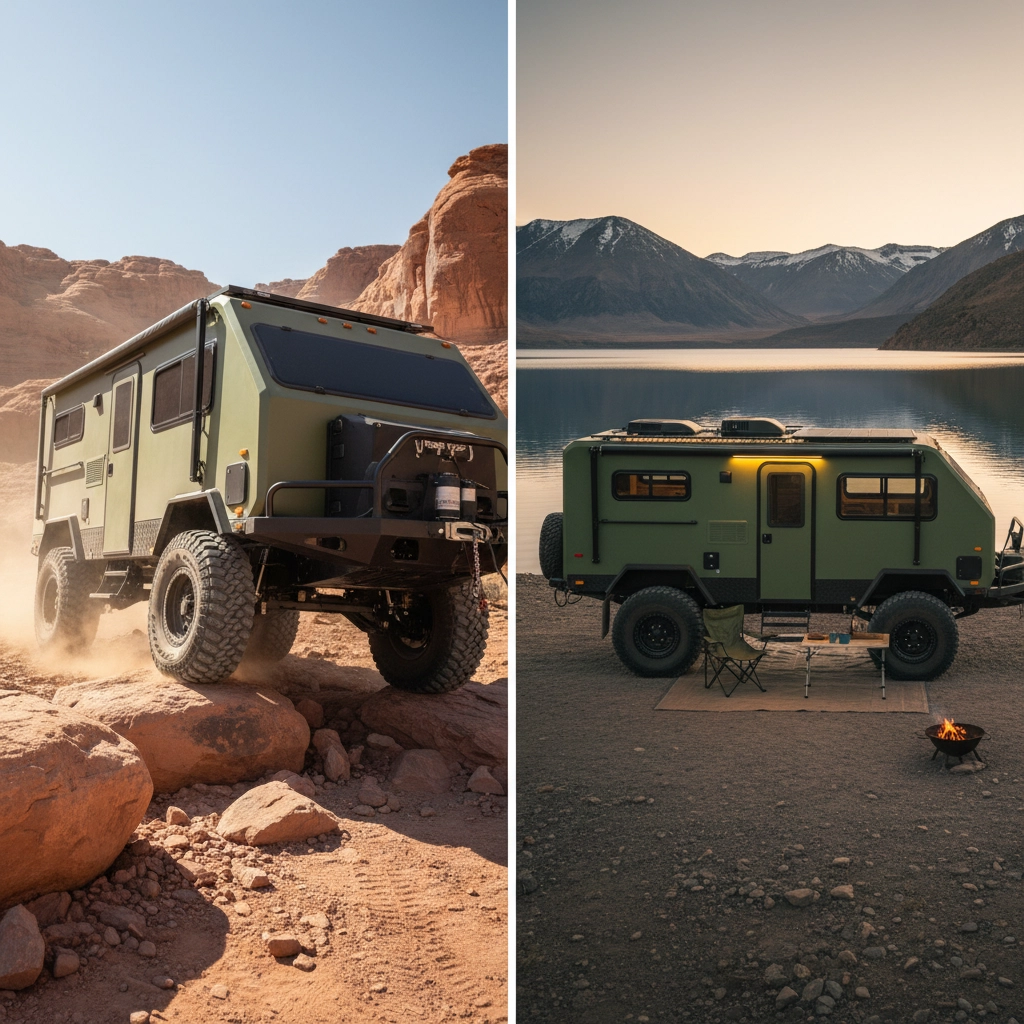
Authentic off-road trailers utilize fully welded steel frames or lightweight aluminum construction engineered to withstand torsional stress from uneven terrain. Steel frames provide superior strength for extreme conditions, while aluminum offers corrosion resistance and weight savings. Critical construction elements include reinforced attachment points, galvanized components, and powder-coated finishes for long-term durability.
The chassis must handle forces that never affect highway trailers: lateral stress from side slopes, vertical impact from rock strikes, and torsional flex from three-wheel contact situations. Premium manufacturers employ computer-aided stress analysis to optimize frame geometry for off-road loads while maintaining reasonable towing weights.
The suspension system represents the most critical differentiator between genuine off-road trailers and marketing-driven “off-road styled” units. True off-road capability requires independent suspension with long-travel shock absorbers that absorb impacts from bumpy trails, rocky paths, and washboard roads.
Modern systems like independent trailing arm suspension provide superior wheel articulation, allowing each wheel to respond independently to terrain variations. This design maintains tire contact for better traction while reducing stress on the trailer frame and tow vehicle. Advanced suspension technologies continue evolving to handle increasingly challenging terrain demands.
Comprehensive off-grid systems separate true overlanding trailers from recreational units. Essential components include:
Solar Power Systems: Roof-mounted arrays typically ranging from 400-1200 watts, with MPPT charge controllers and battery monitoring systems.
Battery Storage: Lithium battery banks providing 400-1000+ amp-hours of capacity for extended off-grid duration.
Water Systems: Large freshwater tanks (40-80+ gallons) with efficient pumps and filtration systems for extended independence.
Climate Control: Four-season insulation and efficient heating systems for year-round adventures.

Off-road trailers incorporate multiple protection systems against environmental hazards:
Rock Guards: Heavy-duty skid plates protecting vulnerable components like tanks, electrical systems, and plumbing from rock strikes.
Impact-Resistant Panels: Diamond plate aluminum or composite panels defending against brush, branches, and debris.
Reinforced Components: Upgraded hinges, latches, and mounting systems that maintain function despite vibration and impact.
Weather Sealing: Advanced sealing systems preventing water intrusion during stream crossings and severe weather.
Off-road trailer interiors balance comfort with durability through specialized design approaches:
Vibration-Resistant Furniture: Custom cabinetry with positive latching systems and reinforced mounting prevents damage from trail vibration.
Durable Materials: High-grade upholstery, solid surface countertops, and impact-resistant fixtures maintain appearance despite heavy use.
Efficient Layouts: Space-optimized designs maximize functionality while minimizing weight and complexity.
Secure Storage: Positive-latch storage prevents contents from becoming projectiles during off-road travel.
The USA market offers diverse off-road trailer categories, each optimized for specific adventure styles and terrain demands.
Compact teardrop trailers provide essential shelter and storage while maintaining minimal towing impact. These units typically feature:
Teardrop designs excel for weekend adventures and established trail systems but lack capacity for extended off-grid expeditions.
Mid-size overlanding trailers balance capability with towing practicality. Typical specifications include:
This category represents the optimal balance for most American overlanding adventures, providing genuine off-road capability without requiring heavy-duty tow vehicles.

Large off-road trailers offer maximum comfort and capability for extended expeditions:
These units suit adventurers prioritizing comfort and extended off-grid duration over maximum terrain access.
Honest assessment of intended use prevents over-buying capability or under-preparing for conditions. Consider typical terrain categories:
Forest Roads: Maintained dirt roads requiring moderate ground clearance and basic traction capability.
Desert Terrain: Sand, rocks, and washouts demanding high ground clearance and advanced traction systems.
Rocky Trails: Technical routes requiring maximum ground clearance, protection systems, and suspension articulation.
Winter Conditions: Snow and ice requiring four-season capability, enhanced heating, and cold-weather equipment.
Document specific destinations and access requirements rather than assuming “maximum capability” needs.
Critical measurements determine actual off-road capability:
Ground Clearance: Minimum 12 inches for moderate off-road use, 14+ inches for challenging terrain.
Approach/Departure Angles: Steep angles prevent high-centering on obstacles.
Suspension Travel: Long-travel systems maintain tire contact on uneven surfaces.
Tire Size: Large diameter tires improve ground clearance and obstacle navigation.
Calculate realistic power and water needs based on trip duration and comfort requirements:
Power Consumption: Inventory electrical devices and daily usage patterns to determine battery capacity needs.
Water Usage: Estimate consumption for drinking, cooking, and hygiene to determine tank capacity.
Climate Control: Assess heating and cooling requirements for intended seasons and regions.
Backup Systems: Consider redundant power generation and water sources for remote areas.

Evaluate construction quality through hands-on inspection:
Frame Inspection: Examine welding quality, material thickness, and reinforcement adequacy.
Component Quality: Assess hardware, electrical systems, and plumbing for appropriate specifications.
Protection Systems: Verify adequate shielding for vulnerable components.
Manufacturer Reputation: Research warranty coverage, service network, and owner satisfaction.
Ensure safe towing through proper vehicle selection:
Towing Capacity: Verify gross trailer weight remains within vehicle limits with safety margin.
Tongue Weight: Confirm hitch weight compatibility and proper weight distribution.
Braking Systems: Evaluate electric brake integration and emergency breakaway systems.
Cooling Systems: Consider transmission and engine cooling upgrades for mountainous terrain.
Suspension Modifications: Assess need for helper springs or load-leveling systems.
What is the difference between an off-road and regular RV trailer?
Off-road trailers feature reinforced construction, independent suspension systems, higher ground clearance (12+ inches vs 6-8 inches), enhanced protection systems, and off-grid capabilities. Regular trailers prioritize interior space and highway comfort over terrain capability and durability.
Do off-road RVs require special tow vehicles?
Most off-road trailers require capable tow vehicles due to increased weight from reinforced construction and equipment. Mid-size models typically need full-size trucks, while larger units may require heavy-duty pickup trucks with appropriate towing packages and brake controllers.
How much does an off-road RV trailer camper cost in the U.S.?
Prices range from $30,000-$50,000 for basic compact models to $80,000-$150,000+ for premium full-size units. Factors affecting cost include size, construction quality, off-grid equipment, and manufacturer reputation.
Are off-road trailers good for winter camping?
Quality off-road trailers with four-season insulation, efficient heating systems, and proper winterization features excel in cold conditions. Enhanced battery capacity and solar systems maintain power during shorter daylight hours.
What suspension type is best for off-road towing?
Independent suspension systems provide superior performance over traditional leaf spring designs. Technologies like trailing arm suspension offer better wheel articulation, reduced frame stress, and improved ride quality on rough terrain.
Can I use solar panels on an off-road trailer?
Modern off-road trailers typically include integrated solar systems with roof-mounted panels, charge controllers, and battery monitoring. Solar capacity typically ranges from 400-1200 watts depending on trailer size and power requirements.
How long can an off-grid camper stay powered?
Duration depends on battery capacity, power consumption, and solar recharging capability. Well-equipped systems provide 5-14 days of independence under typical usage, with indefinite capability under optimal solar conditions.
Are off-road RVs safe for highway travel?
Quality off-road trailers are engineered for highway speeds and long-distance travel. Enhanced suspension systems often provide superior highway stability compared to standard trailers, though increased height may affect crosswind sensitivity.
What maintenance is required for off-road trailers?
Off-road trailers require more frequent inspection and maintenance due to harsh operating conditions. Critical areas include suspension components, protection systems, sealing integrity, and electrical connections. Regular cleaning prevents corrosive buildup from trail conditions.
What states in the U.S. are best for off-road trailer travel?
Western states like Utah, Colorado, Arizona, and California offer extensive public lands and established overlanding routes. The Bureau of Land Management and National Forest Service maintain thousands of miles of off-road accessible trails suitable for properly equipped trailers.
Off-Road RV Trailer Campers 2026 | How to Choose & Best Models最先出现在Black Series RV | Off-Road Travel Trailers, Toy Haulers & Camper Trailers | Off road rv | Off grid rv | Overland rv | Off road trailer | Off road travel trailer | Overland travel trailer。