The American adventure scene is experiencing a massive shift in 2026. More families are ditching crowded RV parks for remote boondocking sites, and the demand for true off-road travel trailers has skyrocketed. Whether you’re planning a weekend desert escape or a month-long exploration through the Rockies, understanding what makes an off-road trailer different, and how to choose the right one, can make or break your adventure. This guide breaks down everything you need to know about off-road travel trailers in 2026, from critical weight considerations to advanced off-grid power systems.
What Makes an Off-Road Travel Trailer Different?
Not all travel trailers are created equal. While standard RVs are designed for paved campgrounds with full hookups, off-road travel trailers are engineered to handle punishment that would destroy a conventional trailer.
Independent Suspension Systems
The most critical difference? Suspension. Off-road trailers feature independent suspension with heavy-duty coil-over shocks or advanced gas shock systems. This allows each wheel to move independently over obstacles, rocks, washboard roads, steep inclines, without transferring stress to the chassis or interior. Traditional trailers use leaf-spring suspension that’s great for highways but terrible for anything rough.
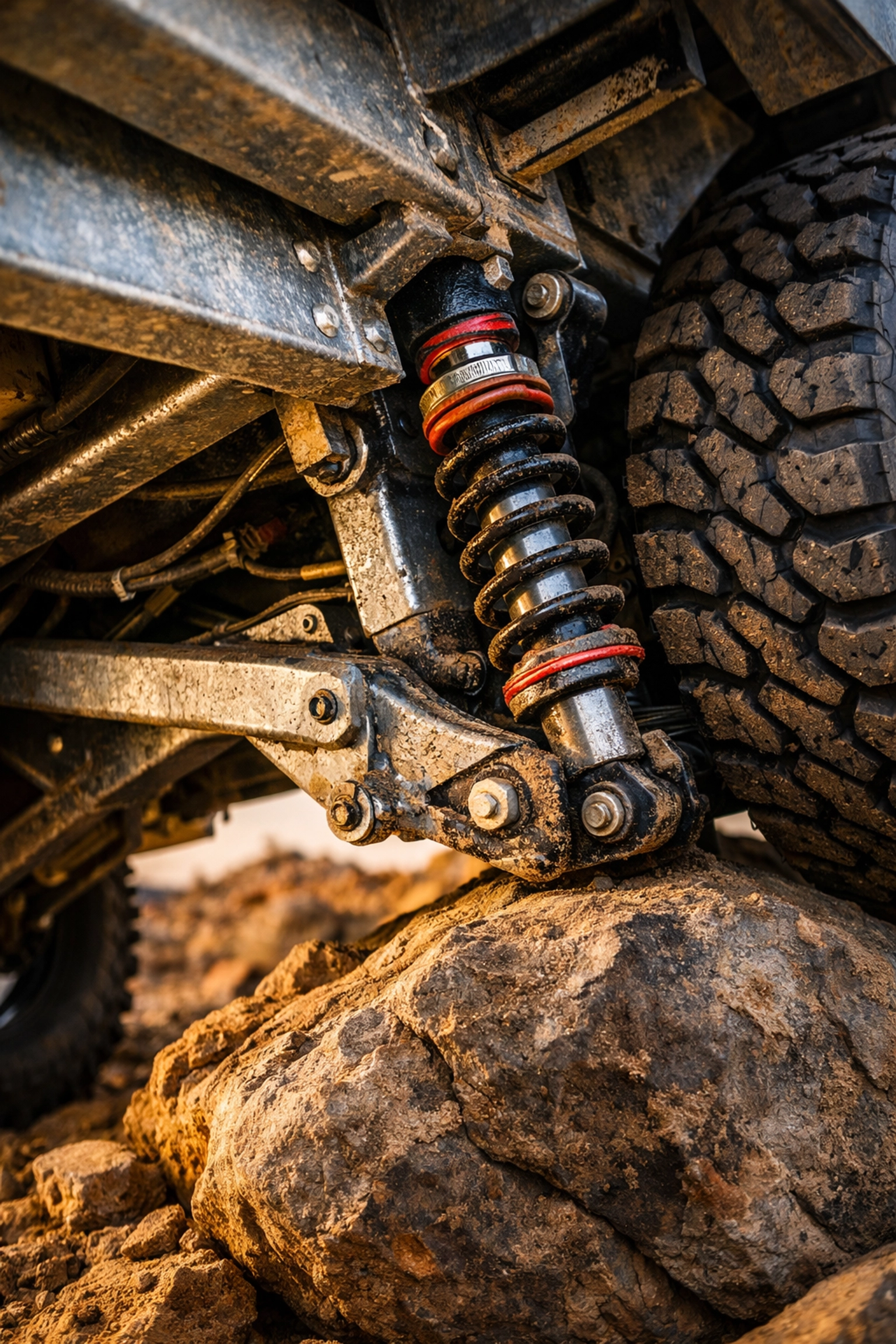
Rugged Chassis Construction
Off-road trailers use hot-dipped galvanized steel or marine-grade aluminum frames instead of standard steel. The galvanization process protects against rust and corrosion, especially important when you’re crossing rivers or camping in coastal areas. Reinforced mounting points for accessories, heavy-duty couplers, and boxed steel construction add strength without unnecessary weight.
Off-Grid Capability
Here’s where 2026 models shine: integrated lithium power systems, 400W+ solar arrays, and advanced battery management. Traditional trailers might offer a converter and a small battery. True off-road trailers come standard with systems designed for extended boondocking, we’re talking 2000W+ inverters, smart solar controllers, and lithium batteries that can handle thousands of charge cycles. Learn more about off-grid power systems for travel trailers.
Ground Clearance and Approach Angles
Off-road trailers sit higher. Much higher. Standard trailers have 6-8 inches of ground clearance. Off-road models feature 12-16 inches or more, with improved approach and departure angles to prevent high-centering on steep terrain. This lets you access campsites that are completely off-limits to regular RVs.
Top Benefits of Off-Road Travel Trailers
Access to Remote Locations
The biggest payoff? You can camp where others can’t. Those hidden mountain meadows, desert valleys, and coastal bluffs that require miles of dirt roads? They’re suddenly accessible. In 2026, as public lands become more crowded, having an off-road camper trailer means you can escape the crowds and find true solitude.
Built to Last
Off-road trailers are overbuilt by design. Thicker aluminum skins, reinforced cabinetry, commercial-grade hinges and latches, and sealed electrical systems mean these trailers handle vibration and impacts that would shake a conventional trailer apart. Owners regularly report using their off-road trailers for 10-15 years without major repairs.

Extended Off-Grid Living
Thanks to advanced solar and lithium power systems, 2026 off-road trailers can support weeks of boondocking. Larger freshwater tanks (80-100 gallons vs. 30-40 gallons in standard trailers), efficient 12V appliances, and smart energy management mean you’re not constantly looking for hookups. This is crucial as boondocking popularity explodes across the American West.
Four-Season Comfort
Many off-road trailers feature four-season insulation packages with heated underbellies, double-pane windows, and upgraded climate control. This means comfortable camping from Death Valley in summer to Montana in winter.
Best Off-Road Travel Trailers of 2026: The BlackSeries Lineup
BlackSeries has become synonymous with rugged, Australian-engineered off-road trailers built for the American market. Here’s the 2026 lineup:
BlackSeries HQ12
The HQ12 is the entry point into serious off-road camping. At just over 3,000 lbs dry weight, it’s towable by mid-sized SUVs and trucks. Features include independent suspension, galvanized chassis, 200W solar standard (upgradeable to 400W), and a surprisingly spacious interior with a queen bed. Perfect for couples who want to go light but not sacrifice comfort.
BlackSeries HQ17
The HQ17 hits the sweet spot for most adventurers. This 17-foot trailer sleeps 2-4 comfortably and includes an outdoor kitchen, upgraded battery system, and enhanced storage capacity. The independent dual-shock suspension handles the worst trails, and the aerodynamic profile reduces wind resistance, important in 2026 as more people tow with EVs or fuel-efficient trucks.
BlackSeries HQ19
Step up to the HQ19 and you’re getting a full-featured off-road home. Larger water capacity, more interior living space, a wet bath, and increased solar options make extended trips more comfortable. The HQ19 balances weight (around 4,800 lbs dry) with amenities, making it ideal for families or couples who need more room.
BlackSeries HQ21
The flagship HQ21 offers maximum space and luxury without sacrificing off-road capability. At 21 feet, you get separate sleeping areas, more storage, upgraded appliances, and premium finishes. The galvanized chassis and independent suspension handle any terrain, while the spacious interior rivals many park-model RVs. This is the choice for full-timers or extended adventure trips.
Each BlackSeries model comes standard with features that are expensive upgrades on other brands: lithium-ready electrical systems, off-road tires, reinforced drawers and cabinets, and diamond-plate armor protection.
Off-Road Trailer Buying Guide: Weight and Towing Capacity
Here’s where things get real: you need to understand trailer weight. This is one of the most common mistakes buyers make, and it can be dangerous. Let’s break down the numbers.
Understanding Trailer Weights by Length
16 ft Camper Weight: A 16-foot off-road trailer typically weighs 2,800-3,500 lbs dry. Add water, gear, food, and propane, and you’re looking at 3,500-4,200 lbs loaded. The average weight of camper in this category is around 3,200 lbs dry.
18 ft Camper Weight: An 18-foot model ranges from 3,200-4,000 lbs dry weight. Loaded, expect 4,000-5,000 lbs. The average 18 ft camper weight sits around 3,600 lbs unloaded.
24 ft Camper Weight: When you jump to 24 feet, dry weights are typically 4,500-5,500 lbs. The average 24 ft camper weight is approximately 5,000 lbs, but with gear and supplies, plan for 6,000-7,000 lbs total.
30 Foot RV Weight: Here’s where it gets heavy. A 30 ft camper weight ranges dramatically based on construction, conventional travel trailers might weigh 6,000-7,500 lbs dry, while off-road models with heavy-duty components can hit 7,000-8,500 lbs. The average 30 foot rv weight is around 7,200 lbs dry. Loaded for adventure? You’re looking at 8,500-10,000 lbs easily. The 30 ft rv weight consideration is critical because many half-ton trucks max out their towing capacity at this size.
Average Travel Trailer Weights: What You Need to Know
The average travel trailer weights have increased in 2026 due to lithium systems, solar arrays, and upgraded construction materials. When shopping:
- Always check the Gross Vehicle Weight Rating (GVWR), not just dry weight
- Calculate payload capacity: GVWR minus dry weight
- Factor in the 80% rule: only use 80% of your tow vehicle’s rated capacity for safety and vehicle longevity
- Remember tongue weight (10-15% of trailer weight) counts against your truck’s payload
For detailed weight considerations, check out our travel trailer weight guide.
Matching Your Tow Vehicle
Half-ton trucks (F-150, Silverado 1500, Ram 1500): Comfortably tow 16-24 ft trailers up to 7,000 lbs. Many modern half-tons are rated higher, but stick to the 80% rule for off-road towing.
Three-quarter-ton trucks (F-250, Silverado 2500, Ram 2500): Can handle 24-30 ft trailers weighing 8,000-12,000 lbs. These are the workhorses for serious off-road adventurers.
Mid-sized trucks and SUVs (Tacoma, Colorado, 4Runner): Best matched with 12-18 ft trailers under 5,000 lbs. Perfect for the HQ12 or HQ17.
Electric tow vehicles are becoming viable in 2026, but range drops significantly when towing. Choose aerodynamic trailers and plan charging stops carefully.
Off-Road Travel Trailers vs. Regular Trailers
Let’s compare what you’re really getting:
The price difference is significant, expect to pay $40,000-$80,000 for a quality off-road trailer versus $25,000-$50,000 for a comparable regular trailer. But if you’re serious about accessing remote locations, there’s no comparison in capability.
Common FAQs
How much does an off-road travel trailer weigh?
Off-road trailers range from 2,800 lbs (small 12-14 ft models) to 8,500+ lbs (large 30 ft models) dry weight. The average weight of camper trailers designed for off-road use is 15-20% heavier than standard trailers due to reinforced construction, heavier suspension components, and upgraded systems. Always factor in loaded weight when calculating towing requirements.
What is the best off-road trailer for a family of four?
For four people, look at 19-21 ft models like the BlackSeries HQ19 or HQ21. You need sleeping space for four, adequate storage for extended trips, and enough water/power capacity to support the extra people. Models in this range typically weigh 4,500-6,500 lbs loaded, requiring a three-quarter-ton truck for safe towing on rough terrain.
How do I maintain an off-road travel trailer?
Regular maintenance includes: checking tire pressure before every trip (critical for off-road), inspecting shock absorbers and suspension components quarterly, maintaining battery systems (especially lithium), cleaning solar panels, greasing wheel bearings annually, and checking all chassis bolts for tightness. The extra abuse off-road trailers take means maintenance is more critical than with regular trailers. For specific guidance, see our off-road trailer maintenance guide.
Can off-road trailers be used in regular campgrounds?
Absolutely. Off-road trailers work perfectly fine at developed campgrounds, they’re just capable of much more. You’ll appreciate the extra ground clearance in campgrounds with poor grading, and the self-sufficiency means you’re not dependent on campground electrical hookups. Many off-road trailer owners spend 60-70% of their time in developed sites and 30-40% boondocking.
Are off-road trailers worth the extra cost?
If you plan to spend significant time exploring public lands, forest service roads, or remote camping areas, yes. The capability gap is enormous. If you’ll stick to paved campgrounds 90% of the time, a regular trailer makes more sense. Consider that upgrading to an off-road RV opens up thousands of camping locations that are completely inaccessible to standard RVs.
Key Off-Road Trailer Accessories and Upgrades
Even the best off-road trailers benefit from smart upgrades:
Solar and Power Systems
In 2026, lithium is king. Upgrading to 300Ah+ of lithium batteries paired with 600-800W of solar creates a nearly unlimited power supply for boondocking. Modern solar controllers with MPPT technology extract maximum power even in partial shade. Consider a lithium power upgrade if your trailer doesn’t come standard with it.
Heavy-Duty Tires and TPMS
Off-road tires are a must: look for Load Range E rated for your trailer’s weight, with aggressive tread patterns. Pair them with a tire pressure monitoring system (TPMS) to catch leaks before they become dangerous on remote trails. Proper tire pressure for off-road conditions differs dramatically from highway pressure.
Additional Storage Solutions
More gear means more storage. Exterior mounted jerry can holders for extra fuel or water, roof rack systems, and reinforced rear bumpers with storage boxes maximize your carrying capacity without eating interior space.
Upgraded Hitching Systems
A quality weight-distribution hitch with integrated sway control is essential for off-road trailers. Many adventurers upgrade to articulating hitches that allow more movement on uneven terrain without binding.
Case Studies: Real Adventures with BlackSeries Trailers
The Martinez Family – HQ19 in Utah’s Backcountry
The Martinez family spent 18 days exploring Utah’s remote canyon country with their HQ19. They accessed campsites 12 miles off paved roads that would have been impossible with a standard trailer. The 400W solar system kept their batteries topped off despite heavy fridge use and electronics charging. Their biggest surprise? “The independent suspension meant we weren’t constantly worrying about breaking something on washboard roads,” Miguel Martinez reported.
Sarah Chen – Solo Traveling in the HQ17
Sarah Chen, a wildlife photographer, puts 15,000+ miles annually on her HQ17. She’s taken it from Alaska to Baja, often camping 10-14 days between supply runs. “The off-road trailer RV design lets me position myself in locations for perfect sunrise shots that other photographers can’t access. The lithium system runs my camera charging and laptop for editing without worrying about power.”
The Johnson Crew – HQ21 Full-Time Adventure
Retired couple Tom and Linda Johnson sold their house in 2025 and hit the road full-time in an HQ21. After 14 months and visits to 43 national forests and BLM areas, they’ve never stayed at a traditional RV park. “The 100-gallon water capacity and upgraded solar means we can stay off-grid for three weeks comfortably. We’ve camped in places we never knew existed, and the HQ21 handles every dirt road we’ve thrown at it.”
Conclusion
The off-road travel trailer market in 2026 offers unprecedented capability for American adventurers willing to invest in quality equipment. Understanding the average travel trailer weights: from compact 16 ft models around 3,200 lbs to full-sized 30 foot rv weight approaching 8,000+ lbs: is crucial for matching the right trailer to your tow vehicle and adventure style.
BlackSeries trailers represent the pinnacle of off-road engineering: galvanized chassis construction, independent suspension systems, integrated lithium power, and rugged durability that opens access to America’s most spectacular wild places. Whether you choose the nimble HQ12, the versatile HQ17, the family-friendly HQ19, or the luxurious HQ21, you’re investing in adventures that conventional trailers simply cannot reach.
The 2026 trends toward boondocking, off-grid capability, and remote exploration aren’t slowing down: they’re accelerating. With public lands facing increased pressure and developed campgrounds often booked months in advance, an off-road travel trailer isn’t just a recreational vehicle. It’s your ticket to freedom, solitude, and the kind of authentic outdoor experiences that are increasingly rare.
Ready to start your off-road adventure? Explore the full BlackSeries lineup and discover which model matches your adventure goals. Check our current upgrade deals to maximize value on your new or upgraded off-road trailer. The backcountry is waiting; and with the right equipment, there’s no limit to where you can explore.

