Off-road trailer maintenance is significantly more demanding than standard travel trailer upkeep because American forest roads, washboard gravel surfaces, and BLM backcountry terrain create intense wear on suspension systems, tires, fasteners, and seals. The constant vibration from washboard roads, combined with dust intrusion and temperature extremes found across U.S. landscapes, accelerates component deterioration and increases failure risks.
This comprehensive guide addresses when to perform maintenance, which systems require attention, and how to establish preventive care schedules based on your overlanding intensity. Black Series trailers offer distinct advantages with their independent suspension systems, hot-dipped galvanized chassis, and specialized off-road tires, but these premium components require “4WD-level” maintenance standards to preserve their trail-ready performance.
Understanding proper maintenance intervals and techniques ensures your Black Series trailer remains reliable during remote adventures while protecting your investment through consistent care and early problem detection.
Why Off Road Trailer Maintenance Matters (U.S. Use Cases + Risks)
American off-road trailer owners typically encounter three challenging scenarios that demand rigorous maintenance attention. National Forest dispersed camping involves extended travel on forest service roads with embedded rocks, water crossings, and steep grades that stress every trailer system. BLM land access often requires navigating sandy washes, rocky terrain, and long stretches without services, where mechanical failures become serious safety concerns.
Mixed interstate and rough road combinations create unique challenges as trailers transition from smooth highway towing to sudden encounters with construction zones, mountain passes, and unpaved detours. These rapid condition changes don’t allow components to gradually adapt to different stress levels.
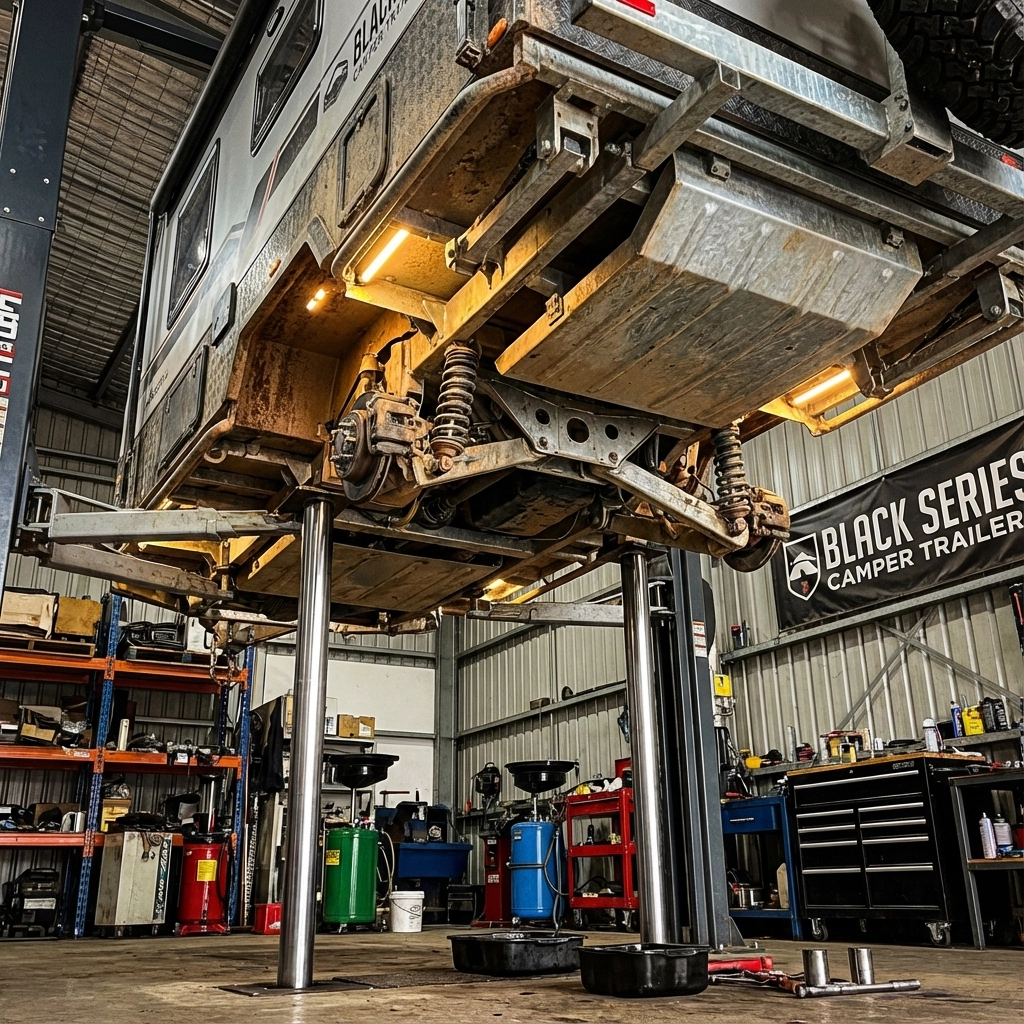
Common failure points include wheel bearing overheating from sustained rough road vibration, tire sidewall damage from sharp rocks and debris, suspension bushing deterioration from constant articulation, and seal degradation allowing water intrusion into electrical and living spaces. Off-road trailers experience three to five times more vibration than highway-only units, requiring maintenance intervals that are 40-50% more frequent than standard RV recommendations.
The financial impact extends beyond repair costs. Remote breakdowns often require expensive emergency towing services, lost camping time, and potential safety risks when stranded in areas with limited cell coverage or extreme weather conditions.
Off Road Trailer Maintenance Schedule (At a Glance)
This schedule integrates standard RV maintenance with off-road specific requirements. High-use overlanders should consider shortening intervals by 25% during active seasons, while occasional users can extend some intervals but should never skip pre-trip safety checks.
Pre-Trip Off Road Travel Trailer Maintenance Checklist
Hitch & Safety Systems
Inspect the hitch coupler for proper engagement and lubricate moving parts with marine-grade grease. Check safety chains for stretched links, worn connection points, and proper crossing under the tongue. Test breakaway switch activation and verify the breakaway battery maintains full charge. Your off road trailer maintenance checklist should always start with these critical safety connections that prevent catastrophic separation during challenging terrain navigation.
Tires & Wheels
Check tire pressure when cold, including the spare tire, and inflate to manufacturer specifications found on the tire sidewall. Inspect for sidewall cuts, embedded stones, unusual wear patterns, and tread depth using the penny test. Verify lug nut torque with a torque wrench, as off-road vibration commonly loosens wheel fasteners. Look for signs of bearing issues such as wheel wobble, grinding sounds, or heat buildup after short test drives.

Brake & Electrical Systems
Test trailer brakes by applying the manual brake controller while stationary to ensure proper engagement. Check all exterior lights including turn signals, brake lights, and clearance lights for proper function. Inspect wiring connections for corrosion, loose connections, or damage from road debris. Clean battery terminals and verify proper voltage in both the tow vehicle and trailer electrical systems.
Suspension Quick Check
Examine independent suspension components for obvious damage, leaking shock absorbers, and worn bushings. Listen for unusual noises during hitching and unhitching that might indicate loose fasteners or worn components. Check that suspension travel appears even on both sides and that no components contact the frame during compression.
After-Trip Checks for Rough Terrain
Post-trip maintenance becomes crucial after encountering challenging terrain that subjects your trailer to extreme conditions. Begin with a thorough undercarriage wash using high-pressure water to remove accumulated mud, sand, and debris that can trap moisture and accelerate corrosion. Pay special attention to suspension mounting points, brake components, and electrical connections.
Re-torque critical fasteners including lug nuts, hitch bolts, and suspension mounting hardware. Western U.S. washboard roads create sustained vibration frequencies that systematically loosen threaded connections, making this step essential for safety. Use a torque wrench rather than impact tools to ensure proper specifications.
Inspect for dust or water intrusion around door seals, electrical panel covers, and storage compartments. Check tire alignment by observing tracking behavior during your next short drive, as rough terrain can shift suspension geometry and cause premature tire wear.
Document any new damage with photos and notes to track deterioration patterns and plan future repairs before they become critical failures.
Seasonal & Annual Maintenance (Deep Service)
Seasonal Maintenance (Spring & Fall)
Roof and seal inspection represents the most critical seasonal task for off-road trailers. Remove all debris from roof surfaces and inspect every seal, paying special attention to areas around vents, antennas, and air conditioning units. Apply fresh lap sealant to any areas showing cracking or separation, as thermal cycling and vibration accelerate seal deterioration.
Water system maintenance includes sanitizing fresh water tanks with bleach solution, flushing all lines, and testing pressure pump operation. Clean or replace water filtration elements and inspect for leaks in plumbing connections that may have developed from road vibration.
HVAC system service involves cleaning or replacing air filters, testing propane system operation, and inspecting furnace and air conditioner components for proper function and electrical connections.
Annual/12,000 Mile Service
Wheel bearing service requires complete disassembly, cleaning, inspection, and repacking with fresh grease. This interval may need shortening for trailers frequently operated in sandy or wet conditions where contamination accelerates bearing wear.
Complete suspension inspection includes checking shock absorber operation, bushing condition, and all mounting hardware torque specifications. Independent suspension systems require more frequent attention to articulating joints and bushings compared to solid axle designs.
Battery and solar system testing involves load testing batteries, cleaning connections, and verifying solar panel output matches specifications. Off-grid capable trailers depend heavily on these systems for extended boondocking success.
Black Series-Specific Maintenance Tips
Black Series trailers feature unique construction elements requiring specific maintenance approaches. The hot-dipped galvanized chassis provides superior corrosion resistance but requires avoiding harsh chemicals during cleaning that might compromise the coating. Use mild detergents and avoid power-washing at close range around chassis welds and connections.
Water system maintenance follows standard RV practices but pay special attention to the robust plumbing designed for off-road use. The reinforced lines and secure fittings require periodic inspection for vibration-induced loosening, particularly around quick-disconnect fittings and pump connections.
The independent suspension system delivers superior off-road performance but requires regular inspection of bushings, shock absorbers, and mounting points. Lubricate grease fittings every 5,000 miles or after particularly dusty conditions to maintain optimal performance and component life.
For trailers equipped with the signature Black Series outdoor kitchen, ensure proper operation of slides, latches, and seals that protect internal components from weather and road debris during travel.
Glossary – Off Road Trailer Maintenance Terms
Independent Suspension: Suspension system where each wheel moves independently, providing better ground contact and ride quality compared to solid axle systems, but requiring more complex maintenance of multiple pivot points and bushings.
Trailing Arm: Suspension component that connects the wheel hub to the trailer frame, allowing controlled wheel movement while maintaining proper alignment geometry.
Wheel Bearing Repack: Complete disassembly, cleaning, inspection, and reassembly of wheel bearings with fresh grease to prevent overheating and premature failure.
Breakaway Switch: Safety device that automatically applies trailer brakes if the trailer becomes separated from the tow vehicle, powered by an independent battery system.
GVWR/Tongue Weight: Gross Vehicle Weight Rating represents maximum safe loaded weight, while tongue weight refers to downward force the trailer tongue applies to the hitch ball, typically 10-15% of total trailer weight.
Lap Sealant: Flexible sealant compound used to waterproof joints and seams on RV exteriors, requiring periodic renewal due to UV degradation and thermal cycling.
FAQ – Off Road Trailer Maintenance
How often should I service wheel bearings on an off-road trailer?
Wheel bearings should be repacked annually or every 12,000 miles under normal conditions, but off-road use in sandy, dusty, or wet environments may require service every 8,000-10,000 miles to prevent contamination-related failures.
What’s the most important pre-trip check for off-road travel trailers?
Tire pressure and condition represent the most critical pre-trip check, as tire failures in remote locations create serious safety and recovery challenges. Always check pressure when cold and inspect sidewalls for cuts or embedded debris.
Do independent suspensions need special maintenance?
Independent suspensions require more frequent inspection of bushings, pivot points, and shock absorbers compared to solid axles due to increased articulation and component complexity, but they provide superior off-road performance when properly maintained.
How do I prevent leaks on rough U.S. roads?
Inspect roof and door seals quarterly, re-seal any cracked areas immediately, and avoid over-tightening fasteners that can compress seals excessively. Quality lap sealant applied in thin, even coats provides the best long-term protection.
What maintenance is unique to boondocking and off-grid use?
Off-grid camping requires additional attention to battery health, solar panel cleanliness, water system sanitization, and waste tank valve operation since these systems receive heavy use without access to external utilities for backup.
Are Black Series trailers hard to maintain?
Black Series trailers follow standard RV maintenance principles but their rugged construction and off-road focus require adherence to more frequent inspection schedules and higher-grade components to maintain their premium performance capabilities.

