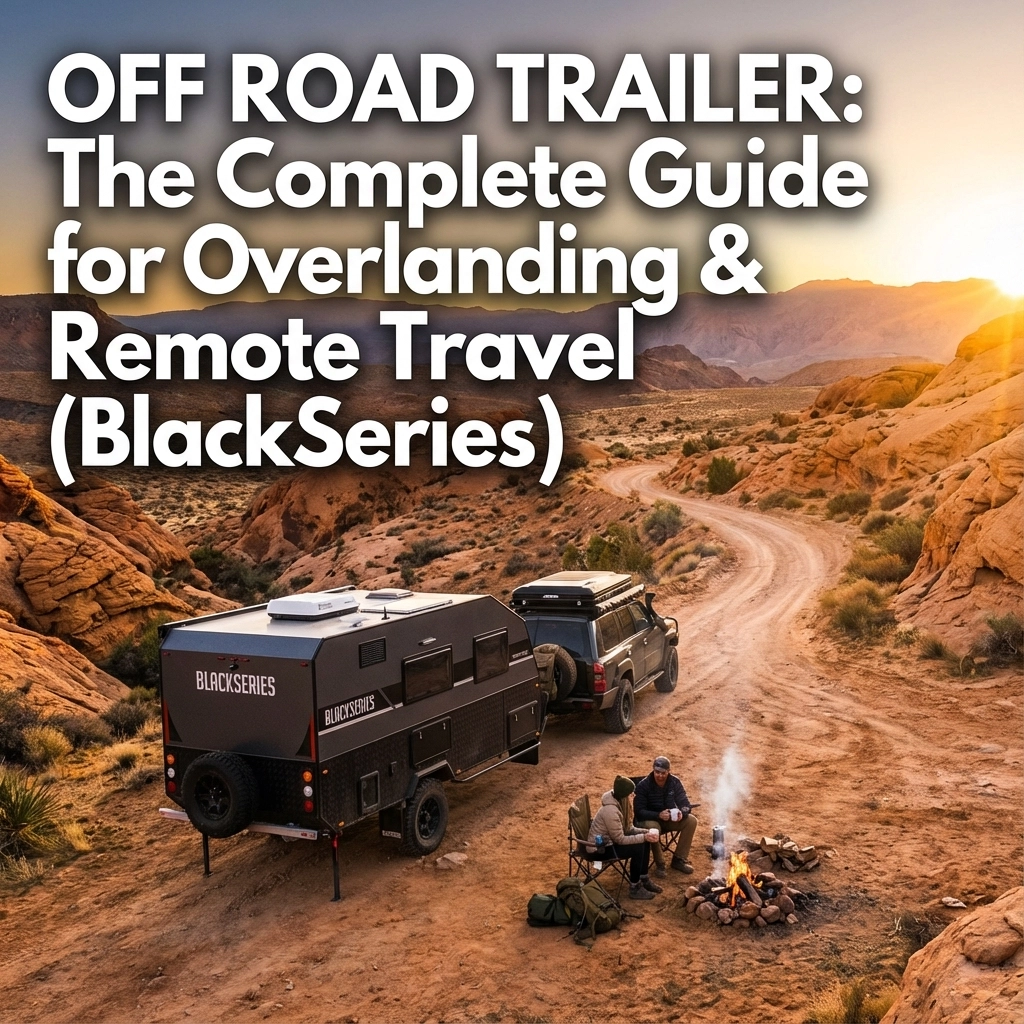
An off road trailer is designed for rugged terrain and remote travel, featuring reinforced chassis, high-clearance suspension, and systems built for off-grid use: unlike standard utility or travel trailers.
What Is an Off Road Trailer?
An off road trailer represents a fundamental departure from conventional travel trailers in both construction and capability. Where standard trailers prioritize lightweight towing and campground comfort, off road trailers are engineered for challenging terrain, extended off-grid periods, and self-sufficient remote camping.
The key distinction lies in structural design. Standard utility trailers typically feature basic leaf spring suspension and minimal ground clearance: adequate for highway transport but vulnerable on washboard roads, rocky terrain, or sandy conditions. Off road trailers incorporate independent suspension systems, reinforced chassis construction, and specialized components designed to withstand the stresses of remote travel.
“Off-road capable” versus “overland-ready” represents an important technical distinction. Off-road capable indicates the mechanical ability to traverse rough terrain: adequate suspension travel, ground clearance, and tire selection. Overland-ready encompasses off-road capability plus the systems integration required for extended remote travel: substantial electrical capacity, water management, temperature regulation, and equipment storage.
At BlackSeries, we believe true off road capability comes from structural engineering rather than cosmetic modifications. A trailer that merely adds aggressive tires and exterior accessories to a standard frame lacks the fundamental design elements required for reliable remote travel.

Why Off Road Trailers Are Popular in the U.S.
The surge in overland trailer popularity reflects broader changes in American outdoor recreation. Public lands managed by the Bureau of Land Management (BLM) and U.S. Forest Service encompass over 400 million acres, much accessible only via non-paved roads. These areas offer dispersed camping opportunities: free, unrestricted camping that appeals to travelers seeking authentic wilderness experiences.
Unlike traditional RV parks with full hookups, dispersed camping requires self-sufficiency. Standard travel trailers lack the electrical capacity, water storage, and structural durability for extended off-grid periods. This gap has driven demand for purpose-built solutions.
Compared to van life alternatives, off road trailers offer superior living space and amenities while maintaining the versatility of a separate tow vehicle for daily transportation. Unlike truck campers, they don’t compromise tow vehicle functionality or require specialized mounting systems.
The 2025 dispersed camping guide details specific regulations and access requirements for public lands throughout the western United States.
Key Features of an Off Road Trailer
Suspension & Chassis Design
Reinforced chassis construction forms the foundation of off road capability. Quality manufacturers utilize fully welded steel or aluminum construction rather than bolted assemblies, eliminating flex points that create stress concentrations and potential failure modes.
Independent suspension systems provide dramatic advantages over traditional leaf springs or torsion axles. Independent coil-over setups offer 8-12 inches of suspension travel, allowing wheels to articulate over obstacles while maintaining tire contact. This configuration reduces component stress, improves ride quality, and enables fine-tuning for different load conditions.
Ground clearance and angles determine terrain capability. Minimum specifications include 12+ inches ground clearance, 35+ degree approach angles, and 30+ degree departure angles. These measurements enable traversal of technical terrain, creek crossings, and steep grades impossible for standard trailers.
Wheels, Tires & Recovery
All-terrain tire selection balances on-road stability with off-road traction. Load ratings must match trailer GVWR requirements: understated tires create safety hazards and premature wear. Tire size affects final drive ratios and ground clearance, requiring careful integration with suspension geometry.
Full-size spare tires eliminate limitations imposed by temporary “donut” spares common on standard trailers. Remote travel demands the ability to continue after tire damage, potentially hundreds of miles from services.
Recovery points and towing stability become critical in challenging conditions. Integrated recovery points enable vehicle-assisted extraction from sand, mud, or rocky terrain. Anti-sway systems and electric brake controllers provide essential stability control during emergency situations or adverse weather.
Power, Water & Off-Grid Capability
Solar and battery systems determine off-grid duration and comfort level. Modern lithium battery banks with 200-400 amp-hour capacity paired with 400+ watts solar generation enable extended periods without generator dependence. Properly designed systems include battery monitoring, inverter capacity, and shore power integration.
Water management systems encompass both capacity and quality considerations. Fifty-gallon freshwater capacity supports 4-5 days conservative usage for two people. Gray water tank capacity and black water considerations (where applicable) affect campsite selection and waste management requirements.
Climate control capability extends usable seasons and geographic range. All-season insulation, efficient heating systems, and adequate electrical capacity for cooling enable year-round operation in extreme temperature variations: from summer desert conditions to alpine winter camping.
How-to: Choose the Right Off Road Trailer
Step 1 – Define Your Terrain & Travel Style
Terrain assessment drives all subsequent decisions. Forest Service roads with washboard surfaces require different capabilities than rocky mountain passes or soft sand conditions. Honest evaluation of intended use prevents both over-specification and inadequate capability.
Travel duration affects system requirements. Weekend adventures demand less electrical capacity and water storage than month-long remote expeditions. Full-time overlanding requires residential-quality amenities and substantial storage capacity.
Step 2 – Match Trailer Weight to Tow Vehicle
Towing capacity represents absolute limits that cannot be exceeded safely. Payload capacity, tongue weight ratings, and brake system adequacy require careful calculation. Altitude conditions, mountain grades, and ambient temperatures all affect towing performance.
Wheelbase and stability considerations become critical for off-road conditions. Shorter wheelbases provide better departure angles but less stability in crosswinds. Longer units offer more interior space but require wider turning radii and limit technical terrain access.
Step 3 – Decide on Layout & Payload
Interior configuration balances living space with storage requirements. Dinette layouts maximize sleeping capacity while galley configurations prioritize food preparation. Fixed bed designs offer comfort advantages but reduce flexibility.
Payload allocation between water, food, equipment, and personal items requires realistic planning. Published payload specifications assume empty water tanks and minimal options: actual usable payload proves substantially less than marketing materials suggest.
Off Road Trailer Buying Checklist
Frame and weld quality: Inspect welds for consistency, penetration, and finish quality. Avoid trailers with bolt-together construction or visible gaps in structural joints.
Suspension travel and articulation: Test suspension compression and rebound. Independent systems should articulate smoothly without binding or interference.
Departure and breakover angles: Measure actual clearances rather than relying on specifications. Spare tire placement, tank locations, and exhaust routing affect real-world capability.
Electrical and solar capacity: Verify actual amp-hour ratings and solar generation capacity. Test battery monitoring systems and inverter operation under load conditions.
Water tank placement and protection: Ensure tanks are positioned above axle centerline and protected from road debris. Verify freeze protection and drainage systems.
Weight distribution: Confirm actual tongue weight falls within 10-15% of total trailer weight. Improper distribution creates dangerous handling characteristics.
Best Applications: When an Off Road Trailer Makes Sense
Long-distance overlanding expeditions benefit from the combination of off-road capability and self-sufficient systems. Multi-week journeys through remote regions require reliable mechanical systems and substantial storage capacity.
Remote desert and mountain camping demands the electrical autonomy and water capacity that off road trailers provide. Standard RVs lack the ground clearance and structural durability for technical access roads.
Couples and solo explorers find off road trailers optimal for balancing comfort with capability. Unlike larger Class A motorhomes, these units access remote locations while providing genuine living amenities.
Not ideal applications include traditional RV park use with full hookups. The additional cost and complexity of off-road systems provide no advantage in developed campgrounds. Families requiring multiple sleeping areas may find space limitations restrictive compared to larger conventional RVs.
Real-World Scenarios
BLM land extended camping: Nevada and Utah BLM areas often require 5-10 miles of gravel road access. Washboard surfaces and scattered rock create constant vibration and impact loads that exceed standard trailer capabilities. Successful expeditions demand reliable suspension systems and robust construction.
Mountain access roads: Colorado Forest Service roads frequently include steep grades, tight switchbacks, and exposed rock. Ground clearance becomes critical, while departure angles determine navigability. Emergency egress may require backing substantial distances on narrow shelves.
Cross-country expedition routes: Multi-state journeys encounter diverse conditions: desert heat, mountain cold, coastal humidity, and altitude variations. System redundancy and all-weather capability prove essential when services are unavailable for extended periods.
Each scenario emphasizes reliability over maximum capability. Remote locations offer limited repair resources, making conservative design and proven components more valuable than cutting-edge features.
FAQ – Off Road Trailer
What makes a trailer truly off road?
True off-road capability requires independent suspension with adequate travel, reinforced chassis construction, appropriate ground clearance, and systems designed for off-grid operation. Cosmetic modifications to standard trailers don’t provide genuine capability.
Are off road trailers worth the cost?
For travelers who regularly access remote areas and require extended off-grid capability, specialized construction justifies additional investment. Traditional campground users find little advantage in off-road features.
Can an SUV tow an off road trailer?
Most mid-size and full-size SUVs can tow off road trailers within their rated capacity. Critical factors include adequate payload for tongue weight, appropriate brake controllers, and cooling system capacity for mountain grades.
How heavy is a typical off road trailer?
Off road trailers typically range from 3,500-7,000+ pounds depending on size and features. Reinforced construction and specialized components add weight compared to standard trailers, requiring careful tow vehicle matching.
What maintenance do off road trailers require?
Off road use demands more frequent inspection and maintenance than highway-only operation. Suspension components, bearings, brakes, and structural joints require regular attention. Electrical systems and water components need protection from dust and vibration.
The decision to invest in an off road trailer should align with genuine use requirements rather than aspirational thinking. Quality construction, proven systems, and conservative design provide the reliability essential for successful remote travel experiences.

