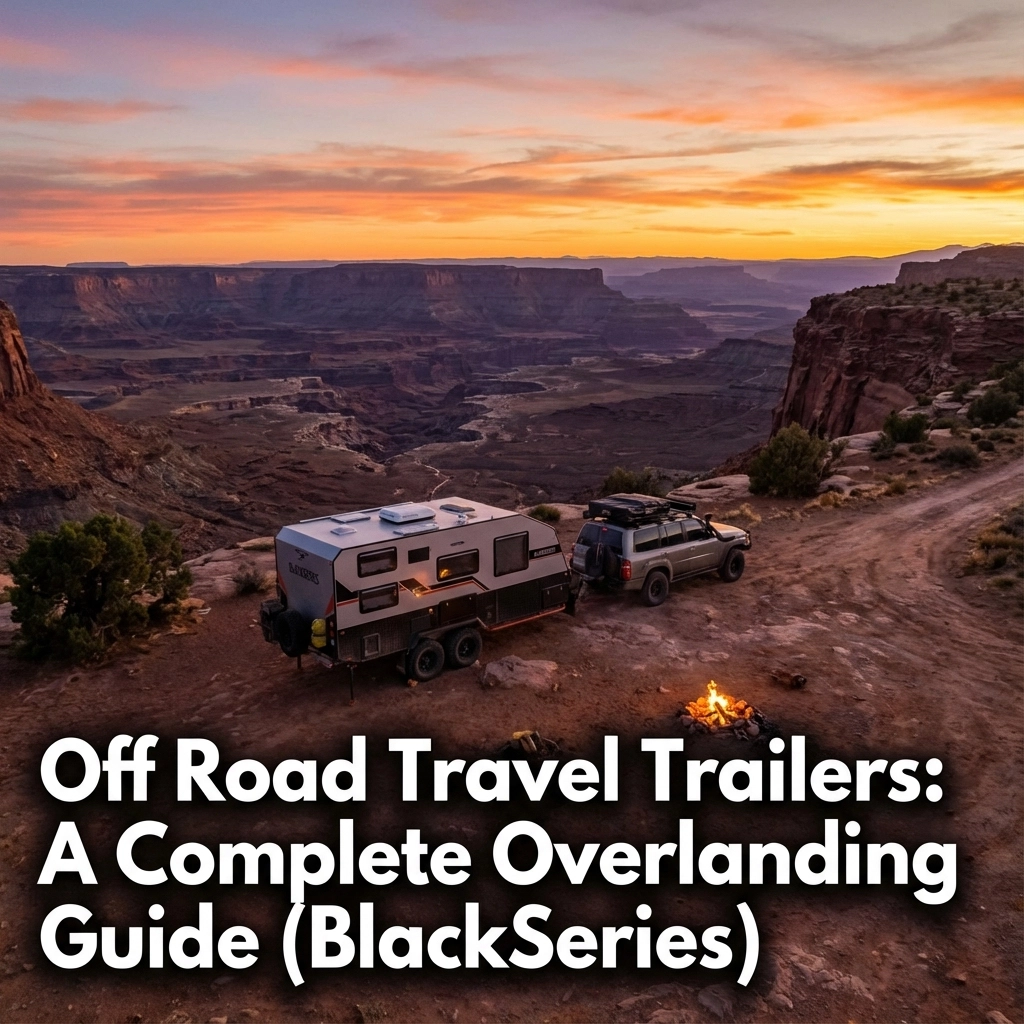
Off road travel trailers are built for rough terrain, remote travel, and self-sufficient camping. They differ from standard RVs in suspension, chassis strength, clearance, and power systems designed for overlanding adventures.
What Are Off Road Travel Trailers?
Off road travel trailers represent a specialized category of recreational vehicles engineered for terrain that would challenge or damage conventional RVs. Unlike standard travel trailers designed for campgrounds and paved roads, these units feature reinforced construction, enhanced ground clearance, and robust suspension systems.
The distinction between “off-road” and “overland-ready” is crucial for buyers. True off-road capability means the trailer can handle technical terrain like rocky trails, steep grades, and uneven surfaces. Overland-ready trailers focus more on extended self-sufficiency and remote camping comfort.
At BlackSeries, our philosophy centers on this principle: genuine off-road ability comes from structural engineering, not cosmetic upgrades. Chrome bumpers and rugged styling don’t replace properly engineered chassis, suspension geometry, or weight distribution.

Why Off Road Travel Trailers Are Popular in the U.S.
The American overlanding movement has exploded due to vast public land access and changing outdoor recreation preferences. With over 640 million acres of public land managed by agencies like the Bureau of Land Management (BLM) and U.S. Forest Service, adventurers can access remote locations requiring capable equipment.
Dispersed camping on public lands offers free camping with minimal restrictions, driving demand for self-sufficient trailers. Unlike developed campgrounds, these locations lack hookups, requiring robust off-grid systems and the ability to access remote sites via unmaintained roads.
Compared to van life conversions, off road travel trailers provide more living space and comfort while maintaining the tow vehicle for daily use. Unlike truck campers, trailers offer better weight distribution and don’t compromise the truck’s payload capacity when unhitched.
For families and couples seeking authentic outdoor experiences, off road trailers bridge the gap between tent camping and resort-style RVing.
Key Features of Off Road Travel Trailers
Chassis & Suspension
The foundation of any capable off road trailer is its chassis construction and suspension system. Standard RV chassis use lightweight materials adequate for highway travel but insufficient for repeated off-road stress.
Quality off road trailers feature hot-dipped galvanized steel chassis with reinforced mounting points and strategic cross-bracing. This construction withstands the torsional forces encountered on uneven terrain without developing stress cracks.
Independent suspension systems dramatically outperform traditional leaf springs or torsion axles. BlackSeries trailers utilize dual-wishbone independent suspension with remote-reservoir shocks, providing 8+ inches of travel while maintaining stability on extreme slopes.
Ground Clearance & Approach Angles
Minimum ground clearance should exceed 12 inches, with premium trailers offering 15+ inches. This clearance prevents high-centering on rocks, logs, or uneven surfaces common on forest roads and desert washes.
Approach, departure, and breakover angles determine the trailer’s ability to navigate obstacles. Look for angles exceeding 30 degrees to handle steep entries, exits, and crests without contact.
Wheels, Tires & Recovery
All-terrain or mud-terrain tires on 16-inch or larger wheels provide better puncture resistance and lower air pressures for improved traction. Full-size spare tires are essential, donut spares are inadequate for remote locations.
Many quality trailers include recovery points and mounting for auxiliary equipment like hi-lift jacks, shovels, and traction aids.
Power, Water & Self-Sufficiency
Electrical systems in off road trailers must support extended off-grid periods. Look for minimum 300 amp-hour lithium battery capacity with 400+ watts of solar panels. Quality units include inverters, battery monitors, and shore power integration.
Water systems require secure mounting to prevent damage during travel. Fresh water capacity should exceed 20 gallons for weekend trips, with gray water storage to minimize environmental impact.
How-to: Choose the Right Off Road Travel Trailer
Step 1 – Define Your Terrain
Forest roads require different capabilities than desert washes or mountain passes. Categorize your intended routes by difficulty:
- Maintained dirt roads: Basic ground clearance and all-terrain tires suffice
- Rocky trails: Enhanced clearance and skid protection required
- Technical terrain: Independent suspension and specialized equipment necessary
Step 2 – Match Tow Vehicle & Trailer
Your vehicle’s towing capacity includes the trailer’s loaded weight plus gear, water, and supplies. Leave 20% margin for safety and maintain proper tongue weight (10-15% of total trailer weight).
Consider your vehicle’s wheelbase and stability characteristics. Shorter wheelbases require more attention to trailer length and weight distribution to prevent instability.
Step 3 – Decide on Layout & Use Case
Weekend explorers prioritize simplicity and reliability over luxury features. Essential systems include basic electrical, water storage, and sleeping accommodations.
Extended overlanders need comprehensive off-grid capabilities including cooking facilities, waste management, and comfort features for longer stays.
Off Road Travel Trailer Buying Checklist
When evaluating potential purchases, systematically inspect these critical areas:
Frame & Weld Quality: Look for continuous welds, proper penetration, and absence of grinding marks indicating repairs
Suspension Travel: Verify actual suspension movement matches specifications and check for quality components
Departure/Breakover Angles: Measure actual angles rather than relying on marketing materials
Electrical Capacity: Confirm battery amp-hours, solar wattage, and inverter capacity meet your needs
Water Tank Placement: Ensure tanks are protected and properly secured for off-road travel
Weight Distribution: Verify proper tongue weight and overall balance when loaded
Build Materials: Aluminum construction resists corrosion better than steel, while avoiding wood frame construction prevents rot and delamination
Best X: When an Off Road Travel Trailer Makes Sense
Best for long-distance overlanding: Trailers excel for multi-state adventures where comfort and gear capacity matter more than ultimate maneuverability.
Best for remote desert camping: Large water capacity and solar systems support extended boondocking in arid climates where resupply is impossible.
Best for couples and solo explorers: Compact layouts provide essential amenities without excess space or weight.
Not suitable for: RV park travelers seeking full hookups, urban camping, or extremely technical single-track trails requiring maximum maneuverability.
Real-World Scenarios
Scenario 1: BLM Land + Long-Term Off-Grid Camping
Extended stays on public lands require substantial water storage (40+ gallons), large battery banks (400+ amp-hours), and robust solar charging. BlackSeries dispersed camping guide provides comprehensive preparation strategies.
Focus on redundant systems for critical functions like water purification and battery charging. Plan resupply routes and emergency communication protocols.
Scenario 2: Mountain Terrain + Rocky Forest Roads
Steep grades and loose surfaces demand independent suspension and proper weight distribution. Low-range gearing in the tow vehicle becomes essential for controlled descents.
Inspect the trailer’s skid protection and recovery points before venturing into technical terrain. Carry appropriate recovery gear including straps, blocks, and communication devices.
Scenario 3: Multi-State Cross-Country Routes
Long highway stretches require excellent aerodynamics and stability to minimize fuel consumption and driver fatigue. BlackSeries trailers’ optimized profiles typically increase fuel consumption only 15-20% compared to unladen vehicles.
Plan maintenance intervals and identify service locations along your route. Carry essential spare parts and tools for roadside repairs.
FAQ – Off Road Travel Trailers
Are off road travel trailers worth it?
Yes, if you regularly venture beyond developed campgrounds. The enhanced durability, ground clearance, and off-grid capabilities justify the price premium for serious overlanders. Standard RVs risk damage and limit accessible destinations.
Can any SUV tow an off road travel trailer?
Not all SUVs have adequate towing capacity or cooling systems for off-road trailers. Verify your vehicle’s tow rating, tongue weight capacity, and cooling system adequacy. Mid-size trucks like the Toyota Tacoma can handle compact trailers (under 3,500 lbs), while larger trailers require full-size vehicles.
What is the difference between off road and overland trailers?
Off-road trailers prioritize mechanical capability, suspension, clearance, and durability for challenging terrain. Overland trailers emphasize extended self-sufficiency with larger water/power systems and comfort features for remote camping.
How heavy are off road travel trailers?
Compact models range from 2,900-4,500 lbs dry weight, while full-size units can exceed 7,000 lbs loaded. Add 1,000-1,500 lbs for water, gear, and supplies when calculating total towing requirements.
Do off road trailers require special maintenance?
Yes, off-road use accelerates wear on suspension components, wheel bearings, and electrical connections. Inspect and service these systems more frequently than standard RV maintenance schedules recommend. Quality construction like BlackSeries’ welded aluminum frames reduces long-term maintenance compared to wood-framed alternatives.

