
Your cart (0)
Your cart is empty
Tax included and shipping calculated at checkout
Your cart is empty
Tax included and shipping calculated at checkout

Propane is the unsung hero of the off-grid lifestyle. It keeps your coffee hot at sunrise, your shower steamy after a dusty trail ride, and your cabin cozy when the temperature drops. For new BlackSeries owners heading out on their first adventure, propane powers everything from your stove to your heater: making it one of the most important systems to understand before you hit the road.
But here’s the thing: propane is incredibly safe when handled correctly, but it demands respect. In the compact environment of an off-road travel trailer, a small oversight can escalate quickly. We’re not trying to scare you: we’re preparing you. Think of this guide as your propane onboarding session, designed to give you confidence and keep your family safe for years of rugged exploration.
Whether you’re towing a nimble 16 ft camper weight rig for solo weekend escapes or a fully-loaded 30 foot rv weight home-on-wheels for extended family trips, the fundamentals of propane safety remain the same. Let’s break it down.
In a traditional home, a gas leak means you open a window and call the utility company. In a travel trailer, especially one parked deep in the backcountry, you’re your own first responder. The compact design of RVs means that propane vapor can concentrate faster, and ventilation may be limited if windows are closed during cold weather.
According to propane safety experts, three primary hazards exist: frost burns from direct contact with liquid propane, fire or explosion from concentrated vapor, and carbon monoxide poisoning from improper appliance use or blocked ventilation. All three are preventable with proper knowledge and routine maintenance.
Here’s the good news: BlackSeries trailers are engineered with safety in mind. Our ruggedized propane mounting systems are designed to withstand the constant vibration and jarring that comes with off-road travel: vibrations that can loosen fittings on standard RVs. High-grade propane lines and DOT-approved components come standard, giving you a solid foundation to build your safety habits on.
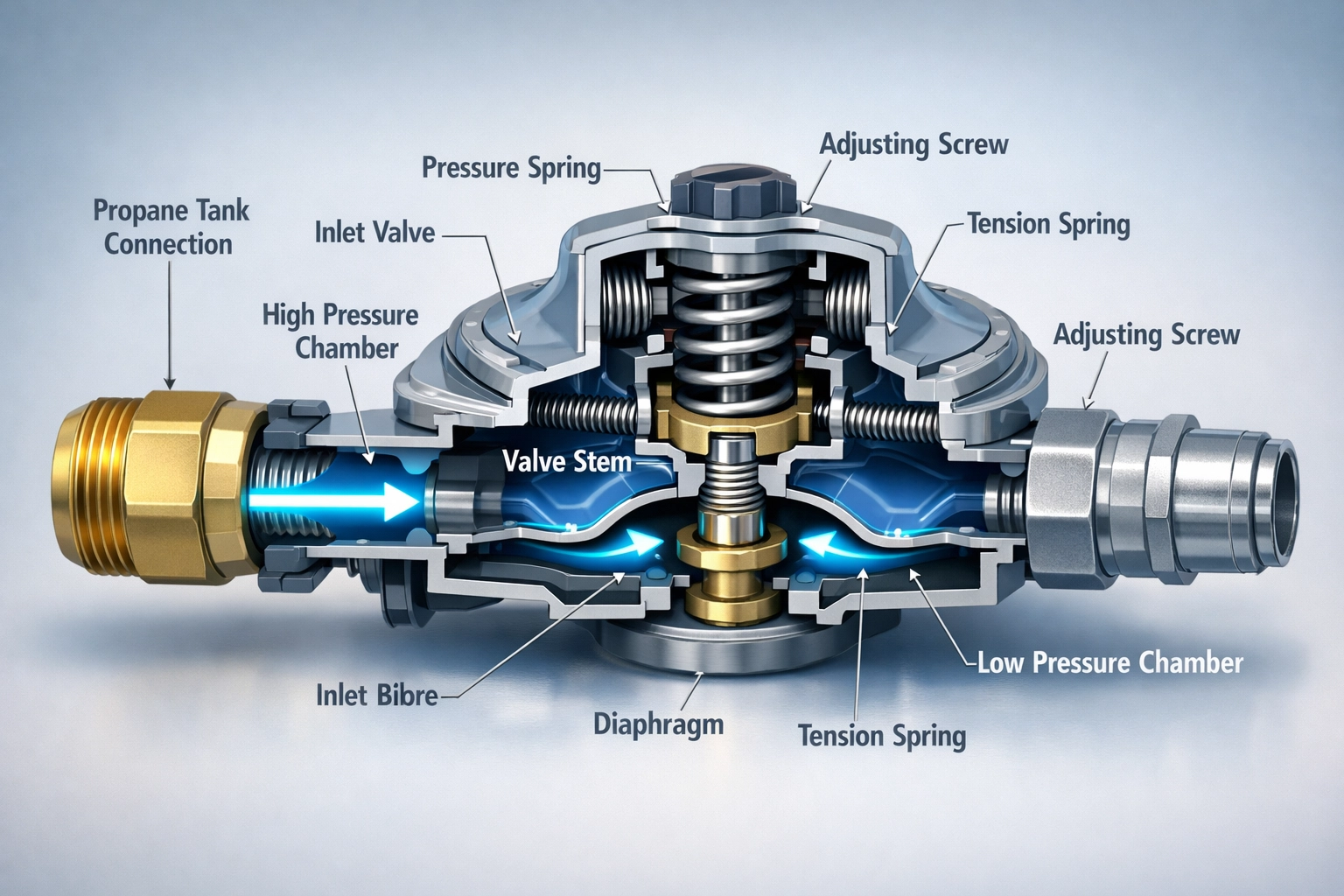
Before we dive into safety tips, let’s talk about what you’re actually working with. Your BlackSeries trailer includes several key propane components:
Most off-road travel trailers run on either one or two 20-pound or 30-pound cylinders mounted externally. A full 20-pound tank weighs approximately 37 pounds total (the cylinder itself weighs about 17 pounds empty). This matters when calculating your average travel trailer weights for towing: especially if you’re running dual tanks and packing heavy for an extended trip.
For context, a 24 ft camper weight might range from 3,500 to 5,000 pounds dry, and adding two full propane tanks, water, gear, and provisions can push you into a different payload category. Always account for consumables when calculating your tow vehicle’s capacity.
This device controls propane pressure as it flows from the tank to your appliances. It’s a critical safety component: without it, you’d have dangerously high pressure entering your trailer. Regulators can freeze in extremely cold conditions (not the propane itself, but moisture in the regulator), which is why winter campers should insulate or heat-wrap their regulators.
From the regulator, propane travels through flexible lines to appliances like your stove, water heater, and furnace. These connections are sealed with fittings that must remain tight and leak-free.
Your BlackSeries trailer comes equipped with propane-powered appliances engineered for mobile use. Unlike home appliances, these are built to handle movement, vibration, and varying altitudes. They also include safety shutoffs and proper venting systems.
Understanding this flow: from tank, through regulator, via lines, to appliances: helps you visualize where problems can occur and where to focus your inspections.
Let’s get practical. These five rules will keep you safe whether you’re towing an 18 ft camper weight setup or a 30 ft rv weight luxury off-grid command center.
This is your first line of defense. Mix a 50/50 solution of dish soap and water in a spray bottle. Before your first trip and then monthly thereafter, spray every connection point: where the tank connects to the regulator, where lines meet fittings, and where appliances connect to the gas supply.
Turn on your propane supply and watch for bubbles. Even small bubbles indicate escaping gas. If you see any, shut off the propane immediately and tighten the connection. Retest. If bubbles persist, the fitting may be damaged and needs replacement by a qualified technician.
Never use matches or lighters to test for leaks. This should go without saying, but people still do it. Don’t be that person.
This one is non-negotiable. Propane tanks must always be stored upright and in well-ventilated areas. BlackSeries trailers feature external propane compartments with proper ventilation: use them. Never store spare propane cylinders inside your trailer, in your tow vehicle, or in any enclosed compartment like a garage or shed.
Why? Propane vapor is heavier than air, meaning it sinks and pools at ground level. In an enclosed space, even a small leak can create a dangerous concentration of flammable gas. Outside, wind and natural air movement disperse any escaping vapor safely.
When transporting spare cylinders for extended trips, secure them upright in an external carrier or truck bed. Use proper tie-downs to prevent rolling or tipping during travel.
Your BlackSeries trailer likely came with propane and carbon monoxide detectors installed. These are separate devices serving different purposes:
Test both detectors monthly using the test button. Replace batteries at the start of each camping season. Most detectors have a 5-7 year lifespan: check the manufacture date on the back and replace as needed.
Carbon monoxide is produced when propane burns without adequate oxygen. This can happen if vents are blocked, appliances are malfunctioning, or you’re running equipment in enclosed spaces. CO is colorless and odorless: your detector is your only warning system.

Right now, stop reading and go find your main propane shut-off valve. Physically touch it. Practice turning it off and on. Every adult and older child in your family should know exactly where it is and how to operate it.
In an emergency, you need to be able to shut off the gas supply in seconds, possibly in the dark, possibly while panicking. Make this a muscle-memory action. The valve is typically located on the tank itself: turn it clockwise to close.
Pro tip: When your RV is parked and unoccupied for more than a few hours, turn off the main valve. This prevents slow leaks from emptying your tank and reduces fire risk if something malfunctions while you’re away. When you return, turn it back on and let the system re-pressurize before lighting pilot lights.
Propane expands when heated. That’s why tanks are filled to only 80 percent capacity: the remaining 20 percent provides expansion room. When you refill at a certified propane station, the attendant knows this. If you’re refilling your own portable cylinders (which BlackSeries owners with detachable tanks might do), use a proper filling adapter with an automatic shut-off that stops at 80 percent.
Overfilled tanks can vent excess gas through the relief valve when temperatures rise. This creates a fire hazard and wastes propane. In extreme cases, overfilling can damage the tank itself.
Signs of overfilling include:
If you suspect overfilling, move the tank to a well-ventilated outdoor area away from ignition sources and let it stabilize. Don’t use it until the pressure normalizes.
Routine maintenance keeps your propane system running safely for years. Add these checks to your pre-trip and monthly maintenance schedule:
Walk around your propane compartment looking for:
BlackSeries mounts are built tough, but off-road travel is brutal. Check that mounting brackets remain tight and that rubber isolation grommets haven’t degraded.
If your appliances aren’t performing correctly: weak flame, uneven heating, pilot lights that won’t stay lit: the regulator might be failing. Regulators typically last 10-15 years but can fail sooner in harsh conditions.
Never attempt to adjust or repair a regulator yourself. This is a job for a certified RV technician. A malfunctioning regulator can allow too much pressure into your system, damaging appliances and creating safety hazards.
When temperatures drop below freezing, moisture in the propane system can freeze in the regulator, causing flow restrictions. This is especially common at higher elevations where temperatures fluctuate dramatically between day and night.
Solutions include:
Some BlackSeries owners also install tank blankets: insulated covers that maintain more consistent temperatures. Just ensure any heating method is approved for propane use and doesn’t block ventilation.
Once a year, have a certified RV technician perform a complete propane system inspection. They’ll pressure-test the entire system, check all connections, inspect appliances, and verify proper operation of safety devices. This typically costs $100-150 and is worth every penny for peace of mind.
Schedule this inspection during your annual pre-season maintenance along with wheel bearings, brakes, and other critical systems. Think of it as an insurance policy against mid-trip breakdowns in remote locations.

Propane has a distinctive smell: often described as rotten eggs or sulfur. This odorant is added intentionally because propane is naturally odorless. Even a faint gas smell signals a potential serious leak and demands immediate action.
If you smell gas:
Get every person and pet out of the trailer and move at least 50 feet away, upwind if possible. Don’t waste time investigating or gathering belongings. Just get out.
If you can safely reach the external propane compartment without entering the trailer, close the main valve on the tank(s). Turn clockwise until tight. If this requires entering the trailer or putting yourself in danger, skip this step and move to Step 3.
Do not:
All of these can create sparks that ignite propane vapor. Even static electricity from synthetic fabrics can be enough.
Walk to a safe distance (at least 100 feet away) and call:
Wait for emergency responders to arrive and declare the area safe. Do not re-enter the trailer or turn propane back on until a qualified technician has identified and repaired the leak.
Before using your propane system again, have it professionally inspected and pressure-tested. Even if you found and fixed an obvious loose connection, there could be additional issues that caused the leak in the first place.
Q: How often should I check my RV propane system for leaks?
Perform the soapy water test on all connections before each trip and then monthly during active use. Do a complete visual inspection of tanks, lines, and fittings at the same time. If you’re storing your trailer for an extended period, check everything when you bring it back into service.
Q: Can I refill my propane tanks myself, or should I always use a certified station?
For portable cylinders (like 20-pound BBQ tanks), you can refill them yourself if you have proper equipment, training, and an automatic shut-off adapter. However, most RVers prefer certified propane stations because they ensure proper fill levels, test for leaks, and inspect tanks for damage or expiration. Permanent-mount tanks require professional service.
Q: What should I do if my propane detector keeps going off but I don’t smell gas?
First, ensure the detector is working properly: test it using the test button. If it continues to alarm without obvious cause, it may be detecting another chemical like aerosol sprays, cooking fumes, or even certain cleaning products. Ventilate the trailer thoroughly. If alarms persist, turn off propane and have the system professionally inspected. False alarms can also indicate a failing detector that needs replacement.
Q: How long does a 20-pound propane tank last in an RV?
This varies wildly based on usage. If you’re running a furnace in winter while also cooking and heating water, a 20-pound tank might last 3-5 days. In moderate weather with minimal heating needs, the same tank could last 2-3 weeks. Most BlackSeries owners running dual tanks on extended trips plan for 1-2 weeks of propane supply depending on season and usage patterns.
Q: Are there specific propane safety features in BlackSeries trailers?
Yes. BlackSeries trailers feature ruggedized propane mounting systems designed to withstand extreme off-road vibration that could loosen fittings on standard trailers. We use high-grade propane lines rated for mobile use, DOT-approved cylinders, and properly vented external storage compartments. All propane appliances meet or exceed RV industry safety standards and include automatic shutoffs. Additionally, our slide-out outdoor kitchens move cooking activities outside, which reduces indoor propane combustion and improves overall safety.
Propane is an incredible technology that enables true off-grid freedom. With proper respect, routine maintenance, and smart safety habits, it’s also one of the safest fuel sources available. The key is making propane awareness a natural part of your camping routine: like checking tire pressure or testing your trailer lights.
For new BlackSeries owners, mastering your propane system is the first step toward confident, worry-free adventures. Whether you’re pulling a lightweight 16 ft camper weight setup for quick weekend escapes or a fully-equipped 30-foot camper weight rig for month-long expeditions, these safety fundamentals remain constant.
Remember: when in doubt, shut it off and call a professional. There’s no shame in asking for help when it comes to propane safety. The only bad question is the one you don’t ask.
Ready to dive deeper into your BlackSeries setup? Check out our blog for more owner resources, maintenance guides, and adventure stories from the BlackSeries community. And if you’re new to the family, welcome aboard: we’re excited to see where the road takes you.
Stay safe out there, and respect the gas. It’ll take care of you. 🔥🚐