A first-time travel trailer camping checklist includes trailer setup, towing safety, campsite essentials, power & water systems, kitchen gear, and emergency items. Whether you’re towing a compact 16 ft camper weight trailer or a full-size 30 foot rv weight rig, being prepared separates a great adventure from a “Why didn’t anyone tell me this?” disaster.
Why First-Time Travel Trailer Camping Is Different
Let’s get one thing straight: RV camping is not “tent camping with walls and a toilet.” It’s managing a mobile house on wheels, complete with plumbing, electrical systems, and enough moving parts to make a NASA engineer nervous.
The biggest mistake first-timers make? Treating their travel trailer like a tent on steroids. You can’t just park it anywhere, toss your gear inside, and call it a day. You need to level it, hook up utilities, manage weight distribution, and, here’s the kicker, actually know your average travel trailer weights before you even hitch up.
Common beginner mistakes include:
- Overpacking (your 24 ft camper weight has a limit, and your collection of “just in case” cast iron pans is pushing it)
- Poor setup (a tilted trailer = a fridge that doesn’t work and a night of rolling toward the low side)
- Ignoring weight limits (your truck may look tough, but physics doesn’t care about aesthetics)
This is why a checklist matters. It’s not about being obsessive, it’s about avoiding the kind of mistakes that turn your dream weekend into a roadside meltdown.
Pre-Trip Preparation Checklist (Before You Leave)
Trailer & Vehicle Setup
Before you even think about pulling out of your driveway, do this:
Hitch & Coupler Check: Your hitch should be properly rated for your trailer. A 30 ft camper weight rig needs serious towing capacity, confirm your truck can handle it. Lock the coupler, insert the pin, and double-check it’s secure.
Safety Chains & Breakaway Cable: Cross the safety chains under the tongue in an “X” pattern. Connect the breakaway cable to your tow vehicle (not the hitch ball). This cable triggers the trailer brakes if it ever detaches, trust me, you want this working.
Tire Pressure: Check both your tow vehicle and trailer tires. Under-inflated tires are a blowout waiting to happen, especially on a hot summer highway. Use the manufacturer’s recommended PSI, not what “feels right.”
Brake Controller Test: If your trailer has electric brakes (and it should), test the brake controller. Manually activate it to confirm your trailer brakes engage before you hit the road.
Documents & Planning
Campsite Reservations: Popular campgrounds book up months in advance, especially in 2026. Reserve your spot early, and confirm they can accommodate your 18 ft camper weight rig or larger.
RV Insurance & Registration: Keep your insurance card and registration documents in the trailer. Some states require separate trailer registration, check before you cross state lines.
Route Planning: Use RV-specific GPS apps or plan your route manually. Watch for low bridges, steep grades, and weight-restricted roads. A scenic mountain pass might look great on Google Maps, but your 30-foot camper weight trailer might not fit through the tunnel.
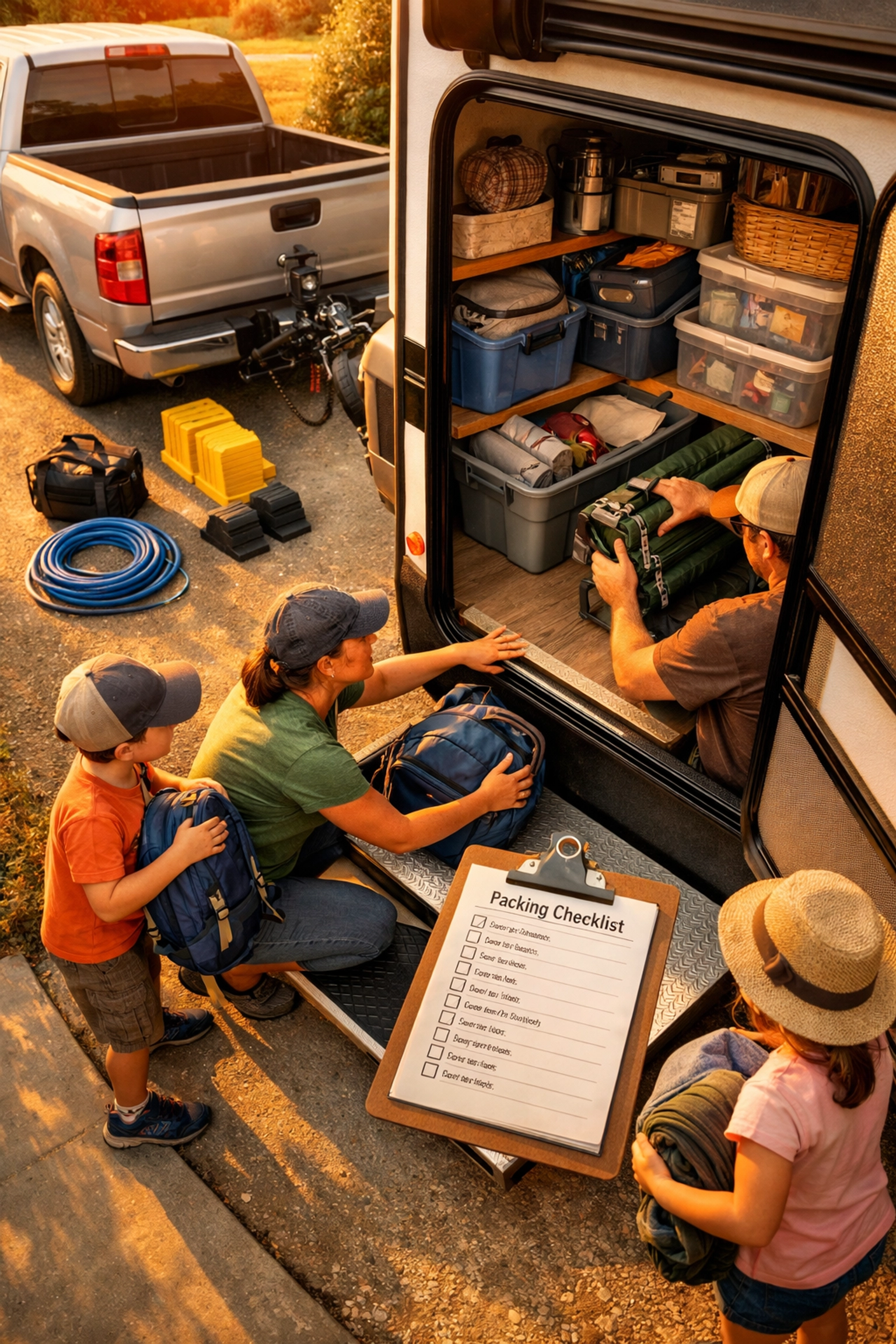
First Time Travel Trailer Camping Packing Checklist
Campsite Setup Essentials
These are the “you’ll regret forgetting these” items:
- Leveling Blocks: Your trailer must be level for the fridge to function properly. Stack these blocks under the low-side wheels until you’re bubble-level perfect.
- Wheel Chocks: Once you’re level, chock the wheels to prevent rolling. Yes, even if you’re on flat ground.
- Power Cord & Adapters: Most campgrounds offer 30-amp or 50-amp service. Bring adapters so you’re covered either way. A surge protector is non-negotiable: one power spike can fry your entire electrical system.
- Fresh Water Hose + Pressure Regulator: Use a drinking-water-safe hose (the white or blue ones, not your garden hose). The pressure regulator prevents campground water pressure from blowing out your plumbing.
- Sewer Hose Kit: You’ll need this for dumping black and gray water tanks. Get one with clear elbows so you can see when the tanks are empty (glamorous, right?).
Interior Living Essentials
- Bedding & Pillows: Most RVs don’t come with bedding. Bring sheets, blankets, and pillows sized for your RV mattress (which is often slightly smaller than standard home sizes).
- Storage Organizers: Space is premium in a travel trailer. Use collapsible bins, hanging organizers, and over-door hooks to maximize storage.
- Trash Bags & Paper Towels: You’ll go through these faster than you think. Bring extras.

Power, Water & Systems Checklist (Beginner-Friendly)
Electrical System
Shore Power vs. Battery Basics: When you plug into campground power (shore power), your trailer runs on AC electricity. When you’re off-grid, you’re running on 12V DC battery power. Know the difference: your microwave won’t work on battery alone.
Extension Cords Rated for RV Use: If you need extra reach, use heavy-duty RV-rated extension cords. Regular household extensions can overheat and cause fires.
Solar (If Equipped): If your BlackSeries trailer came with solar panels, you’re already ahead of the game. Solar keeps your batteries topped off during the day, giving you more off-grid freedom. Just make sure the panels aren’t shaded by trees.
Water System
Fill Fresh Water Tank: Before you leave home, fill your fresh water tank at least halfway. This gives you water for drinking, cooking, and washing, even if the campground doesn’t have hookups.
Test Water Pump: Turn on the water pump and open a faucet. You should hear the pump cycle on and off. If it runs continuously, you might have a leak.
Know Dump Valve Locations: Your trailer has separate valves for the black tank (toilet) and gray tank (sinks/shower). Know where they are and how to operate them before you arrive at the dump station. Pro tip: dump the black tank first, then the gray tank to flush the hose.
Kitchen & Food Checklist for First RV Trip
RV kitchens are compact, so forget the full cookware collection. Here’s what actually matters:
- RV-Safe Cookware: Lightweight pots and pans that won’t slide around while driving. Nesting cookware saves space.
- Collapsible Kitchen Tools: Collapsible colanders, cutting boards, and dish tubs maximize limited counter space.
- Pantry Basics: Salt, pepper, oil, coffee, and spices. You don’t want to buy a full spice rack at every campground store.
- Camp Table or Outdoor Cooking Option: Many BlackSeries trailers come with outdoor kitchens or slide-out prep areas. Use them: cooking outside keeps heat and smells out of your living space.
Even in a compact average weight of camper model, BlackSeries designs layouts for maximum efficiency. You’ll be surprised how functional a small kitchen can be when it’s thoughtfully designed.
Safety Checklist for First-Time Trailer Campers
Safety isn’t sexy, but it’s essential:
- Fire Extinguisher: Your trailer should have at least one, mounted near the exit. Know how to use it (Pull, Aim, Squeeze, Sweep).
- Carbon Monoxide Detector: CO is colorless and odorless. A detector can save your life. Test it before every trip.
- Propane Safety Check: Check for leaks by spraying soapy water on connections. If bubbles form, you’ve got a leak. Tighten or replace the connection.
- First-Aid Kit: Band-aids, antiseptic, pain relievers, and any prescription meds you need.
- Flashlights / Headlamps: Even if your campsite has lights, you’ll need a flashlight for late-night bathroom runs and emergency repairs.
Driving & Arrival Checklist
Before Driving
This is the “don’t be that guy who drives away with the awning out” section:
- Awning Retracted: Roll it up and secure it. A deployed awning at highway speeds is a recipe for disaster.
- Antenna Down: Satellite or TV antennas must be lowered. Forgetting this is an expensive mistake.
- Cabinets Secured: Latch all cabinets, drawers, and the fridge. Anything that can fly open will fly open on the first sharp turn.
At the Campsite
Level Trailer: Use leveling blocks and a bubble level. Get it right before you unhitch.
Connect Power & Water: Plug into shore power, hook up the water hose (with pressure regulator), and connect the sewer hose if you’re at a full-hookup site.
Slide-Out Check (If Applicable): If your trailer has slide-outs, make sure the area is clear before extending them. Check for rocks, tree roots, or anything that could damage the mechanism.
Beginner Mistakes to Avoid
Let’s talk about the mistakes nobody warns you about until it’s too late:
Overloading the Trailer: Just because it fits doesn’t mean you should bring it. Know your 30 ft rv weight limits, including cargo capacity. A scale check before you leave home can save you from a roadside inspection nightmare.
Forgetting to Level Before Fridge Use: RV fridges work on absorption cooling, which requires the trailer to be level. If you don’t level it, your fridge won’t cool, and your groceries will spoil.
Leaving the Awning Out Overnight: Wind can destroy an awning in minutes. Retract it before bed, even if the forecast looks calm.
Not Practicing Dumping Tanks: Your first time dumping tanks shouldn’t be at a crowded campground with a line of irritated campers behind you. Practice at home or at an RV dump station before your trip.
Why BlackSeries Is Ideal for First-Time Owners
Here’s the truth: not all travel trailers are beginner-friendly. Some manufacturers prioritize “cheap” over “functional,” leaving first-time owners frustrated and overwhelmed.
BlackSeries takes a different approach:
Off-Road Stability = Easier Towing Confidence: Our trailers are built with independent suspension and a low center of gravity, making them easier to tow and more stable on rough roads. Even if you’ve never towed before, you’ll feel the difference.
Pre-Installed Solar & Power Systems: No need to retrofit solar panels or upgrade your electrical system. BlackSeries trailers come ready for off-grid adventures, with solar power and efficient battery management built in.
Four-Season Insulation Reduces Setup Stress: Our trailers are designed for extreme conditions, from Arizona summers to Colorado winters. You won’t spend hours winterizing or worrying about temperature control: it’s handled.
Beginner-Friendly Layouts: We design for real people, not Instagram influencers. Our layouts prioritize functionality, storage, and ease of use. You’ll spend less time figuring out where things go and more time enjoying your trip.
Whether you’re towing a compact 16 ft camper weight model or a full-size 30-foot camper weight rig, BlackSeries builds trailers that make your first trip easier: and every trip after that even better. Learn more about our off-road travel trailer lineup here.
First Time Travel Trailer Camping FAQ
What do first-time travel trailer campers forget most?
Leveling blocks and sewer hoses top the list. Most beginners also forget to bring enough fresh water, a pressure regulator, and wheel chocks. A pre-trip checklist (like this one) eliminates 90% of “I forgot that” moments.
How long should a first RV trip be?
Keep it short: two nights, max. Stay within a few hours of home so you can bail out if something goes wrong. Your first trip is a test run, not a cross-country expedition. Once you’ve got the basics down, you can plan longer adventures.
Do I need full hookups for my first trip?
Not necessarily, but it makes life easier. Full hookups (water, electric, and sewer) let you focus on learning the basics without worrying about conserving water or battery power. Save the boondocking adventures for after you’ve mastered the fundamentals.
Is a travel trailer hard to tow for beginners?
It’s not hard, but it’s different. The key is understanding your average travel trailer weights and matching them to your tow vehicle’s capacity. Practice in an empty parking lot before hitting the highway. Start slow, use your mirrors, and give yourself extra space for turns and braking.
What’s the best way to protect my awning from damage?
Retract it before bed and anytime you’re away from the campsite. Even a light breeze can turn into a gust strong enough to rip an awning off. If you want shade, use it during the day and roll it up at night.
Your first travel trailer camping trip doesn’t have to be stressful. With the right checklist, a little preparation, and a BlackSeries trailer built for real-world adventures, you’ll spend less time worrying and more time enjoying the open road. Ready to get started? Explore the benefits of the RV lifestyle here.

