Understanding travel trailer inverters is essential for anyone serious about off-grid camping and boondocking adventures. An inverter converts your trailer’s 12V DC battery power into 120V AC household power, enabling you to run everything from coffee makers to laptops when disconnected from shore power.
Key Inverter Essentials at a Glance
The five most critical factors affecting inverter performance:
- Power requirements – Calculate total wattage needs plus 25% safety buffer
- Inverter type – Pure sine wave vs modified sine wave capabilities
- Battery capacity – AGM vs lithium compatibility and amp-hour requirements
- Installation method – Simple outlet connection vs full electrical integration
- Appliance compatibility – Sensitive electronics require pure sine wave power
BlackSeries electrical advantage: Our off-road trailers feature robust electrical systems with high-capacity battery banks, solar-ready wiring, and premium inverter mounting locations designed for extreme conditions and extended off-grid adventures.
Three immediate takeaways for better inverter performance:
- Size your inverter to handle peak loads, not just running watts
- Install a battery monitor to prevent over-discharge damage
- Use pure sine wave inverters for sensitive electronics and CPAP machines
What Does an Inverter Do in a Travel Trailer?
Travel trailer inverters serve as the bridge between your 12V battery system and standard 120V household appliances. This conversion process allows you to maintain modern comforts while camping in remote locations without electrical hookups.
Converts Battery Power for Household Use
The fundamental job of an inverter is transforming direct current (DC) from your battery bank into alternating current (AC) that powers typical appliances. This enables you to use microwaves, coffee makers, phone chargers, laptops, and entertainment systems just like you would at home.
Supports Off-Grid Living
With dispersed camping and boondocking becoming increasingly popular across American public lands, inverters have become essential for extended stays away from developed campgrounds. The ability to power devices independently creates true freedom to explore remote destinations.
Integrates with Solar and Battery Systems
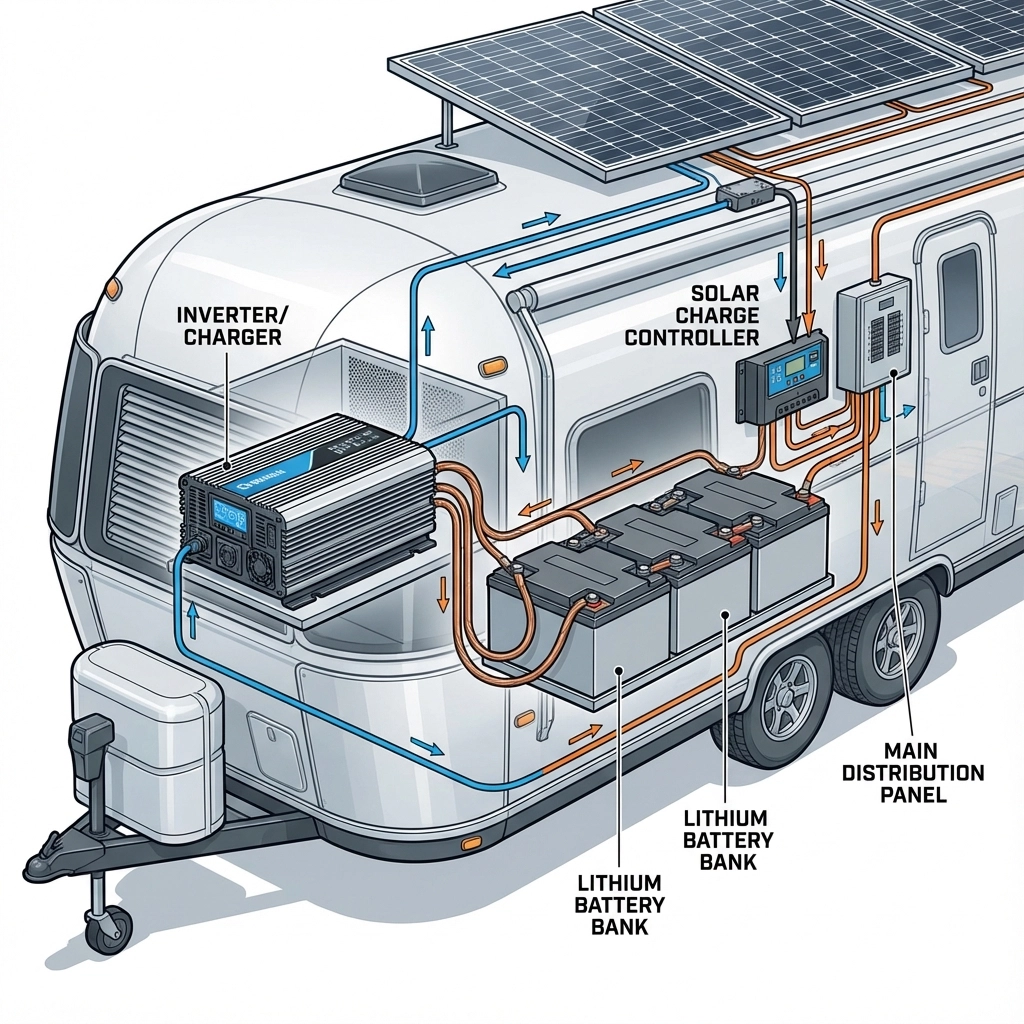
Modern inverters work seamlessly with solar panels and upgraded battery systems. BlackSeries trailers are engineered with this integration in mind, featuring solar-ready wiring and battery compartments designed to accommodate both AGM and lithium battery banks for maximum off-grid capability.
Types of Travel Trailer Inverters
Choosing the right inverter type directly impacts which appliances will function properly and how efficiently your electrical system operates during off-grid adventures.
Modified Sine Wave Inverters
Modified sine wave inverters represent the budget-friendly option for basic power needs. These units work adequately for simple appliances like small microwaves, basic power tools, and standard lighting. However, they produce a choppy electrical waveform that can cause problems with sensitive electronics.
Limitations include:
- Potential interference with radio and TV signals
- Reduced efficiency in some motor-driven appliances
- Possible humming or buzzing sounds from devices
- Not recommended for medical equipment or sophisticated electronics
Pure Sine Wave Inverters
Pure sine wave inverters generate clean electrical power identical to what utilities provide at home. This smooth waveform ensures compatibility with all appliances and maximizes efficiency across your entire electrical system.
Key advantages:
- Complete compatibility with all electronics and appliances
- Quieter operation of motors and fans
- No interference with communications equipment
- Required for CPAP machines and medical devices
- Better efficiency equals longer battery life
Inverter/Charger Combination Units
These advanced systems combine inversion and battery charging capabilities in a single unit. When connected to shore power or generator input, they automatically charge your battery bank while passing AC power through to your trailer’s electrical panel.
Benefits include:
- Automatic switching between power sources
- Integrated battery charging with proper voltage profiles
- Simplified installation with built-in transfer switching
- Advanced battery management features
- Preferred choice for serious boondockers and full-time RVers
Travel Trailer Inverter vs Converter: Understanding the Difference
Many RV owners confuse inverters and converters because both deal with voltage conversion, but they serve opposite functions in your electrical system.
Do you need both? Absolutely. Most travel trailers require both components because they serve completely different purposes. Your converter charges batteries when plugged in, while your inverter powers appliances when disconnected. BlackSeries trailers come equipped with quality converters and are designed for easy inverter upgrades to maximize off-grid potential.

How to Size an Inverter for Your Travel Trailer
Proper inverter sizing prevents frustrating power limitations and ensures reliable operation of your essential appliances during off-grid adventures.
Step 1: List All Appliances and Their Power Requirements
Create a comprehensive list of everything you plan to run simultaneously. Pay attention to both running watts and surge watts, as many appliances require extra power during startup.
Common appliance wattage examples:
- Microwave oven: 1,000-1,500 running watts, 1,500-2,000 surge watts
- Coffee maker: 600-1,200 watts
- Hair dryer: 1,200-1,875 watts
- Laptop computer: 50-100 watts
- LED TV (32-inch): 50-80 watts
- Refrigerator (residential): 150-800 watts running, 1,200+ surge watts
Step 2: Calculate Total Wattage Requirements
Add up the running watts of all devices you might use simultaneously, then identify the highest surge requirement. Your inverter must handle both the total running load and the highest individual surge requirement.
Step 3: Add Safety Buffer
Increase your calculated requirement by 25% to account for efficiency losses and provide headroom for unexpected loads. This buffer prevents overloading and extends inverter lifespan.
Step 4: Consider Battery Capacity
Your battery bank must support your inverter’s maximum output. A 2,000-watt inverter drawing full power consumes approximately 200 amps at 12V (accounting for efficiency losses). Ensure your battery capacity and wiring can handle this demand safely.
Step 5: Match with Solar System Capabilities
If using solar panels for recharging, verify your solar array can replenish the energy you consume. BlackSeries trailers feature robust solar mounting systems and wiring designed to support substantial solar arrays for extended off-grid capability.
Sizing example:
- Microwave: 1,000W + Coffee maker: 800W + Electronics: 200W = 2,000W total
- Add 25% safety buffer: 2,000W × 1.25 = 2,500W
- Recommendation: 2,500W or 3,000W pure sine wave inverter
Travel Trailer Inverter Installation Guide
Proper installation ensures safety, reliability, and optimal performance from your inverter system. While basic installations can be DIY projects, complex integrations often benefit from professional installation.
Step 1: Choose the Optimal Mounting Location
Select a well-ventilated area close to your battery bank to minimize voltage drop and heat buildup. BlackSeries trailers feature designated electrical compartments with proper ventilation for inverter installation.
Installation requirements:
- Minimum 12 inches clearance around unit for airflow
- Protection from moisture and road debris
- Easy access for maintenance and monitoring
- Secure mounting to prevent vibration damage
- Close proximity to battery bank (within 10 feet when possible)
Step 2: Install Proper Fusing and Disconnect Switch
Safety requires appropriate overcurrent protection between your battery and inverter. Install a fuse or breaker rated at 125% of your inverter’s maximum current draw.
For a 3,000W inverter:
- Maximum current: 3,000W ÷ 12V × 1.25 (efficiency factor) = 312.5 amps
- Fuse rating: 312.5 × 1.25 = 390 amp fuse (use 400A)
Step 3: Use Correct Cable Gauge
Undersized cables create voltage drop, reduce performance, and generate dangerous heat. Use these minimum cable sizes for different power levels:
- 1,000W inverter: 4 AWG copper cable
- 2,000W inverter: 2 AWG copper cable
- 3,000W inverter: 1/0 AWG copper cable
- 4,000W+ inverter: 2/0 AWG or larger copper cable
Step 4: Establish Proper Grounding
Connect your inverter’s grounding terminal to your trailer’s main grounding system. This ensures safety and proper operation of GFCI outlets and surge protection features.
Step 5: Connect to Battery Bank
Make final connections with the inverter turned off and battery disconnect engaged. Connect positive first, then negative, and verify all connections are tight and properly insulated.
Step 6: Integration with AC Distribution Panel (Optional)
For whole-trailer power, install a transfer switch to safely connect your inverter to your electrical panel. This prevents dangerous backfeed when connected to shore power and enables automatic switching between power sources.
Best Inverter Options for Travel Trailers
Selecting quality equipment ensures years of reliable service and optimal performance for your off-grid adventures.
Best Budget Pure Sine Wave Inverter
AIMS Power 2000W Pure Sine Inverter
- Excellent value for money
- Clean sine wave output
- Multiple built-in protections
- GFCI outlets included
- Suitable for most basic travel trailer applications
Best Premium Pure Sine Wave Inverter
Victron Energy MultiPlus 3000W Inverter/Charger
- Industry-leading reliability and efficiency
- Advanced battery charging algorithms
- Bluetooth monitoring capability
- Excellent technical support network
- Preferred choice for serious off-grid travelers
Best Inverter/Charger for Heavy Off-Grid Use
Magnum Energy MS2812 Inverter/Charger
- Robust 2,800W continuous power output
- Smart battery charging with multiple battery types
- Advanced power management features
- Proven reliability in extreme conditions
- Excellent choice for BlackSeries trailer upgrades
Best Compact Inverter for Light Duty
Renogy 1000W Pure Sine Wave Inverter
- Space-efficient design
- Built-in cooling fan and protections
- Affordable pure sine wave option
- Perfect for basic electronics and small appliances
- Good starter option for new RV owners
Troubleshooting Common Inverter Problems
Understanding common issues helps maintain reliable operation and prevents costly damage to your electrical system.
Inverter Won’t Turn On
Check these potential causes:
- Battery voltage too low (below 10.5V typically)
- Blown fuse in DC disconnect
- Loose battery connections
- Inverter thermal shutdown from overheating
- Faulty inverter switch or remote control
Overload or Fault Alarms
Common overload situations:
- Total connected load exceeds inverter capacity
- Single appliance surge exceeds inverter capability
- Short circuit in connected device or wiring
- Inverter overheating due to inadequate ventilation
Low Voltage Warnings
Typical causes include:
- Battery bank needs charging
- Undersized cables creating voltage drop
- Poor battery connections
- Aging batteries with reduced capacity
- Excessive load for current battery state
GFCI Outlet Tripping
Troubleshooting steps:
- Disconnect all devices and test outlet alone
- Check for moisture in outlets or connections
- Verify proper grounding installation
- Test individual appliances for ground faults
- Consider dedicated non-GFCI outlets for problematic devices
FAQ: Travel Trailer Inverter Questions
What size inverter do I need for my travel trailer?
Calculate your maximum simultaneous appliance usage, add 25% for safety, and choose the next size up. Most travel trailers work well with 2,000-3,000W inverters. Larger units may require 4,000W+ for residential refrigerators and multiple high-power appliances.
Can I run my RV air conditioner on an inverter?
Running a 15,000 BTU RV air conditioner requires approximately 3,500W during startup and 1,500W continuously. You’ll need a minimum 4,000W inverter and substantial battery capacity. Most boondockers rely on fans and natural ventilation instead due to power requirements.
Do I need a pure sine wave inverter?
Pure sine wave inverters ensure compatibility with all electronics, provide better efficiency, and eliminate potential interference issues. While modified sine wave units cost less, pure sine wave inverters are recommended for any serious off-grid setup, especially if you use sensitive electronics or medical equipment.
What’s the difference between an inverter and a converter?
Inverters convert 12V DC battery power to 120V AC for appliances. Converters convert 120V AC shore power to 12V DC for charging batteries and powering 12V systems. Most RVs need both components for complete electrical functionality.
How long will my battery last when using an inverter?
Battery runtime depends on your total power consumption and battery capacity. A 400 amp-hour lithium bank powering a 1,000W load (approximately 100A at 12V) would last roughly 4 hours. Actual runtime varies based on battery type, age, temperature, and depth of discharge limits.
Can I use an inverter while driving?
Yes, inverters can operate while driving as your alternator charges the battery system. However, high-power appliances can overwhelm alternator output and discharge batteries. Use moderate loads while driving and monitor battery voltage to prevent over-discharge.
Is an inverter necessary for boondocking?
While not absolutely necessary, inverters dramatically improve off-grid comfort and convenience. They enable use of standard electronics, kitchen appliances, and entertainment systems without relying on 12V versions or doing without. For extended boondocking, an inverter is practically essential.
Does BlackSeries include an inverter in its factory setup?
BlackSeries trailers come pre-wired for inverter installation with dedicated mounting locations and proper ventilation. Inverters can be added as factory options or easily installed after delivery. Our electrical systems are designed to support substantial inverter and battery upgrades for serious off-grid capability.

