The boondocking movement is exploding across America. RV solar kit sales have increased 40% year-over-year as more travelers seek energy independence in remote locations. Your travel trailer’s electrical needs: from refrigeration and LED lights to MaxxAir fans and water pumps: require reliable power sources far from traditional hookups.
Off-road trailers like Blackseries models face even greater demands in places like Utah’s BLM lands and Alaska’s wilderness, where solar power isn’t just convenient: it’s essential. This guide covers everything you need to know about travel trailer solar systems, from calculating your power needs to installation and troubleshooting.
Understanding Travel Trailer Solar Systems
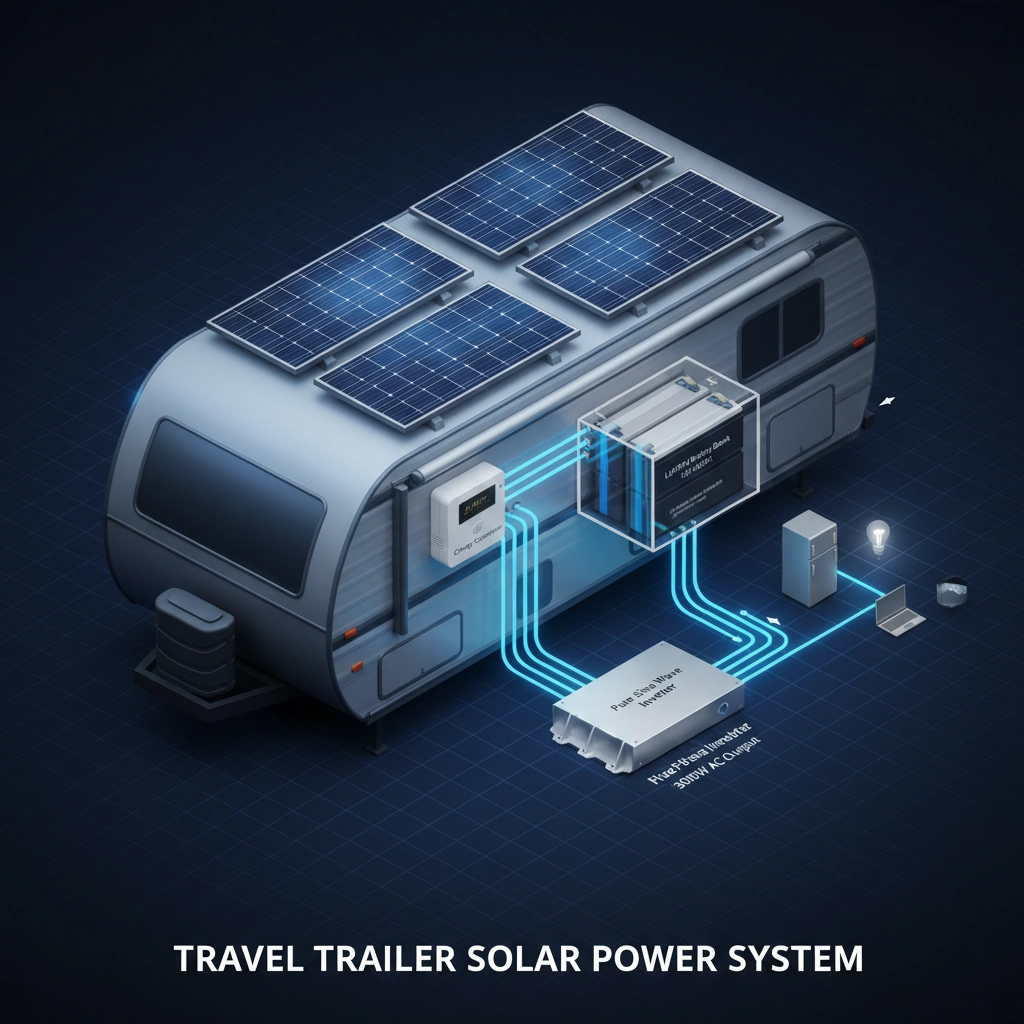
A travel trailer solar system works through a simple but effective process: solar panels capture sunlight and convert it to DC electricity, which flows through a charge controller to your battery bank. An inverter then converts stored DC power to AC electricity for your appliances.
Core Components Explained
Solar Panels come in three main types:
- Monocrystalline: Most efficient, ideal for limited roof space
- Polycrystalline: Budget-friendly option with slightly lower efficiency
- Flexible panels: Conform to curved surfaces, lighter weight
Charge Controllers regulate power flow to prevent battery damage:
- PWM controllers: Basic, affordable option for smaller systems
- MPPT controllers: More efficient, better for larger installations
Battery Banks store your power:
- AGM batteries: Maintenance-free, good for occasional use
- Lithium (LiFePO4): Longer lifespan, faster charging, lighter weight
Inverters convert DC to AC power:
- Pure sine wave: Clean power for sensitive electronics
- Modified sine wave: Budget option for basic appliances
How Much Solar Power Does Your Travel Trailer Need?
Calculating your solar requirements involves a straightforward process:
Step-by-Step Calculation
- List your daily power consumption by device
- Calculate total watt-hours (Wh) needed per day
- Factor in 20-30% system losses for realistic planning
- Consider weather variables – cloudy days reduce output by 50-80%
- Determine peak sun hours in your camping regions
Common Wattage Configurations
For most travel trailer owners, a 400-600W system provides the sweet spot between cost and capability. This setup typically includes 4-6 panels and a 200-400Ah battery bank.
Best Solar Panels for Travel Trailers in 2025
Top Categories
Best Overall: Renogy 400W Monocrystalline Kit
- High efficiency panels with 25-year warranty
- Complete system includes MPPT controller and wiring
- Ideal for first-time solar installations
Best Portable: Goal Zero Boulder 200 Briefcase
- Foldable design for easy storage
- Quick deployment for temporary setups
- Perfect for smaller trailers or supplemental power
Best Flexible: AIMS Power 100W Flexible Panel
- Lightweight and bendable for curved roofs
- Marine-grade construction
- Excellent for unique mounting situations
Best Budget: Renogy 200W Basic Kit
- Entry-level pricing under $300
- Good performance for minimal power needs
- Expandable system for future growth
Best High-Efficiency: SunPower 400W Maxeon Series
- Industry-leading 22% efficiency rating
- Premium build quality and warranty
- Maximum power from limited roof space
Travel Trailer Solar Installation Guide
Pre-Installation Planning
Start by mapping your roof layout. Measure available space while avoiding obstacles like air conditioners, vents, and antenna mounts. Leave room for future expansion and ensure panels won’t create shading issues.
Step-by-Step Installation
Step 1: Mount the Panels
- Choose between permanent mounting (drill-through) or adhesive mounts for RV roofs
- Use marine-grade sealant like Dicor to prevent water intrusion
- Ensure panels are positioned to minimize shading throughout the day
Step 2: Install the Charge Controller
- Mount controller in a ventilated area inside your trailer
- Keep as close to batteries as possible to minimize voltage drop
- Use appropriate fusing between controller and battery bank
Step 3: Connect Battery Bank
- Wire batteries in parallel for 12V systems or series-parallel for 24V
- Use battery monitoring to track state of charge
- Ensure proper ventilation for AGM batteries
Step 4: Add Inverter (Optional)
- Size inverter based on your largest AC load plus 20% headroom
- Install close to batteries with heavy-duty DC wiring
- Add AC disconnect and GFCI protection as required
Step 5: System Testing
- Check all connections with a multimeter
- Verify charge controller displays correct voltages
- Test inverter output under load

Installation Checklist
- Roof layout planned and measured
- All mounting hardware and sealants ready
- DC fusing and disconnects installed
- Battery monitoring system connected
- System grounding completed per NEC code
- All connections tested and verified
Blackseries Off-Grid Solar: Built for Adventure
Blackseries travel trailers are engineered for extreme off-grid adventures, making solar power essential rather than optional. When you’re exploring remote BLM lands in Utah, camping along Alaska’s Dalton Highway, or boondocking in Moab’s backcountry, your energy independence determines your adventure’s success.
Why Off-Road Trailers Need Superior Solar
Off-road adventures present unique challenges that standard RV solar setups can’t handle:
- Extended off-grid periods in areas with no generator-friendly hours
- Rugged mounting requirements to survive washboard roads and rock crawling
- Higher energy demands from additional lighting, communication equipment, and recovery gear
- Variable terrain requiring flexible solar solutions
Blackseries Solar Advantages
Blackseries trailers offer several advantages for solar installations:
Industrial-Grade Wiring: Marine-grade electrical systems reduce power losses and improve reliability in harsh conditions.
Independent Suspension: The robust suspension system handles heavier battery banks without compromising ride quality or handling.
High Ground Clearance: Provides additional space for large battery installations and improved ventilation.
Reinforced Roof Structure: Can support heavier solar panel arrays and mounting systems without flexing.
Recommended Blackseries Solar Configuration
For serious off-grid adventures, consider this proven setup:
Roof-Mounted Array: 600-800W of high-efficiency monocrystalline panels
- Permanently mounted for durability
- Tilted mounting brackets for better winter performance
- Heavy-duty mounting system rated for off-road vibration
Portable Supplement: 200-400W portable panels for sun tracking
- Briefcase-style panels for quick deployment
- Extends daily charging window by 2-3 hours
- Essential for winter camping when roof panels may be snow-covered
Battery Bank: 400-600Ah LiFePO4 system
- Lithium batteries handle vibration and temperature extremes better
- Faster charging means more usable power from limited daylight
- 2000+ cycle life justifies higher upfront cost
MPPT Charge Controller: 60-80A Victron or similar
- Bluetooth monitoring for remote system status
- Advanced charging algorithms maximize battery life
- Multiple input capability for roof and portable panels
This configuration provides 3-5 days of power autonomy in average conditions, extending to a week or more with conservative usage.
Troubleshooting Common Solar Issues
Even well-designed systems can develop problems. Here are the most common issues and their solutions:
Panels Not Producing Expected Power
Symptoms: Lower than rated wattage output on sunny days
Common Causes:
- Partial shading from roof accessories or nearby trees
- Dirty panels reducing light transmission
- Aging panels with reduced efficiency
- Poor electrical connections creating resistance
Solutions: Clean panels monthly, check for loose connections, use a multimeter to test individual panel output, consider panel positioning adjustments.
Battery Not Charging Despite Panel Output
Symptoms: Solar panels show good voltage but battery state of charge isn’t increasing
Common Causes:
- Faulty charge controller or incorrect settings
- Battery bank at end of life and won’t accept charge
- Blown fuses in DC disconnect switches
- Sulfated AGM batteries from deep discharge
Solutions: Reset charge controller to factory defaults, load test individual batteries, check all fusing, consider battery equalization for AGM types.
Poor Performance on Cloudy Days
Symptoms: Minimal power production during overcast conditions
Common Causes:
- Undersized system for available light conditions
- Inefficient panels (polycrystalline vs monocrystalline)
- System not optimized for low-light conditions
Solutions: Add supplemental portable panels, upgrade to high-efficiency panels, consider MPPT controller upgrade for better low-light harvesting.
Voltage Drop Issues
Symptoms: Good production at panels but low voltage at batteries
Common Causes:
- Undersized wiring between components
- Long wire runs without proper gauge increases
- Corroded connections creating resistance points
Solutions: Upgrade to proper wire gauge based on amperage and distance, clean all connections with dielectric grease, relocate charge controller closer to batteries.
Maximizing Your Solar Investment
Success with travel trailer solar depends on matching your system to your actual usage patterns rather than peak theoretical needs. Start with a modular 400W system that can grow over time, focus on energy-efficient appliances, and always size your battery bank larger than your daily consumption.
For Blackseries owners heading into truly remote terrain, solar isn’t just about convenience: it’s about safety and self-reliance. A well-designed system keeps your communication devices powered, your food fresh, and your adventure running smoothly, no matter how far off the grid you venture.
Remember that solar supplements rather than replaces good energy management. Combine your solar system with energy-efficient habits and backup power sources for the ultimate off-grid experience.
Ready to start your solar journey? Check out our dispersed camping guide for tips on finding the perfect off-grid locations to test your new setup, and explore our technical support resources at blackseries.net for trailer-specific installation guidance.

