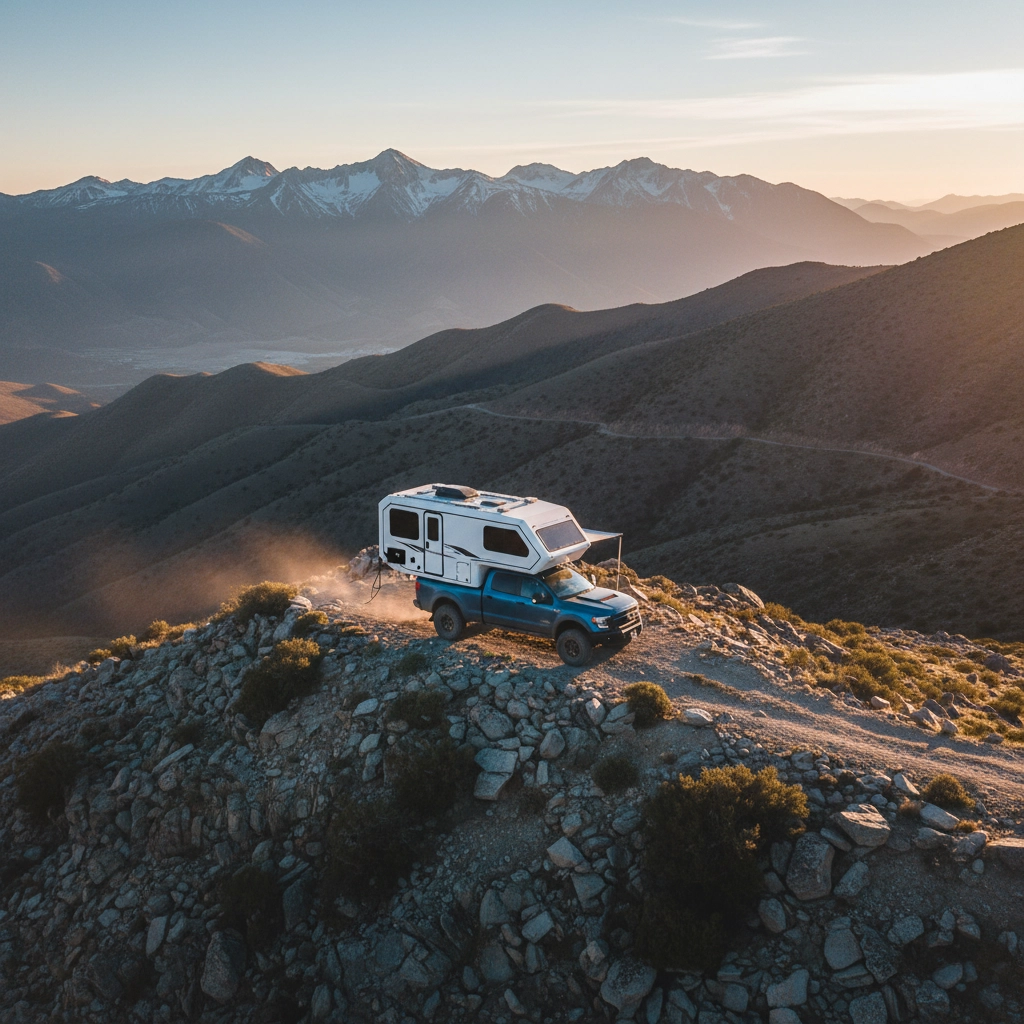
A truck bed motorhome, also known as a truck camper, is a self-contained recreational unit that mounts directly into your pickup truck bed, offering the mobility of a truck with the comfort of a small motorhome. Unlike traditional motorhomes built on dedicated chassis or travel trailers that require towing, truck bed motorhomes provide unmatched off-road access and maneuverability while maintaining full living amenities.
What You Need to Know
Who should consider a truck bed motorhome?
- Solo travelers and couples seeking maximum mobility
- Off-road enthusiasts who want access to remote locations
- Weekend warriors who value easy setup and breakdown
- Boondockers prioritizing self-sufficiency over space
Price ranges:
- Entry-level pop-ups: $15,000-$35,000
- Mid-range hard-sides: $35,000-$65,000
- Premium slide-outs: $65,000-$120,000+
- Custom builds: $80,000-$200,000+
Off-grid capability: Excellent with proper setup (lithium batteries, solar, water conservation)
Truck requirements: ¾-ton or 1-ton trucks recommended; payload capacity 2,000-4,000+ lbs depending on camper
Truck Bed Motorhome vs. Alternatives Comparison
What is a Truck Bed Motorhome?
The term “truck bed motorhome” is commonly searched by Americans looking for the functionality of a motorhome while maintaining their pickup truck’s versatility. In the RV industry, these units are technically called truck campers or slide-in campers, but the motorhome terminology reflects users’ desire for complete living amenities in a compact, mobile package.
Common industry terms include:
- Slide-in truck camper – The most accurate technical term
- Cabover design – Features a sleeping area over the truck cab
- Pop-up truck camper – Collapsible roof for reduced height
- Hard-side camper – Fixed rigid walls and roof
The appeal lies in combining a pickup truck’s off-road capability with self-contained living quarters, making it possible to access remote locations that would challenge traditional RVs while maintaining the ability to detach and use your truck independently.
U.S. Market Overview: Growth and Consumer Trends
The truck camper market is experiencing steady growth, projected to expand from $1.6 billion in 2025 to $2.1 billion by 2035 at a 2.7% CAGR. This growth is driven by increasing interest in adventure travel, overlanding, and off-grid experiences.
Market Drivers and Consumer Demographics
Adventure Travel Surge: The overlanding movement has significantly boosted truck camper popularity. These units excel at accessing Bureau of Land Management (BLM) lands, national forest dispersed camping areas, and remote wilderness locations where larger RVs cannot venture.
Truck Ownership Growth: Rising pickup truck ownership, particularly among outdoor enthusiasts, creates a natural market for truck bed motorhomes. The preference is shifting toward longer bed configurations, with 67.18% of current owners wanting long beds (8+ feet) for their next setup.
User Profile:
- Primary: Couples and solo travelers aged 35-65
- Income: $60,000-$120,000 annually
- Priorities: Mobility over space, self-sufficiency, adventure access
- Experience level: Often experienced campers seeking more remote experiences
Configuration Preferences Shift
Recent survey data reveals significant changes in truck bed preferences:
- Current ownership: 89% factory pickup beds
- Dream truck preferences: Only 58% want factory beds, 24% prefer custom storage beds, 19% want flatbeds
This represents the largest shift toward custom configurations in survey history, indicating growing sophistication in the truck camper community.
Types of Truck Bed Motorhomes
Hard-Side Truck Bed Motorhomes
Hard-side units feature fixed walls and roofs, providing the most traditional motorhome experience in a truck camper format.
Advantages:
- Superior insulation for four-season camping
- More robust interior amenities (full kitchens, bathrooms)
- Better security and weather protection
- Quieter operation
Disadvantages:
- Higher weight (typically 2,500-4,000+ lbs dry)
- Reduced fuel economy
- Height restrictions in some areas
- Requires heavy-duty truck (¾-ton minimum)
Pop-Up Truck Bed Motorhomes
Pop-up designs feature collapsible roofs that can be lowered for travel and raised for camping, offering a balance between aerodynamics and livability.
Advantages:
- Better fuel economy due to lower profile
- Lighter weight (1,500-2,500 lbs)
- Easier to maneuver in tight spaces
- Some models fit ½-ton trucks
Disadvantages:
- Limited headroom when collapsed
- More complex mechanisms requiring maintenance
- Reduced insulation compared to hard-sides
- Setup/breakdown required at each stop
Slide-Out Truck Bed Motorhomes
Premium units feature slide-out rooms that dramatically expand interior space when parked, approaching the comfort level of small motorhomes.
Advantages:
- Maximum interior space
- Full-size amenities possible
- Can accommodate larger groups
- High resale value
Disadvantages:
- Highest weight and cost
- Complex systems requiring maintenance
- Requires 1-ton trucks typically
- Longer setup time
Lightweight Half-Ton Models
Specifically engineered for half-ton trucks (F-150, Ram 1500, Silverado 1500), these models prioritize weight savings while maintaining essential amenities.
Design Focus:
- Dry weights under 2,000 lbs
- Simplified systems
- Lightweight materials (aluminum framing, composites)
- Compact but functional layouts
Truck Bed Motorhome Buying Guide
Step 1: Confirm Truck Compatibility
Critical Specifications:
- Payload capacity: Your truck’s maximum carrying capacity
- GVWR (Gross Vehicle Weight Rating): Total vehicle and cargo weight limit
- Rear axle rating: Maximum weight the rear axle can support
- Bed dimensions: Length and width compatibility
Most truck bed motorhomes require ¾-ton or 1-ton trucks due to weight and center of gravity considerations. While some lightweight models work with half-tons, payload calculations must include passengers, gear, water, and propane.
Step 2: Determine Use Case
Weekend Camping: Pop-up or lightweight hard-side models provide adequate comfort for short trips with minimal setup requirements.
Extended Travel: Hard-side or slide-out models offer better comfort and amenities for longer adventures.
Off-Grid/Boondocking: Focus on models with substantial electrical systems, large water tanks, and robust construction similar to what you’d find in purpose-built off-road trailer designs.
DIY Conversion vs. Factory-Built Comparison
Off-Grid Capability Requirements
Electrical Systems:
- Lithium battery banks: 300-800+ amp hours
- Solar panels: 400-1200+ watts
- Inverter capacity: 2000-3000 watts
- DC-DC charging from truck alternator
Water Systems:
- Fresh water: 20-50+ gallons
- Grey water: 15-40+ gallons
- Black water: Consider composting toilets for extended boondocking
Structural Considerations:
Like the rugged construction principles used in BlackSeries off-road trailers, truck campers need reinforced frames, quality suspension tie-down points, and durable exterior finishes to handle rough terrain and weather exposure.

Best Truck Bed Motorhome Alternatives
Many buyers ultimately choose between three main categories based on their priorities:
For Maximum Mobility: Lightweight Truck Campers
Best for: Solo travelers, hunters, minimalists
Examples: Scout Kenai, Four Wheel Campers
Pros: Excellent off-road access, fits smaller trucks
Cons: Limited space and amenities
For Balanced Adventure: Off-Road Travel Trailers
Best for: Families, serious overlanders, extended trips
Why consider: Models like those in the BlackSeries lineup offer more space than truck campers while maintaining excellent off-road capability through independent suspension systems and reinforced construction.
Pros: More space, can unhitch truck, family-friendly
Cons: Requires towing, limits some access
For Comfort Priority: Class B/C Motorhomes
Best for: Luxury seekers, older travelers, full-timing
Pros: Maximum comfort, no setup required, drives like a vehicle
Cons: Poor off-road access, expensive, poor fuel economy
The choice often comes down to your priority ranking: mobility vs. space vs. comfort vs. budget.
Installation and Operational Guide
Mounting Your Truck Bed Motorhome
Essential Equipment:
- Tie-down system (turnbuckles or cam-buckle straps)
- Bed mat or liner protection
- Corner stabilizers or jacks
- Frame-mounted tie-down points
Installation Steps:
- Position camper: Use loading ramps or commercial loading services
- Center and align: Ensure even weight distribution
- Secure tie-downs: Connect to truck frame points, never just bed rails
- Test stability: Rock test before first trip
- Check clearances: Ensure tailgate operation and clearance lights work
Safety Checklist:
- Verify all electrical connections
- Test emergency breakaway procedures
- Confirm tie-down torque specifications
- Check for proper weight distribution
Daily Operation Setup
Arriving at Camp:
- Level the unit using corner jacks
- Deploy stabilizers to reduce movement
- Connect to shore power (if available) or activate battery systems
- Deploy awnings and outdoor equipment
- Set up slide-outs (if equipped)
Boondocking Setup:
- Monitor battery levels and solar input
- Implement water conservation practices
- Use propane efficiently for heating and cooking
- Plan waste tank capacity carefully
Maintenance and Care
Pre-Trip Inspections:
- Tire pressure and condition
- Tie-down hardware inspection
- Electrical system check
- Propane system leak test
- Water system sanitization
Quarterly Maintenance:
- Roof and seal inspection
- Slide-out mechanism lubrication
- Battery maintenance and testing
- Water pump and filter replacement
Annual Services:
- Professional weight verification
- Suspension and tie-down point inspection
- Appliance servicing
- Structural integrity assessment
Market Data and Usage Trends
Recent industry data reveals interesting patterns in truck camper adoption:
Geographic Concentration:
- Western states lead in ownership (Colorado, Utah, Montana, Wyoming)
- Growing popularity in Southeast for off-road recreation
- Texas shows significant growth due to hunting and ranch applications
Seasonal Usage Patterns:
- 65% report year-round usage capability
- Winter camping growing among four-season model owners
- Summer remains peak usage period for all types
Length of Ownership:
- Average ownership: 7-10 years
- High satisfaction rates (85%+) among serious users
- Low regret purchases compared to other RV categories
The data suggests that truck bed motorhomes serve a specific but growing niche of outdoor enthusiasts who prioritize access over accommodation size.
Frequently Asked Questions
What’s the difference between a truck bed motorhome and a truck camper?
They’re the same thing. “Truck bed motorhome” is a search term used by consumers wanting motorhome-like amenities in a truck-mounted unit. The industry calls them truck campers or slide-in campers.
Can a half-ton truck safely carry a truck bed motorhome?
Some lightweight models (under 2,000 lbs) work with half-ton trucks, but most require ¾-ton or larger trucks. Always verify your specific truck’s payload capacity and calculate total weight including passengers, gear, water, and propane.
Are truck bed motorhomes suitable for families?
They can accommodate families, but space is limited compared to travel trailers. Most sleep 2-4 people comfortably. Families often prefer off-road travel trailers for longer trips while using truck campers for weekend adventures.
How much battery and water capacity do I need for off-grid camping?
For extended boondocking, plan for 400+ amp hours of lithium batteries, 600+ watts of solar, 30+ gallons fresh water, and 25+ gallons grey water capacity. Usage patterns vary significantly based on occupancy and conservation practices.
What maintenance is required for truck bed motorhomes?
Regular maintenance includes roof seal inspection, tie-down hardware checks, electrical system maintenance, and appliance servicing. The mechanical systems are generally simpler than larger RVs, but the mounting system requires careful attention.
How do truck bed motorhomes compare to travel trailers for fuel economy?
Truck campers typically reduce fuel economy by 15-25% due to weight and aerodynamics. Travel trailers can reduce fuel economy by 30-50% when towing. However, truck campers eliminate the need for a second vehicle at destinations, which can offset fuel costs for some users.

